Last updated: September 30, 2026
We may earn a commission when you buy through links on this page, at no extra cost to you. How we research and rate.
Safety note: Essential oils are highly concentrated. Most should be diluted in a carrier oil before applying to skin, kept away from eyes, and never swallowed unless under professional guidance. Keep them out of reach of children and pets (some oils are toxic to cats and dogs), and check with your doctor if pregnant, nursing, or managing a health condition.
The short version
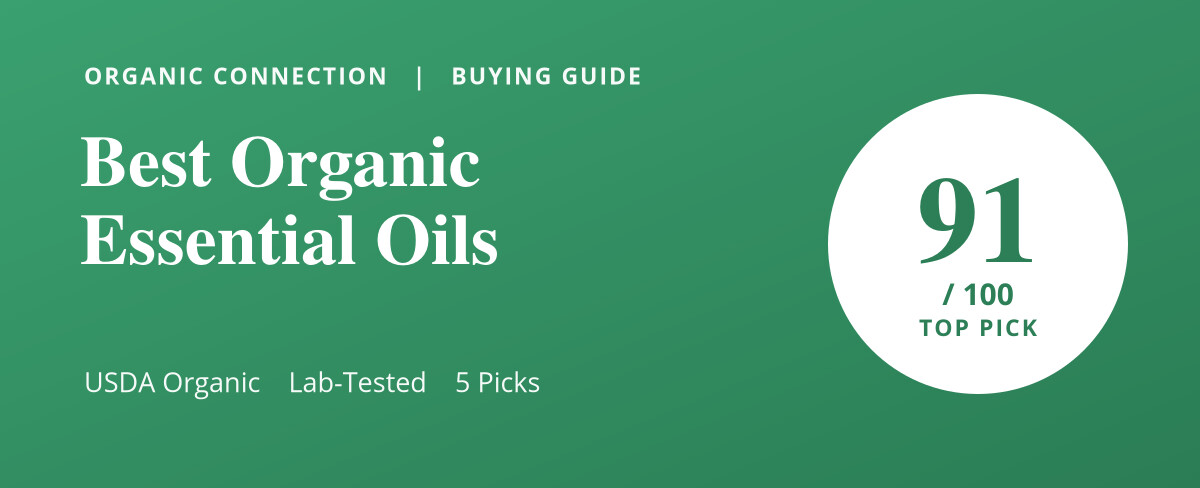
After researching the certifications, purity, and testing of the most popular organic essential oils, our top pick is the Cliganic USDA Organic Aromatherapy Set. It bundles eight USDA-organic, 100% pure single-ingredient oils, each third-party lab-tested, which is why it earned our highest Organic Integrity Score of 92 out of 100. For a premium single oil, Plant Therapy Organic Lavender is our pick, and for the best value single, NOW Organic Peppermint is the best choice.
The key thing with “organic” essential oils is real USDA certification plus purity testing, because the market is full of diluted, adulterated, or synthetic oils dressed up with wellness language. We flag which are USDA certified and third-party tested, and which are sets or single oils.
Best organic essential oils compared
| Best Choice | Best Value | ||||
 |  |  |  |  | |
| Product | Cliganic Top 8 Set | Plant Therapy Lavender | Aura Cacia Lavender | Plant Therapy Top 6 Set | Nirvana Nurture Peppermint |
| Organic Integrity Score | 92/ 100 | 90/ 100 | 89/ 100 | 88/ 100 | 84/ 100 |
| Our rating | 4.6 | 4.5 | 4.5 | 4.4 | 4.2 |
| Best for | Best overall set | Premium single | Co-op sourced | Starter kit | Value single |
| Type | 8-oil set | Lavender | Lavender | 6-oil set | Peppermint |
| Certification | USDA Organic, Non-GMO Project Verified, Certified Vegan | USDA Organic | USDA Organic | USDA Organic | USDA Certified Organic, GC/MS tested |
| Price | $22.99 $25.99 −12%$17.96 / fluid ounce View on Amazon | $18.99 View on Amazon | $14.60 $15.54 −6%$58.40 / fluid ounce View on Amazon | $34.99$11.66 / fluid ounce View on Amazon | $9.99$29.38 / fluid ounce View on Amazon |
Price and availability as of October 11, 2026 7:10 pm EDT. Product prices and availability are accurate as of the date/time indicated and are subject to change. Any price and availability information displayed on Amazon.com at the time of purchase will apply to the purchase of this product.
Scores are ours, based on independent research of certification, purity, testing, and value, using the same 10-criteria method we apply to every product. See how we research and rate.
Reading the seals on organic essential oils: what each one does and does not cover
Certification names are easy to confuse and easy to trade on. Below is what each of these marks covers, and the part of the picture it says nothing about.
| Certification | Covers | Key exclusion |
| USDA Organic | Farming and handling: no synthetic pesticides or fertilizers, no GMOs, no sewage sludge or irradiation, audited yearly by an accredited certifier | Three different tiers share the one seal, and it makes no claim about worker pay, food miles, or nutrition |
| Non-GMO Project | Testing and supply-chain traceability showing the ingredients are not genetically engineered | Sets no limit on synthetic pesticides or fertilizers, so it is not an organic claim |
| Certified Vegan | No animal ingredients or animal-derived processing aids, and no animal testing | Not an organic, safety or nutritional claim |
The mark most often mistaken for an organic claim is Non-GMO Project Verified. It is a real standard with real testing, and it verifies exactly one thing: that the ingredients are not genetically engineered. It sets no limit on synthetic pesticides, synthetic fertilizers, or anything else about how the crop was grown. USDA Organic already prohibits GMOs outright, so on a certified organic product the butterfly adds independent verification rather than a new promise. On a product carrying only the butterfly, the pesticide question has not been asked.
Key things to look for in organic essential oils
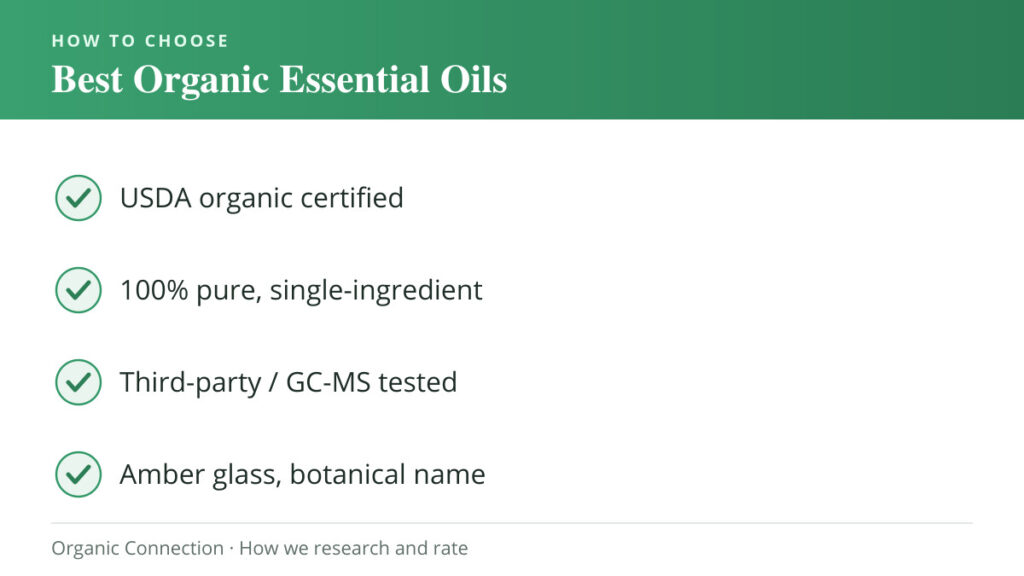
Good organic essential oils come down to certification, purity, and testing. Here is what matters.
1. USDA organic certification
It confirms the botanicals were grown without synthetic pesticides and processed to organic standards, a real signal in a loosely regulated market.
2. 100% pure, single-ingredient
Look for oils that are pure and undiluted with no fillers, carrier oils, or synthetic fragrance added.
3. Third-party or GC-MS testing
Independent lab testing verifies purity and identity; the best brands publish it.
4. Amber glass and clear labeling
Dark glass protects the oil from light, and a clear botanical (Latin) name signals a genuine essential oil.
Why “organic” and “pure” both matter here
Essential oils are one of the least regulated corners of the wellness market, where “therapeutic grade” is a marketing phrase with no official standard, and plenty of products are diluted, synthetic, or mislabeled. That is why we look for two things together: USDA organic certification, which verifies clean growing and processing, and demonstrated purity, meaning a 100% pure single-ingredient oil backed by third-party or GC-MS lab testing. A pretty label and vague wellness claims are not enough.
Our scoring rewards genuine USDA certification, verified purity and testing, honest single-ingredient labeling, and value, so you get oils that are both certified organic and actually what they say they are, whether you want a ready-made set or a specific single oil.
“Therapeutic grade” is not a certification
This is the single most important thing to understand before spending money on essential oils, and it is printed on a large share of bottles.
There is no grading system. No US government agency, and no independent standards body, grades or certifies essential oils as “therapeutic grade”. Terms like “therapeutic grade”, “clinical grade”, and “aromatherapy grade” are marketing phrases coined by the companies that print them. Some are even trademarked by the brand using them, which means the company is certifying itself against its own standard. A bottle carrying such a phrase tells you nothing verifiable.
What is actually verifiable is USDA organic certification on the plant material, and GC/MS testing on the finished oil. Those are the two claims with something real behind them.
GC/MS testing: the report that actually proves purity
Gas chromatography-mass spectrometry separates an oil into its individual chemical constituents and identifies each one. For essential oils it is the closest thing to proof, because adulteration is otherwise very hard to detect by nose or eye.
What it catches. Dilution with a cheap carrier oil, extension with a synthetic compound, substitution of a cheaper species, and blending of a low-grade oil with a small amount of the real thing. All of these are common, and all are invisible to a consumer without testing.
What a good brand does with it. The gold standard is batch-specific reports you can look up. Rocky Mountain Oils, for example, lets you enter the batch number from your bottle and pull that lot’s report. Plant Therapy publishes GC/MS reports publicly. A generic report for “our lavender” with no batch number is considerably weaker, because it does not correspond to the bottle in your hand.
| Signal | What it means |
| Batch-specific GC/MS you can look up | Strongest verification available |
| Latin botanical name on the label | Essential. Lavandula angustifolia is not Lavandula latifolia, and they differ in use |
| Country of origin stated | Composition varies by growing region |
| Extraction method stated | Steam distilled, or cold pressed for citrus |
| Batch number and expiry date | Absence is a red flag |
| Dark glass bottle | Essential oils degrade in light; clear glass or plastic signals carelessness |
| “Therapeutic grade” and little else | Marketing substituting for verification |
Red flags worth acting on: no Latin name, noticeable inconsistency in color or smell between bottles of the same oil, heavy reliance on grading buzzwords, no sourcing information, no batch number, and a price that is implausibly low. Rose otto and melissa in particular are extremely expensive to produce; a cheap bottle of either is almost certainly diluted or synthetic.
One honest note on price. Multi-level marketing brands are often the most expensive per milliliter in this category, and price is not evidence of purity. Several non-MLM direct-to-consumer brands publish more thorough testing at a fraction of the cost.
How to choose organic essential oils
- Look for USDA organic and 100% pure. Clean growing plus a single-ingredient, undiluted oil.
- Check for third-party or GC-MS testing. Published testing verifies purity and identity.
- Start with a set or the oils you will use. Lavender, peppermint, eucalyptus, tea tree, and lemon cover most needs.
- Use amber glass and read the Latin name. Dark glass protects potency; the botanical name confirms a real essential oil.
- Dilute and use safely. Mix with a carrier oil for skin, diffuse in moderation, and keep away from children and pets.
Who should buy organic essential oils
Buy for what you will actually use. A starter set covers the essentials, and ours is the top pick. If you want a premium single lavender, a value single peppermint, a trusted co-op-sourced oil, or an affordable starter kit, we have a pick for each.
Best overall set: Cliganic USDA Organic Aromatherapy Set
| Organic Integrity Score | 92 / 100 |
| Type | 8-oil set (lavender, peppermint, eucalyptus, tea tree, and more) |
| Certification | USDA Organic, Non-GMO Project Verified, Certified Vegan |
| Best for | An all-around organic starter and everyday set |
Cliganic is our top pick because it delivers real certification and purity in one affordable set. It bundles eight USDA-organic, 100% pure single-ingredient oils, peppermint, lavender, eucalyptus, tea tree, lemongrass, rosemary, frankincense, and orange, each Non-GMO verified, vegan, cruelty-free, and third-party lab-tested for purity, covering the oils most people actually use.
The trade-off is that a set gives smaller bottles of each oil than buying a single you use heavily. For a genuinely organic, tested, do-everything starter set, it is our first choice.
What we liked: USDA organic, eight pure single-ingredient oils, third-party tested, and excellent value covering the most-used oils.
Keep in mind: Set bottles are smaller, so if you use one oil constantly you may also want a larger single.
What the listing discloses: Cliganic states USDA organic certification, Non-GMO Project Verified and a single-ingredient formula, and does not say where it was grown or made.
Best premium single: Plant Therapy Organic Lavender
| Organic Integrity Score | 90 / 100 |
| Type | Lavender (Lavandula angustifolia) |
| Certification | USDA Organic |
| Best for | A premium, versatile single oil |
Plant Therapy is our pick for a premium single oil. Its organic lavender is 100% pure, USDA certified organic, and undiluted, never standardized, and put through multiple rounds of organoleptic and GC-MS testing by third-party labs. Lavender is the most versatile oil to own, calming for sleep and diffusing and, when diluted, useful for skin.
It scores just below our top pick because it is a single oil rather than a full set, but on purity, testing transparency, and quality it is outstanding.
What we liked: USDA organic, 100% pure and undiluted, rigorous GC-MS testing, and the versatility of lavender.
Keep in mind: It is a single oil, so pair it with others if you want variety.
What the listing discloses: Plant Therapy lists USDA organic certification and a single-ingredient formula. The gap is where it was grown or made.
Best co-op sourced: Aura Cacia Organic Lavender
| Organic Integrity Score | 89 / 100 |
| Type | Lavender (Lavandula angustifolia) |
| Certification | USDA Organic |
| Best for | Ethically sourced, well-tested lavender |
Aura Cacia is our pick for sourcing. A member-owned co-op founded in 1982, it offers USDA-certified-organic lavender sourced from Bulgaria and put through a rigorous multi-step testing process (GC-FID, GC-MS, and more), with a strong commitment to purity, ethics, and consumer safety, in a widely available small bottle.
It scores in the value range here only because it overlaps with our premium lavender pick, but for a trusted, co-op-sourced, well-tested organic lavender, it is an excellent choice.
What we liked: USDA organic, extensive GC testing, a member-owned co-op with strong ethics, and easy availability.
Keep in mind: It overlaps with our premium lavender pick, so choose based on price and bottle size.
What the listing discloses: You are told USDA organic certification for Aura Cacia; you are not told where it was grown or made.
Best starter kit: Plant Therapy Top 6 USDA Organic Set
| Organic Integrity Score | 88 / 100 |
| Type | 6-oil set (lavender, peppermint, eucalyptus, lemon, tea tree, and more) |
| Certification | USDA Organic |
| Best for | A tested starter set from a trusted brand |
Plant Therapy’s Top 6 organic set is our starter-kit pick. It gathers six USDA-organic, 100% pure oils, the everyday essentials like lavender, peppermint, eucalyptus, lemon, and tea tree, each GC-MS tested, from a brand known for rigorous quality, a great tested foundation if you are just getting into aromatherapy.
It scores at the value end here mainly because it overlaps with our top-pick set, but as a smaller, well-tested organic starter kit from a premium brand, it is a strong choice.
What we liked: USDA organic, six tested everyday oils, premium brand quality, and a convenient starter format.
Keep in mind: It overlaps with our top-pick eight-oil set, so compare the oils and bottle sizes to pick.
What the listing discloses: Plant Therapy commits to USDA organic certification but stops short of where it was grown or made.
Best value single: Nirvana Nurture Organic Peppermint Essential Oil
| Organic Integrity Score | 84 / 100 |
| Type | Peppermint (Mentha piperita) |
| Certification | USDA Certified Organic, GC/MS batch tested |
| Best for | An affordable, high-quality single |
This is the cheapest way onto this page, and it does not cut the corner that usually gets cut at this price. The listing states USDA Certified Organic, 100% pure and undiluted, steam-distilled from Mentha piperita, free of chemicals, fillers and hexane, and non-GMO.
What lifts it above the pick it replaces is the testing claim. Nirvana Nurture states that every batch goes through GC/MS analysis to verify purity and the oil’s constituents. Gas chromatography-mass spectrometry is the actual laboratory method for telling a pure essential oil from a diluted or adulterated one, and naming it is a great deal more useful than the word “pure”, which anyone can print.
Peppermint is the workhorse of any oil collection: invigorating to diffuse, and useful diluted for DIY and cleaning. If you want to find out whether you use essential oils enough to justify a set, this is the bottle to find out with.
What we liked: USDA Certified Organic stated plainly, GC/MS batch testing named, steam-distilled and undiluted. The lowest entry price on the page.
Keep in mind: A smaller brand than the others here, and a single oil rather than a set, so it is a starting point rather than a collection.
What the listing discloses: On the Nirvana Nurture label: USDA organic certification and a single-ingredient formula. Not stated: where it was grown or made.
How to use essential oils safely
To diffuse, add a few drops to water in an aromatherapy diffuser. For topical use, always dilute in a carrier oil such as jojoba or coconut (a common range is about 2 to 5%, roughly 12 to 30 drops per ounce of carrier), and patch-test first. Keep oils away from eyes and mucous membranes, and do not swallow them unless guided by a qualified professional. Store bottles tightly closed in a cool, dark place. Keep essential oils out of reach of children, and note that some oils, including tea tree, eucalyptus, and citrus, can be toxic to cats and dogs, so diffuse carefully around pets and check with a vet.
How we researched this guide
We are a research-based review site. We compared each product against its certification, purity and single-ingredient labeling, third-party or GC-MS testing, and the weight of aggregated customer feedback, then scored each with our 10-criteria Organic Integrity Score. No brand paid to be included or ranked. Read the full method on our How We Research and Rate page.
Common questions about organic essential oils
What are the best organic essential oils?
Our overall pick is the Cliganic USDA Organic Aromatherapy Set, because it bundles eight USDA-organic, 100% pure, third-party-tested oils at great value. For a premium single, Plant Therapy Organic Lavender is our pick, and for value, NOW Organic Peppermint.
What does “organic” mean for essential oils?
USDA organic certification means the botanicals were grown without synthetic pesticides and processed to organic standards. Because terms like “therapeutic grade” are unregulated marketing, USDA certification plus third-party purity testing is the meaningful signal.
Are essential oils safe to put on skin?
Most essential oils should be diluted in a carrier oil before applying to skin, usually around 2 to 5%, and patch-tested first. Undiluted oils can irritate skin, and oils should be kept away from eyes and not swallowed unless guided by a professional.
Should I buy a set or single oils?
A set is the best value to start, covering the most-used oils like lavender, peppermint, and eucalyptus in smaller bottles. If you use one oil constantly, add a larger single bottle of that oil.
Are essential oils safe around pets?
Some essential oils, including tea tree, eucalyptus, and citrus, can be toxic to cats and dogs. Diffuse in well-ventilated spaces, keep oils out of reach, avoid applying them to pets, and check with your veterinarian.
- Organic Skincare and Beauty hub
- Best Organic Jojoba Oil (a carrier oil)
- Best Organic Body Wash
- How we research and rate products
- Organic Product Database — search every product we have reviewed, by certification
- Best Organic Tea Tree Oil
Price and availability as of October 11, 2026 7:10 pm EDT. Product prices and availability are accurate as of the date/time indicated and are subject to change. Any price and availability information displayed on Amazon.com at the time of purchase will apply to the purchase of this product.
Looking for other organic products?
We have checked more than 800 products across food, household goods, gardening, personal care and pet, every one against its stated certification. Browse all reviews.
Organic Connection is reader-supported. When you buy through links on this page we may earn a commission, at no extra cost to you. As an Amazon Associate we earn from qualifying purchases. We are not paid to feature or rank any product. How we research and rate.