Last updated: September 30, 2026
We may earn a commission when you buy through links on this page, at no extra cost to you. How we research and rate.
The short version
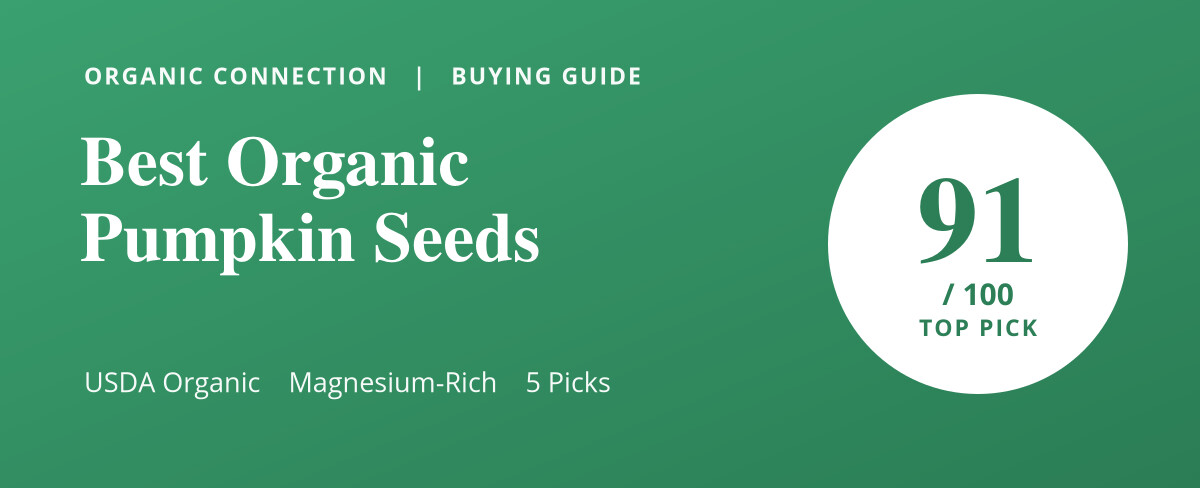
After researching the sourcing, processing, and certifications of the most popular organic pumpkin seeds, our top pick is Terrasoul Superfoods Organic Pumpkin Seeds. They are USDA organic, raw, unsalted, and lab-tested for quality by a specialist superfood brand, which is why they earned our highest Organic Integrity Score of 84 out of 100. For maximum nutrient availability, the Food to Live Organic Sprouted Pumpkin Seeds are our pick, and for a ready-to-eat snack, Terrasoul Dry-Roasted Salted pepitas are the best choice.
The main choices with pumpkin seeds (pepitas) are raw vs roasted, shelled vs in-shell, and sprouted vs regular, plus clean organic sourcing. We flag each pick’s form and certification.
Best organic pumpkin seeds compared
| Best Choice | Best Value | ||||
 |  |  |  |  | |
| Product | Terrasoul Roasted | Food to Live Sprouted | Terrasoul Raw | Food to Live Pepitas | Food to Live In-Shell |
| Organic Integrity Score | 84/ 100 | 82/ 100 | 81/ 100 | 80/ 100 | 79/ 100 |
| Our rating | 4.2 | 4.1 | 4.1 | 4.0 | 4.0 |
| Best for | Best overall | Easier digestion | Versatile organic seed | Bulk value | Roasting whole |
| Form | Dry-roasted, salted | Sprouted, shelled | Raw, shelled | Raw pepitas, bulk | Raw, in-shell |
| Certification | Non-GMO, Gluten-free, Vegan | Non-GMO, Kosher, Vegan | — | Non-GMO, Kosher, Vegan | Non-GMO, Vegan, Organic |
| Price | $14.99$0.94 / ounce View on Amazon | $14.99$0.94 / ounce View on Amazon | $21.99$0.69 / ounce View on Amazon | Currently unavailable See buying options | Currently unavailable See buying options |
Price and availability as of October 19, 2026 7:10 am EDT. Product prices and availability are accurate as of the date/time indicated and are subject to change. Any price and availability information displayed on Amazon.com at the time of purchase will apply to the purchase of this product.
Scores are ours, based on independent research of certification, testing, form, and value, using the same 10-criteria method we apply to every product. See how we research and rate.
Reading the seals on organic pumpkin seeds: what each one does and does not cover
Most shoppers read a certification as a general signal of quality. Every one of them is narrower than that, and the gaps between them are where the marketing lives.
| Certification | Covers | Key exclusion |
| USDA Organic | Farming and handling: no synthetic pesticides or fertilizers, no GMOs, no sewage sludge or irradiation, audited yearly by an accredited certifier | Three different tiers share the one seal, and it makes no claim about worker pay, food miles, or nutrition |
| Kosher | Ingredients and production comply with Jewish dietary law, verified by a rabbinic agency that inspects the facility | A dietary-law standard: it makes no claim about pesticides, GMOs or farming practice |
Kosher and organic answer entirely different questions. A kosher mark, OU, OK, Star-K and others, confirms that ingredients and production follow Jewish dietary law, verified by an agency that inspects the facility. It is a rigorous supply-chain audit and it says nothing about pesticides, GMOs or farming. The two seals appear together often precisely because neither substitutes for the other.
Key things to look for in organic pumpkin seeds
Good organic pumpkin seeds are about form and freshness as much as certification. Here is what matters.
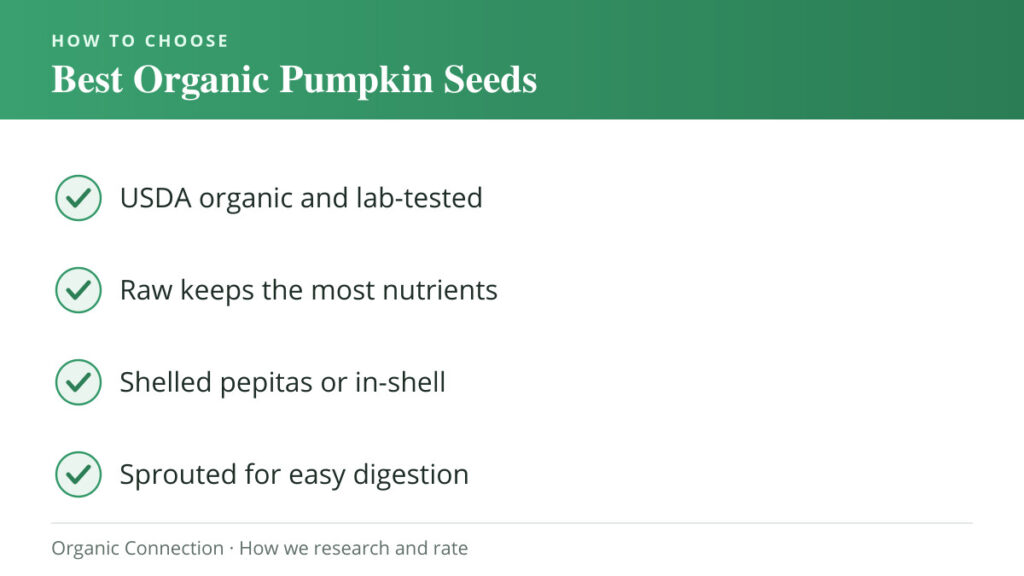
1. USDA organic sourcing
Organic certification confirms the seeds were grown without synthetic pesticides, and the best brands add lab testing for cleanliness.
2. Raw vs roasted
Raw seeds keep the most delicate nutrients and let you season them yourself; dry-roasted salted seeds are ready to snack.
3. Shelled vs in-shell
Shelled pepitas (the green kernels) are convenient for salads, smoothies, and snacking; in-shell seeds are great for roasting whole.
4. Sprouted for digestibility
Sprouting can make minerals more available and the seeds easier to digest, a nice option for daily eaters.
Are organic pumpkin seeds worth it?
Pumpkin seeds are a nutrient-dense whole food, exceptionally rich in magnesium and zinc, and you often eat them raw and unwashed straight from the bag, which is a good reason to choose organic and avoid synthetic pesticide residues. Beyond certification, form matters: raw seeds preserve the most nutrients and flexibility, sprouted seeds are gentler on digestion, and dry-roasted salted pepitas are the easy grab-and-go snack. Freshness is key too, since the healthy fats can go rancid, so lab-tested, well-packaged seeds from a brand that turns over stock quickly are ideal.
Our scoring rewards genuine organic certification, clean testing, form and freshness, and value, so you get seeds that are both certified organic and genuinely fresh and versatile.
Rancidity is the real quality problem, not pesticides
Most guides in this category focus entirely on certification. The thing far more likely to actually affect what you eat is oxidation, and almost nobody checks for it.
Why it happens. Nuts and seeds are high in unsaturated fat, and unsaturated bonds react with oxygen. Once that starts, the fats break down into hydroperoxides which decompose further into volatile compounds, chiefly hexanal, pentanal, and 2,4-decadienal, that produce the sharp, waxy, paint-like or old-crayon smell people recognize as rancid. It is a chemical cascade rather than a spoilage organism, so there is no mold to see and no obvious visual warning.
What it costs you. Beyond taste, oxidation destroys the things you bought the food for. In chia specifically, tocopherol content can fall by up to 91% within six months of poor storage. Rancid nuts and seeds deliver oxidized fats instead of intact ones, which is the opposite of the intended result.
| Factor | Effect on shelf life |
| Whole and unopened, cool and dark | Longest, often a year or more |
| Opened at room temperature | Cut sharply, often to a few months |
| Ground, milled, or chopped | Degrades roughly 3 to 5 times faster, since surface area rises enormously |
| Refrigerated after opening | Substantially extends life |
| Frozen | Best option for anything you will not finish in a couple of months |
| Clear jar in daylight, warm cupboard | Worst case; light and heat both accelerate oxidation |
The test is your nose, every time. Fresh nuts and seeds smell faintly sweet, buttery, or grassy. If it smells sharp, bitter, waxy, or like old paint, it has oxidized and should be thrown out rather than masked in a smoothie. This is more reliable than any date on the packet, because the date does not know how the product was stored between the factory and your kitchen.
Two things commonly claimed that do not hold up
Soaking to remove phytic acid. The popular advice is to soak nuts and seeds to neutralize phytates and “unlock” minerals. Research is unflattering: soaking whole nuts was not effective at reducing phytate concentration at all. Soaking chopped nuts did reduce phytic acid, and it also reduced the mineral content along with it, which rather defeats the purpose. Soaking has legitimate uses, it makes nuts softer and some people find them easier to digest, and the phytate-and-minerals argument for it is weak.
Aflatoxins, in proportion. Aflatoxins are carcinogenic compounds produced by Aspergillus molds, and nuts, peanuts, pistachios, and dried fruit are all susceptible during growing and storage. This is a genuine food safety category with real regulatory limits, and commercial products in developed markets are tested against them. The practical protections are ordinary: buy from suppliers with high turnover, store cool and dry, and discard any nut that tastes bitter or looks shrivelled or discolored rather than eating around it. Organic certification does not address aflatoxin, which is a storage and handling issue rather than a spraying one.
How to choose organic pumpkin seeds
- Look for USDA organic and lab testing. Clean growing plus quality testing is the ideal combination.
- Pick raw or roasted for your use. Raw for cooking and seasoning yourself, dry-roasted salted for snacking.
- Choose shelled or in-shell. Shelled pepitas for salads and smoothies, in-shell for roasting whole.
- Consider sprouted. For daily eaters, sprouted seeds can be easier to digest.
- Store them cool. Keep seeds sealed and, ideally, refrigerated or frozen to keep the healthy fats fresh.
Who should buy organic pumpkin seeds
Snacking and cooking want different bags. Raw seed suits general use; buy our top pick. If you want sprouted seeds for digestibility, a ready-to-eat salted snack, the best bulk value, or whole seeds in the shell for roasting, we have a pick for each.
Best overall: Terrasoul Organic Dry-Roasted Salted Pepitas
| Organic Integrity Score | 84 / 100 |
| Form | Dry-roasted, salted, shelled |
| Certification | Non-GMO, Gluten-free, Vegan |
| Best for | Grab-and-go snacking |
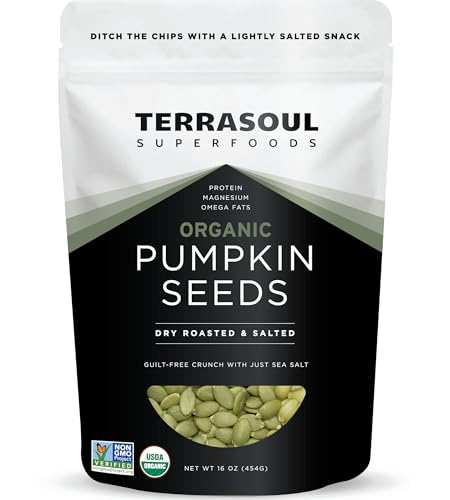
Terrasoul roasted is our pick for a ready snack. These USDA-organic pepitas are dry-roasted and lightly salted, non-GMO, gluten-free, and keto-friendly, in a resealable bag, so they are ready to eat straight away with a satisfying crunch and savory flavor, no prep needed.
It scores in the middle because roasting and salting trade a little of the raw-nutrient edge and add sodium, but for a clean, organic, ready-to-eat crunchy snack, it is exactly right.
What we liked: USDA organic, dry-roasted and lightly salted, satisfying crunch, and a resealable bag for snacking.
Keep in mind: Roasting and salting add sodium and trade a little of the raw-nutrient advantage.
What the listing discloses: Terrasoul Superfoods is thin on detail, and does not say whether the USDA seal applies and where it was grown or made.
Easier digestion and mineral: Food to Live Organic Sprouted Pumpkin Seeds
| Organic Integrity Score | 82 / 100 |
| Form | Sprouted, shelled, raw |
| Certification | Non-GMO, Kosher, Vegan |
| Best for | Easier digestion and mineral absorption |
Food to Live Sprouted is our pick for digestibility. These USDA-organic, non-GMO pumpkin seed kernels are sprouted, which can make their minerals more available and the seeds gentler on digestion, and they are raw, unsalted, and processed in an organic-certified facility, great over oats, yogurt, and salads.
It takes first place on documentation: its listing names Kosher, where most of this category asks to be taken on trust.
For clean, sprouted, organic pumpkin seeds, it is our pick.
What we liked: USDA organic and non-GMO, sprouted for digestibility and mineral availability, raw kernels, and clean processing.
Keep in mind: Sprouted seeds cost a bit more than standard raw seeds.
What the listing discloses: Food to Live documents kosher certification, and leaves whether the USDA seal applies and where it was grown or made unsaid.
Versatile organic seed: Terrasoul Superfoods Organic Pumpkin Seeds
| Organic Integrity Score | 81 / 100 |
| Form | Raw, shelled, unsalted |
| Certification | — |
| Best for | An all-around versatile organic seed |
Terrasoul is one we still rate because it pairs clean organic sourcing with freshness and versatility. These USDA-organic, non-GMO raw pumpkin seeds are shelled and unsalted, lab-tested for quality by a specialist superfood company that imports and tests its own ingredients, so you get fresh, clean pepitas ready for snacking, salads, granola, or smoothies.
The trade-off is that raw and unsalted means you season them yourself if you want a savory snack. For genuinely organic, fresh, do-anything pumpkin seeds, they are a solid choice.
What we liked: USDA organic and non-GMO, raw and versatile, lab-tested freshness, and a resealable bag.
Keep in mind: They are raw and unsalted, so you add seasoning or roasting yourself if you want a savory snack.
What the listing discloses: Terrasoul Superfoods documents a single-ingredient formula, and leaves whether the USDA seal applies and where it was grown or made unsaid.
Best bulk value: Food to Live Organic Raw Pepitas
| Organic Integrity Score | 80 / 100 |
| Form | Raw pepitas, shelled, bulk |
| Certification | Non-GMO, Kosher, Vegan |
| Best for | Heavy users who want the best price |
Food to Live pepitas are our bulk-value pick. These USDA-organic, non-GMO raw pumpkin seed kernels are unsalted with no oil, sold in larger bulk sizes that give a low cost per serving, ideal for families, batch baking, granola-making, and anyone who eats seeds daily.
It scores in the value range because it is a straightforward raw kernel in bulk rather than a specialty form, but for clean, organic pepitas at the best price per pound, it is excellent.
What we liked: USDA organic and non-GMO, raw and unsalted, and a low cost per serving in bulk sizes.
Keep in mind: Buy a size you will use and store it cool, since larger bags of seeds can go rancid if kept too long.
What the listing discloses: Food to Live is explicit about kosher certification, and silent on whether the USDA seal applies and where it was grown or made.
Best in-shell: Food to Live Organic Pumpkin Seeds in Shell
| Organic Integrity Score | 79 / 100 |
| Form | Raw, in-shell (whole) |
| Certification | Non-GMO, Vegan, Organic |
| Best for | Roasting whole seeds at home |
Food to Live in-shell is our pick for roasting whole. These USDA-organic, non-GMO whole pumpkin seeds come dried, unsalted, and unroasted in the shell, perfect for tossing with oil and seasoning and roasting at home for a fresh, crunchy, fall-favorite snack with extra fiber from the shell.
It scores at the value end because in-shell seeds take some prep and the fibrous shell is not to everyone’s taste, but for the classic roast-your-own experience with organic seeds, it is the right choice.
What we liked: USDA organic and non-GMO, whole in-shell seeds ideal for home roasting, and extra fiber from the shell.
Keep in mind: They need roasting and seasoning at home, and the fibrous shell is not for everyone.
What the listing discloses: Food to Live leaves the basics open, including whether the USDA seal applies and where it was grown or made.
How to enjoy pumpkin seeds
Shelled pepitas are ready to sprinkle over salads, yogurt, oatmeal, and smoothie bowls, or to fold into granola, trail mix, and baking. To roast in-shell seeds, toss them with a little olive oil and salt and bake at around 300°F for 20 to 40 minutes until golden and crunchy, stirring occasionally. Because the healthy fats in seeds can go rancid, store them sealed in a cool, dark place, or in the fridge or freezer for longer freshness. A small handful is a nutrient-dense, magnesium- and zinc-rich snack.
Pepitas are a variety, not a peeled seed
Almost every pumpkin seed guide describes pepitas as “hulled” pumpkin seeds, and that is wrong in a way worth correcting, because it explains the price difference and the flavor.
The flat green seeds sold as pepitas come from Styrian pumpkins — a hulless or naked-seeded variety developed in Austria from a natural mutant discovered around 150 years ago. The seed simply grows without a hard husk. Nobody shelled it. Styrian seeds are darker and larger than ordinary pumpkin seed kernels, with slightly less fat and slightly more fiber.
Ordinary carving-pumpkin seeds do have a tough white husk, and mechanically hulling them is possible but wasteful, which is why nearly all commercial pepitas are Styrian-type rather than shelled jack-o’-lantern seed. If a bag lists Cucurbita pepo and shows flat dark-green seeds, that is what you have.
| Form | What it is | Best for |
| Pepitas (green kernels) | Hulless Styrian-type seed | Snacking, salads, granola, pesto, baking |
| In-shell whole seeds | Conventional pumpkin seed with husk | Slow snacking, more fiber, cheaper per kilo |
| Sprouted pepitas | Germinated then dried at low heat | Those who find raw seeds heavy; germination activates endogenous phytase |
| Pumpkin seed oil | Roasted Styrian seed, cold-pressed | Finishing oil only — never cooking. Deep green, nutty. |
What a serving actually delivers
Pumpkin seeds are one of the genuinely nutrient-dense snack foods, and the two standouts are magnesium and zinc — both nutrients a large share of people fall short on.
| Per 28 g (1 oz), approx. | Amount | Roughly |
| Magnesium | ~150 mg | About 35–40% of daily needs — one of the densest food sources there is |
| Zinc | ~2.2 mg | Around 20% of daily needs; notable for plant-based diets |
| Protein | ~8.5 g | Higher than most nuts by weight |
| Iron | ~2.5 mg | Non-haem, so pair with vitamin C |
| Fat | ~13 g | Predominantly polyunsaturated — see the roasting note below |
| Calories | ~155 | Easy to overshoot; a handful is a serving, not a bowl |
The zinc figure is why pumpkin seeds turn up in vegetarian and vegan nutrition advice so often — plant sources of zinc are relatively few, and this is among the better ones. Bear in mind that zinc from seeds and grains absorbs less efficiently than zinc from meat, so the practical contribution is somewhat lower than the number suggests.
Roasting temperature matters more than roasting time
Pumpkin seed fat is predominantly polyunsaturated, which is exactly the fat most vulnerable to heat. That has a direct consequence for how you should roast them, and it is the opposite of what most recipes say.
- Roast low: 150–160°C (300–325°F) for 12–20 minutes, stirring once or twice. Not 200°C for ten minutes.
- They are done before they look done. Pepitas puff slightly and start to pop; pull them when the first few pop rather than waiting for deep color.
- Cool completely on the tray — they crisp as they cool, and seeds that seem soft out of the oven usually are not.
- Salt after, not before. Salt draws moisture to the surface and makes them steam rather than toast.
- Oil is optional. Seeds have enough fat of their own; added oil mostly helps seasoning stick.
- Never fry pumpkin seed oil or cook with it. It has a low smoke point and its character is destroyed by heat. Drizzle it on soup, salad or even vanilla ice cream — the Styrian tradition — after cooking.
Commercially dry-roasted seeds are often roasted hotter and faster than is ideal, which is one reason raw seeds frequently taste fresher. It is also why a bag that smells strongly of “toasted nuts” in the shop may already be part-way to rancid.
Cadmium: a small caveat, stated proportionately
Pumpkin plants are efficient mineral accumulators, and that ability is not selective — in areas with contaminated soil, pumpkin seeds can take up abnormally high levels of cadmium along with the zinc and magnesium. Studies assessing cadmium and lead in pumpkin, sunflower and watermelon seeds have measured this directly.
Some perspective is warranted. Analyses of pumpkin seed oils from established growing regions have found cadmium below the limit of quantification in every sample tested, so this is a soil-and-origin issue rather than a property of the seed. It matters where the crop was grown, not whether it was grown organically — cadmium is a soil contaminant, and organic certification governs what was sprayed on the plant, not what the plant drew up from the ground.
Practically: this is not a reason to avoid pumpkin seeds, which remain one of the better things you can eat by the handful. It is a reason to buy from brands that name their origin and publish contaminant testing if you eat them daily in quantity, and the same reasoning we apply to cocoa, rice and supplement powders elsewhere on this site.
The prostate claim, assessed
Pumpkin seeds and pumpkin seed oil are widely marketed for prostate health and benign prostatic hyperplasia, and the evidence is more modest than the marketing.
There is a plausible mechanism — the seeds contain phytosterols, zinc and lignans — and a number of small trials, mostly of concentrated pumpkin seed oil or extract rather than of eating seeds, have reported improvements in urinary symptom scores. The trials are generally small, several are industry-supported, and results are not consistent across them. Larger, independent replication is thin.
The honest position: eating pumpkin seeds is good for you for straightforward reasons — magnesium, zinc, protein, unsaturated fat — and if you have urinary symptoms, that is a conversation for a doctor rather than a supplement aisle. BPH shares symptoms with conditions that need proper assessment, and self-treating with seeds delays that. Nothing here argues against enjoying them; it argues against buying them as medicine.
Storage: the thing that actually ruins them
- High polyunsaturated fat means fast rancidity. Pumpkin seeds go off sooner than almonds or cashews, and shelled pepitas sooner than in-shell seeds, because there is no husk protecting them.
- Pantry: 2–3 months in an airtight container away from light and heat. Refrigerator: 6 months. Freezer: a year, and they need no thawing before use.
- Smell them. Fresh seeds smell faintly sweet and green; rancid seeds smell like old oil paint or putty, and taste sharply bitter. That bitterness is the reliable tell — a bitter seed is a spoiled seed, not a strong-flavored one.
- Buy from high-turnover suppliers. With any high-PUFA seed, how long it sat in a warehouse matters more than the printed date.
- Keep pumpkin seed oil refrigerated once opened and use within a few months. It is expensive and it oxidizes quickly.
- Roasted seeds keep less well than raw ones. If you buy in bulk, buy raw and roast small batches as you need them.
How we researched this guide
We are a research-based review site. We compared each product against its certification, testing, form and freshness, and the weight of aggregated customer feedback, then scored each with our 10-criteria Organic Integrity Score. No brand paid to be included or ranked. Read the full method on our How We Research and Rate page.
Magnesium, zinc, and eating them by the handful
Pumpkin seeds are nutritionally strong and easy to over-serve, and both facts deserve equal weight.
An ounce of pumpkin seeds carries around 150 calories with about 7 grams of protein and 1.7 grams of fiber, alongside a genuinely notable mineral content. They are one of the better dietary sources of magnesium, supplying roughly 40% of the daily requirement in an ounce, and a good source of zinc and iron. Magnesium is a nutrient a substantial proportion of people fall short of, so this is a real contribution rather than a trace-amount argument.
On satiety, they behave like other seeds and nuts: the combination of protein, fat and some fiber makes them more filling than an equivalent number of calories from a refined snack. The nut literature on displacement broadly applies.
The practical problem is that they are small and eaten loose. Unlike almonds, which are countable, pumpkin seeds are consumed by the handful from a bowl, and three ounces disappears without registering as a meal. At that point you have eaten 450 calories of snack.
Roasted and salted versions compound this, since salt drives continued eating, and honey-roasted versions add sugar to an already calorie-dense food.
There is no specific weight mechanism here and no research suggesting one. The relevant question is entirely about portion and what the seeds are replacing.
Honest summary: a nutritionally excellent snack, genuinely useful for magnesium, with no weight-specific properties and a strong tendency to be eaten in quantities well beyond a serving. Portion them out rather than eating from the bag.
Common questions about organic pumpkin seeds
What are the best organic pumpkin seeds?
Our overall pick is Terrasoul Superfoods Organic Pumpkin Seeds, because they are USDA organic, raw, unsalted, lab-tested, and versatile. For digestibility, Food to Live Sprouted is our pick, and for a ready snack, Terrasoul Dry-Roasted Salted.
Are pumpkin seeds healthy?
Yes. Pumpkin seeds are nutrient-dense, especially rich in magnesium (around 150 mg per ounce) and zinc, plus plant protein, iron, and healthy fats. A small handful is a nourishing snack; roasted salted versions add sodium.
Raw or roasted pumpkin seeds, which is better?
Raw seeds keep the most delicate nutrients and let you season them yourself, while dry-roasted salted seeds are ready to eat with more crunch and flavor. Both can be part of a healthy diet; choose based on convenience and sodium preference.
What are pepitas?
Pepitas are the shelled green kernels of pumpkin seeds, without the white outer shell. They are convenient for salads, smoothies, and snacking, while in-shell seeds are better for roasting whole.
How should I store pumpkin seeds?
Keep them sealed in a cool, dark place, or refrigerate or freeze them for longer freshness, since the healthy fats can go rancid over time. A resealable bag helps keep them fresh after opening.
Are pepitas just hulled pumpkin seeds?
No, and this is widely misreported. Pepitas come from Styrian pumpkins, a hulless or naked-seeded variety developed in Austria from a natural mutant found around 150 years ago — the seed grows without a husk in the first place. They are darker and larger than ordinary pumpkin seed kernels, with slightly less fat and slightly more fiber. Carving-pumpkin seeds do have a hard husk, and hulling them is wasteful, which is why nearly all commercial pepitas are the Styrian type.
How much magnesium and zinc is in pumpkin seeds?
About 150 mg of magnesium per 28 g serving — roughly 35 to 40% of daily needs, making them one of the densest food sources available — plus around 2.2 mg of zinc, about 20% of daily needs. That zinc figure is why they appear so often in vegetarian nutrition advice, though zinc from seeds absorbs less efficiently than zinc from meat, so the practical contribution is somewhat lower than the number suggests.
What temperature should you roast pumpkin seeds at?
150 to 160°C (300 to 325°F) for 12 to 20 minutes — lower and longer than most recipes suggest. Pumpkin seed fat is predominantly polyunsaturated, which is the fat most vulnerable to heat. Pull them when the first few pop rather than waiting for deep color, cool them completely on the tray so they crisp, and salt after roasting rather than before, since salt draws moisture out and makes them steam.
Can you cook with pumpkin seed oil?
No. It has a low smoke point and heat destroys its character entirely. Use it as a finishing oil — drizzled over soup, salad, or in the Styrian tradition, vanilla ice cream. Keep it refrigerated once opened and use within a few months, since it is expensive and oxidizes quickly.
Do pumpkin seeds contain cadmium?
They can, depending on where they grew. Pumpkin plants are efficient mineral accumulators and that ability is not selective, so seeds grown in contaminated soil can take up abnormally high cadmium alongside the zinc and magnesium. For perspective, analyses of pumpkin seed oils from established growing regions have found cadmium below the limit of quantification in every sample. It is an origin issue rather than a property of the seed, and organic certification does not address it because cadmium comes from the soil rather than a spray.
Do pumpkin seeds help with prostate problems?
The evidence is more modest than the marketing. There is a plausible mechanism — phytosterols, zinc and lignans — and several small trials of concentrated seed oil or extract have reported improved urinary symptom scores, but the trials are small, several are industry-supported, and independent replication is thin. Eat them because they are nutritious. If you have urinary symptoms, see a doctor, since BPH shares symptoms with conditions that need proper assessment.
How long do pumpkin seeds last?
2 to 3 months in an airtight pantry container, 6 months refrigerated, or a year frozen with no thawing needed. Their high polyunsaturated fat content means they go rancid faster than almonds or cashews, and shelled pepitas faster than in-shell seeds. Fresh seeds smell faintly sweet and green; rancid ones smell like old oil paint and taste sharply bitter. A bitter seed is spoiled, not strongly flavored.
Are raw or roasted pumpkin seeds better?
Raw ones often taste fresher, because commercial dry-roasting is usually done hotter and faster than is ideal for a polyunsaturated fat. Roasted seeds also keep less well than raw. If you buy in bulk, buy raw and roast small batches as you go — you control the temperature and get better flavor.
- Organic Food and Pantry hub
- Best Organic Chia Seeds
- Best Organic Peanut Butter
- How we research and rate products
- every organic food product we have reviewed — searchable by brand and certification
Price and availability as of October 19, 2026 7:10 am EDT. Product prices and availability are accurate as of the date/time indicated and are subject to change. Any price and availability information displayed on Amazon.com at the time of purchase will apply to the purchase of this product.
Looking for other organic products?
We have checked more than 800 products across food, household goods, gardening, personal care and pet, every one against its stated certification. Browse all reviews.
Organic Connection is reader-supported. When you buy through links on this page we may earn a commission, at no extra cost to you. As an Amazon Associate we earn from qualifying purchases. We are not paid to feature or rank any product. How we research and rate.