Last updated: September 30, 2026
We may earn a commission when you buy through links on this page, at no extra cost to you. How we research and rate.
The short version
Judged on what each maker will put in writing, our top pick is the MAGNIFIQUE 4 Quart Programmable Casserole Slow Cooker. It names its liner as heat-resistant porcelain, names the coating on it as ceramic nonstick, excludes PFAS and PFOA explicitly, and states an oven rating of 450°F. That earned it our highest Organic Integrity Score of 91 out of 100.
Two things about this category are worth knowing before you buy.
First, “High”, “Low” and “Warm” are not temperatures — they are labels, and they vary between machines. One listing here publishes the actual figures behind them, and it is the only one.
Second, the part that holds your food for eight hours is a glazed ceramic crock, and glaze is the one place in a kitchen where lead has a genuine history. None of these five says anything about it.
What the listings leave out
| Best Choice | Best Value | ||||
 |
 |
 |
 |
 |
|
| Product | MAGNIFIQUE 4 Qt | Sunvivi 6 Qt | Crock-Pot 7 Qt | Elite Gourmet 1.5 Qt | Hamilton Beach 6 Qt |
| Organic Integrity Score | 91/ 100 | 88/ 100 | 86/ 100 | 83/ 100 | 79/ 100 |
| Our rating | 4.6 | 4.4 | 4.3 | 4.2 | 4.0 |
| Best for | Best overall | Actual temperatures published | Biggest crock, best seller | Single portions, safety listed | Simple 6-quart family cooking |
| Crock material named | Porcelain, ceramic nonstick coated | Detachable pot, not named | Stoneware | Stoneware, oval | Stoneware |
| Setting temperatures | Not stated | 100°C / 80°C / 60°C | Not stated | Not stated | Not stated |
| Coating exclusions | PFAS and PFOA, stated | Silicone liners, no coating claim | Not stated | Not stated | Not stated |
| Oven safe | 450°F | Not stated | 400°F | Not stated | Not stated |
| Warranty / listing | Not stated | Not stated | Not stated | ETL listed, 1-year warranty | 1-year limited warranty |
| Price | $179.99 View on Amazon |
$69.99 View on Amazon |
$35.99 $59.99 −40% View on Amazon |
$15.99 View on Amazon |
$39.99 View on Amazon |
Scores are ours, based on independent research of materials disclosure, published specifications, safety listings and value, using the same ten-criteria method we apply to every product.
What each claim on a slow cooker listing covers
| Claim | Covers | Key exclusion |
| Leach-tested / lead-free glaze | Migration into food, measured against FDA limits | The claim worth wanting on a crock; none makes it |
| Stoneware crock | The removable ceramic vessel that holds the food | Says nothing about the glaze on it |
| Porcelain liner | A denser, less porous ceramic body | More specific than “stoneware”; one listing states it |
| Ceramic nonstick, PFAS and PFOA free | A coating over the ceramic, with named exclusions | An extra layer between food and glaze; one listing has it |
| 100°C / 80°C / 60°C | What High, Low and Warm actually mean | The only published temperatures here |
| Oven safe to 400–450°F | The crock can finish or brown in an oven | Genuinely useful; two listings state a figure |
| ETL listed | Independent electrical safety certification | A named third-party listing; one product carries it |
| Dishwasher safe | Crock and lid survive a cycle | Universal here; says nothing about the glaze |
The glaze question, handled carefully
This is the concern people bring to slow cookers, it circulates widely online, and it deserves an accurate answer rather than either reassurance or alarm.
The facts. A slow cooker crock is glazed ceramic or stoneware. Lead has historically been used in ceramic glazes, and it is still permitted at controlled levels. The FDA regulates leachable lead in ceramic foodware through compliance policy guides, which set limits on how much metal may migrate into food under normal use — roughly 3.0 µg/mL for flatware and around 0.5 µg/mL for small hollowware.
Why a slow cooker is the hardest case. Leaching is driven by acidity, temperature and time. A slow cooker holds acidic food — tomato, wine, citrus, vinegar — at temperature for six to ten hours. That is close to the worst-case scenario for any glazed vessel, and considerably harsher than a dinner plate holding food for twenty minutes.
The distinction that matters, and that most online discussion gets wrong. There are two different tests, and they answer different questions.
- XRF testing detects whether lead is present in a material. It will find lead that is fully fired and sealed inside a glaze where it never contacts food.
- Leach testing fills the vessel with a weak acid solution and measures how much lead actually migrates into the liquid. That is the number FDA limits are written against.
A great deal of alarming content about slow cookers is built on XRF results. Presence is not migration, and a crock can contain lead in its glaze while leaching none.
What we can and cannot tell you. Reputable manufacturers selling into the US market are required to meet those leach limits, and the products here are from established brands and marketplaces subject to them. We have no evidence of a problem with any crock on this page.
What we can say is that none of these five listings mentions it. Not one states a lead-free glaze, cites a leach test, or references the FDA limits it is presumably meeting. On the one product in a kitchen where an acid leach test would genuinely mean something, no manufacturer is volunteering one — and a brand that published leach results would immediately be the best-documented slow cooker on the market.
If you want to sidestep the question entirely: one machine here uses silicone liners inside the pot, so food does not contact the ceramic at all. Stainless-lined multi-cookers are the other route.
High and Low are labels, not temperatures
Every slow cooker sold has High, Low and Warm. Almost none tells you what they are, and that is a genuine gap because the numbers matter for both food safety and results.
One listing publishes them: High 100°C, Low 80°C, Warm 60°C.
Those figures are worth having. Warm at 60°C sits just above the 57°C food-safety threshold below which bacteria multiply, which tells you a warm setting is genuinely safe to hold food on for a couple of hours and not merely “not cold”. Low at 80°C is a gentle simmer, which is why it renders tough collagen without boiling meat into fibers. High at 100°C is a true simmer.
Knowing them also settles the most common slow cooker question: High and Low reach broadly similar final temperatures, but High gets there faster. That is why the conventional rule — that one hour on High is roughly two on Low — works, and why Low is better for tough cuts that need time rather than heat.
Every other listing here leaves you to infer it.
Best overall: MAGNIFIQUE 4 Quart Programmable Casserole Slow Cooker
| Organic Integrity Score | 91 / 100 |
| Liner | Heat-resistant porcelain, ceramic nonstick coated |
| Exclusions | Free from PFAS and PFOA, stated |
| Oven and microwave | Safe to 450°F |
| Functions | 8-in-1: slow cook, braise, sear/sauté, keep warm, rice, oats, pasta |
| Best for | The only crock here described in materials rather than category |
This wins because it is the only listing that treats the crock as a material rather than a shape.
It names the body as porcelain rather than the generic “stoneware” everyone else uses. Porcelain is fired hotter and is denser and less porous than ordinary stoneware, which matters for staining and for how the glaze sits on it.
It names a coating on top — ceramic nonstick — and excludes PFAS and PFOA explicitly. That coating is also, incidentally, a second answer to the glaze question above: a coated surface means food is not in direct contact with the glaze at all.
And 450°F is the highest oven rating here, which turns the crock into a casserole dish. Brown a top under the broiler, finish a gratin, bake in it — this is the “casserole slow cooker” the name promises rather than a slow cooker that tolerates an oven.
The sear and sauté function is the other genuinely useful inclusion. Browning meat before a long braise is the single biggest improvement available to slow-cooked food, and doing it in the same pot removes the frying pan that stops people bothering.
Two reservations. At around a hundred and forty dollars it is by a wide margin the most expensive here, and four quarts is the second-smallest capacity — it holds a four-pound chicken, not a family roast. There is no warranty statement and no setting temperatures.
What we liked: Porcelain liner named, ceramic coating named with PFAS and PFOA excluded, a 450°F oven rating, eight functions including a genuine sear, and a digital display.
Keep in mind: The most expensive by far, and only 4 quarts. No warranty, no setting temperatures, and nothing about the glaze beneath the coating.
Actual temperatures published: Sunvivi 6 Quart Programmable Slow Cooker
| Organic Integrity Score | 88 / 100 |
| Temperatures | High 100°C, Low 80°C, Warm 60°C — the only figures on this page |
| Liners | 2-in-1 silicone, heat resistant to 446°F, dishwasher safe |
| Timer | 30 minutes to 20 hours, programmable |
| Capacity | 6 quarts |
| Best for | Knowing what the settings mean, and cooking two dishes at once |
The most transparent listing here on the thing that is normally a black box.
Publishing 100°C, 80°C and 60°C is genuinely unusual and genuinely useful. It tells you the Warm setting sits safely above the 57°C food-safety line, that Low is a true gentle simmer, and it lets you convert oven recipes with some confidence instead of guessing.
The 2-in-1 silicone liners are the other real idea. They divide the pot so you can cook two dishes at once — a main and a side, or a portion without chile for a child. And because food sits in silicone rather than on the ceramic, they neatly sidestep the glaze question this guide opens with. The liners are rated to 446°F and are dishwasher safe.
The timer range is stated properly too: 30 minutes to 20 hours. Twenty hours is more than most people need and the 30-minute floor is the more useful end, since many slow cookers will not go below two.
It sits second because the pot itself is described only as “a detachable pot” — no material named at all, which on this page is a notable omission — and there is no warranty statement or oven rating.
What we liked: Actual temperatures for all three settings, silicone liners that divide the pot and avoid ceramic contact, a 30-minute to 20-hour programmable timer, and a practical 6-quart size.
Keep in mind: The pot material is never named. No warranty and no oven rating. Silicone liners reduce usable capacity slightly.
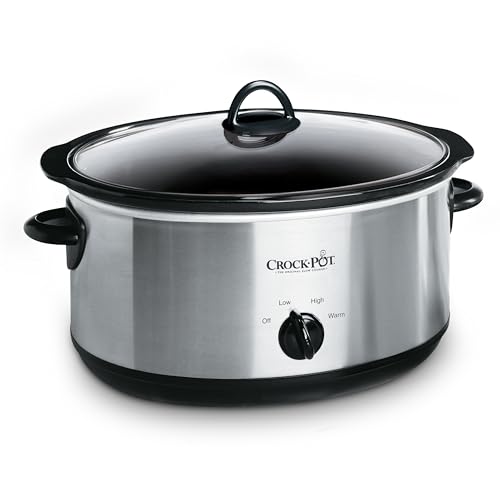
Biggest crock, best seller: Crock-Pot 7 Quart Manual Slow Cooker
| Organic Integrity Score | 86 / 100 |
| Capacity | 7 quarts, serves 8+ |
| Crock | Removable stoneware, microwave and oven safe to 400°F |
| Settings | High, Low and Warm |
| Exterior | Stainless steel with plastic handles, named |
| Best for | Feeding a crowd, from the brand that named the category |
The best-selling slow cooker here and the one most people picture when they think of one.
Seven quarts is genuinely large — enough for a big roast or batch cooking for a week — and the crock is microwave and oven safe to 400°F, which two competitors do not state at all. Being able to reheat leftovers in the crock itself is a real convenience.
We also want to credit a small piece of honesty: the listing states the handles are plastic. On a stainless-steel-exterior appliance, most sellers would let “stainless steel” carry the impression. Naming the polymer part is exactly the disclosure we spend these guides looking for.
One thing to note before ordering. The product title says it fits a 6-pound roast and the first bullet says 7 pounds. It is a small discrepancy and it will not affect most purchases, but a listing that contradicts itself on its own capacity is worth reading twice — buy on the smaller figure.
Beyond that the specification is thin for a category leader: no temperatures, no wattage, no warranty terms, and nothing about the glaze.
What we liked: The largest capacity here, a 400°F oven and microwave rating, dishwasher-safe crock and lid, honest disclosure that the handles are plastic, and an enormous track record.
Keep in mind: Title and description disagree on roast capacity. No setting temperatures, wattage or warranty. Manual dial only, with no timer.
Single portions, safety listed: Elite Gourmet 1.5 Quart Ceramic Slow Cooker
| Organic Integrity Score | 83 / 100 |
| Capacity | 1.5 quarts — personal size |
| Safety | ETL listed, 120 watts stated |
| Crock | Removable oval stoneware, tempered glass lid |
| Warranty | 1 year limited, with US-based support |
| Best for | One or two portions, dips, or a desk |
The cheapest product here at around fifteen dollars, and the only one carrying a named third-party safety listing.
ETL listed means the appliance has been tested by an accredited laboratory against the applicable North American electrical safety standard. It is not a materials certification and it says nothing about the glaze — but it is an independent body verifying something, which is more than three competitors offer, and on a heating appliance left running unattended for eight hours it is not nothing.
It also states its wattage — 120W, which is genuinely low and correct for this size — and publishes a 1-year limited warranty with US-based support. Two disclosures the far more expensive machines above omit entirely.
Cool-touch handles and knob are called out for safe carrying, and both the tempered glass lid and the oval stoneware pot are dishwasher safe.
The limitation is obvious and unavoidable: 1.5 quarts. This is a single-portion cooker, a dip warmer, or a desk-side machine. It will not cook a family meal and it is not trying to.
What we liked: ETL safety listing named, wattage published, a stated one-year warranty with US support, cool-touch handles, dishwasher-safe stoneware and glass lid, and the lowest price here by far.
Keep in mind: Only 1.5 quarts. No setting temperatures, no oven rating, and nothing about the glaze. Manual dial with no timer.
Simple 6-quart family cooking: Hamilton Beach 6 Quart Slow Cooker
| Organic Integrity Score | 79 / 100 |
| Capacity | 6 quarts, serves 7+, fits a 6-pound roast |
| Crock | Removable stoneware, dishwasher safe with glass lid |
| Settings | 3 — Low, High and Keep Warm |
| Handles | Full-grip, for carrying to the table |
| Warranty | 1 year limited |
| Best for | Straightforward family cooking with nothing to learn |
A perfectly sensible 6-quart cooker from a long-established brand, and the most modest listing on the page.
The full-grip handles are the one design point worth calling out. A 6-quart crock full of stew is heavy and hot, and handles you can get a whole hand around rather than a finger-width lug make a real difference carrying it to a table. It is the kind of detail that only comes from someone having done it.
Six quarts fits a whole six-pound roast, there are three settings, the stoneware and glass lid are dishwasher safe, and a 1-year limited warranty is stated.
Beyond that the listing offers very little. Of nine bullets, several are about how much time you will save and what you could make in it — breakfast casserole, cobbler, mulled drinks. No temperatures, no wattage, no oven or microwave rating, no material detail beyond “stoneware”, and nothing about the glaze.
It is not a bad machine. It is a machine sold on familiarity rather than on specification, and on this page that is what separates it from the cookers above.
What we liked: A practical 6-quart capacity with a stated roast size, genuinely good full-grip handles, dishwasher-safe crock and glass lid, a one-year warranty, and a trusted brand at a fair price.
Keep in mind: No temperatures, wattage, oven rating or material detail. Several bullets are recipe suggestions rather than specification. Manual dial with no timer.
Sizing, and the rule that matters most
Fill it between half and three-quarters full. This is the single most important slow cooker rule and no listing here states it.
Under half full, food scorches at the edges and overcooks. Over three-quarters, the contents heat too slowly — which is a genuine food-safety issue, since food should pass through the 40–140°F danger zone promptly rather than dwelling in it for hours.
That rule drives sizing. A 7-quart cooker is not “a 4-quart with room to spare” — it is a machine that wants at least three and a half quarts of food in it to work properly.
1.5 quarts: one or two portions, dips, sauces.
4 quarts: two to four people, a small chicken.
6 quarts: the standard family size, a 6-pound roast.
7 quarts and up: batch cooking and entertaining.
If you cook for two but batch cook occasionally, buy 4 quarts and cook twice rather than 7 and run it half empty.
Getting better results
Brown the meat first. The biggest single improvement, and the reason the sear function on our top pick matters. A slow cooker cannot brown — there is no dry heat — so without searing, a stew tastes flat and gray.
Use less liquid than you think. Nothing evaporates under a sealed lid, and vegetables release their own water. Recipes converted from the stovetop usually need roughly half the liquid.
Do not lift the lid. Each peek loses steam and can add twenty minutes. Two listings here include glass lids for exactly this reason.
Add dairy and delicate herbs at the end. Cream and yogurt split over eight hours; fresh herbs turn to sludge. Stir them in during the last half hour.
Cheap cuts, not expensive ones. Chuck, shin, shoulder and thigh have the collagen that a long gentle cook converts to gelatine. A lean fillet in a slow cooker just becomes dry.
Do not reheat in it. A slow cooker warms too gradually to bring cold food safely through the danger zone. Reheat on a stovetop or in a microwave, then hold it on Warm.
Care
Never put a hot crock into cold water, or a cold crock into a preheated base. Ceramic cracks from thermal shock, and a cracked crock must be replaced rather than used.
Soak rather than scour. Warm soapy water for half an hour lifts almost anything. Abrasives dull and eventually damage the glaze, which is the surface you least want to abrade.
Check the glaze periodically. Crazing — a fine network of surface cracks — is worth taking seriously on a vessel that holds acidic food hot for hours, because it exposes the porous body beneath. A crock with crazing, chips or cracks is due for replacement.
Wipe the base, never immerse it. The heating element and wiring live there.
Replacement crocks are widely sold for major brands and are far cheaper than a new machine, which is worth knowing before you throw out a cooker whose pot has cracked.
How we researched this guide
We read all five listings in full, title and description, and recorded every materials, temperature and safety claim. Because the crock is the food-contact component and holds acidic food hot for many hours, we scored first on whether its material is named specifically, whether any coating is described and what it excludes, and whether any listing addresses the glaze — through a leach test, a lead-free statement, or a reference to the FDA limits it must meet. We then scored published setting temperatures, oven and microwave ratings, wattage, safety listings and warranty terms. We distinguish throughout between lead being present in a fired glaze and lead migrating into food, since only the second is what regulation measures, and we make no allegation about any product here.
Common questions about slow cookers
Do slow cooker crocks contain lead?
Lead has historically been used in ceramic glazes and remains permitted at controlled levels. The FDA regulates leachable lead in ceramic foodware, and products sold legally in the US must meet those limits. None of these five listings states a leach test or a lead-free glaze.
Is XRF testing the same as a leach test?
No, and the difference matters. XRF detects whether lead is present in a material, including lead fully sealed inside a fired glaze. A leach test measures how much actually migrates into an acidic solution, which is what regulatory limits are written against.
What temperature is Low on a slow cooker?
One listing here publishes its figures: High 100°C, Low 80°C, Warm 60°C. The others do not. High and Low reach broadly similar final temperatures; High simply gets there faster.
How full should a slow cooker be?
Between half and three-quarters. Under half scorches at the edges; over three-quarters heats too slowly, which is a food-safety concern rather than just a cooking one.
Should I brown meat before slow cooking?
Yes. A slow cooker cannot brown because there is no dry heat, and without searing a braise tastes flat. One machine here has a sear function so you can do it in the same pot.
Can I reheat food in a slow cooker?
No. It warms too gradually to move cold food safely through the danger zone. Reheat on a stovetop or in a microwave, then hold it on the Warm setting.
Is the Warm setting safe to leave food on?
Yes, for a couple of hours. Where a temperature is published it is around 60°C, comfortably above the 57°C threshold below which bacteria multiply.
How much liquid should I use?
Roughly half what a stovetop recipe calls for. Nothing evaporates under a sealed lid and the ingredients release their own moisture.
Can the crock go in the oven?
Some can. Two listings here state ratings — 400°F and 450°F. The others make no oven claim, so do not assume it.
What does ETL listed mean?
That an accredited laboratory tested the appliance against the applicable North American electrical safety standard. It is a safety certification, not a materials one. One product here carries it.
Why did my crock crack?
Thermal shock — a hot crock into cold water, or a cold crock into a hot base. Replacement crocks are sold for most major brands and cost far less than a new cooker.
Can I avoid the ceramic entirely?
Yes. Silicone liners sit inside the pot so food never touches the glaze, and one machine here includes a divided set. Stainless-lined multi-cookers are the other option.
- Best PFAS-Free Air Fryers
- Best Enameled Cast Iron Dutch Ovens
- Best Dinnerware Sets
- Best Roasting Pans
- Organic Product Database — search all 800+ products we have reviewed