Last updated: September 11, 2026
We may earn a commission when you buy through links on this page, at no extra cost to you. How we research and rate.
The short version
After researching the certifications, alcohol content, and extraction of the most popular organic witch hazel toners, our top pick is Thayers Alcohol-Free Unscented Witch Hazel Toner. It uses proprietary USDA certified organic witch hazel extracted with water rather than alcohol, blended with aloe vera, with no added fragrance, which is why it earned our highest Organic Integrity Score of 88 out of 100. For the best value, Quinn’s Alcohol-Free Witch Hazel is our pick, and for a rose-scented option, Thayers Rose Petal is the best choice.
Witch hazel is one of the oldest products in the American pharmacy and one of the most commonly bought in a form that does the opposite of what the buyer wants, because the standard drugstore bottle is up to 14% alcohol. We flag each product’s alcohol status, certification, and additives.
Best organic witch hazel compared
| Best Choice | Best Value | ||||
 |  |  |  |  | |
| Product | Thayers Rose Petal 12 oz | Quinn’s Unscented 16 oz | Quinn’s Rose Petal 16 oz | Humphreys with Aloe 8 oz | Thayers Unscented 3-Pack |
| Organic Integrity Score | 88/ 100 | 87/ 100 | 86/ 100 | 85/ 100 | 72/ 100 |
| Our rating | 4.4 | 4.4 | 4.3 | 4.3 | 3.6 |
| Best for | Best overall | Best value | Non-distilled formula | Daily facial toning | Bulk buying |
| Fragrance | Rose | None | Rose | None | None |
| Certification | Certified Organic | Certified Organic | Certified Organic | Vegan, Organic | Not stated on the listing |
| Key ingredients | Certified organic witch hazel, rose water, aloe vera | Witch hazel, certified organic aloe vera | Witch hazel, certified organic aloe vera, rose | Certified organic witch hazel extract, aloe vera | Certified organic witch hazel extract, aloe vera |
| Price | $43.42$1.21 / fluid ounce View on Amazon | $15.95$1.00 / fluid ounce View on Amazon | $15.95$1.00 / fluid ounce View on Amazon | $11.99$1.50 / fluid ounce View on Amazon | $32.97$0.92 / fluid ounce View on Amazon |
Price and availability as of October 12, 2026 1:10 am EDT. Product prices and availability are accurate as of the date/time indicated and are subject to change. Any price and availability information displayed on Amazon.com at the time of purchase will apply to the purchase of this product.
Scores are ours, based on independent research of alcohol content, extraction method, organic certification of the witch hazel itself, added ingredients and fragrance, packaging, and value, using the same 10-criteria method we apply to every product. See how we research and rate.
Key things to look for in organic witch hazel
Good witch hazel comes down to alcohol, extraction, certification, and what has been added. Here is what matters.
1. Alcohol-free, stated on the front
This is the single most important thing. If the label does not say alcohol-free, assume it contains around 14%.
2. Water-extracted, not just distilled
Steam distillation destroys most tannins. Water extraction retains them, which is where the astringent benefit actually comes from.
3. Certified organic witch hazel
Look for a USDA organic claim on the witch hazel extract itself rather than on one supporting botanical.
4. No added fragrance
Fragrance is the most common cause of reaction in toners. Unscented is the safer default, especially on sensitive or acne-prone skin.
What witch hazel does, and where it gets oversold
Witch hazel has genuine, modest uses and a long list of exaggerated ones.
The active compounds. Witch hazel’s activity comes chiefly from tannins, specifically hamamelitannin and galloylated procyanidins, along with gallic acid and catechins. Concentration varies by plant part: the leaves run roughly 3% to 10% tannins and the bark around 8% to 12%, which is one reason products differ in strength depending on what was extracted and how.
Hemorrhoids: the strongest claim. This is the use with formal backing. The FDA recognizes witch hazel as safe and effective for the relief of hemorrhoid symptoms, which puts it on firmer ground than almost anything else in natural skincare. It is also a long-standing standard recommendation for postpartum perineal care, typically applied to pads.
Eczema: genuinely mixed, and more interesting than expected. Some findings are surprisingly positive. Witch hazel distillate has shown soothing effects comparable to low-dose hydrocortisone in small trials of atopic eczema-like inflammation, and a study of 72 people with moderately severe atopic eczema found witch hazel cream reduced scaling, erythema, and itching after one week. Against that, other reviewers judge the eczema evidence weak overall and note it may reduce surface inflammation without addressing itch, which is the symptom patients care about most. Laboratory work has shown bark extract can dampen the keratinocyte inflammatory cascade typical of atopic eczema, which is a plausible mechanism. The fair reading: promising for mild surface inflammation, not a substitute for prescribed eczema treatment.
Everyday irritation. It is genuinely useful on razor burn, minor sunburn, insect bites, and general inflamed skin. Dermatologists broadly support it for mild, surface-level concerns, and many recommend it for oily or acne-prone skin specifically on the condition that the formula contains no alcohol.
Partially supported. As a facial toner it is a reasonable, mild option for oily and combination skin, and the anti-inflammatory effect can calm redness. It does not “shrink pores” in any lasting sense; astringents cause temporary tightening that reverses within hours. Pore size is largely genetic and not changeable by a toner.
Where it goes wrong. Witch hazel has a reputation as an acne treatment, and it is a weak one. It does not kill acne bacteria and does not clear blocked pores; it can reduce the look of inflammation temporarily. Worse, when people use alcohol-based witch hazel several times a day on acne, the alcohol strips the barrier, which frequently triggers more oil production and more irritation, making things worse over weeks. If you are treating acne, a salicylic acid or benzoyl peroxide product does the job witch hazel is being asked to do.
Practical cautions. Even alcohol-free witch hazel is astringent, so daily use on dry or already-compromised skin can be too much; two or three times a week is plenty for many people. Patch test first. And do not use it on broken skin or open wounds beyond minor irritation without medical advice. Nothing here is medical advice.
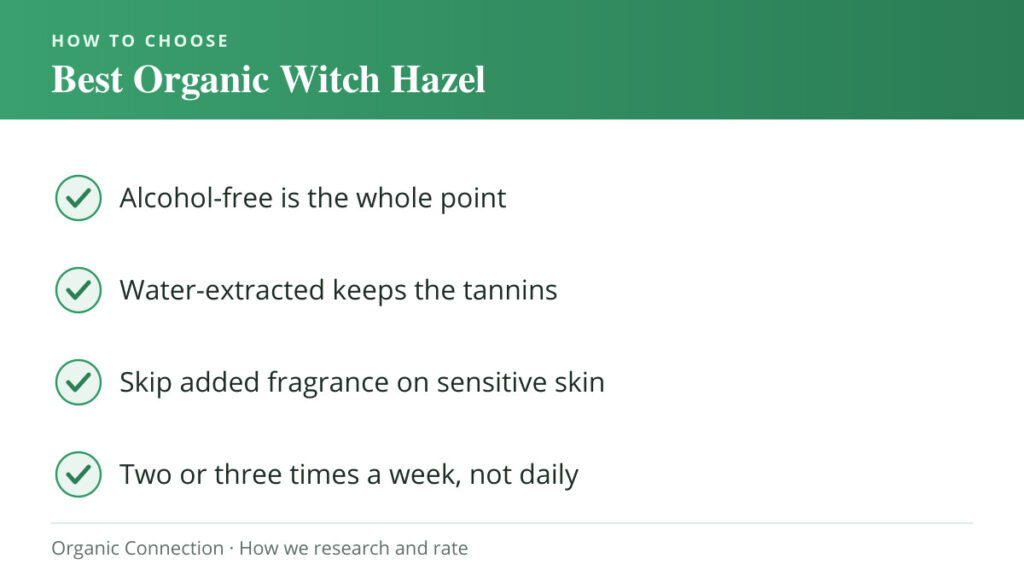
How to choose organic witch hazel
- Buy alcohol-free. If the front of the bottle does not say so, assume it is not.
- Look for water extraction, which retains the tannins that distillation destroys.
- Check the organic claim applies to the witch hazel, not just to added aloe.
- Choose unscented unless you specifically want a scent and know you tolerate it.
- Start two or three times a week, not twice daily, and build up only if your skin is happy.
Who should buy organic witch hazel
The right bottle depends on your skin and your use. If you want the gentlest certified organic option for daily facial toning, our top pick fits. If you want the best cost per ounce, a scented version, a non-distilled formula, or a bulk supply, we have a pick for each.
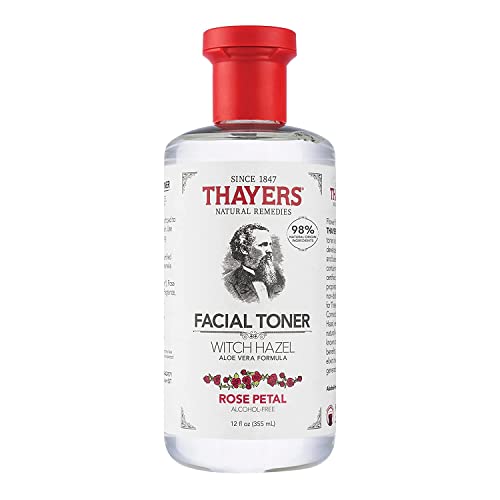
Best overall: Thayers Alcohol-Free Rose Petal Witch Hazel Toner, 12 oz
| Organic Integrity Score | 88 / 100 |
| Key ingredients | Certified organic witch hazel, rose water, aloe vera |
| Certification | Certified Organic |
| Best for | Normal to combination skin that tolerates fragrance |
This is the version most people actually buy, and for good reason: the rose makes it a genuinely pleasant thing to use, which matters for a step you are meant to do daily. It is the same alcohol-free, water-extracted certified organic witch hazel base with rose water added, plus aloe. If you like rose and your skin is not reactive, it is the more enjoyable product and works identically.
The trade-off is the fragrance itself. Any added scent raises the chance of irritation, and on genuinely sensitive, eczema-prone, or compromised skin the unscented version is the better choice. The rose here is also a scent addition rather than a meaningful dose of rose hydrosol, so do not buy it expecting the benefits of a dedicated rose water.
What we liked: The same certified organic alcohol-free base with a pleasant rose scent that makes daily use easy.
Keep in mind: Added fragrance raises irritation risk, and the rose is cosmetic rather than a functional dose.
What the listing discloses: THAYERS leaves the basics open, including whether the USDA seal applies and where it was grown or made.
Best value: Quinn’s Alcohol-Free Witch Hazel with Aloe Vera, 16 oz Unscented
| Organic Integrity Score | 87 / 100 |
| Key ingredients | Witch hazel, certified organic aloe vera |
| Certification | Certified Organic |
| Best for | Generous everyday use on face and body |
Quinn’s makes an interesting technical choice: its witch hazel is not distilled, which means the tannins that steam distillation destroys are retained, giving a product with more actual plant material than most. It is alcohol-free, contains certified organic aloe vera, and is free of parabens and propylene glycol. At 16 oz it is a third more product than the Thayers bottles at a comparable or lower price, which makes it the pick if you use witch hazel liberally, on the body as well as the face.
The trade-off on certification: the organic claim here is on the aloe vera rather than on the witch hazel itself, which is a weaker claim than Thayers makes, and it is the reason this sits third despite the good extraction approach. It is a well-made, sensibly formulated product, and if a USDA organic seal on the witch hazel specifically is your priority, the top two are the better buy.
What we liked: Non-distilled so tannins are retained, alcohol-free, certified organic aloe, and a third more product for the money.
Keep in mind: The organic certification applies to the aloe, not to the witch hazel itself.
What the listing discloses: Quinn’s is thin on detail, and does not say whether the USDA seal applies and where it was grown or made.
Non-distilled with rose: Quinn’s Rose Petal Alcohol-Free Witch Hazel, 16 oz
| Organic Integrity Score | 86 / 100 |
| Key ingredients | Witch hazel, certified organic aloe vera, rose |
| Certification | Certified Organic |
| Best for | Buyers who want scent and volume together |
The same non-distilled, alcohol-free Quinn’s formula with a delicate rose scent, in a 16 oz bottle. It is the largest scented option here and the cheapest per ounce of the scented products, which makes it a sensible buy if you have found that you like a rose toner and are getting through it quickly. The scent is lighter and less sweet than Thayers Rose Petal, which some people much prefer.
It scores below the unscented Quinn’s for the same reason the Thayers rose sits below the Thayers unscented: added fragrance is the most common irritant in toners, and on reactive skin it is an unnecessary risk. The organic certification again applies to the aloe rather than the witch hazel.
What we liked: Non-distilled alcohol-free witch hazel with a lighter rose scent, and the best value of the scented options.
Keep in mind: Fragrance raises irritation risk, and organic certification covers the aloe only.
What the listing discloses: Quinn’s leaves the basics open, including whether the USDA seal applies and where it was grown or made.
Daily facial toning: Humphreys Witch Hazel Nourishing Toner with Aloe, 8 oz
| Organic Integrity Score | 85 / 100 |
| Key ingredients | Certified organic witch hazel extract, aloe vera |
| Certification | Vegan, Organic |
| Best for | Daily facial toning, including sensitive skin |
Thayers remains a sound option because it is the brand that did the two things that matter in this category. It uses its own USDA certified organic witch hazel, hand-picked and extracted with water only rather than alcohol, which preserves the tannins that steam distillation destroys. And it leaves the alcohol out entirely, blending with aloe vera instead, so the toner soothes rather than strips. The unscented version adds no fragrance at all, which makes it the safest option for reactive skin. It is dermatologist tested and made with 98% natural origin ingredients.
The trade-off is that it is not a purist single-ingredient product: it contains aloe, glycerin, and a preservative system, which is what makes it stable and pleasant but means it is a formulated toner rather than plain witch hazel. It is also priced above drugstore witch hazel, though it is a different product. Some long-time users have noted formulation changes since the brand was acquired.
What we liked: USDA certified organic witch hazel, water-extracted so tannins survive, genuinely alcohol-free, no fragrance, and aloe rather than alcohol as the base.
Keep in mind: A formulated toner rather than pure witch hazel, and priced above drugstore bottles.
What the listing discloses: Beyond the organic claim itself, Humphreys does not say whether the USDA seal applies and where it was grown or made.
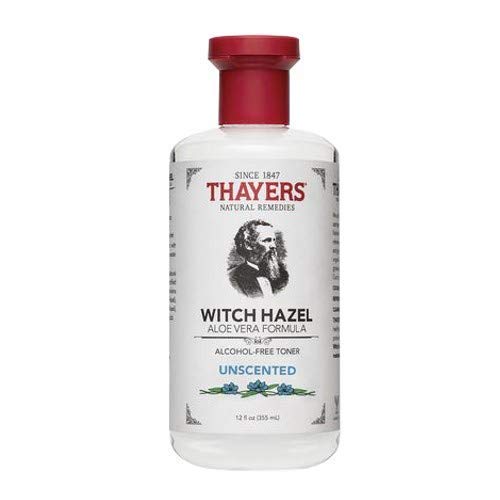
Best for bulk: Thayers Alcohol-Free Unscented Witch Hazel, 12 oz 3-Pack
| Organic Integrity Score | 72 / 100 |
| Key ingredients | Certified organic witch hazel extract, aloe vera |
| Certification | Not stated on the listing |
| Best for | Households, or anyone using it beyond the face |
Three bottles of our top pick, which brings the cost per ounce down and makes sense if witch hazel is a fixture in your household. Beyond facial toning it is genuinely useful for razor burn, after sun, insect bites, and postpartum care, so a household that uses it for those things gets through it faster than a face-only user expects. Each bottle stays sealed until opened.
It scores lowest here purely on commitment. Buying three bottles of a toner you have not established suits your skin is a poor bet, particularly on a product where a meaningful minority find even alcohol-free witch hazel too astringent for daily use. Buy one bottle, use it for a month, and then buy the three-pack if it is working.
What we liked: Our top-pick formula at a better rate per ounce, in individually sealed bottles.
Keep in mind: A large commitment to a product that does not suit everyone; try one bottle first.
What the listing discloses: No organic certification appears anywhere on the THAYERS listing.
How to use witch hazel without overdoing it
Less than you think, less often than you think. The most common mistake is treating witch hazel as a multiple-times-daily cleansing step, usually in pursuit of clearer skin, and that is the pattern most likely to backfire. Even alcohol-free witch hazel is astringent, and over-use disrupts the skin barrier, which can leave you oilier and more irritated than when you started. Start at two or three times a week, in the evening, and increase only if your skin stays comfortable.
To use it as a toner: cleanse, then apply witch hazel on a cotton pad or press it in with clean hands, then follow with a moisturizer or facial oil while the skin is still slightly damp. That last step matters. An astringent alone leaves skin tighter and drier, and the point is to calm and prep, not to strip and stop.
Its best uses are arguably not on the face at all. It is excellent on razor burn after shaving, on insect bites, on minor sunburn, and it is a standard recommendation for hemorrhoids and for postpartum perineal care, usually applied to pads. In all of those it earns its long reputation more clearly than it does as a facial toner.
Store it somewhere cool and out of direct sun, keep the cap on, and check the date, since alcohol-free formulas rely on gentler preservative systems than the traditional 14% alcohol bottle did. Patch test on your inner arm before first facial use. And if you are treating acne specifically, be honest with yourself about whether witch hazel is doing anything: if there is no improvement after a month, the answer is a salicylic acid or benzoyl peroxide product, not more witch hazel.
How we researched this guide
We are a research-based review site. We compared each product against alcohol content, extraction method and tannin retention, whether organic certification applies to the witch hazel itself or only to supporting botanicals, added fragrance and preservative systems, packaging, volume and value, and the weight of aggregated customer feedback on stinging and dryness, then scored each with our 10-criteria Organic Integrity Score. No brand paid to be included or ranked. This page is informational and is not medical advice; persistent acne or skin conditions should be discussed with a dermatologist. Read the full method on our How We Research and Rate page.
Common questions about organic witch hazel
What is the best organic witch hazel toner?
Our overall pick is Thayers Alcohol-Free Unscented Witch Hazel Toner, because it uses the brand’s own USDA certified organic witch hazel extracted with water rather than alcohol, so the tannins survive, and blends it with aloe vera with no added fragrance. For the best value, Quinn’s Alcohol-Free Witch Hazel, and for a scented version, Thayers Rose Petal.
Why should witch hazel be alcohol-free?
Because the standard drugstore bottle is preserved with up to 14% isopropyl or ethyl alcohol, and that alcohol is what makes skin feel tight and squeaky. Over time it strips the skin barrier, which often leads to more oil production and more irritation. The witch hazel itself is not the problem; the alcohol it is usually dissolved in is.
Does witch hazel help with acne?
Weakly, and it is commonly oversold for this. It can temporarily reduce the appearance of inflammation, but it does not kill acne bacteria or clear blocked pores. Used several times a day, especially in alcohol-based form, it frequently makes acne worse by damaging the barrier. Salicylic acid or benzoyl peroxide are the appropriate products for acne.
Does witch hazel shrink pores?
Not permanently. Astringents cause a temporary tightening of the skin around the pore, which makes pores look smaller for a few hours, and then it reverses. Pore size is largely genetic. Any product claiming to permanently shrink pores is overselling, whatever its ingredients.
Can you use witch hazel every day?
Some people can, many should not. Even alcohol-free witch hazel is astringent, and daily use on dry, sensitive, or already-compromised skin is often too much. Start two or three times a week in the evening, always follow with a moisturizer, and increase only if your skin stays comfortable.
- Organic Skincare & Beauty hub
- Best Organic Rose Water
- Best Organic Rosehip Oil
- Organic Skincare 101: How to Read Labels
- our full product index — search by brand, product or certification
Price and availability as of October 12, 2026 1:10 am EDT. Product prices and availability are accurate as of the date/time indicated and are subject to change. Any price and availability information displayed on Amazon.com at the time of purchase will apply to the purchase of this product.
Looking for other organic products?
We have checked more than 800 products across food, household goods, gardening, personal care and pet, every one against its stated certification. Browse all reviews.
Organic Connection is reader-supported. When you buy through links on this page we may earn a commission, at no extra cost to you. As an Amazon Associate we earn from qualifying purchases. We are not paid to feature or rank any product. This page is informational and is not medical advice. How we research and rate.