Last updated: September 11, 2026
We may earn a commission when you buy through links on this page, at no extra cost to you. How we research and rate.
The short version
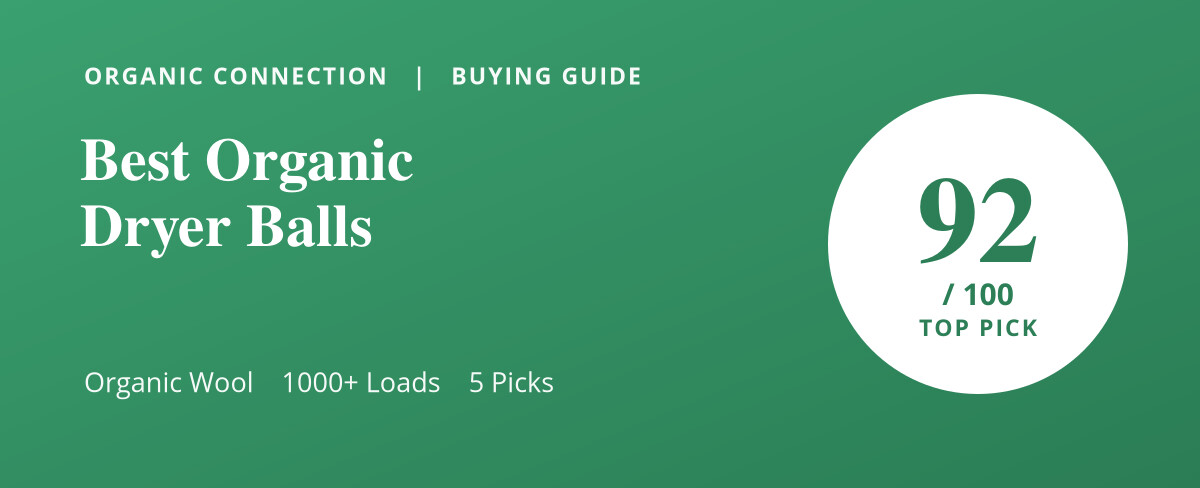
After researching the wool sourcing, construction, and durability of the most popular organic wool dryer balls, our top pick is Friendsheep Organic Wool Dryer Balls, 6 Pack XL. They are handcrafted in Nepal from organic New Zealand wool under fair trade conditions, are cruelty-free and rated for over 1,000 loads, which is why they earned our highest Organic Integrity Score of 81 out of 100. For the best value, Smart Sheep 6-Pack XL is our pick, and on a budget, Handy Laundry 6-Pack is the best choice.
Wool dryer balls are one of the few genuinely good swaps in a laundry room, and they are also routinely oversold on claims that do not hold up. We flag each product’s wool source, size, and construction.
Best organic wool dryer balls compared
| Best Choice | Best Value | ||||
 |  |  |  |  | |
| Product | Friendsheep 6 Pack XL | Friendsheep Penguin 6 XL | Ecoigy 6-Pack XL | Handy Laundry 6-Pack | Smart Sheep 6-Pack XL |
| Organic Integrity Score | 81/ 100 | 80/ 100 | 79/ 100 | 78/ 100 | 77/ 100 |
| Our rating | 4.1 | 4.0 | 4.0 | 3.9 | 3.9 |
| Wool | Organic New Zealand | Organic New Zealand | New Zealand | Wool | New Zealand |
| Best for | Best overall | Decorative set | Mid-price pick | Best budget | Best value |
| Fair trade | Yes, handmade Nepal | Yes, handmade Nepal | Family business | Not stated | Handmade |
| Certification | Fair Trade, Organic | Fair Trade, Organic | — | Not stated on the listing | Not stated on the listing |
| Material | Organic New Zealand wool, solid core | Organic New Zealand wool, solid core | 100% pure New Zealand wool | Wool | 100% premium New Zealand wool |
| Price | $42.00 View on Amazon | $42.00$7.00 / count View on Amazon | $12.97$2.16 / count View on Amazon | $12.99$2.17 / count View on Amazon | $19.95$3.33 / count View on Amazon |
Price and availability as of October 11, 2026 7:10 pm EDT. Product prices and availability are accurate as of the date/time indicated and are subject to change. Any price and availability information displayed on Amazon.com at the time of purchase will apply to the purchase of this product.
Scores are ours, based on independent research of wool sourcing and organic status, construction and density, size, fair trade and cruelty-free credentials, durability claims, and value, using the same 10-criteria method we apply to every product. See how we research and rate.
Key things to look for in organic wool dryer balls
Good dryer balls come down to wool quality, density, size, and ethics. Here is what matters.
1. 100% wool all the way through
No plastic or foam core, no synthetic filler. If the listing does not say solid wool core, assume it is not.
2. XL size
Smaller balls lack the mass to separate a full load. XL, roughly tennis to baseball size, is what you want.
3. Stated wool origin
New Zealand wool is the benchmark for this use. A named origin usually means a deliberate choice rather than a commodity buy.
4. Fair trade and cruelty-free claims
These are handmade products from wool-producing regions, so labor conditions and animal welfare are relevant and checkable.
What dryer balls actually do, and what they do not
This is a product with real but modest benefits and unusually inflated marketing, so it is worth separating the two.
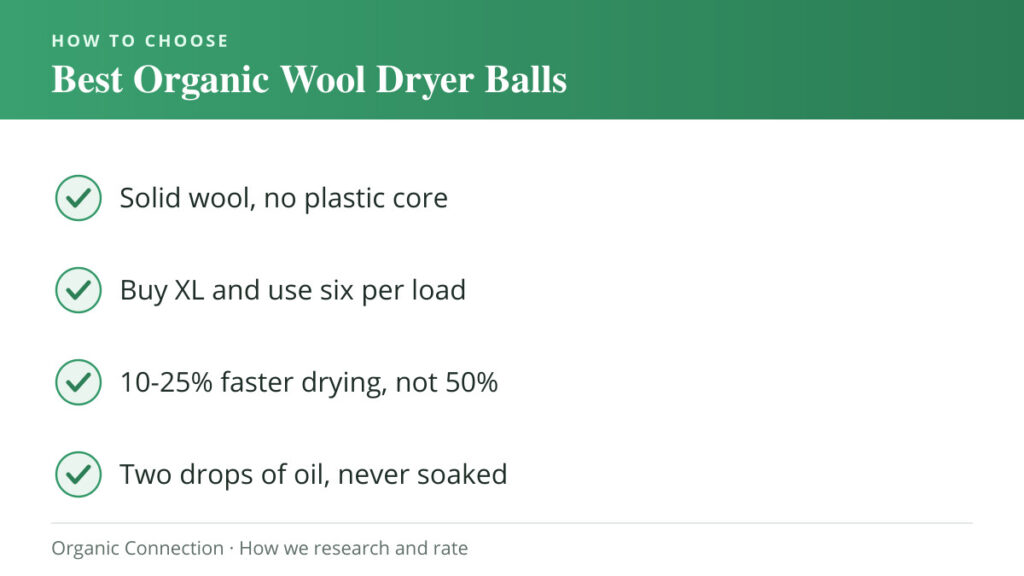
What they genuinely do. They physically separate laundry in the drum so hot air reaches more fabric, which does reduce drying time. Realistic figures are around 10 to 25% on a typical load, more on bulky items like towels and duvets where clumping is worst. They soften fabric mechanically by tumbling against it. They reduce wrinkling somewhat. And they replace dryer sheets and liquid softener entirely, which is the substantive win: conventional fabric softener works by coating fibers in a waxy residue, which reduces towel absorbency and gradually degrades the wicking of technical fabrics, and dryer sheets add fragrance chemicals to every load.
What is overstated. The claims of 40 to 50% drying time reduction are not realistic in normal use. Static reduction is genuinely mixed: wool balls help in moderately humid conditions but in very dry air or with heavy synthetic loads they can make static slightly worse, because tumbling wool against polyester generates charge. If static is your main problem, the more effective fix is to stop over-drying, since bone-dry synthetics are what generate it.
The essential oil question. Almost every listing suggests adding essential oils to scent your laundry. Be careful with this. Undiluted essential oil on wool goes into the drum with hot air and fabric, and oil residue on fabric is a genuine fire consideration in a dryer, particularly on towels that then sit in a warm pile. If you do it, use two or three drops on a ball, let it dry completely before it goes near clothes, and never soak the ball. The scent fades within a few loads anyway.
Wool sensitivity. Lanolin-sensitive people occasionally react to wool-dried laundry. It is uncommon, and worth knowing if you have unexplained skin irritation after switching.
What they actually save you, in money and time
Dryer balls are cheap enough that the maths is worth doing, because the payback is faster than most eco swaps.
| Factor | Dryer sheets or liquid softener | Wool dryer balls |
| Cost per load | Ongoing, every load, forever | One purchase, 1,000+ loads |
| Lifespan | Single use | Roughly 3 to 5 years at typical use |
| Drying time | No reduction | Roughly 10% to 25% shorter |
| Effect on towels | Waxy coating reduces absorbency over time | None; absorbency preserved |
| Technical fabrics | Coating degrades wicking | Safe |
| End of life | Landfill | Compostable, being pure wool |
The towel point deserves emphasis, because it is the argument that converts people who do not care about the environmental case. Liquid fabric softener works by depositing a waxy cationic coating on fibers. That is what makes fabric feel soft, and it is also what makes towels progressively less absorbent and what clogs the wicking structure of sports and technical fabrics. If your towels have stopped drying you properly, softener is the usual culprit. Wool balls soften mechanically instead, by tumbling against the fabric, so nothing is deposited.
On the energy saving. A 10% to 25% reduction in drying time is a real but modest saving, and it compounds over years of use. The larger and less glamorous saving is simply not buying a consumable every month.
How to choose organic wool dryer balls
- Confirm solid wool throughout, with no plastic or foam core.
- Buy XL, and buy six rather than three for full loads.
- Prefer a stated wool origin, with New Zealand wool the benchmark.
- Check for fair trade and cruelty-free claims on a handmade product.
- Judge by density. A good ball feels heavy and hard, not squashy.
Who should buy organic wool dryer balls
The right set depends on your priorities. If you want the best ethics and construction, our top pick fits. If you want the best-known brand at a fair price, a mid-priced alternative, a decorative set, or the cheapest functional option, we have a pick for each.
Best overall: Friendsheep Organic Wool Dryer Balls, 6 Pack XL
| Organic Integrity Score | 81 / 100 |
| Material | Organic New Zealand wool, solid core |
| Certification | Fair Trade, Organic |
| Best for | Buyers who want ethics and durability together |
Friendsheep is our top pick because it is the option where the ethics are as substantive as the product. The balls are handcrafted in Nepal under fair trade conditions from organic New Zealand wool, they are cruelty-free, and the packaging is plastic-free, which matters on a product whose entire purpose is reducing waste. Construction is genuinely dense: solid felted wool through the core, XL sized, and rated for over 1,000 loads, which at four loads a week is roughly five years. In practice they hold their shape rather than compressing flat.
The trade-off is price, and it is a real gap: Friendsheep costs noticeably more than the mass-market sets. The decorative felted faces on the “Flock of Friends” design are charming to some buyers and irrelevant to others who would rather pay less for plain balls. Like all wool balls, they shed a little fuzz for the first few loads before settling.
What we liked: Organic New Zealand wool, genuine fair trade handmade production, plastic-free packaging, dense solid construction, and 1,000+ load durability.
Keep in mind: Clearly the most expensive set here, and some initial fuzz shedding.
What the listing discloses: Friendsheep lists Fair Trade. The gap is whether the USDA seal applies and where it was grown or made.
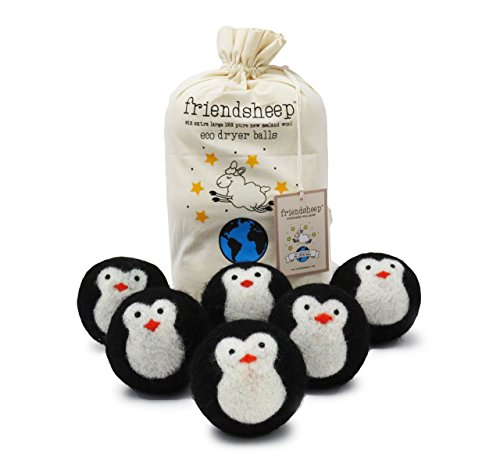
Best decorative set: Friendsheep Wool Dryer Balls, Black Penguin 6 Pack XL
| Organic Integrity Score | 80 / 100 |
| Material | Organic New Zealand wool, solid core |
| Certification | Fair Trade, Organic |
| Best for | Gifts and households with children |
The same organic wool, fair trade, plastic-free Friendsheep product in a decorated penguin design. Functionally identical to our top pick, and the reason it earns a place is that these make genuinely good gifts and they get children interested in helping with laundry, which is a small thing but a real one. Hypoallergenic and cruelty-free like the rest of the range.
It scores lower than the plain set only because the decoration adds cost without adding function, and because the felted facial details are the part most likely to wear or fuzz over hundreds of hot cycles. The wool underneath is the same quality, so this is a cosmetic judgement rather than a quality one.
What we liked: Identical organic fair trade wool quality with a design that makes a good gift.
Keep in mind: You pay a premium for decoration, and the felted details wear before the ball does.
What the listing discloses: Friendsheep commits to Fair Trade but stops short of whether the USDA seal applies and where it was grown or made.
Mid-price pick: Ecoigy Wool Dryer Balls XL, 6-Pack
| Organic Integrity Score | 79 / 100 |
| Material | 100% pure New Zealand wool |
| Certification | — |
| Best for | Buyers who want a solid set without the premium |
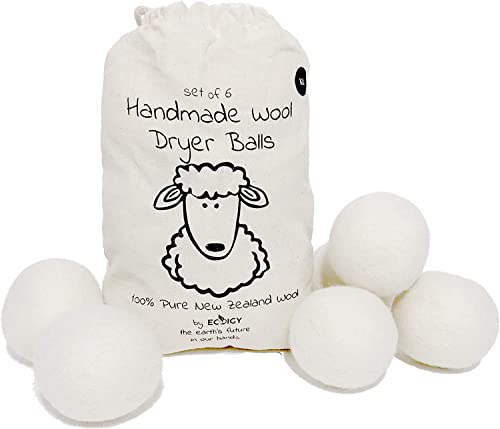
Ecoigy is a small family business in Michigan selling dense XL balls made from 100% pure New Zealand wool with no synthetic filler. They perform essentially as well as the better-known brands at a slightly lower price, they reduce wrinkles and drying time as expected, and buyers report good longevity. If you want something between the budget sets and the fair trade premium, this is a sensible middle.
The trade-off is again certification: no organic seal, no fair trade audit, and less published detail about how and where the balls are made than either Friendsheep or Smart Sheep offer. The listings also lean heavily on the essential oil use case, which we would treat with the caution described above.
What we liked: Dense pure New Zealand wool, XL sizing, small-business sourcing, and good value below the premium brands.
Keep in mind: No organic or fair trade certification and limited published production detail.
What the listing discloses: Ecoigy states a single-ingredient formula, and does not say whether the USDA seal applies and where it was grown or made.
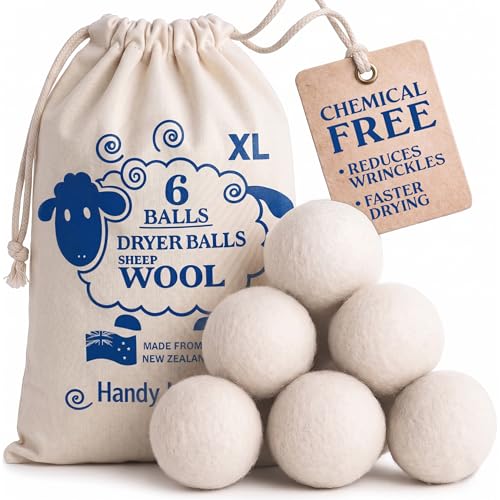
Best budget: Handy Laundry Wool Dryer Balls, 6-Pack
| Organic Integrity Score | 78 / 100 |
| Material | Wool |
| Certification | Not stated on the listing |
| Best for | Trying dryer balls at minimal cost |
The cheapest functional entry point. Six reusable wool balls that do the basic job of separating laundry, cutting drying time, and letting you stop buying dryer sheets and liquid softener. If you are unconvinced that dryer balls are worth anything and want to test the idea for the price of a couple of boxes of sheets, this is a reasonable way to do it.
It scores lowest for straightforward reasons. There is no stated wool origin, no organic certification, and no fair trade claim, and the balls are less densely felted than the premium sets, which shows up as faster compression and more shedding over time. They are also smaller than the true XL options, which reduces how well they separate a heavy load. Expect a shorter life and treat them as a trial rather than a decade-long purchase.
What we liked: The lowest-cost way to stop buying dryer sheets, and they do the basic job.
Keep in mind: No stated origin or certification, less dense, smaller, and shorter-lived than the premium sets.
What the listing discloses: Handy Laundry makes no organic claim anywhere, so the case rests on the other claims it does make.
Best value: Smart Sheep Wool Dryer Balls, 6-Pack XL
| Organic Integrity Score | 77 / 100 |
| Material | 100% premium New Zealand wool |
| Certification | Not stated on the listing |
| Best for | Most households |
Smart Sheep is the best-known name in this category and the most sensible default buy. The balls are 100% premium New Zealand wool with no synthetic filler or core, XL sized, handmade, and rated for more than 1,000 loads. They are dense, heavy, and hold their shape well, and they cost meaningfully less than the fair trade options. For a household that simply wants to stop buying dryer sheets, this is the straightforward answer.
The trade-off is on certification and provenance. Smart Sheep does not carry an organic certification on the wool or a fair trade claim on the labor, so you are relying on the material specification rather than an audited standard. That is a genuine step down from our top pick even though the physical product is very close.
What we liked: Dense 100% New Zealand wool with no filler, XL sizing, long rated life, and clearly the best quality-to-price ratio here.
Keep in mind: No organic certification on the wool and no fair trade claim on production.
What the listing discloses: The word organic does not appear on the Smart Sheep listing at all.
How to get the most out of wool dryer balls
Use enough of them. This is the single most common mistake: three balls in a full load of towels does very little. Six XL balls is right for a standard load, and for a large or bulky load, a duvet or a full basket of towels, use all six and consider more. The balls work by physically getting between items, so quantity matters more than any other variable.
Expect a break-in period. New wool balls shed a small amount of fuzz for the first three or four loads, which is normal and stops. Run them with towels first rather than with dark clothing, and if fuzz bothers you, a quick run in the dryer on their own knocks the loose fibers off.
On static, be strategic. Wool balls help in normal conditions and can make things marginally worse with heavy synthetic loads in very dry air. The real fix is to stop over-drying: pull laundry out slightly damp and let it finish in the air. Bone-dry synthetics tumbling against each other is what generates charge, and no dryer ball solves that. A damp hand-towel thrown in for the last few minutes also works.
If you want scent, use two or three drops of essential oil on a ball, let it dry fully before running a load, and accept the fragrance will fade within a few cycles. Never saturate the wool with oil. When the balls eventually go soft and start to look shaggy, usually after several years, they can go in the compost, since they are pure wool. If they become genuinely grubby, wash them inside a sock on a hot cycle and tumble dry, which re-felts them and firms them up again.
How we researched this guide
We are a research-based review site. We compared each product against wool sourcing and stated origin, organic certification where claimed, construction density and whether the core is solid wool or filled, size, fair trade and cruelty-free credentials, packaging materials, rated and reported lifespan, and the weight of aggregated customer feedback on shedding and shape retention, then scored each with our 10-criteria Organic Integrity Score. No brand paid to be included or ranked. Read the full method on our How We Research and Rate page.
Common questions about organic wool dryer balls
What are the best organic wool dryer balls?
Our overall pick is Friendsheep Organic Wool Dryer Balls, because they are handcrafted in Nepal under fair trade conditions from organic New Zealand wool, are cruelty-free with plastic-free packaging, densely felted with a solid wool core, and rated for over 1,000 loads. For the best value, Smart Sheep 6-Pack XL, and on a budget, Handy Laundry.
Do wool dryer balls actually reduce drying time?
Yes, modestly. Realistic reductions are around 10 to 25% on a typical load, and more on bulky items like towels and duvets where laundry clumps most. Claims of 40 to 50% are not realistic in normal use. They work by physically separating laundry so hot air circulates, which is why using six rather than three matters.
Do wool dryer balls cause static?
It depends on conditions. They usually help in normal humidity, but with heavy synthetic loads in very dry air they can make static slightly worse, because tumbling wool against polyester generates charge. The more effective fix is to stop over-drying, since bone-dry synthetics are the main cause of static.
How long do wool dryer balls last?
Good ones are rated for over 1,000 loads, which at four loads a week is roughly five years. Density is what determines this: solid, hard-felted balls hold their shape, while cheap ones with loose or synthetic cores compress flat within months. When they finally go soft, pure wool balls can be composted.
Can you put essential oils on wool dryer balls?
You can, with care. Use only two or three drops per ball, let the ball dry completely before it goes in with clothes, and never saturate the wool, since oil residue on fabric in a hot dryer is a genuine fire consideration. The scent fades within a few loads regardless, so expectations should be modest.
- Organic Household & Cleaning hub
- Best Natural Laundry Detergent
- Best Organic Castile Soap
- The Non-Toxic Home: Cleaning Room by Room
- all our reviewed products in one place — sortable by Organic Integrity Score
Price and availability as of October 11, 2026 7:10 pm EDT. Product prices and availability are accurate as of the date/time indicated and are subject to change. Any price and availability information displayed on Amazon.com at the time of purchase will apply to the purchase of this product.
Looking for other organic products?
We have checked more than 800 products across food, household goods, gardening, personal care and pet, every one against its stated certification. Browse all reviews.
Organic Connection is reader-supported. When you buy through links on this page we may earn a commission, at no extra cost to you. As an Amazon Associate we earn from qualifying purchases. We are not paid to feature or rank any product. How we research and rate.