Last updated: September 30, 2026
We may earn a commission when you buy through links on this page, at no extra cost to you. How we research and rate.
The short version
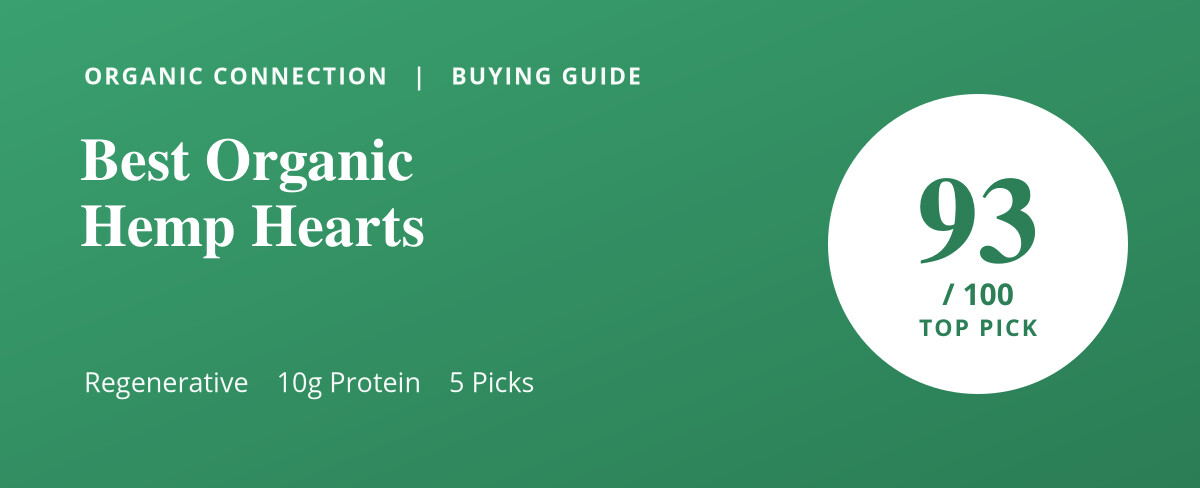
After researching the certifications, sourcing, and processing of the most popular organic hemp hearts, our top pick is Manitoba Harvest Regenerative Organic Certified Hemp Hearts, 12 oz. It carries Regenerative Organic Certification, which is USDA organic plus audited soil health, animal welfare, and farmworker fairness, and delivers 10 g of complete plant protein per 30 g serving, which is why it earned our highest Organic Integrity Score of 93 out of 100. For the best value, the 18 oz bag is our pick, and for bulk, the 5 lb is the best choice.
Hemp hearts are one of the few genuinely easy nutrition wins in a pantry, and the category is dominated by a single producer for reasons that turn out to be legitimate. We flag each product’s certification, size, and format.
Best organic hemp hearts compared
| Best Choice | Best Value | ||||
 |  |  |  |  | |
| Product | Regenerative Organic 12 oz | Manitoba Harvest 18 oz | Terrasoul 2 lb x2 | 365 Organic 12 oz | Yupik Canadian 1 lb |
| Organic Integrity Score | 93/ 100 | 90/ 100 | 88/ 100 | 86/ 100 | 80/ 100 |
| Our rating | 4.7 | 4.5 | 4.4 | 4.3 | 4.0 |
| Certification | Non-GMO Project Verified, Regenerative Organic, Kosher | USDA Organic, Non-GMO Project Verified, Kosher | USDA Organic, Non-GMO, Gluten-free | USDA Organic, Non-GMO, Kosher | Gluten-free, Vegan, Organic |
| Best for | Best overall | Best value | Bulk | Own-brand value | Named origin |
| Price | $19.94$1.66 / ounce View on Amazon | $17.08$0.95 / ounce View on Amazon | $29.99$0.94 / ounce View on Amazon | $12.28$1.02 / ounce View on Amazon | $14.84$0.93 / ounce View on Amazon |
Price and availability as of October 11, 2026 7:10 pm EDT. Product prices and availability are accurate as of the date/time indicated and are subject to change. Any price and availability information displayed on Amazon.com at the time of purchase will apply to the purchase of this product.
Scores are ours, based on independent research of certification level, sourcing and soil practices, hulling quality, packaging, freshness handling, and price per pound, using the same 10-criteria method we apply to every product. See how we research and rate.
What each certification on an organic hemp hearts label actually covers
The labels on these products are not interchangeable, and several of them cover things that have nothing to do with each other. Here is what each one actually buys you.
| Certification | Covers | Key exclusion |
| USDA Organic | Farming and handling: no synthetic pesticides or fertilizers, no GMOs, no sewage sludge or irradiation, audited yearly by an accredited certifier | Three different tiers share the one seal, and it makes no claim about worker pay, food miles, or nutrition |
| Non-GMO Project | Testing and supply-chain traceability showing the ingredients are not genetically engineered | Sets no limit on synthetic pesticides or fertilizers, so it is not an organic claim |
| Regenerative Organic | Soil health, animal welfare and farmworker fairness, built on top of an existing organic certification | Requires organic certification as its baseline, so it is an addition to the USDA seal and never a replacement for it |
| Kosher | Ingredients and production comply with Jewish dietary law, verified by a rabbinic agency that inspects the facility | A dietary-law standard: it makes no claim about pesticides, GMOs or farming practice |
Non-GMO and organic are not two grades of the same thing. The butterfly certifies an absence of genetic engineering and stops there; the USDA seal prohibits genetic engineering as one clause among many, alongside synthetic pesticides, synthetic fertilizers, sewage sludge and irradiation. That makes organic the broader claim by some distance. Where both appear together, the butterfly is adding batch testing on top of a standard that had already banned GMOs.
Hemp hearts nutrition, and the omega ratio that stands out
| Per 3 tbsp (about 30 g) | Amount |
| Protein | About 9 to 10 g, complete |
| Polyunsaturated fat | About 15 g |
| Magnesium | About 250 mg |
| Zinc | About 3 mg |
| Iron | About 2 mg |
| Omega-6 to omega-3 ratio | Roughly 2:1 to 3:1 |
The magnesium figure is the underrated one. Around 250 mg in three tablespoons is a substantial share of a day’s requirement from a single spoonable ingredient, and magnesium is one of the more commonly under-consumed minerals. Protein makes up roughly a quarter of hemp hearts’ calories, which is high for a seed.
Why the omega ratio matters. Hemp hearts sit at roughly 2:1 to 3:1 omega-6 to omega-3, which is unusually favorable. Typical Western diets run far higher, often cited around 15:1 or worse, driven by refined seed oils in processed food. Hemp is one of very few foods that supplies meaningful amounts of both linoleic acid and alpha-linolenic acid in something close to the proportions commonly recommended. The same ALA caveat as flaxseed applies: ALA converts to EPA and DHA at a low rate, so hemp is not a replacement for oily fish or an algal supplement.
Hearts versus whole seed. Hemp hearts are the hulled kernel, so they lose most of the fiber that the intact shell provides while keeping essentially the same protein, fat, and mineral content. If fiber is what you are after, whole hemp seed or another seed serves you better.
Key things to look for in organic hemp hearts
Good hemp hearts come down to certification, freshness, hulling quality, and packaging. Here is what matters.
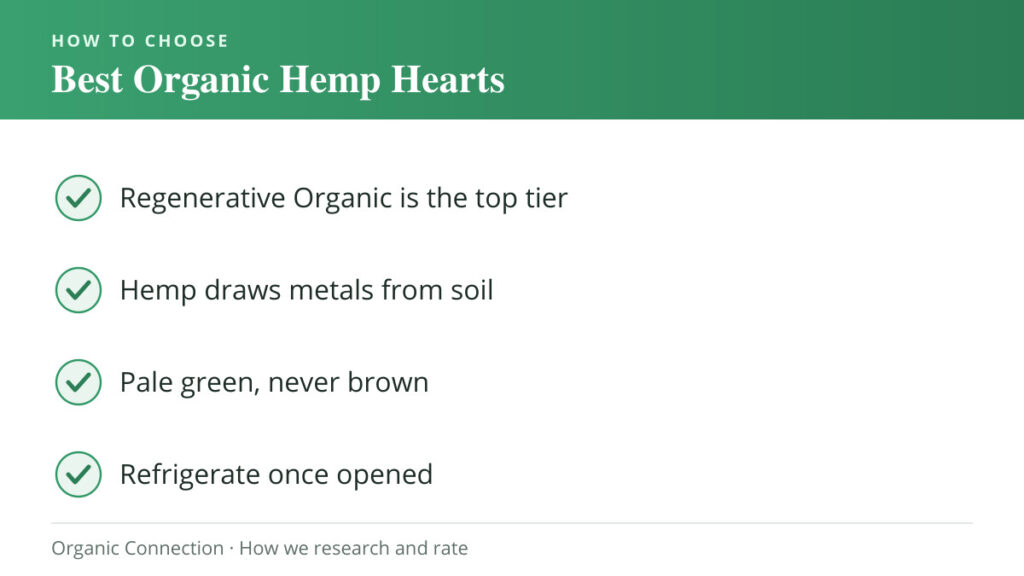
1. USDA organic, ideally Regenerative Organic Certified
Hemp is a bioaccumulator that draws contaminants from soil readily, which makes where and how it was grown genuinely important.
2. Pale green color, not brown
Fresh hemp hearts are creamy white to pale green. Browning or gray tones indicate oxidation and age.
3. Clean hulling
Good hearts are soft throughout. Gritty or crunchy bits mean shell fragments left in from sloppy dehulling.
4. Resealable, opaque packaging
Hemp hearts are high in polyunsaturated fat and go rancid quickly. A resealable opaque bag beats a clear tub.
Why hemp is worth buying organic specifically
The case for organic certification is stronger here than for most seeds, and it is a soil argument rather than a pesticide one.
Hemp is a bioaccumulator. The plant is unusually efficient at drawing substances out of soil and concentrating them in its tissue, which is precisely why it has been studied and used for phytoremediation, the practice of planting crops to clean contaminated ground. That property is excellent when you want to clean soil and less appealing when you want to eat the seed. Heavy metals, particularly cadmium and lead, are the specific concern, and they come from the soil rather than from spraying. Organic certification does not directly test for heavy metals, but it does require documented land history and prohibits many soil amendments that carry contaminants, which meaningfully shifts the odds.
Regenerative Organic Certification goes further. ROC requires organic certification as a baseline, then audits soil health practices, animal welfare, and farmworker fairness on top. For a crop where soil quality directly affects what ends up in the seed, that is a more relevant certification than most, and it is the reason our top pick sits where it does.
The nutrition is genuinely good, without needing exaggeration. Complete protein at around 10 g per 30 g serving is legitimately impressive for a plant food. The omega ratio is favorable. What is worth stating plainly is the same caveat that applies to flaxseed: hemp’s omega-3 is alpha-linolenic acid, which the body converts to EPA and DHA at a low rate. Hemp hearts are an excellent food; they are not a substitute for oily fish or an algal supplement if EPA and DHA are the goal.
On THC. Hemp hearts contain no meaningful THC or CBD, since those concentrate in the flower and leaf rather than the seed kernel. Trace amounts from hull contact are possible but far too low to have any effect. The occasional story about a failed drug test relates to poorly cleaned whole seed rather than properly hulled hearts.
Heavy metals and mold: what independent testing found
Because hemp is a bioaccumulator, heavy metals are the concern people raise, and independent testing has produced a slightly surprising answer about where the real risk sits.
Heavy metals came back reassuring. ConsumerLab testing across a range of hemp seed products, including Manitoba Harvest, Bob’s Red Mill, Terrasoul, Kirkland, Trader Joe’s, and 365, found none exceeded California Prop 65 limits for lead, cadmium, arsenic, or mercury. That is a genuinely good result for the category and worth stating plainly rather than stoking anxiety.
Mold was the actual finding. The more useful result from that testing was mold contamination, which varied considerably between products. Notably, the product with the highest mold count also carried the most cadmium, around three times any other tested, which suggests general quality control rather than hemp itself being the problem.
What follows practically. Buy from brands with high turnover and good handling, check the seeds smell fresh and nutty rather than musty when you open the bag, store them refrigerated or frozen once opened, and do not buy more than you will get through in a couple of months. Mold thrives on the moisture and warmth that a bag of high-fat seeds sitting in a cupboard provides, and a musty smell is your signal to bin it.
How to choose organic hemp hearts
- Confirm USDA organic, and prefer Regenerative Organic Certified where available.
- Check the color: creamy white to pale green, not brown or gray.
- Look for a resealable opaque bag rather than a clear tub.
- Buy a size you will finish in two or three months, and refrigerate after opening.
- Compare per pound, since bag sizes vary widely and the spread is large.
Who should buy organic hemp hearts
The right bag depends on how much you eat. If you want the highest certification standard, our top pick fits. If you want the best price per pound, a bulk supply, a standard everyday bag, or a small one to try, we have a pick for each.
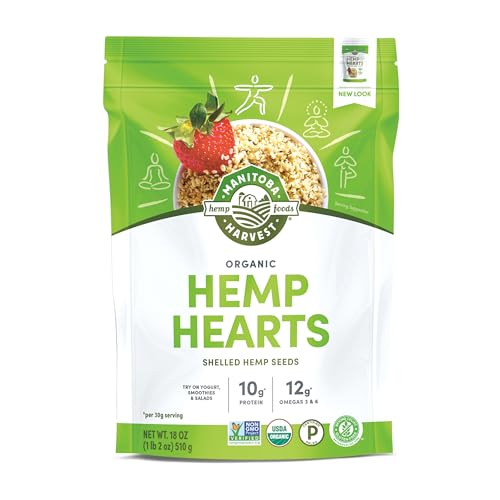
Best overall: Manitoba Harvest Regenerative Organic Certified Hemp Hearts, 12 oz
| Organic Integrity Score | 93 / 100 |
| Ingredients | Organic shelled hemp seeds |
| Certification | Non-GMO Project Verified, Regenerative Organic, Kosher |
| Best for | Anyone who wants the strictest available standard |
This is the pick because of the certification. Regenerative Organic Certified requires USDA organic as a starting point, then audits soil health, animal welfare, and farmworker fairness on top, and for a bioaccumulating crop like hemp, soil practice is not an abstract ethical nicety, it directly affects what ends up in the seed. Manitoba Harvest is the dominant hemp food producer in North America with genuine scale and consistency behind it, and the hearts are soft, pale, and clean-tasting, with 10 g of complete protein and 12 g of omegas per 30 g serving.
The trade-off is price. ROC certification costs money and it shows on the shelf, so this sits above the standard organic version of essentially the same product. Twelve ounces also disappears fast if you are putting two tablespoons on everything, and hemp hearts are perishable enough that buying larger is not automatically better.
What we liked: Regenerative Organic Certification on a crop where soil practice genuinely matters, Non-GMO verified, and consistently clean soft hulling.
Keep in mind: The highest priced option per ounce, and 12 oz goes quickly with daily use.
What the listing discloses: Manitoba Harvest commits to Non-GMO Project Verified, Regenerative Organic Certified and kosher certification but stops short of whether the USDA seal applies and where it was grown or made.
Best value: Manitoba Harvest Organic Hemp Hearts, 18 oz
| Organic Integrity Score | 90 / 100 |
| Ingredients | Organic shelled hemp seeds |
| Certification | USDA Organic, Non-GMO Project Verified, Kosher |
| Best for | Daily use in smoothies, yogurt, and salads |
Eighteen ounces is the size that matches how hemp hearts actually get used, which is a couple of tablespoons a day scattered on things, and the price per ounce is meaningfully better than the 12 oz bags. It is USDA organic and non-GMO with the same 10 g protein and 12 g omegas per serving, in a resealable bag. For most households this is the sensible default purchase.
The trade-off is the certification step down from ROC to standard USDA organic, which is a real difference on a bioaccumulator crop even though standard organic is still a solid baseline. Eighteen ounces is also enough that you will want to refrigerate it after opening rather than leaving it in a warm cupboard for two months.
What we liked: The best balance of certification, size, and price here, with a proper resealable bag.
Keep in mind: Standard USDA organic rather than Regenerative Organic, and needs refrigerating once opened.
What the listing discloses: Manitoba Harvest documents a USDA organic claim, Non-GMO Project Verified, kosher certification and Whole30 approval, and leaves where it was grown or made unsaid.
Best bulk: Terrasoul Superfoods Organic Hemp Seeds, 2 lb (2 Pack)
| Organic Integrity Score | 88 / 100 |
| Size | 2 lb x 2, four pounds in total |
| Certification | USDA Organic, Non-GMO, Gluten-free |
| Best for | Households getting through hemp hearts weekly |
The bulk option, and it solves the problem bulk usually creates. Hemp hearts are roughly half fat, much of it polyunsaturated, so a single enormous bag goes rancid before most households finish it. Two sealed 2 lb bags means the second one is not exposed to air until you open it.
The certification is stated in the regulated form — USDA Certified Organic — alongside non-GMO, raw, gluten-free and vegan. Raw is worth noting: hemp hearts are usually sold unroasted, and saying so confirms nothing was heat-treated.
Terrasoul is the brand we credited in our comparison of organic Brazil nuts for naming a kosher agency, and in rolled oats for publishing a gluten threshold in parts per million. This listing is thinner than either, at one line of certifications.
What we liked: Two sealed bags rather than one huge one, the regulated certification wording, and raw stated explicitly.
Keep in mind: A single line of claims and no macros. Refrigerate the opened bag; hemp is high in polyunsaturated fat and goes off.
What the listing discloses: Terrasoul Superfoods lists USDA organic certification. The gap is where it was grown or made.
Best own-brand value: 365 by Whole Foods Market Organic Hulled Hemp Seed, 12 oz
| Organic Integrity Score | 86 / 100 |
| Size | 12 oz |
| Certification | USDA Organic, Non-GMO, Kosher |
| Best for | The lowest price per ounce from a certified own-brand |
The cheapest bag on this page, and the listing does something own-brand copy usually does not: it enumerates. “USDA organic, non-GMO, gluten-free, kosher, and vegan certified” is five attributes in one line, each of them checkable.
Note the wording on the last one. It says vegan certified rather than just vegan, which is the stronger construction, and it is unusual to see an own-brand bother with the distinction.
What you do not get is any nutrition detail, any sourcing, or any processing description. Two bullets, one of which restates the bag size. For a single-ingredient product that is less of a gap than it would be elsewhere, and the price reflects it.
What we liked: Five certifications enumerated rather than summarized, vegan stated as certified, and the lowest price per ounce here.
Keep in mind: No macros, no sourcing, no processing detail. A 12 oz bag goes quickly if hemp is a daily habit.
What the listing discloses: 365 by Whole Foods Market is explicit about a USDA organic claim and kosher certification, and silent on where it was grown or made.
Best named origin: Yupik Organic Canadian Hulled Hemp Seeds, 1 lb
| Organic Integrity Score | 80 / 100 |
| Size | 1 lb |
| Origin | Canadian, stated in the product name |
| Certification | Gluten-free, Vegan, Organic |
| Best for | Buyers who want a stated country of origin |
The only bag here that tells you where the hemp was grown. Canada is the dominant producer of food-grade hemp, so a Canadian origin claim is not exotic, and naming it is still more than any competitor on this page manages.
It is also the honest counterweight to the rest of the comparison. Every other listing here talks about certifications and nutrients; this one talks about a country and stops.
Which is the problem too. The listing body carries no claims at all — organic appears in the product title and nowhere else, with no certifier, no macros and no processing detail. On our scoring that costs it the top half of the table despite a genuinely useful sourcing disclosure.
What we liked: Names the growing country, which nothing else here does, and is vegan and gluten-free by the title.
Keep in mind: No claims whatsoever in the listing body, no certifier named, and a weak sales rank.
What the listing discloses: Little to verify on the Yupik listing: no word on whether the USDA seal applies and where it was grown or made.
How to use hemp hearts, and how to keep them fresh
Hemp hearts need no preparation at all, which is their main practical advantage over chia or flax. You do not grind them, soak them, or cook them. Two to three tablespoons is a standard serving, and the easiest way to build the habit is simply to keep the bag next to whatever you eat in the morning and scatter them over it: porridge, yogurt, smoothie bowls, or toast with avocado.
Beyond breakfast they are excellent on salads in place of croutons, stirred into soup at the end, blended into smoothies where they add creaminess as well as protein, and pressed into the outside of fish or chicken as a coating. They can replace some of the flour in energy balls and flapjacks. Blended with water and strained they make a decent hemp milk. The flavor is mild and nutty, close to a pine nut, so they do not fight with much.
The one thing not to do is cook them hard. High heat degrades the polyunsaturated fats that are much of the reason to eat them, and toasting turns them bitter quickly because there is no protective hull. Add them at the end of cooking or use them raw.
Storage follows the same logic as every high-polyunsaturate seed: refrigerate after opening, or freeze if you have bought a large bag. They keep around a year unopened in a cool cupboard, and roughly three months refrigerated once open. Fresh hemp hearts smell faintly nutty and taste creamy; rancid ones taste sharp and bitter, and the color shifts from pale green towards brown. If a bag tastes bitter, it has gone, and no amount of hiding it in a smoothie will help. Introduce them gradually if you are not used to a high-fiber, high-fat seed.
How we researched this guide
We are a research-based review site. We compared each product against its certification level including USDA organic and Regenerative Organic Certification, sourcing and soil practices relevant to hemp’s bioaccumulating properties, hulling quality, color and freshness, packaging and resealability, price per pound, and the weight of aggregated customer feedback on texture and taste, then scored each with our 10-criteria Organic Integrity Score. No brand paid to be included or ranked. This page is informational and is not medical advice. Read the full method on our How We Research and Rate page.
Protein, fat and a favorable ratio
Hemp hearts are among the more nutritionally impressive seeds, and they are worth assessing on what they actually deliver per serving rather than on the superfood framing.
Three tablespoons of hemp hearts carry around 10 grams of protein and 166 calories, which is a genuinely good protein-to-calorie ratio for a seed and better than most nuts. The protein is also reasonably complete, containing all essential amino acids, which is uncommon in plant foods.
The fat profile is the other distinctive feature. Hemp is unusually high in polyunsaturated fat with an omega-6 to omega-3 ratio of roughly 3:1, which is far more favorable than most seeds and oils in a typical diet, where the ratio often runs above 15:1.
Where hemp hearts differ from other seeds is fiber. The hearts are the hulled inner seed, and hulling removes most of the fiber. Three tablespoons carry only around 1 gram, against 5 for the same volume of chia or ground flax. If fiber and gelling is what you want, hemp is the wrong seed; if protein is, it is the right one.
That makes them useful for a specific job: adding protein and unsaturated fat to a meal without adding much volume, which suits smoothies, yogurt and salads. They do not need grinding, unlike flax, and they are soft enough to eat by the spoon.
They are calorie-dense, and three tablespoons scattered generously is easily doubled without noticing, which is the usual caveat for anything eaten from a bag.
Honest summary: excellent protein quality and fat profile for a seed, very little fiber because the hull is removed, and a good addition when protein rather than bulk is what you are after.
Common questions about organic hemp hearts
What are the best organic hemp hearts?
Our overall pick is Manitoba Harvest Regenerative Organic Certified Hemp Hearts, because ROC requires USDA organic as a baseline and then audits soil health, animal welfare, and farmworker fairness, which matters for a crop that draws substances from soil readily. For the best value, the 18 oz organic bag, and for bulk, the 5 lb.
Do hemp hearts contain THC?
No meaningful amount. THC and CBD concentrate in the flower and leaf of the plant, not in the seed kernel. Properly hulled hemp hearts have the outer shell removed, and any trace from hull contact is far too low to have any effect. Reports of failed drug tests relate to poorly cleaned whole seed rather than hulled hearts.
Do hemp hearts need to be refrigerated?
After opening, yes. Hemp hearts are high in polyunsaturated fat, which oxidizes readily once exposed to air and warmth. They keep around a year unopened in a cool cupboard and roughly three months refrigerated once opened. Freeze large bags. Rancid hemp hearts taste sharp and bitter and turn from pale green towards brown.
Are hemp hearts a complete protein?
Yes. They contain all nine essential amino acids, which puts them among a small group of complete plant proteins, at roughly 10 g per 30 g serving. That is genuinely strong for a plant food, and it is one of the clearest reasons to eat them.
Should you buy hemp hearts organic?
The case is stronger than for most seeds. Hemp is a bioaccumulator, unusually efficient at drawing substances out of soil into its tissue, which is why it is used to remediate contaminated ground. Heavy metals from soil are the specific concern. Organic certification requires documented land history and restricts many contaminated soil amendments, which shifts the odds meaningfully.
- Organic Food & Pantry hub
- Best Organic Chia Seeds
- Best Organic Ground Flaxseed
- Best Organic Pumpkin Seeds
- our organic food product database — compare brands across every pantry guide
Price and availability as of October 11, 2026 7:10 pm EDT. Product prices and availability are accurate as of the date/time indicated and are subject to change. Any price and availability information displayed on Amazon.com at the time of purchase will apply to the purchase of this product.
Looking for other organic products?
We have checked more than 800 products across food, household goods, gardening, personal care and pet, every one against its stated certification. Browse all reviews.
Organic Connection is reader-supported. When you buy through links on this page we may earn a commission, at no extra cost to you. As an Amazon Associate we earn from qualifying purchases. We are not paid to feature or rank any product. This page is informational and is not medical advice. How we research and rate.