Last updated: September 30, 2026
We may earn a commission when you buy through links on this page, at no extra cost to you. How we research and rate.
The short version
Reading what each listing will actually stand behind, our top pick is Badger Anti-Bug Balm, 0.75 oz (3-Pack). Its listing names certified organic, which earned it our highest Organic Integrity Score of 83 out of 100. Murphy's Naturals Mosquito & Tick Repellent Spray, 4 fl oz is our pick for also considered, and Murphy's Naturals Mosquito Repellent Balm, 2 oz for balm.
This is a category where getting it wrong has consequences beyond a wasted purchase, so we are going to be blunter than usual about what works and for how long.
Best organic insect repellent compared
| Best Choice | Best Value | ||||
 |  |  |  |  | |
| Product | Badger Anti-Bug Balm 3pk | Badger Bug Spray 4 oz | Badger Travel Stick | Murphy’s OLE Spray 4 oz | Murphy’s Balm 2 oz |
| Organic Integrity Score | 83/ 100 | 82/ 100 | 79/ 100 | 78/ 100 | 77/ 100 |
| Our rating | 4.2 | 4.1 | 4.0 | 3.9 | 3.9 |
| Active | Citronella, cedar, lemongrass | Citronella and organic oils | Citronella, rosemary | 30% OLE | Cedarwood, lemongrass, rosemary |
| Protection | About 2 hours | About 3 hours | About 2 hours | Up to 6 hours | About 2 hours |
| EPA registered | No, exempt | No, exempt | No, exempt | Yes | No, exempt |
| Certification | Certified Organic | Gluten-free, Vegan, Organic | Gluten-free, Organic | Not stated on the listing | Not stated on the listing |
| Best for | Gardens, patios | Covering arms and legs | Handbags, pockets | Real mosquito protection | Patios, camping chairs |
| Active ingredients | Organic citronella, cedar, and lemongrass essential oils | Citronella and organic essential oils | Organic citronella and rosemary essential oils | — | Lemongrass 3.25%, rosemary 3.25%, cedarwood 2%, peppermint 2% |
| Price | $22.64$11.32 / fluid ounce View on Amazon | Currently unavailable See buying options | $21.99$5.50 / ounce View on Amazon | $18.99 $19.99 −5%$2.37 / fluid ounce View on Amazon | $14.80$7.40 / ounce View on Amazon |
Price and availability as of October 11, 2026 7:10 pm EDT. Product prices and availability are accurate as of the date/time indicated and are subject to change. Any price and availability information displayed on Amazon.com at the time of purchase will apply to the purchase of this product.
Scores are ours, based on independent research of active ingredient and concentration, EPA registration, evidence for the active, stated protection duration, organic certification, and value, using the same 10-criteria method we apply to every product. See how we research and rate.
Reading the seals on organic insect repellent: what each one does and does not cover
Certification names are easy to confuse and easy to trade on. Below is what each of these marks covers, and the part of the picture it says nothing about.
| Certification | Covers | Key exclusion |
| USDA Organic | Farming and handling: no synthetic pesticides or fertilizers, no GMOs, no sewage sludge or irradiation, audited yearly by an accredited certifier | Three different tiers share the one seal, and it makes no claim about worker pay, food miles, or nutrition |
| GOTS | Organic fiber from farm to finished textile, plus dyeing, finishing, wastewater and labor criteria | Has a weaker second tier, “made with organic”, that needs only 70% organic fiber and carries the same name |
What makes GOTS unusual is how far past the farm it reaches. Most organic marks certify how a crop was grown and stop there. GOTS carries the requirement through spinning, weaving, dyeing and finishing, bans a long list of processing chemicals, sets wastewater limits, and adds labor criteria at every stage. That is why a GOTS textile costs more than a fabric merely woven from organic cotton, and why the two are not the same claim.
Key things to look for in a natural insect repellent
Good natural repellent comes down to the active ingredient, registration, duration, and honest labeling. Here is what matters.
1. A named active ingredient at a stated percentage
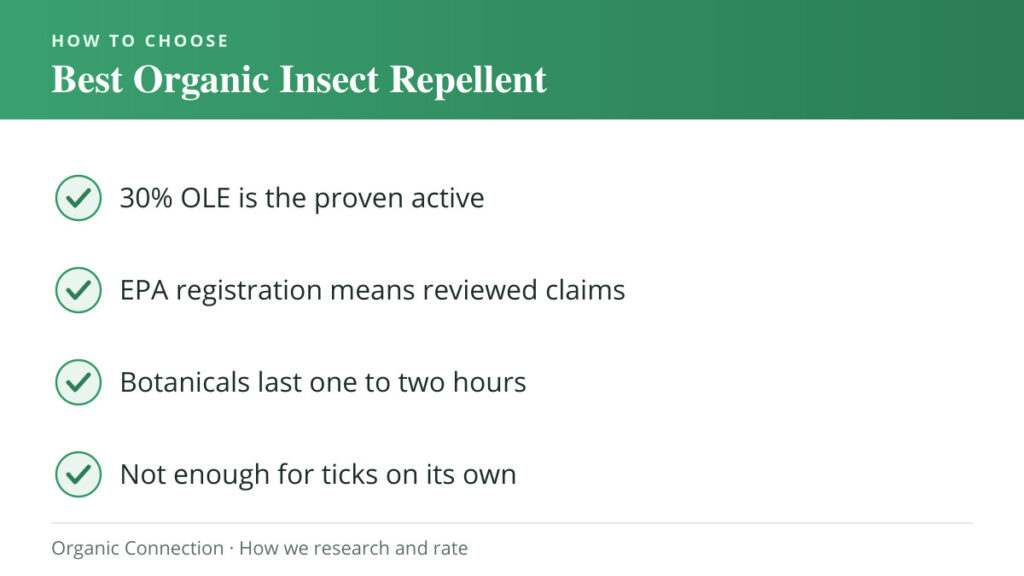
“Blend of essential oils” tells you nothing. 30% oil of lemon eucalyptus tells you a great deal.
2. EPA registration
An EPA registration number means the efficacy claims have been reviewed rather than simply asserted. Most botanical repellents are exempt and unreviewed.
3. Stated protection duration
A product that tells you it lasts two hours is being honest. One that implies all-day protection from essential oils is not.
4. Organic certification on the oils
Useful, and secondary to efficacy. An organic repellent that does not repel is not a good buy.
Matching the product to the actual risk
This is the part that matters most, and it is where natural repellent guides usually go soft. The right choice depends entirely on what you are being protected from.
Where a botanical blend is genuinely fine. A summer evening on a patio, a garden barbecue, a walk in a low-risk area, or keeping midges off at a picnic. Nuisance biting, in other words. A citronella and cedarwood balm reapplied every hour or two is perfectly adequate, smells pleasant, and avoids putting DEET on your skin for a low-stakes situation. That is a completely reasonable trade.
Where you need OLE at minimum. Anywhere with meaningful mosquito-borne disease risk, extended time outdoors at dawn or dusk, or camping. OLE at 30% is the natural option with genuine evidence behind it, and it is what the CDC lists alongside DEET and picaridin.
Where natural repellents are not the right tool. Ticks are the honest weak point. Botanical repellents perform poorly against ticks, and tick-borne disease is serious and increasingly widespread. Even OLE gives shorter tick protection than mosquito protection, typically around an hour on the Murphy’s label versus six hours for mosquitoes. If you are walking through long grass or wooded areas in a Lyme-endemic region, the appropriate approach is permethrin-treated clothing plus a proven skin repellent, tucked trousers, and a tick check afterwards. This site is about organic products and we are not going to pretend an essential oil balm is adequate protection against Lyme disease.
On children. OLE is not recommended under three years old. Essential oil repellents vary widely in their guidance and several oils are unsuitable for infants. For young children, physical barriers, mosquito nets on prams, long sleeves, and avoiding peak biting hours, do more than any product. Check the specific label rather than assuming natural means safe for babies.
Protection times compared, including the synthetics
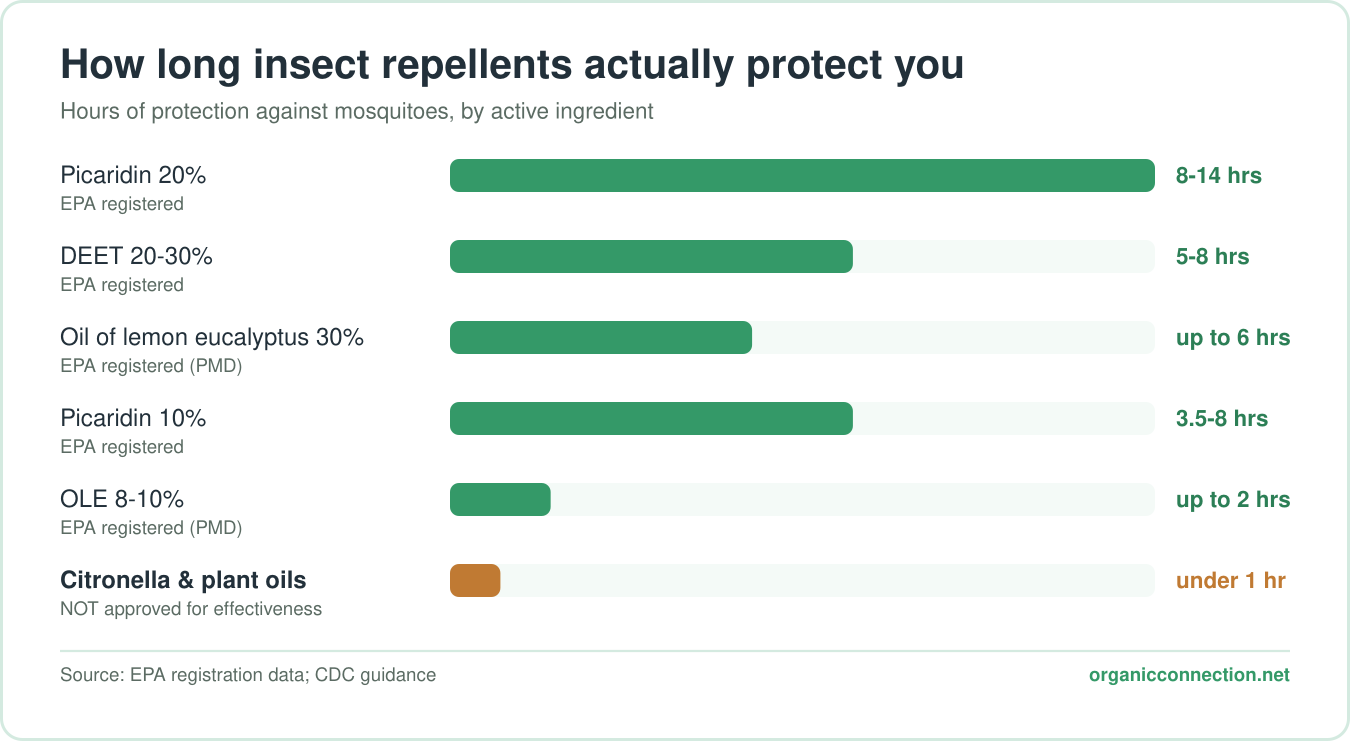
Since the whole decision turns on how long you are protected, here is the honest comparison including the products this guide does not cover, because pretending DEET does not exist would not serve you.
| Active | Mosquito protection | Tick protection | CDC recognized |
| Oil of lemon eucalyptus, 30% | Up to 6 hours | About 1 hour | Yes |
| Citronella and botanical blends | 20 min to 2 hours | Poor | No |
| DEET, 20% to 30% | 5 to 8 hours | Effective | Yes |
| Picaridin, 20% | 8 to 14 hours | Effective | Yes |
| Permethrin on clothing | Through several washes | Most effective option | Yes, fabric only |
How to read that table honestly. For a patio evening or a garden barbecue, a botanical balm reapplied every hour or two is a completely reasonable choice, and avoiding DEET for a low-stakes situation is a legitimate preference. For extended time outdoors in an area with mosquito-borne disease, oil of lemon eucalyptus at 30% is the natural option that actually competes. And for ticks in a Lyme-endemic region, permethrin-treated clothing is the intervention that works, and it goes on fabric rather than skin, which is a meaningful distinction if your objection to synthetics is about skin contact.
Picaridin is worth knowing about even on a site about organic products. It is synthetic, and it is odorless, does not damage plastics and synthetic fabrics the way DEET does, and offers the longest protection of anything here. If your reason for avoiding DEET is the smell and the way it melts sunglasses rather than a principled objection to synthetics, picaridin solves both problems.
Our position is straightforward: use the gentlest thing that is actually adequate for the situation you are in, and do not let a preference for natural products put you in a position where you are inadequately protected against a disease vector.
How to choose a natural insect repellent
- Match the product to the risk. Botanicals for nuisance biting, OLE for disease risk.
- Look for a named active at a stated percentage, not a vague oil blend.
- Prefer EPA-registered products where protection actually matters.
- Read the duration and reapply on schedule, which for botanicals means every one to two hours.
- Do not rely on any natural repellent for tick protection in a Lyme-endemic area.
Who should buy organic insect repellent
The right product depends on where you are going. If you want the strongest natural protection with real evidence, our top pick fits. If you want certified organic ingredients, a mess-free balm, a travel stick, or a smaller spray, we have a pick for each.
Best overall: Badger Anti-Bug Balm, 0.75 oz (3-Pack)
| Organic Integrity Score | 83 / 100 |
| Active ingredients | Organic citronella, cedar, and lemongrass essential oils |
| Certification | Certified Organic |
| Best for | Gardens, patios, and nuisance biting |
Badger is the pick if certified organic ingredients are your priority. The balm uses certified organic citronella, cedar, and lemongrass essential oils in a beeswax and oil base, with no DEET and no synthetic anything. The balm format is genuinely practical: it goes exactly where you put it, does not drift on the breeze, cannot be inhaled as spray, and travels without leaking. For a garden, a patio evening, or a low-risk walk, it does the job and smells pleasant doing it.
The trade-off is duration and evidence. This is a masking-type botanical repellent, so realistic protection is around two hours and you must reapply. It is not EPA-registered, meaning the claims have not been reviewed, and citronella-type blends have weak evidence against ticks. The balm is also sticky in heat and takes effort to spread over large areas.
What we liked: Certified organic essential oils in a simple base, no DEET, mess-free balm format, and a pleasant smell.
Keep in mind: About two hours of protection, not EPA-registered, and poor against ticks.
What the listing discloses: Beyond the organic claim itself, Badger does not say whether the USDA seal applies and where it was grown or made.
Best organic spray: Badger Bug Spray, 4 fl oz
| Organic Integrity Score | 82 / 100 |
| Active ingredients | Citronella and organic essential oils |
| Certification | Gluten-free, Vegan, Organic |
| Best for | Covering arms and legs quickly |
The spray format solves the balm’s main weakness, which is how long it takes to cover a pair of legs. This uses citronella with organic essential oils, is DEET-free, and comes in an aluminum bottle rather than plastic, which is a genuine packaging improvement in a category dominated by single-use plastic. Badger states around three hours of protection, which is at the upper end for a botanical blend.
The trade-off is that as a pump spray it drifts, so you use more product than a balm and some of it ends up in the air rather than on you, which matters with concentrated essential oils. It is not EPA-registered, and like all citronella-type products it is weak against ticks. Some buyers also find the oil base leaves a slight sheen on skin.
What we liked: Organic essential oils in a recyclable aluminum bottle, DEET-free, and quick to apply over larger areas.
Keep in mind: Spray drift wastes product, not EPA-registered, and weak tick protection.
What the listing discloses: Badger leaves the basics open, including whether the USDA seal applies and where it was grown or made.
Best for travel: Badger Bug Repellent Travel Stick
| Organic Integrity Score | 79 / 100 |
| Active ingredients | Organic citronella and rosemary essential oils |
| Certification | Gluten-free, Organic |
| Best for | Handbags, pockets, and flights |
A twist-up stick of the same certified organic essential oil balm, which is the most practical format for carrying around. No tin to open with sticky fingers, nothing to leak in a bag, nothing to declare as a liquid at security, and you can apply it one-handed on a walk. For keeping in a rucksack or a car door pocket for unexpected midges, it is the right thing to own.
It scores lowest here on coverage and economics. A stick is slow going over large areas, so it is really an ankles-and-wrists product rather than a full-body one, and the cost per ounce is the highest in the guide. Protection is the usual roughly two hours for a citronella-type blend, and it is not EPA-registered. Treat it as a convenient supplement to a proper repellent rather than as your main protection.
What we liked: Certified organic oils in a genuinely convenient, leak-proof, travel-friendly format.
Keep in mind: Slow to cover large areas, highest cost per ounce, and about two hours of protection.
What the listing discloses: Little to verify on the Badger listing: no word on whether the USDA seal applies and where it was grown or made.
Real mosquito protection: Murphy’s Naturals Mosquito & Tick Repellent Spray, 4 fl oz
| Organic Integrity Score | 78 / 100 |
| Active ingredient | 30% oil of lemon eucalyptus |
| Certification | Not stated on the listing |
| Best for | Real mosquito protection where it matters |
This is one we still rate because it is the only product here with genuine evidence behind its active ingredient. Oil of lemon eucalyptus at 30% is the one plant-derived repellent the CDC recognizes alongside DEET and picaridin, and this is EPA-registered, which means the six-hour mosquito protection claim has been reviewed rather than asserted. It works on skin and on gear, it is DEET-free so it will not damage synthetic fabrics or plastics the way DEET can, and it does not leave the greasy film DEET does.
The trade-offs are real and worth stating. The lemon eucalyptus smell is strong and medicinal, and a meaningful number of people dislike it. OLE is not recommended for children under three. And note carefully that the tick protection is about one hour, not six, so in a Lyme-endemic area this is not sufficient protection on its own.
What we liked: The only active here with real CDC recognition, EPA-registered so claims are reviewed, six-hour mosquito protection, and safe on gear.
Keep in mind: Strong medicinal smell, not for under-threes, and only about an hour of tick protection.
What the listing discloses: Murphy’s Naturals carries no organic claim, certified or otherwise.
Best plant-oil balm: Murphy’s Naturals Mosquito Repellent Balm, 2 oz
| Organic Integrity Score | 77 / 100 |
| Active ingredients | Lemongrass 3.25%, rosemary 3.25%, cedarwood 2%, peppermint 2% |
| Certification | Not stated on the listing |
| Best for | Patios, camping chairs, and everyday outdoor use |
What sets this apart from most botanical repellents is that Murphy’s actually states the percentage of each active oil on the label rather than hiding behind “proprietary blend”. That transparency is rare in this category and is exactly what we want brands to do. The balm is plant-based, DEET-free, non-greasy, and the cedarwood-lemongrass scent is genuinely pleasant rather than medicinal. In a 2 oz tin it lasts a long time and travels well.
The trade-off is the same as any masking botanical: protection is around two hours and it does not have the evidence base OLE does. It is also not EPA-registered. Buy it for pleasant, frequent-reapplication protection on a patio, not for a night in mosquito country.
What we liked: Stated percentages for every active oil, pleasant scent, non-greasy balm, and good value in the 2 oz tin.
Keep in mind: Roughly two-hour protection, not EPA-registered, and no organic certification on the oils.
What the listing discloses: The word organic does not appear on the Murphy’s Naturals listing at all.
How to use natural repellent so it actually works
Reapply on a timer, not on feeling. This is the single biggest reason people conclude natural repellents do not work. Botanical oils evaporate, and evaporation is exactly what removes the masking effect, so a product that genuinely works for two hours provides nothing at hour three. Set a phone timer if you are outdoors for an evening. OLE gives you six hours; a citronella balm gives you one to two.
Cover properly. Mosquitoes find bare skin with impressive reliability, so ankles, the backs of knees, wrists, and the back of the neck are where bites happen. Apply thinly and evenly rather than in patches, and apply repellent after sunscreen, not before, allowing a few minutes between. Do not use combined sunscreen-repellent products, since sunscreen needs frequent reapplication and repellent should not be over-applied.
Stack your defenses rather than relying on the bottle. Long sleeves and trousers at dawn and dusk do more than any product. A fan on a patio is remarkably effective, because mosquitoes are weak fliers. Removing standing water from gutters, plant saucers, and buckets cuts the local population at source. Mosquito nets over prams protect infants better than any repellent you would want to put on them.
For ticks specifically, do the boring things: tuck trousers into socks, stay on paths, wear light colors so you can see them, and do a full body check within a couple of hours of coming inside. Permethrin-treated clothing is the genuinely effective intervention for tick-heavy areas, and it goes on fabric rather than skin. Do not substitute an essential oil balm for that in a Lyme-endemic region.
How we researched this guide
We are a research-based review site. We compared each product against its active ingredient and stated concentration, EPA registration status, the strength of published evidence for the active, stated protection duration against mosquitoes and ticks separately, organic certification of the ingredients, packaging, label transparency, and the weight of aggregated customer feedback on real-world efficacy, then scored each with our 10-criteria Organic Integrity Score. No brand paid to be included or ranked. Always read and follow the product label. This page is informational and is not medical advice; for travel to areas with malaria, dengue, or other serious vector-borne disease, follow official health guidance rather than a buying guide. Read the full method on our How We Research and Rate page.
Common questions about organic insect repellent
What is the best natural insect repellent?
Our overall pick is Murphy’s Naturals Mosquito & Tick Repellent Spray with 30% oil of lemon eucalyptus, because OLE is the only plant-derived active the CDC recognizes alongside DEET, the product is EPA-registered, and it protects for up to six hours against mosquitoes. For certified organic ingredients, Badger Anti-Bug Balm is our pick.
Do essential oil repellents actually work?
For short periods, yes. Citronella, cedarwood, lemongrass, and similar oils mask the carbon dioxide and body odor cues mosquitoes use, giving roughly 20 minutes to two hours of protection before they evaporate. That is genuinely useful for nuisance biting on a patio. It is not adequate where mosquito-borne disease is a real risk.
Is oil of lemon eucalyptus the same as lemon eucalyptus essential oil?
No, and the distinction matters. Oil of lemon eucalyptus (OLE) and its refined form PMD are recognized repellents registered with the EPA. Lemon eucalyptus essential oil is the unrefined oil and has not been shown to work as a repellent. Check the label says oil of lemon eucalyptus or PMD, with a percentage.
Do natural repellents work against ticks?
Poorly, and this is the honest weak point of the category. Botanical blends perform badly against ticks, and even OLE gives roughly an hour of tick protection versus six hours for mosquitoes. In Lyme-endemic areas, use permethrin-treated clothing, tuck trousers into socks, and do a thorough tick check afterwards rather than relying on an essential oil product.
Are natural repellents safe for babies and young children?
Not automatically. Oil of lemon eucalyptus is not recommended for children under three, and several essential oils are unsuitable for infants. For babies, physical protection works better than any product: mosquito netting over prams, long lightweight clothing, and avoiding peak biting hours at dawn and dusk. Always read the specific label rather than assuming natural means safe.
- Organic Household & Cleaning hub
- Best Organic Neem Oil
- Organic Pest Control That Actually Works
- Best Organic Essential Oils
- every product we have reviewed — filter by USDA Organic, GOTS, Fair Trade and more
Price and availability as of October 11, 2026 7:10 pm EDT. Product prices and availability are accurate as of the date/time indicated and are subject to change. Any price and availability information displayed on Amazon.com at the time of purchase will apply to the purchase of this product.
Looking for other organic products?
We have checked more than 800 products across food, household goods, gardening, personal care and pet, every one against its stated certification. Browse all reviews.
Organic Connection is reader-supported. When you buy through links on this page we may earn a commission, at no extra cost to you. As an Amazon Associate we earn from qualifying purchases. We are not paid to feature or rank any product. Always read and follow the product label. This page is informational and is not medical advice. How we research and rate.