Last updated: September 23, 2026
We may earn a commission when you buy through links on this page, at no extra cost to you. How we research and rate.
The short version
After researching the certifications, ingredients, and performance of the most popular organic potting soils, our top pick is Burpee Organic Premium. It is OMRI-listed for organic use, alive with beneficial microbes and mycorrhizae, and pH-adjusted for strong root growth, which is why it earned our highest Organic Integrity Score of 92 out of 100. For the best value at garden centers everywhere, Espoma Organic Potting Mix is our pick, and for the richest compost-based blend, Coast of Maine is the best choice.
The key certification here is OMRI Listed (Organic Materials Review Institute), which verifies that a product is allowed in certified organic growing. We flag which mixes are OMRI-listed and which simply say “organic.”
Best organic potting soil compared
| Best Choice | Best Value | ||||
 |  |  |  |  | |
| Product | Burpee Organic | Dr. Earth | Miracle-Gro Organic Outdoor Potting Mix | Espoma Organic | Coast of Maine |
| Organic Integrity Score | 92/ 100 | 88/ 100 | 84/ 100 | 78/ 100 | 76/ 100 |
| Our rating | 4.6 | 4.4 | 4.2 | 3.9 | 3.8 |
| Best for | Best overall | Biologically active | Containers, transplants | Availability | Compost-rich |
| Certification | OMRI Listed, Organic | Non-GMO Project Verified, OMRI Listed | — | — | — |
| Feeds with | Coir, plant food | Microbes, probiotics | Microbes, mycorrhizae | Myco-tone, humus | Compost, kelp |
| Price | $20.69$0.30 / ounce View on Amazon | $20.73 View on Amazon | $9.59 View on Amazon | $22.51 View on Amazon | $20.79$0.04 / ounce View on Amazon |
Price and availability as of September 26, 2026 1:10 pm EDT. Product prices and availability are accurate as of the date/time indicated and are subject to change. Any price and availability information displayed on Amazon.com at the time of purchase will apply to the purchase of this product.
Scores are ours, based on independent research of certification, ingredient quality, biology, drainage, and value, using the same 10-criteria method we apply to every product.
Key benefits of organic potting soil
Potting soil is the entire root environment for a container plant, so what is in it determines how the plant grows. Choosing an OMRI-listed organic mix gets you living, feeding soil. Here is what that gets you.
1. Living soil biology
Organic mixes include compost, worm castings, and beneficial microbes and fungi that partner with roots to deliver nutrients naturally.
2. Slow, steady feeding
Instead of a synthetic salt spike, organic mixes release nutrients gradually, which is gentler on roots and less prone to burn.
3. No synthetic pesticide or fertilizer residue
OMRI-listed mixes are made without synthetic pesticides or prohibited fertilizers, which matters most for edibles you will eat.
4. Better long-term soil structure
Organic matter improves water retention and drainage, so containers stay healthier through the season.
Organic vs conventional potting mix: does it matter?
Many conventional potting mixes rely on synthetic slow-release fertilizer pellets that feed the plant but not the soil, and some include wetting agents or synthetic additives. For containers you will use to grow vegetables and herbs, that difference reaches your plate.
An OMRI-listed organic mix feeds through living biology, compost, and natural amendments instead. The USDA NRCS emphasizes that healthy, biologically active soil is the foundation of plant health, and that is exactly what a good organic mix is built to provide. Our scoring weights certification and biology alongside real-world drainage, feeding, and value, because a mix that compacts or drains poorly is not a good mix.
OMRI listed versus USDA organic: the distinction that matters for inputs
This trips up almost every gardener, and it explains why you will rarely see a USDA organic seal on a bag of fertilizer or soil.
USDA Organic certifies outputs. It applies to food and fiber products, the things a farm sells. It is not designed to certify the inputs a grower uses to produce them, so a bag of fertilizer is generally not the sort of thing that carries the USDA organic seal.
OMRI certifies inputs. The Organic Materials Review Institute is an independent non-profit that reviews products against the USDA National Organic Program standards and determines whether they are allowed in certified organic production. When you see “OMRI Listed” on a soil amendment, fertilizer, or pest control product, it means an accredited third party has verified the product is permitted for organic growing.
So for garden inputs, OMRI Listed is the seal to look for, not USDA Organic. A product claiming to be “organic” with neither OMRI listing nor a stated certifier is making an unverified claim, and the word organic is not legally protected on garden products the way it is on food.
You may also see “USDA Certified Biobased”, which is a different thing again: it certifies the proportion of the product derived from renewable biological material, not whether it meets organic standards.
Reading NPK, and why organic numbers look disappointingly low
Every fertilizer carries three numbers. They are percentages by weight, always in the same order.
| Letter | Nutrient | What it drives |
| N | Nitrogen | Leafy vegetative growth, green color |
| P | Phosphorus | Roots, flowers, fruit, and seed |
| K | Potassium | Root and stem strength, disease resistance, protein synthesis |
Why organic products show low numbers. A typical OMRI-listed organic fertilizer might read 4-4-4, while a synthetic product sits at 20-20-20. That looks like a fivefold difference in value, and it is not, because the two work in fundamentally different ways.
Synthetic fertilizer delivers nutrients in immediately plant-available mineral form. The plant takes up what it can and the rest is prone to leaching away, which is where nutrient runoff into waterways comes from. Organic fertilizer delivers nutrients bound up in organic matter that soil microbes must break down first. That makes it slower, steadier, far harder to burn plants with, and it feeds soil biology rather than bypassing it. The nutrients release over weeks to months rather than days.
The practical implication. Do not compare an organic fertilizer to a synthetic one on the NPK numbers alone; you are comparing a slow-release biological system with a fast-release chemical one. Apply organic fertilizer earlier than you think you need it, since it takes time to become available, and judge it over a season rather than over a fortnight. The goal with organic growing is a living soil that holds and cycles nutrients, at which point you need less input each year rather than more.
How to choose an organic potting soil
- Look for the OMRI seal. “Organic” is loosely used on soil; OMRI Listed is the verified standard for organic growing.
- Check what feeds it. Favor compost, worm castings, bat guano, kelp, and mycorrhizae over synthetic pellets.
- Match the mix to the plant. Seed-starting, general potting, and cactus or succulent mixes differ in drainage; buy for your use.
- Consider peat-free options. Coco coir and compost-based mixes avoid mined peat, which matters to eco-minded gardeners.
- Mind drainage. Good mixes include perlite or pumice; containers need drainage holes regardless.
Who should buy organic potting soil
What you are growing decides the mix. Our top pick is the living organic soil for general use. If you want the easiest to find, the richest compost blend, a premium biologically active mix, or a widely available value bag, we have a pick for each.
The certification map for organic potting soil, and what each one actually excludes
Most shoppers read a certification as a general signal of quality. Every one of them is narrower than that, and the gaps between them are where the marketing lives.
| Certification | Covers | Key exclusion |
| USDA Organic | Farming and handling: no synthetic pesticides or fertilizers, no GMOs, no sewage sludge or irradiation, audited yearly by an accredited certifier | Three different tiers share the one seal, and it makes no claim about worker pay, food miles, or nutrition |
| OMRI Listed | Review of an input, a fertilizer, pesticide or soil amendment, as allowed in certified organic production | Reviews the product, not the farm: it cannot make your garden or your crop organic |
OMRI Listed is about the input, not the farm. The Organic Materials Review Institute reviews a fertilizer, pesticide or amendment and confirms it is permitted in certified organic production. That is genuinely useful when you are deciding what to put on your own soil. What it does not do is certify the manufacturer, the crop you grow with it, or your garden, and only an accredited certifier can do the last of those.
Best overall: Burpee Organic Premium
| Organic Integrity Score | 92 / 100 |
| Certification | OMRI Listed, Organic |
| Feeds with | Coconut coir, plant food, mycorrhizae |
| Best for | An affordable, easy-to-find certified bag |
Burpee Organic Premium Potting Mix is the value bag. It is OMRI-listed, uses coconut coir for water retention (a peat-reducing plus), includes a starter charge of organic plant food and mycorrhizae, and is sold at most garden centers and online at a low price.
What puts it first is simply that its listing names OMRI. That is a lower bar than it sounds, and most rivals here do not clear it.
What we liked: OMRI-listed, uses coconut coir instead of relying only on peat, includes starter plant food and mycorrhizae, and is affordable and easy to find.
Keep in mind: The included plant food feeds for a limited window, so plan to supplement with organic fertilizer for long-season crops.
What the listing discloses: Beyond the organic claim itself, Burpee does not say whether the USDA seal applies and where it was grown or made.
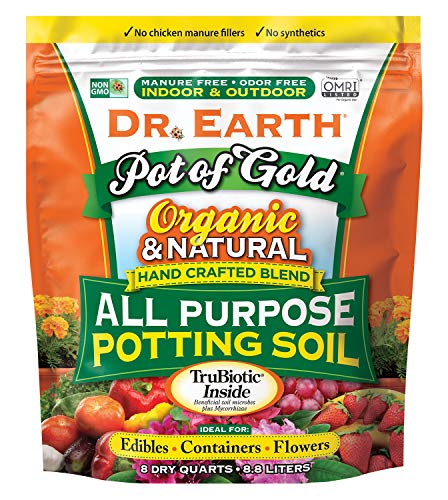
Best biologically active: Dr. Earth Pot of Gold
| Organic Integrity Score | 88 / 100 |
| Certification | Non-GMO Project Verified, OMRI Listed |
| Feeds with | Beneficial microbes, mycorrhizae, probiotics |
| Best for | Gardeners who want maximum soil biology |
Dr. Earth Pot of Gold is our pick for maximum biology. It is OMRI-listed and loaded with the brand’s TruBiotic beneficial microbes, mycorrhizae, and non-GMO ingredients, aimed at building the most active living soil for strong, resilient plants.
It scores in the value range mainly on price and availability rather than quality, since it is a premium bag that can be harder to find, but for microbe-forward organic growing it is excellent.
What we liked: OMRI-listed, packed with beneficial microbes, mycorrhizae, and probiotics, with verified non-GMO ingredients.
Keep in mind: It is a premium-priced mix and can be harder to find in stores than the biggest brands.
What the listing discloses: Dr. Earth carries no organic claim, certified or otherwise.
Containers, transplants: Miracle-Gro Organic Outdoor Potting Mix
| Organic Integrity Score | 84 / 100 |
| Certification | — |
| Feeds with | Beneficial microbes, mycorrhizae, humic acid |
| Best for | Containers, transplants, and vegetables |
Miracle-Gro Organic Outdoor Potting Mix is still a reasonable buy because it is a genuinely living soil. It is OMRI-listed, inoculated with beneficial soil microbes and mycorrhizal fungi that colonize roots, buffered with humic acid, and pH-adjusted so plants can take up nutrients efficiently. Gardeners consistently report vigorous root growth and healthy transplants.
The trade-off is that it is a premium bag and, like most quality mixes, it still contains some sphagnum peat, so peat-free purists may prefer a coir-based option. For all-around container growing and edibles, it does the job well.
What we liked: OMRI-listed, alive with beneficial microbes and mycorrhizae, pH-adjusted, and a proven performer for roots and transplants.
Keep in mind: It is priced as a premium mix and contains some peat, so committed peat-free gardeners may want a coir-based alternative.
What the listing discloses: Miracle-Gro is thin on detail, and does not say whether the USDA seal applies and where it was grown or made.
Best value: Espoma Organic Potting Mix
| Organic Integrity Score | 78 / 100 |
| Certification | — |
| Feeds with | Myco-tone mycorrhizae, humus |
| Best for | An easy-to-find certified mix at a fair price |
Espoma Organic Potting Mix is our value pick. It is OMRI-listed, enhanced with the brand’s Myco-tone mycorrhizae blend to improve root growth and water uptake, and carried by garden centers and big-box stores almost everywhere at a friendly price.
What we liked: OMRI-listed, Myco-tone mycorrhizae for root and water uptake, widely available, and priced well.
Keep in mind: It holds a lot of moisture, so ease off watering, and the biology is not quite as rich as our top pick.
What the listing discloses: Little to verify on the Espoma listing: no word on whether the USDA seal applies and where it was grown or made.
Best compost-rich blend: Coast of Maine
| Organic Integrity Score | 76 / 100 |
| Certification | — |
| Feeds with | Compost, kelp, lobster and crab meal |
| Best for | Nutrient-dense growing and heavy feeders |
Coast of Maine is our pick for a compost-rich, nutrient-dense mix. Its OMRI-listed blends are built on real compost and marine ingredients like kelp, lobster, and crab meal, which give heavy feeders like tomatoes plenty to work with straight out of the bag.
It scores in the middle mainly on availability outside the Northeast and price, but for a genuinely rich, biologically active mix, it is a standout, especially for vegetables.
What we liked: OMRI-listed, compost- and marine-rich, and full of nutrients for heavy feeders right out of the bag.
Keep in mind: Distribution is strongest in the Northeast, so availability and price vary by region.
What the listing discloses: Beyond the organic claim itself, Coast of Maine does not say whether the USDA seal applies and where it was grown or made.
How to use organic potting soil well
Fill containers loosely rather than packing the mix down, so roots get air. Always use pots with drainage holes, and water when the top inch feels dry rather than on a fixed schedule. Because organic mixes feed gradually, top up with an organic fertilizer for heavy feeders like tomatoes about midway through the season. At season’s end, spent mix is not wasted: refresh it with compost and reuse it, or add it to garden beds.
Potting mix, potting soil, topsoil and garden soil are four different products
This is the most expensive mistake in container gardening and it is made constantly, because the bags sit next to each other and the names sound interchangeable. They are not.
| Product | What it is | Use it for |
| Potting mix | A soilless blend — peat or coir, bark, perlite, compost. Contains no actual soil. | Containers and houseplants. This is what you want. |
| Potting soil | Usually the same thing under a looser name; occasionally contains some field soil | Containers, but read the ingredient list rather than the front |
| Seed starting mix | Finer, lighter, deliberately low in nutrients | Germination only. Too weak to grow plants on in. |
| Garden soil | Amended field soil, heavy, holds water | Digging into beds. Never in a container. |
| Topsoil | Bulk mineral soil, quality varies enormously | Leveling and filling. Not a growing medium on its own. |
Keep in mind: garden soil in a pot compacts within weeks. Without earthworms, roots and weather to keep it open, it turns into a dense block that holds water at the bottom and suffocates roots — the single most common cause of container plants that yellow, wilt and die despite regular watering. If a bag says “for in-ground use” or “garden soil”, it belongs in the ground.
The reason potting mix contains no soil is drainage. A container has a hard bottom and a perched water table, so the medium must be far more porous than anything that works outdoors. That is what the perlite and bark are doing.
What is in the bag, and what each component does
| Component | Job | Notes |
| Sphagnum peat moss | Water retention, structure | The traditional base. Acidic, and environmentally contentious — see below. |
| Coco coir | Water retention, structure | The main peat alternative. Near-neutral pH, rewets easily, very low in nutrients. |
| Perlite | Aeration and drainage | The white specks. Volcanic glass, inert, does not break down. |
| Vermiculite | Water and nutrient holding | Holds far more water than perlite. Too much makes a mix soggy. |
| Bark fines / forest products | Structure and long-term air space | Slows compaction. Can temporarily tie up nitrogen as it decomposes. |
| Compost | Nutrients and biology | Where most of the actual feeding comes from in an organic mix |
| Worm castings | Gentle nutrients, microbial life | A quality signal; expensive, so usually a small percentage |
| Yucca extract / wetting agent | Helps dry mix absorb water | Organic mixes use plant-derived wetting agents rather than synthetic surfactants |
| Mycorrhizae | Root-symbiotic fungi | Genuinely useful for most plants, though not for brassicas or beets, which do not form the association |
Peat versus coir: the trade nobody explains
Peat is being phased out of retail horticulture in the UK, and the numbers behind that decision are substantial. UK peatlands store around 3.2 billion tonnes of carbon — roughly twice as much as all the forests of Britain and France combined — and emissions from degraded peatlands account for about 4% of UK annual greenhouse gas emissions. Extracting peat for compost releases carbon that took thousands of years to accumulate and destroys bog habitat that does not regenerate on any human timescale. The UK ban has been repeatedly rescheduled, with retail bagged compost the first target and the full prohibition now signalled for 2030.
The US has no equivalent restriction, and most peat used in North America comes from Canadian bogs harvested under a regulated regime with restoration requirements — a genuinely different situation from historic UK and Irish extraction, though still slow-forming carbon being released.
So how do the alternatives compare in practice?
| Peat | Coco coir | |
| pH | 3.5–4.5, needs lime added | 5.5–6.8, near ideal as is |
| Rewetting when dry | Hydrophobic — water runs off | Rewets readily. A real practical advantage. |
| Nutrients | Very low | Very low; can also hold sodium and potassium if poorly washed |
| Longevity | Breaks down slowly | Breaks down slowly; holds structure well |
| Footprint | Releases ancient stored carbon | Coconut industry by-product, but shipped long distances and needs heavy washing |
Neither is perfect. Coir is the better environmental choice on balance and is easier to manage because it does not repel water when dry and does not need lime. Its weakness is that poorly processed coir carries salt, so buy from brands that state their coir is washed or buffered.
Feeding: why a good bag stops working after two months
Organic potting mixes are pre-charged with compost and slow-release amendments — feather meal, bone meal, kelp, bat guano — and those are typically exhausted in 4 to 8 weeks of active growth. This is the single most common reason people conclude a mix “stopped working.”
- Start feeding at around week 6 for fast-growing annuals and vegetables, sooner for heavy feeders like tomatoes and peppers.
- Liquid feeds act fastest — fish emulsion, seaweed, compost tea. Granular amendments need soil biology to mineralize them, which takes weeks and needs warmth and moisture.
- Organic nutrients depend on living soil. That is why they work poorly in cold conditions and why an organic mix underperforms indoors in winter compared with a synthetic feed.
- Topdress rather than repot mid-season: an inch of worm castings or compost on the surface, watered in, extends a container considerably.
- Do not reuse mix straight from last year’s pots. Refresh it with a third fresh mix plus compost, or the structure and nutrition are both spent.
The three problems people actually hit
- Fungus gnats. Almost universal with compost-rich organic mixes, because the larvae feed on decaying organic matter in damp surface soil. They are a nuisance rather than a plant killer. Let the top inch dry between waterings, top with a centimeter of coarse sand or grit, and use yellow sticky traps for the adults. Bottom watering breaks the cycle faster than anything else.
- Damping off in seedlings. A fungal collapse at soil level, favored by rich, wet, warm, still conditions — which is exactly what a nutrient-heavy potting mix provides. This is why seed starting mix is deliberately lean and sterile. Do not start seeds in a rich organic potting mix, and give seedlings air movement.
- Hydrophobic dry-out. Peat-based mixes that dry completely repel water, which then runs down the gap between mix and pot wall and out of the drainage holes, leaving the root ball bone dry. The fix is bottom watering: stand the pot in water for 20–30 minutes until the surface darkens. Coir-based mixes largely avoid this.
Storage and handling
- Keep opened bags closed and off wet ground. Damp mix left open grows fungus and loses structure; bone-dry mix becomes hard to rewet.
- An unopened bag keeps 1–2 years. The biology declines over time — mycorrhizal inoculants and beneficial bacteria have limited shelf life, so an old bag is still usable mix with fewer of the living extras you paid for.
- A sour, sulfurous or ammonia smell means the bag went anaerobic. Spread it out to air for a day or two and it usually recovers.
- Wear a mask when handling dry mix. Peat, coir and perlite all produce fine dust, and potting media can carry Legionella longbeachae — a rare but documented cause of pneumonia in gardeners. Dampen the mix before working with it and wash your hands afterwards.
- Store somewhere that will not freeze solid if you want the biology to survive to spring.
How we researched this guide
We are a research-based review site. We did not lab-test these soils ourselves. We compared each against its OMRI listing, ingredient disclosures, biological content, and the weight of aggregated gardener feedback on drainage and plant performance, then scored each with our 10-criteria Organic Integrity Score. No brand paid to be included or ranked. Read the full method on our How We Research and Rate page.
Common questions about organic potting soil
What is the best organic potting soil?
Our overall pick is Burpee Organic Premium, which scores highest here at 92, because its listing names OMRI listing. For the best value at most stores, Espoma Organic Potting Mix is our pick.
What does OMRI Listed mean?
OMRI (Organic Materials Review Institute) reviews and lists products that are allowed for use in certified organic growing. On potting soil, the OMRI seal is the verified signal that a mix is genuinely organic, versus a loosely used “organic” label.
Is organic potting soil better for vegetables?
For edibles, yes, many gardeners prefer it, because OMRI-listed mixes feed through compost and natural amendments rather than synthetic fertilizers, and support the living soil biology that helps plants take up nutrients.
Do organic potting mixes contain peat?
Many do, using sphagnum peat for structure and moisture. If you want to avoid mined peat, look for coco coir or compost-based mixes, which several brands now offer.
Can I reuse organic potting soil?
Yes. At season’s end, refresh spent mix with fresh compost and a little organic fertilizer to restore nutrients and biology, or work it into garden beds rather than throwing it away.
Can you use garden soil in pots?
No — this is the most common and most expensive container gardening mistake. Garden soil compacts within weeks in a pot, because there are no earthworms, roots or weather to keep it open. It turns into a dense block that holds water at the bottom and suffocates roots, which is why container plants yellow and wilt despite regular watering. Potting mix contains no soil at all by design, because containers have a hard bottom and a perched water table and need far more porosity than anything that works outdoors.
What is the difference between potting mix and seed starting mix?
Nutrients and particle size. Seed starting mix is finer, lighter and deliberately lean, because rich, wet, warm conditions favor damping off — the fungal collapse that kills seedlings at soil level. Potting mix is nutrient-heavy and will actively work against germination. Start seeds in starting mix, then pot on into potting mix once they have true leaves.
Is peat or coco coir better?
Coir on balance, for both environmental and practical reasons. UK peatlands store around 3.2 billion tonnes of carbon — roughly twice all the forests of Britain and France combined — and degraded peatland emissions make up about 4% of UK annual greenhouse gas emissions, which is why retail peat sales are being phased out. Practically, coir sits near pH 5.5 to 6.8 so it needs no lime, and it rewets readily where dry peat repels water. Coir’s weakness is salt from poor processing, so buy brands stating their coir is washed or buffered.
Why did my organic potting soil stop working?
The pre-charged nutrients ran out. Organic mixes carry compost and slow-release amendments that are typically exhausted within 4 to 8 weeks of active growth. Start feeding around week six — sooner for tomatoes and peppers — using liquid feeds like fish emulsion or seaweed for speed, since granular amendments need soil biology and warmth to mineralize. Topdressing with an inch of worm castings mid-season extends a container considerably.
How do you get rid of fungus gnats in potting soil?
They are near-universal with compost-rich organic mixes because larvae feed on decaying matter in damp surface soil, and they are a nuisance rather than a plant killer. Let the top inch dry between waterings, top the surface with a centimeter of coarse sand or grit, and use yellow sticky traps for adults. Bottom watering breaks the cycle faster than anything else.
Why does water run straight through my pot?
The mix has dried out and gone hydrophobic — a known behavior of peat-based media. Water runs down the gap between the mix and the pot wall and straight out the drainage holes while the root ball stays bone dry. Stand the pot in water for 20 to 30 minutes until the surface darkens. Coir-based mixes largely avoid this problem.
Can you reuse potting soil?
Not straight from last year’s pots. Both the structure and the nutrition are spent. Refresh it with about a third fresh mix plus compost, or use the old material in beds rather than containers. An unopened bag of new mix keeps 1 to 2 years, though the biology declines — mycorrhizal inoculants and beneficial bacteria have limited shelf life, so an old bag is usable mix with fewer of the living extras.
Is potting soil dangerous to handle?
Worth basic precautions. Peat, coir and perlite all produce fine dust, and potting media can carry Legionella longbeachae, a rare but documented cause of pneumonia in gardeners. Dampen the mix before working with it, wear a mask when handling it dry, and wash your hands afterwards. A sour or ammonia smell from a bag means it went anaerobic — spread it out to air for a day or two and it usually recovers.
- Organic Gardening hub
- Best Organic Fertilizer
- Best Organic Compost
- our searchable product database — compare all 800+ picks side by side
- Soil amendments, explained
- What OMRI Listed actually checks
Price and availability as of September 26, 2026 1:10 pm EDT. Product prices and availability are accurate as of the date/time indicated and are subject to change. Any price and availability information displayed on Amazon.com at the time of purchase will apply to the purchase of this product.
Looking for other organic products?
We have checked more than 800 products across food, household goods, gardening, personal care and pet, every one against its stated certification. Browse all reviews.
Organic Connection is reader-supported. When you buy through links on this page we may earn a commission, at no extra cost to you. As an Amazon Associate we earn from qualifying purchases. We are not paid to feature or rank any product. How we research and rate.