Last updated: September 30, 2026
We may earn a commission when you buy through links on this page, at no extra cost to you. How we research and rate.
The short version
After working through the certification rules, the published label-accuracy testing, and the clinical guidelines, our top pick is MaryRuth’s Organic Liquid Probiotic. It is genuinely USDA Certified Organic, it names thirteen strains, and it states its CFU count honestly rather than hiding behind a manufacture-date number, which is why it earned our highest Organic Integrity Score of 88 out of 100.
But this is a category where we have to lead with a caveat rather than a recommendation. Certified organic probiotics carry dramatically lower CFU counts than the non-organic bestsellers sitting beside them, and the clinical evidence for probiotics in healthy adults is far weaker than the shelf suggests. If you want the honest version before you spend anything, read the next two sections before the picks.
Best organic probiotics compared
| Best Choice | Best Value | ||||
 |  |  |  |  | |
| Product | MaryRuth’s Organic Liquid | Ora Organic Capsules | MaryRuth’s Organic Kids | MaryRuth’s Organics Kids | Garden of Life Dr. |
| Organic Integrity Score | 88/ 100 | 87/ 100 | 84/ 100 | 83/ 100 | 74/ 100 |
| Our rating | 4.4 | 4.4 | 4.2 | 4.2 | 3.7 |
| Certification | USDA Organic, Non-GMO, Gluten-free | Gluten-free, Vegan, Organic | USDA Organic, Non-GMO, Vegan | USDA Organic, Non-GMO, Vegan | Non-GMO |
| CFU per serving | Up to 2 billion | Up to 2 billion | Up to 2 billion | — | 30 billion |
| Strains | 13 | 13 | 13 | — | 14 |
| Format | Liquid, 40 servings | Liquid, travel size | Liquid, flavored | — | Capsule, shelf stable |
| Best for | Everyday use | Travel | Children | — | Higher potency |
| Price | $29.95$7.49 / fluid ounce View on Amazon | $39.99 $42.00 −5%$0.67 / count View on Amazon | $24.95 $26.49 −6%$12.48 / fluid ounce View on Amazon | $19.95 View on Amazon | Currently unavailable See buying options |
Scores are ours, based on independent research of certification, strain transparency, label honesty, and value, using the same 10-criteria method we apply to every product.
The organic probiotics certifications, and the question each one leaves open
A seal is a specific promise about a specific thing. These are the promises behind the marks on this page, in plain terms, along with the question each one leaves unanswered.
| Certification | Covers | Key exclusion |
| USDA Organic | Farming and handling: no synthetic pesticides or fertilizers, no GMOs, no sewage sludge or irradiation, audited yearly by an accredited certifier | Three different tiers share the one seal, and it makes no claim about worker pay, food miles, or nutrition |
| B Corp | The whole company: social and environmental performance, governance, and transparency | Certifies the company, not the product in your hand |
USDA Organic is three claims wearing one seal. “100% Organic” means every ingredient is certified. Plain “Organic”, the version you will see most often, means at least 95% by weight, with the remainder drawn from an approved national list. “Made with organic ingredients” means 70%, and that wording may not carry the USDA seal at all. The phrase on the front of the pack tells you which of the three you are holding, and the gap between them is not small.
What the evidence actually says about probiotics
The American Gastroenterological Association published clinical practice guidelines on probiotics in 2020, and they are considerably less enthusiastic than the supplement aisle. Reviewing the evidence disease by disease, and assessing each single-strain and multi-strain formulation independently rather than lumping everything together as “probiotics”, the AGA concluded that evidence remains insufficient to support routine probiotic use for most gastrointestinal conditions.
The guidelines support probiotic use in three specific settings: preventing Clostridioides difficile infection in adults and children taking antibiotics, preventing necrotizing enterocolitis in preterm low-birthweight infants, and managing pouchitis, a complication of inflammatory bowel disease. Outside those, the AGA discouraged broad, non-strain-specific supplementation.
None of that means probiotics are useless. It means the benefits that have been demonstrated are tied to particular strains at particular doses for particular conditions, and they do not transfer to a different product simply because it contains a bacterium with a similar-sounding name. A guideline written for clinicians is also not the same question as whether a healthy person notices a difference. But it is the most rigorous read of the evidence available, and you deserve to see it before you spend money rather than after.
Why organic probiotics have much lower CFU counts
This is the trade-off nobody selling probiotics wants to explain, and it is the most useful thing on this page.
Probiotic bacteria are grown on a fermentation substrate. For a probiotic to carry the USDA Organic seal, that substrate and the other ingredients have to be certified organic, which is why organic formulas list things like organic sugarcane molasses and organic juice concentrate. Certification is genuinely meaningful, but it constrains the growth media, the carriers, and the preservation methods available to the manufacturer.
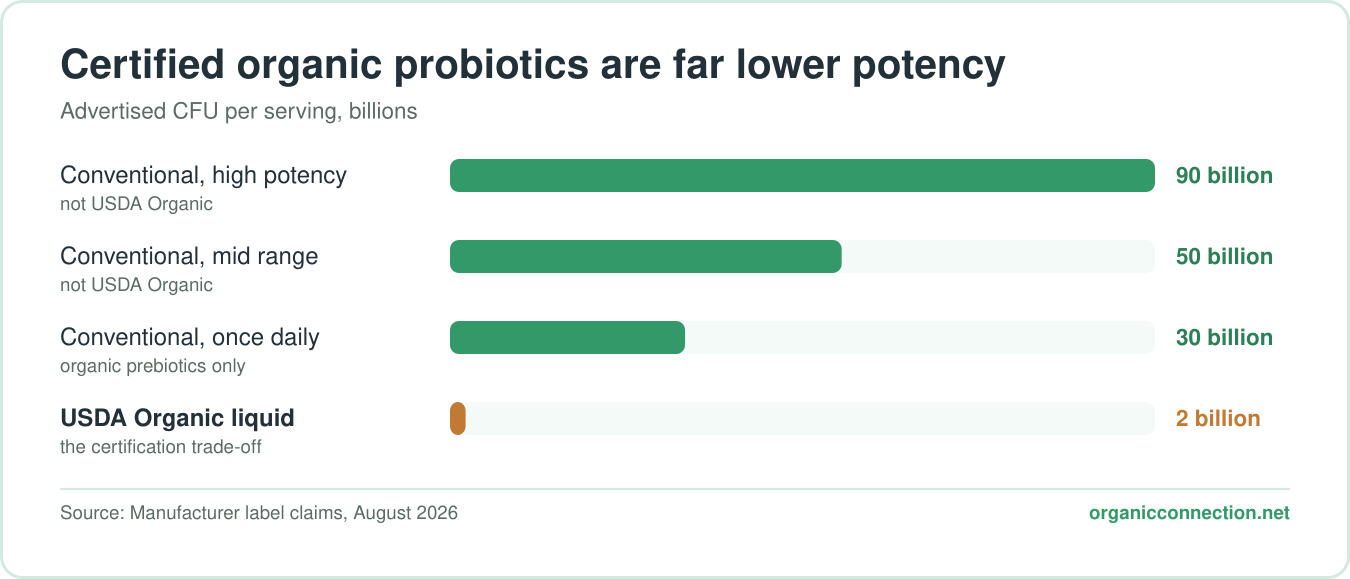
The practical result is stark. The USDA Organic liquid probiotics on the market typically deliver around 2 billion CFU per serving. The non-organic bestsellers sitting next to them advertise 30, 50 or 90 billion. That is not a rounding difference. It is an order of magnitude or more.
So which matters? Here the earlier evidence section does real work. Because demonstrated probiotic benefits are strain-specific rather than driven by raw dose, a bigger CFU number is not automatically a better product, and the industry’s own testing shows the number is frequently wrong anyway. A 90 billion CFU claim that is unverified is worth less than a 2 billion claim you can trust. What you are really choosing between is certified inputs and advertised potency, and you should make that choice deliberately rather than assume the organic seal is a free upgrade.
CFU at manufacture versus CFU at expiry
Read the small print next to the CFU number. There are two very different claims in circulation and they are not comparable.
“10 billion CFU at time of manufacture” tells you what was in the batch on the day it was made. It says nothing about what survives shipping, warehousing, and the months on a shelf. “10 billion CFU through expiration” is a materially stronger promise, because the manufacturer has to overfill the product so the count still holds at the best-before date.
Industry practice tolerates a drop of roughly 0.5 to 1 log across a product’s shelf life. In plain terms, a bottle labeled 50 billion at manufacture can legally reach you at somewhere between 5 and 15 billion and still be considered acceptable. Trade bodies including the International Probiotic Association and the Council for Responsible Nutrition have pushed for products to hold 100 percent of the label claim through shelf life, which tells you plainly that not everyone does.
A brand that prints “through expiration” has accepted a cost the manufacture-date brands have avoided. That single phrase is a better quality signal than the size of the number in front of it.
Key things to look for in an organic probiotic
1. A real USDA Organic seal, not organic ingredients
“Made with organic prebiotic fiber” is not the same claim as USDA Certified Organic, and the distinction is deliberate. Several of the biggest probiotic brands use organic potato starch and organic acacia fiber as prebiotics inside a product that is not itself certified organic. That is a legitimate formulation, but if certification is why you are here, look for the seal on the product rather than the word “organic” in the ingredient list.
2. Strain names, not just species
The clinical evidence attaches to specific strains, written as genus, species and a strain designation, for example Lacticaseibacillus rhamnosus GG. A label that says only “Lactobacillus blend” is telling you the genus and withholding the part that would let you check whether anything has been studied. Strain-level naming is the clearest sign a manufacturer expects to be checked.
3. A CFU count tied to expiry
As above. “Through expiration” beats a bigger number “at time of manufacture” every time.
4. Third-party testing you can actually see
Given that most tested products miss their label, independent verification matters more here than in almost any other supplement category. Look for a certificate of analysis you can request, or a testing seal from a body such as USP or NSF. Our guide to supplement third-party testing covers what each seal does and does not cover.
5. Storage instructions that match reality
Some strains are genuinely shelf stable; others are not and need refrigeration. A product that requires refrigeration but was shipped to you across a warm week has lost potency nobody is measuring. Shelf-stable formulations exist precisely to avoid that problem, and for mail order they are the more sensible default.
Who should buy an organic probiotic
Buy one if you want certified organic inputs and you have decided, with the potency trade-off in front of you, that certification is what you are paying for. Buy one if you are looking for a liquid or a children’s format, where organic options are comparatively strong. Buy one if you are taking antibiotics and have discussed C. difficile prevention with a clinician, which is one of the three uses the AGA guidelines actually support.
Do not buy one expecting a general wellness effect the evidence does not promise, and do not buy on CFU count alone. If you have an active gastrointestinal condition, this is a conversation for your doctor rather than a shelf, because the strains that have been shown to help are specific and a guide like this one cannot substitute for that.
How to choose an organic probiotic
Work in this order. First decide whether you need the USDA Organic seal or whether organic prebiotic ingredients inside a conventional formula would satisfy you, because that single decision sets your potency ceiling. Second, check whether strains are named at strain level. Third, read whether the CFU figure is guaranteed through expiry. Fourth, pick the format you will actually take daily, since a liquid you enjoy beats a capsule you forget. Cost per serving matters last, because a cheap product that misses its label is not cheap.
Best overall: MaryRuth’s Organic Liquid Probiotic, 40 Servings
| Organic Integrity Score | 88 / 100 |
| Format | Liquid, 40 servings |
| Certification | USDA Organic, Non-GMO, Gluten-free |
| Best for | Everyday use where certification is the priority |
Few probiotics on the shelf carry a genuine USDA Organic seal rather than organic ingredients inside a conventional formula. This is one of them. Thirteen strains, a liquid format that avoids the capsule-survival question entirely, and forty servings per bottle, which makes the cost per day reasonable despite the certification premium.
What we liked: Real certification rather than an organic-sounding ingredient list. The liquid format is easy to take consistently and easy to adjust for a smaller dose. Vegan and non-GMO. Forty servings is a genuine month-plus at one serving a day.
Keep in mind: Up to 2 billion CFU is a fraction of what the non-organic bestsellers advertise, and if raw potency is your priority this is the wrong product. The label states strains but does not publish strain-level designations for all thirteen, so you cannot map them to specific clinical trials.
What the listing discloses: On the MARYRUTH’S label: USDA organic certification and a B Corp certification. Not stated: where it was grown or made.
Best named strains: MaryRuth’s Organic Liquid Probiotic and Prebiotic Capsules
| Organic Integrity Score | 87 / 100 |
| Potency | 16 billion CFU per serving |
| Strains | Six, each named: L. acidophilus, L. reuteri, B. bifidum, B. breve, B. lactis, B. longum |
| Prebiotics | Organic Jerusalem artichoke and organic tapioca |
| Organic wording | “Certified made with organic”, which is the 70 percent tier phrasing |
| Best for | Anyone who wants to know which organisms they are taking |
The only probiotic on this page that names its strains, and it names all six: Lactobacillus acidophilus, L. reuteri, Bifidobacterium bifidum, B. breve, B. lactis and B. longum.
That matters more in probiotics than in almost any supplement category. Probiotic effects are strain-specific, not species-specific and certainly not generic, so a product that says only “probiotic blend” is asking you to trust a number. A named strain list is what lets you check the research.
It also publishes potency — 16 billion CFU per serving — and includes prebiotics from organic Jerusalem artichoke and organic tapioca, naming the sources rather than writing “prebiotic fiber”. The listing explains why they are there: prebiotics are what the probiotics feed on.
Now the wording to read carefully. The listing says the product is “certified made with organic”, and that is the phrasing of the third USDA labeling tier, which requires at least 70 percent organic content and cannot carry the USDA seal. That is a meaningfully weaker claim than the certified organic products above it on this page, and it is stated honestly rather than dressed up.
The final bullet is a customer quote, which is testimony rather than evidence.
What we liked: Six strains named individually, a published CFU count, prebiotic sources named, and honest tier wording.
Keep in mind: “Made with organic” is the 70 percent tier, not the certified organic seal. No CFU-at-expiry figure, and one bullet is a customer testimonial.
What the listing discloses: Little to verify on the Ora Organic listing: no word on whether the USDA seal applies and where it was grown or made.
Best for children: MaryRuth’s Organic Kids Liquid Probiotic, Very Berry
| Organic Integrity Score | 84 / 100 |
| Format | Flavored liquid, 2 fl oz |
| Certification | USDA Organic |
| Dosing | By the drop, scalable for a younger child |
| Best for | Children who will not swallow a capsule |
A flavored liquid is the format most likely to be taken willingly by a child, and this one carries the same USDA Organic certification as the adult formula. Two fluid ounces, berry flavored, and dosable by the drop rather than requiring a swallowed capsule.
What we liked: Certified organic, which matters more to most parents in a children’s product than in their own. Flavor that children accept. Liquid dosing is easy to scale down for a younger child.
Keep in mind: Check the age guidance on the label before buying for a very young child. Probiotics for infants specifically are a medical conversation, not a shelf decision, and the AGA’s support for probiotics in preterm infants refers to clinical settings rather than home supplementation.
What the listing discloses: MARYRUTH’S is explicit about a USDA organic claim and a B Corp certification, and silent on where it was grown or made.
Best drops format: MaryRuth’s Organics Kids Probiotic Liquid Drops
| Organic Integrity Score | 83 / 100 |
| Format | Liquid drops, 1 fl oz |
| Certification | USDA Organic, Non-GMO, Vegan |
| Best for | Flexible or occasional dosing |
A one-ounce dropper bottle for ages four and up, useful when you want to add a probiotic to food or a drink rather than administer it directly. The smaller bottle suits intermittent use better than a large one that will pass its date before you finish it.
What we liked: Dropper gives precise control over dose. Certified organic, vegan, gluten free. Small size means it gets used before it degrades.
Keep in mind: One ounce goes quickly with daily use, so the cost per serving is not the best here. Labeled for ages four and up.
What the listing discloses: On the MARYRUTH’S label: a USDA organic claim and a B Corp certification. Not stated: where it was grown or made.
Best higher potency, but not certified organic: Garden of Life Dr. Formulated Once Daily
| Organic Integrity Score | 74 / 100 |
| Format | Capsule, once daily, shelf stable |
| Certification | Non-GMO |
| Best for | Buyers who want potency over certification |
We are including this one with an explicit warning label, because it is the honest answer to a question the organic-only picks cannot address. If you want 30 billion CFU, you cannot currently have it with a USDA Organic seal. This product uses organic potato starch and organic acacia fiber as its prebiotic, and it is shelf stable, but the product itself is not USDA Certified Organic.
It scores 74 rather than lower because the formulation is transparent about what it is, and rather than higher because the front of the bottle leans on the word organic in a way that we think invites the wrong conclusion.
What we liked: Genuine higher potency at 30 billion CFU. Shelf stable, which removes the cold-chain problem in mail order. Once-daily capsule is simple to keep up.
Keep in mind: Not USDA Organic. The organic claim covers the prebiotic fiber, not the product. If certification is the reason you are shopping this category, this is not your pick, and we would rather say so than let the label do the work.
What the listing discloses: The word organic does not appear on the Garden of Life listing at all.
The microbiome and weight: genuinely interesting, genuinely unsettled
The link between gut bacteria and body weight is one of the more active areas in nutrition research, and it is worth describing accurately because the marketing has run far ahead of it.
The underlying observations are real. People with obesity tend to show different gut bacterial composition from lean people, and transferring gut bacteria between animals can transfer metabolic phenotypes, which is a striking finding. Gut bacteria influence energy harvest from food, produce short-chain fatty acids that affect appetite signalling, and interact with the gut hormones that regulate fullness.
What has not followed is a reliable intervention. Trials of specific probiotic strains for weight have produced inconsistent results. Some strains, particularly certain Lactobacillus species, have shown modest reductions in body weight or fat mass in individual trials, while others have shown nothing and a few have been associated with weight gain. Meta-analyses generally find small effects with high heterogeneity and low certainty.
Strain specificity is the reason results do not generalise. Effects belong to particular strains at particular doses, not to probiotics as a category, and a product containing a dozen unspecified strains cannot be assumed to do what a trial of one strain showed. This is why we weight strain naming so heavily above.
There is also good evidence that dietary fiber shifts the microbiome more reliably than supplementation does, by feeding the bacteria already present.
Honest summary: a genuinely important research area with a plausible mechanism, inconsistent trial results, effects that belong to named strains rather than the category, and fiber a more dependable lever than a capsule.
Common questions about organic probiotics
Can probiotics actually be USDA Organic?
Yes. Certification applies to the fermentation substrate and the other ingredients rather than to the bacteria as such, which is why certified organic formulas list things like organic sugarcane molasses and organic juice concentrate. Genuine USDA Organic probiotics exist and are certified by accredited certifiers. They are simply far less common, and lower in CFU, than the conventional products beside them.
Why do organic probiotics have so few CFU?
Because organic certification constrains the growth media, carriers and preservation methods a manufacturer can use. Certified organic liquid probiotics commonly land around 2 billion CFU per serving where conventional products advertise 30 to 90 billion. Whether that matters depends on your view of whether raw dose or specific strains drive the benefit, and the clinical evidence leans towards strains.
Is a higher CFU count better?
Not reliably. Demonstrated probiotic benefits are tied to specific strains at studied doses for specific conditions, so a larger number of a different organism is not an upgrade. Published testing also found that only about 27 percent of 25 commercial products actually contained their labeled CFU count, which makes an unverified big number a weak thing to buy on.
What does “CFU at time of manufacture” mean?
It means the count was measured on the day the batch was made, with no promise about what survives to the date you take it. Industry practice tolerates a 0.5 to 1 log drop across shelf life, so a product labeled 50 billion at manufacture may reach you at 5 to 15 billion. A label reading “through expiration” is a stronger and more expensive claim, and a better signal.
Do probiotics need to be refrigerated?
It depends on the strains and the formulation. Some are genuinely shelf stable and some are not. For anything bought by mail order, a shelf-stable product avoids the risk of a refrigerated formula spending days in a warm van, which degrades potency in a way nobody measures. Follow the storage instruction on the bottle rather than a general rule.
Do doctors recommend probiotics?
Selectively. The American Gastroenterological Association’s 2020 clinical guidelines found evidence insufficient to support probiotics for most digestive conditions, while supporting them in three settings: preventing C. difficile infection during antibiotic use, preventing necrotizing enterocolitis in preterm low-birthweight infants, and managing pouchitis. That is a narrower endorsement than the category’s marketing implies.
Should I take a probiotic while on antibiotics?
This is the use with the strongest guideline support, specifically for reducing the risk of C. difficile infection, and it is worth raising with whoever prescribed the antibiotic rather than deciding alone. The strain and timing matter, and your prescriber knows your situation in a way a buying guide cannot.
What should I look for on the label?
Four things, in order: a USDA Organic seal if certification is why you are here, strain-level names rather than a genus-only blend, a CFU figure guaranteed through expiry rather than at manufacture, and third-party testing you can verify. The number on the front of the bottle is the least informative thing on the package.
- Organic Supplements and Wellness hub
- Supplement third-party testing explained
- Best Organic Psyllium Husk
- our searchable product database — compare all 800+ picks side by side
Price and availability as of October 15, 2026 7:10 pm EDT. Product prices and availability are accurate as of the date/time indicated and are subject to change. Any price and availability information displayed on Amazon.com at the time of purchase will apply to the purchase of this product.
Looking for other organic products?
We have checked more than 800 products across food, household goods, gardening, personal care and pet, every one against its stated certification. Browse all reviews.
Organic Connection is reader-supported. When you buy through links on this page we may earn a commission, at no extra cost to you. As an Amazon Associate we earn from qualifying purchases. We are not paid to feature or rank any product. How we research and rate.