Last updated: September 30, 2026
We may earn a commission when you buy through links on this page, at no extra cost to you. How we research and rate.
The short version
After working through the labeling and what actually separates a snack from a confectionery bar, our top pick is Jonesbar Organic Plant Based Protein Bars. They are USDA certified organic, built on five ingredients or fewer, with no added sugar and no oils, which is why they earned our highest Organic Integrity Score of 89 out of 100.
The rule that matters across this entire category: organic certification says nothing whatsoever about sugar. An organic snack bar can be a confectionery bar with a certified supply chain.
Best organic snacks compared
| Best Choice | Best Value | ||||
 |  |  |  |  | |
| Product | Jonesbar Organic Plant | ALOHA Organic Plant Based | Pure Bliss Organics Real | Health Warrior Pumpkin | Organic Food Bar Protein |
| Organic Integrity Score | 89/ 100 | 87/ 100 | 86/ 100 | 84/ 100 | 82/ 100 |
| Our rating | 4.5 | 4.4 | 4.3 | 4.2 | 4.1 |
| Best for | Best overall | Best for protein | Best whole food | Best seed-based | Highest protein |
| Added sugar | None | 5 g sugar | No refined sugar | Honey sweetened | — |
| Protein | Plant based | 14 g | Seeds, nuts, fruit | 7 g+ | — |
| Ingredients | 5 or fewer | Short list | Whole food | Short list | — |
| Certification | USDA Organic, Non-GMO, Kosher | USDA Organic, Non-GMO, Kosher | USDA Organic, Gluten-Free Certified, Non-GMO | USDA Organic, Non-GMO Project Verified, Gluten-free | USDA Organic, Non-GMO Project Verified, Gluten-free |
| Pack | 6 flavor variety pack, 12 bars | 3 flavor variety, 12 bars, 1.9 oz each | 6 flavors, 2 of each, 12 bars, 1.7 oz | Variety pack, 12 bars | 12 bars, 2.6 oz each |
| Price | $29.88$1.46 / ounce View on Amazon | $37.70$3.14 / count View on Amazon | $29.00$1.42 / ounce View on Amazon | Currently unavailable See buying options | Currently unavailable See buying options |
Scores are ours, based on independent research of added sugar, ingredient quality, protein and fiber, certification and value, using the same 10-criteria method we apply to every product.
The organic snacks certifications, and the question each one leaves open
Certification names are easy to confuse and easy to trade on. Below is what each of these marks covers, and the part of the picture it says nothing about.
| Certification | Covers | Key exclusion |
| USDA Organic | Farming and handling: no synthetic pesticides or fertilizers, no GMOs, no sewage sludge or irradiation, audited yearly by an accredited certifier | Three different tiers share the one seal, and it makes no claim about worker pay, food miles, or nutrition |
| GOTS | Organic fiber from farm to finished textile, plus dyeing, finishing, wastewater and labor criteria | Has a weaker second tier, “made with organic”, that needs only 70% organic fiber and carries the same name |
| Kosher | Ingredients and production comply with Jewish dietary law, verified by a rabbinic agency that inspects the facility | A dietary-law standard: it makes no claim about pesticides, GMOs or farming practice |
GOTS has a second tier that shares its name. The organic grade requires at least 95% certified organic fiber; the “made with organic” grade requires 70%, and both are labeled GOTS. It remains the strongest textile standard in the field, because it follows the fiber through dyeing, finishing, wastewater and working conditions rather than stopping at the farm. The percentage is on the label for a reason, and it is worth reading.
The three things that separate a snack from a sweet
Added sugar. The single most useful number. Look at the added sugars line rather than total sugars, because whole dried fruit inflates the latter while contributing fiber alongside its sugar. A bar under about 6 grams of added sugar is doing well; many “healthy” bars sit at double that.
Protein and fiber. These are what make a snack hold you until the next meal rather than producing a spike and a slump an hour later. Roughly 5 grams of protein and 3 of fiber is a reasonable floor for something you are eating instead of a meal component.
Ingredient count. Not a nutritional measure in itself, but a good proxy. A bar made of dates, nuts and cocoa is a different product from one with twenty-two ingredients including three syrups, and the short list is usually the one that behaves like food.
Syrup names to recognize on an organic label
Sugar appears under many names, and organic versions of all of them exist. Worth being able to spot:
Brown rice syrup is very common in organic bars and is worth knowing about specifically. It is high in glucose, has a high glycaemic index, and has also been the subject of arsenic concerns, since rice takes up arsenic from soil more readily than other grains. That is a real consideration for anyone eating rice-syrup bars daily, and particularly for children.
Cane syrup, evaporated cane juice, coconut sugar, agave, honey and date syrup are all added sugars regardless of how wholesome the name sounds. Agave in particular is very high in fructose despite its low glycaemic index marketing.
Whole dates are a different matter. Dates used as the binding base of a bar bring fiber with their sugar, and while the total sugar figure will look high, the food is behaving quite differently from one built on syrup. Total sugars high with added sugars zero is generally a good sign.
Protein bars, and where the protein comes from
If you are buying a bar for protein, the source matters more than the number.
Plant protein bars usually rely on pea, brown rice or hemp protein. Pea protein is a good complete-ish source and is what most organic bars use. Combinations of pea and rice are common because their amino acid profiles complement each other, which is a genuine formulation reason rather than marketing.
Watch for bars where the protein figure is high but the sugar is too, which is common in the mainstream protein bar market. A bar at 20 grams of protein and 18 grams of sugar is closer to a sweet with protein added than to a protein snack.
Also worth noting: most people in developed countries already eat sufficient protein. If you are buying protein bars because you assume you are short, it is worth checking rather than assuming. Our guide to organic protein powder covers the same question in more detail.
Key things to look for in an organic snack
1. Added sugars under about 6 g
Read the added sugars line specifically, not total sugars.
2. A short ingredient list
Five ingredients or fewer is achievable in this category and is a strong signal.
3. Protein and fiber worth having
Around 5 g protein and 3 g fiber is a sensible floor for something meant to sustain you.
4. No brown rice syrup if you eat them daily
High glycaemic index and the arsenic question make it the sweetener to avoid at frequency, especially for children.
5. Variety packs before cases
Bar flavor preference is highly personal and a case of one flavor you dislike is money wasted.
Who should buy organic snack bars
Buy them if you want a portable snack with certified ingredients and you are reading the sugar panel rather than trusting the packaging. Buy them for travel, hiking, lunchboxes and desk drawers, where the alternative is usually worse. Buy the short-ingredient options if you are feeding children regularly.
Be realistic that whole foods are cheaper and usually better. A handful of nuts and a piece of fruit does most of what a bar does at a fraction of the cost. Bars are a convenience product, and that is a perfectly good reason to buy them as long as you are not paying a premium under the impression that they are health food.
How to choose an organic snack
Turn the packet over and find added sugars first. Then scan the ingredient list for length and for syrups. Then check protein and fiber if the bar is replacing part of a meal. Then buy a variety pack rather than a case, because taste is unpredictable. Certification is worth having but, as above, it is answering a different question from the one the nutrition panel answers.
Best overall: Jonesbar Organic Plant Based Protein Bars, 6 Flavor Variety, 12 Bars
| Organic Integrity Score | 89 / 100 |
| Pack | 6 flavor variety pack, 12 bars |
| Certification | USDA Organic, Non-GMO, Kosher |
| Best for | Anyone wanting a genuinely short-ingredient bar |
It does the hard thing: five ingredients or fewer, no added sugar, no oils, nothing artificial, and it is still a bar people finish. Most of the category adds syrup to make the numbers work on texture and taste, and this range does not.
The six-flavor variety pack is also the right way to buy bars. Preference here is strongly personal, and twelve bars across six flavors tells you what to reorder rather than leaving you with eleven of something you disliked.
What we liked: Five ingredients or fewer, which is genuinely rare. No added sugar and no oils. USDA organic, kosher, vegan and gluten free covers most household requirements at once. Variety pack removes the guesswork.
Keep in mind: Date-based bars are sticky and dense, which is not everyone’s texture. Total sugars still look high because dates are sugar-rich fruit, even though none is added.
What the listing discloses: You are told USDA organic certification and kosher certification for jonesbar; you are not told where it was grown or made.
Best for protein: ALOHA Organic Plant Based Protein Bars, 12 Count
| Organic Integrity Score | 87 / 100 |
| Pack | 3 flavor variety, 12 bars, 1.9 oz each |
| Certification | USDA Organic, Non-GMO, Kosher |
| Best for | A genuinely filling snack with real protein |
Fourteen grams of plant protein with ten grams of fiber and only five grams of sugar is a genuinely good ratio, and it is the combination of protein and fiber that makes these actually filling rather than briefly satisfying.
Worth noting what they leave out as much as what they include: no sugar alcohols and no stevia. Sugar alcohols are a common way for protein bars to hit low sugar figures, and they cause digestive trouble for a lot of people. Avoiding both is a considered formulation choice.
What we liked: Excellent protein-to-sugar ratio. Ten grams of fiber is substantial. No sugar alcohols, which many competitors rely on. USDA organic and vegan.
Keep in mind: Ten grams of fiber in one bar can cause bloating if your usual intake is low, so ease in. Only three flavors in the pack.
What the listing discloses: ALOHA commits to a USDA organic claim and kosher certification but stops short of where it was grown or made.
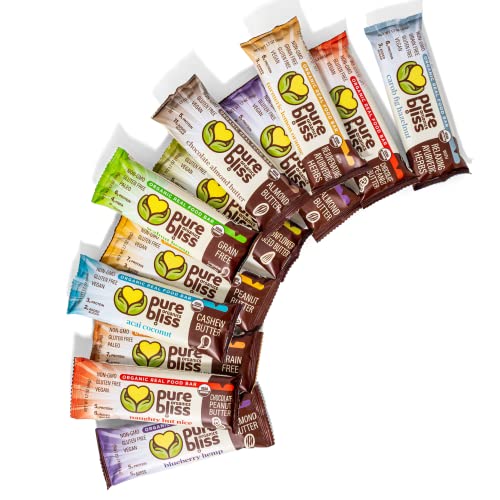
Best whole food: Pure Bliss Organics Real Food Bars, 6 Flavor Variety, 12 Bars
| Organic Integrity Score | 86 / 100 |
| Pack | 6 flavors, 2 of each, 12 bars, 1.7 oz |
| Certification | USDA Organic, Gluten-Free Certified, Non-GMO |
| Best for | Whole-food snacking with interesting flavors |
Built on seeds, nuts and dried fruit with no preservatives or refined sugars, and the flavor range is more adventurous than most: acai coconut, blueberry hemp, turmeric lemon orange. If you find most bars taste like variations on chocolate peanut butter, this range is a genuine change.
Whole-food bars like these are essentially compressed fruit and nuts, so expect a dense, chewy texture rather than anything light. That is the honest trade for avoiding the fats and syrups that make softer bars soft.
What we liked: Genuinely whole-food ingredients. Unusual and interesting flavor range. Free of dairy, soy and gluten. Two of each flavor is a sensible split.
Keep in mind: Dense and chewy, which not everyone enjoys. Fruit-based means total sugars are high even without refined sugar added. Smaller bars at 1.7 oz.
What the listing discloses: You are told USDA organic certification and Certified Gluten-Free for Pure Bliss Organics; you are not told where it was grown or made.
Best seed-based: Health Warrior Pumpkin Seed Bars, Variety Pack, 12 Bars
| Organic Integrity Score | 84 / 100 |
| Pack | Variety pack, 12 bars |
| Certification | USDA Organic, Non-GMO Project Verified, Gluten-free |
| Best for | Nut-free households and school lunchboxes |
Built on pumpkin seeds rather than nuts, which makes these one of the few decent organic bars suitable for nut-free environments — genuinely useful given how many schools ban nuts entirely. Seven grams of plant protein is respectable for a seed-based bar.
They are sweetened with honey, so this is not a no-added-sugar bar and we have scored it accordingly. Honey is still added sugar however wholesome it sounds, and it is worth checking the panel against your own threshold rather than assuming honey is exempt.
What we liked: Nut free, which solves a real problem for schools. Pumpkin seeds bring magnesium and zinc alongside protein. Certified organic. Good protein for a seed bar.
Keep in mind: Honey-sweetened, so this sits in the added-sugar bracket. Contains honey, so not vegan.
What the listing discloses: Health Warrior commits to USDA organic certification and Non-GMO Project Verified but stops short of where it was grown or made.
Best high protein: Organic Food Bar Protein, 22 g Protein, 12 Pack
| Organic Integrity Score | 82 / 100 |
| Pack | 12 bars, 2.6 oz each |
| Certification | USDA Organic, Non-GMO Project Verified, Gluten-free |
| Best for | Meal replacement and serious training days |
Twenty-two grams of certified organic vegan protein is the highest here by a distance, and at 2.6 ounces these are substantial bars that function closer to a meal replacement than a snack.
Two honest caveats. High-protein bars are dense and chewy by nature, and these are no exception. And as noted earlier, most people already eat enough protein, so this is the right bar if you have a specific reason to want 22 grams and overkill if you are buying on a general impression that more protein is better.
What we liked: Highest protein of our picks by a wide margin. USDA organic and vegan. Genuinely substantial enough to replace a light meal.
Keep in mind: Dense, chewy texture that takes commitment. Larger bar means more calories. Only worth it if you actually need the protein.
What the listing discloses: Organic Food Bar documents USDA organic certification and Non-GMO Project Verified, and leaves where it was grown or made unsaid.
Energy density, and the only rule that survives contact with a snack aisle
Snacks are where most unplanned eating happens, and rather than ranking products it is more useful to give the single principle that predicts which ones help.
That principle is energy density: calories per gram of food. People tend to eat a fairly consistent weight of food rather than a consistent number of calories, so a snack carrying fewer calories in the same physical bulk produces comparable fullness for less. This is one of the better-supported findings in appetite research.
The practical consequence is a spread. Popcorn, fruit, raw vegetables, yogurt and broth-based soups sit at the low end and fill you up cheaply. Crisps, crackers, dried fruit, granola and chocolate sit at the high end, delivering a great deal of energy in a small volume that registers as barely having eaten.
Water content is what drives most of the difference, which is why fresh fruit fills you and dried fruit does not, and why a bowl of soup fills you and a handful of crackers does not.
The second principle is protein and fiber. A snack with meaningful amounts of either behaves quite differently from one with neither, regardless of calorie count. Nuts are calorie-dense and still satiating, which is why they are the exception discussed in our organic nuts guide.
Organic certification is orthogonal to all of this. An organic crisp is a crisp, and the health halo that comes with the label makes overeating slightly more likely rather than less.
Honest summary: judge a snack by calories per gram and by whether it contains protein or fiber, ignore the front of the packet, and remember that the label says nothing about how much you will eat.
Common questions about organic snacks
Does organic mean a snack is low in sugar?
No. Organic certification governs how ingredients were farmed and sets no limit on sweeteners. Organic cane syrup, brown rice syrup, honey and agave are all permitted without restriction, so a fully certified organic bar can carry more added sugar than a chocolate biscuit. Read the added sugars line.
What is brown rice syrup and should I avoid it?
It is a common sweetener in organic bars, high in glucose with a high glycaemic index. It has also attracted arsenic concerns, since rice takes up arsenic from soil more readily than other grains. For occasional eating it is not a major issue; for daily consumption, and particularly for children, it is the sweetener we would most avoid.
How much added sugar is reasonable in a snack bar?
Under about 6 grams is doing well, and many bars marketed as healthy carry double that. Look at added sugars rather than total sugars, since bars built on whole dates will show high total sugars while contributing fiber alongside.
Are date-based bars high in sugar?
Their total sugar figure is high, yes, but the sugar arrives with the fruit’s fiber rather than as an extracted syrup, and that behaves differently. A bar showing high total sugars and zero added sugars is generally a good sign rather than a bad one.
Do I need protein bars?
Most people in developed countries already eat sufficient protein, so probably not by default. They are useful if you have a specific need, train seriously, or need a portable meal replacement. Buying them on a general impression that more protein is better is usually paying a premium for something you were already getting.
Are sugar alcohols a problem?
They let manufacturers report low sugar figures, but erythritol, maltitol and sorbitol cause bloating, wind and digestive discomfort for a lot of people, particularly at the doses used in bars. If bars upset your stomach, sugar alcohols are the first thing to check for.
Are organic bars better than fruit and nuts?
Generally no, and it is worth being straightforward about it. A handful of nuts and a piece of fruit does most of what a bar does, more cheaply and with no processing. Bars win on portability and shelf life, which are perfectly good reasons to buy them, just not nutritional ones.
Why are organic snack bars so expensive?
Certified organic ingredients cost more, production runs are smaller, and short-ingredient formulations use more of the expensive components such as nuts, seeds and dates rather than cheap syrups and fillers. The premium is largely real, which is also why the cheapest organic bars are usually the most syrup-heavy.
- Organic Food and Pantry hub
- Best Organic Nuts
- Best Organic Granola
- every product we have reviewed — filter by USDA Organic, GOTS, Fair Trade and more
- Best Organic Granola Bars
- Best Organic Crackers
Price and availability as of October 15, 2026 7:10 pm EDT. Product prices and availability are accurate as of the date/time indicated and are subject to change. Any price and availability information displayed on Amazon.com at the time of purchase will apply to the purchase of this product.
Looking for other organic products?
We have checked more than 800 products across food, household goods, gardening, personal care and pet, every one against its stated certification. Browse all reviews.
Organic Connection is reader-supported. When you buy through links on this page we may earn a commission, at no extra cost to you. As an Amazon Associate we earn from qualifying purchases. We are not paid to feature or rank any product. How we research and rate.