Last updated: September 30, 2026
We may earn a commission when you buy through links on this page, at no extra cost to you. How we research and rate.
The short version
After working through what the trials actually measured, the dose they used, the melatonin claim and the sugar nobody mentions, our top pick is Eden Organic Montmorency Tart Cherry Concentrate. It is certified organic, unsweetened, 100 percent Montmorency concentrate with nothing added, and the large bottle brings the cost of a genuine daily dose down to something sustainable. It earned our highest Organic Integrity Score of 90 out of 100.
The mechanism everyone cites is almost certainly the wrong one. Tart cherry may genuinely help you sleep, but the “natural melatonin” explanation for why is largely mistaken.
Best organic tart cherry juice compared
| Best Choice | Best Value | ||||
 |  |  |  |  | |
| Product | Eden Montmorency 68 Brix | Pomona RTD Glass | Pomona Organic Pure Tart Cherry Juice | Eden Organic Montmorency Tart Cherry | Pomona Organic Pure Tart Cherry Juice |
| Organic Integrity Score | 90/ 100 | 89/ 100 | 88/ 100 | 86/ 100 | 85/ 100 |
| Our rating | 4.5 | 4.5 | 4.4 | 4.3 | 4.3 |
| Form | Concentrate | Concentrate | Concentrate | Concentrate | — |
| Added sugar | None | None | None | None | — |
| Days at full dose | About 6 | About 8 | About 16 | About 37 | — |
| Best for | Trying it first | Short trial | Daily use, best value | Long-term daily use | — |
| Certification | — | USDA Organic, Non-GMO, Kosher | Certified Organic | Not stated on the listing | — |
| Price | $22.95$3.06 / fluid ounce View on Amazon | $49.99$0.50 / fluid ounce View on Amazon | $32.79 $40.99 −20%$1.02 / fluid ounce View on Amazon | $102.92$1.37 / fluid ounce View on Amazon | $18.94 View on Amazon |
Scores are ours, based on independent research of variety, concentration, certification, ingredient purity, dose economics and packaging, using the same 10-criteria method we apply to every product.
What each certification on an organic tart cherry juice label actually covers
A seal is a specific promise about a specific thing. These are the promises behind the marks on this page, in plain terms, along with the question each one leaves unanswered.
| Certification | Covers | Key exclusion |
| USDA Organic | Farming and handling: no synthetic pesticides or fertilizers, no GMOs, no sewage sludge or irradiation, audited yearly by an accredited certifier | Three different tiers share the one seal, and it makes no claim about worker pay, food miles, or nutrition |
| Kosher | Ingredients and production comply with Jewish dietary law, verified by a rabbinic agency that inspects the facility | A dietary-law standard: it makes no claim about pesticides, GMOs or farming practice |
Kosher and organic answer entirely different questions. A kosher mark, OU, OK, Star-K and others, confirms that ingredients and production follow Jewish dietary law, verified by an agency that inspects the facility. It is a rigorous supply-chain audit and it says nothing about pesticides, GMOs or farming. The two seals appear together often precisely because neither substitutes for the other.
What the evidence actually supports
Tart cherry is one of the better-researched things in this aisle, which makes it worth being precise about where the support is strong and where it thins out.
The strongest area is exercise recovery. Multiple trials, mostly using Montmorency cherry concentrate, have found reduced muscle soreness and faster recovery of strength after demanding exercise, particularly the eccentric kind that produces next-day soreness. The mechanism is plausible: tart cherries are rich in anthocyanins with anti-inflammatory and antioxidant activity. Effects are modest rather than transformative, and they show up most clearly in the days following genuinely hard sessions.
The second area is sleep. Several small trials have found modest increases in total sleep time and sleep efficiency, in the region of tens of minutes rather than hours. The studies are small and the effect is not dramatic, but it is more than nothing, and it is one of the few dietary sleep interventions with any controlled evidence behind it at all.
The third, weaker, area is gout and uric acid. Some research suggests cherry intake is associated with fewer gout attacks and modest reductions in uric acid. The evidence is thinner and more observational, and it is not a substitute for treatment. If you have gout, tart cherry juice is a reasonable addition to what your doctor has prescribed and not a replacement for it.
What it does not do is detoxify anything, burn fat or replace sleep hygiene. Those claims travel alongside the real ones and should be ignored.
The dose, which is the part that matters
This is where most people go wrong, and it is a straightforward fix.
The trials generally used Montmorency cherry concentrate at roughly 30 milliliters — about one fluid ounce — taken twice a day, diluted in water. That is the protocol behind most of the recovery and sleep findings, typically for several days around a training block or over a week or two for sleep.
Two things follow. First, concentrate is what was studied, not ready-to-drink juice, which is far more dilute and would require an impractical volume to match. Second, a genuine daily dose is roughly two ounces of concentrate, which means a 32 ounce bottle is about sixteen days. If you buy a small bottle and use a teaspoon at a time, you are not taking what the research tested, and you should not expect what the research found.
Timing matters for sleep: take it in the evening, an hour or two before bed. For recovery, consistency across the days around hard training appears to matter more than the exact hour.
Montmorency is the variety that was studied
Worth checking on the label, because “cherry juice” covers several quite different things.
Almost all the research has used Montmorency, a tart or sour cherry variety with a much higher anthocyanin content than sweet cherries. Balaton is another tart variety, less studied but broadly comparable in character. Sweet cherry juice — from Bing or similar — is a different product with a different polyphenol profile, and it has not been the subject of the same research.
So if you are buying tart cherry juice for the reasons in this guide, look for Montmorency stated on the label. A product simply labeled cherry juice, or a blend with apple or grape juice for sweetness, is not what was tested and is usually mostly cheaper juice.
Why organic matters for cherries specifically
Cherries are consistently among the fruits with the highest measured pesticide residues in conventional production, appearing regularly on the annual Dirty Dozen list. They are a soft-skinned crop with significant pest pressure, they are not peeled, and the whole fruit is pressed.
Concentrate compounds this. Making concentrate means removing most of the water, which concentrates everything that remains — the anthocyanins you want, and anything else present in the fruit. That is a straightforward argument for choosing organic in this category specifically, more so than for a thick-skinned fruit eaten fresh. We cover which produce this reasoning applies to in our Dirty Dozen and Clean Fifteen guide.
What organic does not change is the sugar, and tart cherry concentrate is very high in it. An ounce of concentrate carries a substantial amount of naturally occurring sugar, which is why it must be diluted and why doubling the dose is not a free improvement.
Key things to look for in organic tart cherry juice
1. Montmorency stated on the label
The variety the research used. Generic cherry juice or sweet cherry blends are different products with different chemistry.
2. Concentrate rather than ready to drink
Concentrate is what the trials used, is far better value, and lets you take a meaningful dose without drinking a liter of juice.
3. Unsweetened, with nothing added
The ingredient list should be tart cherry juice concentrate alone. Added apple or grape juice dilutes the active fraction while adding sugar.
4. Bottle size against a real dose
At roughly two ounces a day, a 16 oz bottle is about a week and a 32 oz bottle about two. Buy for the dose you intend to take, not the price on the shelf.
5. Glass, and a plan for the fridge
Concentrate must be refrigerated after opening and lasts several weeks. Glass suits an acidic product and is what most quality brands use.
Who should buy organic tart cherry juice
Buy it if you train hard enough to experience real muscle soreness and want a modest, evidence-supported reduction in it. Buy it if you sleep poorly and want to try something with actual controlled trials behind it rather than folklore, while keeping expectations at the level of tens of minutes rather than a cure.
Buy organic specifically because cherries carry high conventional pesticide residues and concentrating the juice concentrates everything in it. Be cautious if you are managing blood glucose, since concentrate is a dense sugar source. And if you have gout, treat it as an addition to medical treatment rather than an alternative.
How to choose organic tart cherry juice
Start with Montmorency concentrate and an ingredient list containing nothing else. Work out how long a bottle will last at a real dose of about two ounces a day, and buy a size that matches how long you intend to try it — a fortnight is a reasonable trial for sleep.
Then dilute it properly, around one ounce in a glass of water, and take it in the evening if sleep is the goal. Refrigerate after opening. And judge it after a week or two rather than a night, because the trials that found effects ran over days, not hours.
Best overall: Eden Organic Montmorency Tart Cherry Concentrate, 7.5 fl oz
| Organic Integrity Score | 90 / 100 |
| Size | 7.5 fl oz |
| Concentration | 68 Brix, published |
| Variety | Montmorency tart cherries |
| Origin | Michigan family orchard |
| Sugars | No artificial or refined sugars added |
| Best for | Trying tart cherry concentrate with the strength actually stated |
The only tart cherry concentrate in this comparison that publishes its concentration, and it is the number that decides everything else on the label.
68 Brix is a measure of dissolved solids, effectively how far the juice has been reduced. It matters because concentrates are diluted before drinking, so a higher Brix means you use less per glass and the bottle goes further. Comparing two concentrates without it is guesswork, and every other listing here leaves you guessing.
The sourcing is specific too: Montmorency cherries, which is the variety nearly all tart cherry research uses, from a Michigan family orchard. Michigan grows the majority of the American Montmorency crop, so that is a coherent claim rather than a decorative one.
On sugar it states no artificial or refined sugars, which is the right exclusion for a concentrate — sweetening a reduced juice is exactly where a cheaper product cuts corners.
The closing line about “the flavor and purity our grandparents enjoyed” is nostalgia rather than information, and it is the only soft sentence in an otherwise precise listing.
What we liked: A published Brix figure, the Montmorency variety named, a named growing region, and refined sugars excluded explicitly.
Keep in mind: The smallest bottle here at 7.5 fl oz, and at 68 Brix it is a concentrate to dilute rather than drink neat.
What the listing discloses: The listing leaves the basics open, including whether the USDA seal applies and where it was grown or made.
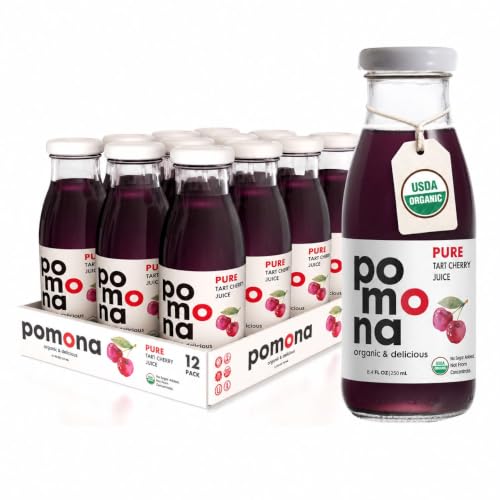
Best ready to drink: Pomona Organic Pure Tart Cherry Juice, 8.4 oz Glass
| Organic Integrity Score | 89 / 100 |
| Format | Ready to drink, 8.4 fl oz glass bottles |
| Ingredients | One: organic tart cherries |
| Processing | Cold pressed, not from concentrate |
| Certification | USDA Organic, Non-GMO, Kosher |
| Packaging | Glass, stated free of BPA, BPS and DEHP |
| Best for | Drinking tart cherry without measuring and diluting |
Everything else on this page is a concentrate you dilute. This is the ready-to-drink alternative, which is a genuinely different product rather than another bottle size.
It is also the only one here that is not from concentrate. Concentrate is reduced by removing water, usually with heat; cold pressed and never reduced is the other end of the processing scale. That is the reason for the price difference, and it is stated plainly rather than implied.
The ingredient claim is as short as it gets: one ingredient, organic tart cherries. Nothing added, no sugar, no preservatives.
The packaging detail is unusually thorough. Glass bottles stated free of BPA, BPS and DEHP — naming BPS specifically is worth noting, because BPS is the substitute compound that replaced BPA in many plastics and is far less often mentioned.
Certification is given as 100% USDA Organic alongside kosher, vegan and gluten-free.
The cost per serving is high next to a concentrate, and that is the honest trade: you are paying not to dilute it yourself.
What we liked: One ingredient, cold pressed and not from concentrate, and glass packaging with BPA, BPS and DEHP all named.
Keep in mind: Much more expensive per serving than concentrate, and 8.4 oz bottles mean more packaging per drink.
What the listing discloses: POMONA ORGANIC JUICES documents a USDA organic claim, kosher certification and a single-ingredient formula, and leaves where it was grown or made unsaid.
Best for a daily dose: Pomona Organic Tart Cherry Juice Concentrate, 32 fl oz
| Organic Integrity Score | 88 / 100 |
| Contents | 100% organic Montmorency tart cherry juice concentrate, 32 fl oz |
| Certification | Certified Organic |
| Best for | Anyone taking a genuine daily dose |
It makes a research-level dose affordable, which is what decides this category. At roughly two ounces a day, a 32 ounce bottle lasts around a fortnight, which is exactly the timeframe over which the sleep and recovery research found effects. Smaller bottles are fine for trying it and become expensive if you keep going.
It is certified organic Montmorency concentrate with nothing added — no sweeteners, no apple juice bulking it out, no preservatives. Dynamic Health have been making this for a long time and the product is consistent bottle to bottle, which matters when you are trying to judge an effect on yourself.
Two honest points. It is intensely tart and needs diluting; taken neat it is genuinely unpleasant and hard on tooth enamel. And once opened it must be refrigerated, where it keeps for several weeks — long enough for the bottle to be used at a proper dose, but not indefinitely, so do not buy this to take occasionally.
What we liked: Makes a research-level daily dose economically realistic. Pure organic Montmorency with nothing added. Consistent from bottle to bottle.
Keep in mind: Extremely tart, must be diluted. Needs refrigerating and finishing within weeks. Poor choice for occasional use.
What the listing discloses: Dynamic Health is thin on detail, and does not say whether the USDA seal applies and where it was grown or made.
Best value: Eden Organic Montmorency Tart Cherry Concentrate, 12.5 oz (Pack of 6)
| Organic Integrity Score | 86 / 100 |
| Contents | Organic tart cherry juice concentrate, 12.5 oz x 6, glass |
| Certification | Not stated on the listing |
| Best for | Long-term daily use with no open-bottle waste |
Six sealed bottles is a genuinely clever format for this product, and it solves a problem the large bottles have. Concentrate must be refrigerated once opened and does not last forever, so a very large bottle can degrade before it is finished. Here, five bottles stay sealed and shelf-stable while you work through one.
Seventy-five ounces total is around five weeks at a full daily dose, at a much better price per ounce than single small bottles.
The trade-offs are cost and fridge space. It is a substantial upfront purchase, and it should not be your first — buy one bottle first and confirm you will actually keep taking it. Six glass bottles is also heavy to ship and takes real storage room.
What we liked: Sealed bottles avoid the degradation problem of one large open bottle. Far better value than buying singles. Glass throughout.
Keep in mind: Substantial upfront cost and a poor first purchase. Heavy and bulky. Still needs refrigerating once opened.
What the listing discloses: Lakewood makes no organic claim anywhere, so the case rests on the other claims it does make.
Best for consistent dosing: Pomona Organic Tart Cherry Concentrate, 16 Servings
| Organic Integrity Score | 85 / 100 |
| Contents | 100% pure organic tart cherry juice concentrate, 16 servings |
| Certification | — |
| Best for | People who want to know they are taking the right amount |
The most common reason tart cherry juice does not work for people is that they take far too little of it, usually a splash rather than a measured ounce. A product with servings clearly defined helps close the gap between what the research tested and what ends up in the glass.
It is the same clean organic concentrate as Dynamic Health’s other bottles, with no additives and no sweeteners.
Two caveats. The serving count assumes the manufacturer’s serving size, which may be smaller than the roughly two ounces daily used in the trials — so read the label and work out your own arithmetic rather than trusting the number on the front. And it sits at middling value against the 32 ounce bottle.
What we liked: Encourages measuring rather than guessing, which is the main failure mode here. Same pure organic concentrate. No additives.
Keep in mind: Manufacturer serving size may be smaller than the studied dose. Middling value per ounce. Refrigerate after opening.
What the listing discloses: Dynamic Health lists a single-ingredient formula. The gap is whether the USDA seal applies and where it was grown or made.
Sleep, recovery, and a sugar cost worth counting
Tart cherry juice has a more interesting evidence base than most juices, and as usual the evidence is not about weight.
Two areas have reasonable support. Tart cherries contain measurable melatonin along with tryptophan and anthocyanins, and several small trials have found improvements in sleep duration and quality with tart cherry juice, particularly in older adults with insomnia. And a body of exercise research has found reduced markers of muscle damage and faster recovery of strength after strenuous exercise, which is why it is common in endurance sport.
Neither is a weight mechanism. The indirect argument through sleep is genuine, since sleep quality and appetite regulation are linked, and it is the same chain discussed for chamomile and magnesium, with a somewhat better-supported first step here.
The cost side needs stating clearly. A cup of tart cherry juice carries around 130 to 140 calories with roughly 30 grams of sugar. Taken nightly for sleep, that is a meaningful daily addition, and the typical dose used in the sleep trials is a cup twice a day, which doubles it.
Concentrate diluted in water is the more sensible form for daily use, delivering the same anthocyanin content in a smaller volume of sugar, and it is considerably cheaper per serving.
Honest summary: genuine evidence for sleep and exercise recovery, an indirect and plausible route to appetite through sleep, and a real sugar cost that argues for the concentrate rather than the bottle if this becomes a nightly habit.
Common questions about organic tart cherry juice
How much tart cherry juice should I drink?
The trials generally used about 30 milliliters, roughly one fluid ounce, of Montmorency concentrate twice daily, diluted in water. That is around two ounces of concentrate a day. Most people who report no effect are taking a fraction of that, often a splash rather than a measured dose.
Does tart cherry juice actually help you sleep?
Several small controlled trials have found modest improvements in total sleep time and efficiency, in the range of tens of minutes. It is one of the few dietary sleep interventions with any controlled evidence at all. It is not a sleeping pill, and the effect is small enough that it will not fix a serious sleep problem.
Is the sleep effect due to melatonin?
Almost certainly not. Tart cherries contain melatonin in micrograms, while sleep supplements are dosed in milligrams — a difference of about a thousandfold. The more plausible explanation from the research is that cherry polyphenols increase the availability of tryptophan, which your body uses to make its own serotonin and melatonin.
Does tart cherry juice help muscle soreness?
This is the strongest area of evidence. Multiple trials, mostly using Montmorency concentrate, have found reduced muscle soreness and faster strength recovery after demanding exercise. The effects are modest and show up most clearly after genuinely hard sessions, particularly ones involving eccentric loading.
Does it help with gout?
Possibly, and the evidence is weaker than for recovery or sleep. Some research associates cherry intake with fewer gout attacks and modest reductions in uric acid, but much of it is observational. Treat it as a reasonable addition to prescribed treatment rather than a replacement for it.
Should I buy concentrate or ready-to-drink juice?
Concentrate. It is what the research used, it is far better value, and reaching a studied dose with ready-to-drink juice would mean drinking an impractical volume. Dilute about an ounce in a glass of water rather than drinking it neat.
Is tart cherry juice high in sugar?
Concentrate is very high in sugar per ounce, since concentrating the juice concentrates everything in it. Diluted to a normal serving it is comparable to other fruit juices. It is worth knowing if you are managing blood glucose, and it is a reason not to assume more is better.
Does the cherry variety matter?
Yes. Almost all the research used Montmorency, a tart variety much higher in anthocyanins than sweet cherries. Balaton is a comparable tart variety with less research behind it. Sweet cherry juice, or blends bulked out with apple or grape juice, are different products that have not been shown to do the same things.
- Organic Supplements and Wellness hub
- Best Organic Beetroot Powder
- Dirty Dozen and Clean Fifteen
- Organic Product Database — search every product we have reviewed, by certification
- Juice labels explained
Price and availability as of October 15, 2026 7:10 pm EDT. Product prices and availability are accurate as of the date/time indicated and are subject to change. Any price and availability information displayed on Amazon.com at the time of purchase will apply to the purchase of this product.
Looking for other organic products?
We have checked more than 800 products across food, household goods, gardening, personal care and pet, every one against its stated certification. Browse all reviews.
Organic Connection is reader-supported. When you buy through links on this page we may earn a commission, at no extra cost to you. As an Amazon Associate we earn from qualifying purchases. We are not paid to feature or rank any product. How we research and rate.