Last updated: September 30, 2026
We may earn a commission when you buy through links on this page, at no extra cost to you. We were not sent samples and no brand paid for placement. How we research and rate.
The short version
Worm castings are among the most useful things you can add to a garden and among the most oversold. The single most important thing to understand before buying is that castings are a soil conditioner, not a fertilizer. The nutrient numbers are tiny, and the value is in structure, microbiology and slow release rather than in feeding a hungry plant.
Our top pick is Back to the Roots Organic Worm Castings, which is by a wide margin the best-selling castings product available and pairs a genuine organic claim with a size and price that suit most home gardeners. Brut Organic Worm Castings is the value choice at a lower cost per pound, and Worm Bliss is the pick if you want an OMRI listing specifically, which is the credential that actually means something for a garden input.
An honest note on this category: castings vary enormously in quality depending on what the worms were fed and how the product was screened and cured, and almost no bag tells you either. Price per pound is also wildly inconsistent, ranging from under a dollar to several dollars for a material that is fundamentally the same thing.
Best organic worm castings compared
Five products, scored on the same criteria. The Organic Integrity Score is out of 100 and our rating is that score expressed out of five. Prices update automatically.
| Best Choice | Best Value | ||||
 |  |  |  |  | |
| Product | Worm Bliss 8 Qt | Back to the Roots | Brut Organic 5 lb | Wiggle Worm 15 lb | 20 oz Castings |
| Organic Integrity Score | 94/ 100 | 92/ 100 | 90/ 100 | 86/ 100 | 78/ 100 |
| Our rating | 4.7 | 4.6 | 4.5 | 4.3 | 3.9 |
| Credential | OMRI listed | Organic | Certified organic | Organic | Organic |
| Demand rank | Strong | Highest here | Strong | Moderate | Low |
| Size | 8 quarts | Mid, container-friendly | 5 lb bag | 15 lb bag | 20 oz |
| Best for | Certified organic growers | Most gardens, first purchase | Lowest cost per pound | Larger beds and borders | Houseplants and trials |
| Price | $25.99$0.16 / ounce View on Amazon | $15.91 $16.99 −6%$0.20 / ounce View on Amazon | $15.99$0.20 / ounce View on Amazon | $26.75$0.11 / ounce View on Amazon | $10.49$0.52 / ounce View on Amazon |
Price and availability as of October 27, 2026 7:10 am EDT. Product prices and availability are accurate as of the date/time indicated and are subject to change. Any price and availability information displayed on Amazon.com at the time of purchase will apply to the purchase of this product.
The organic worm castings certifications, and the question each one leaves open
A seal is a specific promise about a specific thing. These are the promises behind the marks on this page, in plain terms, along with the question each one leaves unanswered.
| Certification | Covers | Key exclusion |
| USDA Organic | Farming and handling: no synthetic pesticides or fertilizers, no GMOs, no sewage sludge or irradiation, audited yearly by an accredited certifier | Three different tiers share the one seal, and it makes no claim about worker pay, food miles, or nutrition |
| OMRI Listed | Review of an input, a fertilizer, pesticide or soil amendment, as allowed in certified organic production | Reviews the product, not the farm: it cannot make your garden or your crop organic |
OMRI Listed is about the input, not the farm. The Organic Materials Review Institute reviews a fertilizer, pesticide or amendment and confirms it is permitted in certified organic production. That is genuinely useful when you are deciding what to put on your own soil. What it does not do is certify the manufacturer, the crop you grow with it, or your garden, and only an accredited certifier can do the last of those.
What worm castings actually are, and what they do
Castings are worm manure: organic matter that has passed through the digestive tract of composting worms, usually red wigglers, and emerged as a fine, dark, crumbly material with a smell like clean forest soil.
The microbiology is the point
Passing through a worm does something compost heaps do not. The gut inoculates the material with a dense and diverse population of bacteria, and the resulting castings carry far more microbial life per gram than the feedstock did going in. Those microbes are what convert bound nutrients in soil into forms roots can take up, and building that population in a depleted bed is the substantive benefit.
This is also why castings behave differently from a bag of nutrients. You are adding a biological system rather than a chemical input, and the results appear over weeks rather than days.
Structure and water holding
Castings have an unusual physical structure: fine aggregates that resist compaction while holding water. Worked into heavy clay they improve drainage and friability; worked into sandy soil they improve water retention. Doing both is uncommon and it is a large part of why castings are recommended so widely.
They also hold water at a rate several times their own weight, which reduces the frequency of watering in containers noticeably.
Slow, gentle nutrient release
The nutrients in castings are bound in organic form and released as soil microbes break them down, which means they cannot burn roots. This is the practical advantage over synthetic fertilizer for seedlings, houseplants and anything you are worried about over-feeding. You can use castings at any concentration, including neat, without risk.
The trade-off is that a plant showing an actual deficiency needs feeding, and castings will not fix it quickly. That is a job for a fertilizer, and our organic fertilizer guide covers the general-purpose options.
OMRI listing, and why it matters more than the word organic here
Garden inputs sit outside the food labeling system, and the credential that carries weight is different from the one on a grocery shelf.
USDA organic certification applies to agricultural products. A bag of worm castings is not a food, so it is not certified under the National Organic Program, and any product using the word organic on a garden input is making an unregulated claim about how it was produced.
OMRI is the body that fills the gap. The Organic Materials Review Institute reviews inputs against the National Organic Program standards and lists products that comply, which is the mechanism a certified organic farm uses to know a given input will not jeopardise their certification. An OMRI listing on a bag of castings means somebody independent examined what went into it. Our OMRI listed explainer sets out exactly what the review covers.
For castings specifically, the relevant question OMRI answers is what the worms were fed. Castings inherit whatever was in the feedstock, including any pesticide residue, heavy metals or contaminants in the bedding and food waste. A listing is the only practical assurance most buyers can get.
The contamination worth knowing about
The specific risk in this category mirrors the one in bulk compost: persistent broadleaf herbicides. If worms are fed material derived from treated hay or manure from animals grazed on treated pasture, those compounds can survive vermicomposting and remain active in the finished castings, producing cupped and twisted growth on tomatoes, beans and potatoes.
It is uncommon in commercial bagged castings and it is not impossible. The precaution is the same one we recommend for compost: if you are unsure of a source, plant a few bean seeds in a pot of it and watch for two weeks before it goes near a bed.
How we scored these castings
Every product on this site is scored out of 100 against the same ten criteria. Four carried most of the weight here.
Verified credentials
OMRI listing scored highest, a specific certified organic claim next, and a general use of the word organic lowest. We checked each claim against the product listing itself rather than the product name, because search results in this category carry heavy sponsored placement and a certification badge on the page frequently belongs to a different product.
Moisture and screening
Castings should arrive damp and crumbly, not dusty and not sodden. Over-dried castings lose a large share of their microbial population, which is the thing you are paying for. Screened castings are more consistent and easier to work with than unscreened material full of undigested bedding.
Cost per pound
Bag sizes in this category range from 20 ounces to 40 pounds and prices do not scale sensibly, so we converted everything. The spread across this page is several-fold for a material that is fundamentally the same.
What the worms were fed
Very few products state this, and the ones that do deserve credit for it. Castings from worms fed a controlled diet are more consistent than castings from an undisclosed waste stream.
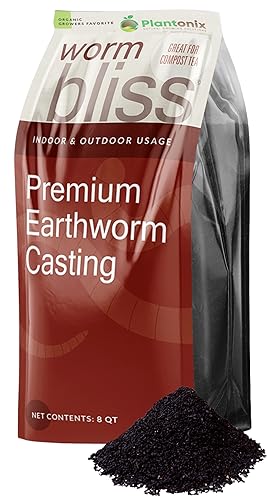
Best overall: Worm Bliss Organic Worm Castings
| Organic Integrity Score | 94 / 100 |
| Credential | OMRI listed |
| Size | 8 quarts, other sizes available |
| Review | Independently assessed against NOP standards |
| Best for | Anyone growing to certified organic standards |
This is the highest-scoring product on the page, and the reason is the OMRI listing rather than anything visible in the bag. An OMRI listing means an independent body reviewed the inputs and the process against the National Organic Program standards, which on a garden input is the only meaningful third-party check available.
For a certified organic grower that is not optional, it is the difference between an input you can use and one you cannot. For a home gardener it is a reasonable proxy for knowing what the worms were fed, which no other product here discloses.
Sold by volume in quarts rather than by weight, which makes direct price comparison against the others awkward. Castings are dense, and 8 quarts is a substantial quantity, but check the conversion if cost per pound is how you are deciding.
The material itself is comparable to the others: fine, screened and damp. You are paying for the paperwork, and in this category the paperwork is the part that is hard to verify any other way.
Containers, seed starting: Back to the Roots Organic Worm Castings
| Organic Integrity Score | 92 / 100 |
| Credential | Organic, stated by the manufacturer |
| Typical NPK | Approximately 1-0-0 |
| Texture | Fine, screened, damp |
| Best for | Containers, seed starting and general soil improvement |
Back to the Roots is the most popular worm castings product on Amazon by a substantial margin, and in a category where consistency is the main variable, volume is a more meaningful signal than usual. Producing castings at scale requires a controlled feedstock and a repeatable curing process, and the brands that sell the most tend to be the ones that have solved that.
The material arrives damp and finely screened, which is what you want. Dry, dusty castings have lost much of the microbial population that justifies the price, and screening removes the undigested bedding that makes cheaper products awkward to mix.
The size is the practical reason it tops the list. Larger bags cost less per pound, and most home gardeners never get through them before the castings dry out and the biology declines. A mid-size bag used within a season is better value than a sack that sits in a shed for two years, whatever the arithmetic says.
The one thing it does not have is an OMRI listing, which is why it scores below Worm Bliss despite outselling it many times over. If you garden to certified organic standards, that distinction matters.
Best value: Brut Organic Worm Castings
| Organic Integrity Score | 90 / 100 |
| Credential | Certified organic |
| Size | 5 lb, larger sizes available |
| Texture | Screened, damp |
| Best for | Getting the most castings for the money |
Brut is a dedicated worm farm rather than a garden brand that added castings to a range, and the product reflects that. The certified organic claim is more specific than the general organic wording most competitors use, and the material is well screened and properly moist.
Cost per pound is the reason it takes the value slot. Brut sell in several sizes and the larger ones drop the price per pound considerably, which makes them the sensible choice if you have beds rather than pots and will get through it in a season.
The 5 lb bag is the right starting point for most people. It treats a reasonable number of containers or a small bed, and it is small enough to use before the biology fades.
There is no OMRI listing here either, so certified growers should look at Worm Bliss. For everyone else, this is the same material as the top pick at a lower cost per pound.
Best for larger beds: Wiggle Worm Organic Worm Castings
| Organic Integrity Score | 86 / 100 |
| Credential | Organic, 100% pure castings |
| Size | 15 lb, 40 lb also sold |
| Best for | Beds and borders where quantity is the constraint |
Wiggle Worm has been producing castings longer than most of the brands here, and the 15 lb bag is the sensible size once you are amending beds rather than pots. The larger 40 lb sack drops the cost per pound further if you have the space to store it and the garden to use it.
The claim is 100% pure castings with no fillers, which matters because some cheaper products blend castings with compost or peat and sell the mixture by the casting name. Reading for the word pure is worth doing across this category.
Scored lower than the top three on credential specificity rather than material quality. The listing states organic without naming a certifier or an OMRI listing, and we have not assumed those are equivalent claims.
Storage becomes the practical issue at this size. Castings that dry out in a shed lose the microbial population that distinguishes them from ordinary compost, so buy the size you will actually use in a season.
Best small size: 20 oz Organic Worm Castings
| Organic Integrity Score | 78 / 100 |
| Credential | Organic |
| Size | 20 oz |
| Best for | A few houseplants, or trying castings before committing |
Included because the small size solves a real problem. Castings decline in biological activity once they dry, and someone with six houseplants will never use five pounds before that happens. A 20 oz bag used within a few months delivers more benefit than a large bag used over three years.
It is by far the most expensive option per pound, which is the honest trade and the reason it scores lowest. You are paying for a quantity that matches your use rather than for the material.
It is also the sensible way to find out whether castings do anything noticeable for your plants before committing to a sack. Top-dress a few pots, water normally, and judge over a couple of months.
How to actually use worm castings
Castings are difficult to misuse, which is one of their genuine advantages, but there are more and less effective ways to apply them.
Top-dressing established plants. Spread a half-inch layer over the soil surface around the plant and water it in. Nutrients and microbes move down with the water. This is the lowest-effort method and it is effective on houseplants, containers and established beds alike, repeated every couple of months during growing season.
Mixing into potting soil. Ten to twenty percent castings by volume is the usual recommendation, which is roughly one part castings to five parts mix. More is not harmful and it gets expensive quickly. Our organic potting soil guide covers what the base mix should be.
Seed starting. A smaller proportion, around ten percent, is plenty. Castings cannot burn seedlings, which makes them a safer amendment than any fertilizer at this stage, and the improved water retention helps in small cells that dry out fast.
Planting holes. A generous handful in the hole when transplanting puts the biology exactly where the new roots will grow. This is probably the highest-value use per pound of castings.
Casting tea. Steeping castings in aerated water to make a liquid drench is popular and the evidence for it is mixed. It certainly extracts soluble nutrients and some microbes. Whether it outperforms simply applying the castings is not well established, and unaerated tea left to sit can go anaerobic and smell foul. If you want to try it, use it within a day.
Storage, shelf life and telling good castings from bad
Keep them damp and out of direct sun. The microbial population is the product, and it declines as the material dries. Store the bag closed in a cool place, and if castings have dried out, moistening them and leaving them a week will recover some of the activity.
They do not expire in the way fertilizer does. Dried-out castings still have value as a soil conditioner, and the physical structure and slow-release nutrients survive. What you lose is the biological component, which is the part that justified the premium.
Judging quality on arrival. Good castings are dark, uniform, crumbly and smell faintly of clean earth. They should hold together lightly when squeezed and break apart easily. Warning signs are a sour or ammonia smell, which suggests incomplete processing, visible undigested bedding, which indicates poor screening, and a dusty texture, which means they were over-dried.
Sowbugs and small organisms are normal. Finding the occasional small creature in a bag of castings is a sign of a living product rather than a fault, and none of them will harm your plants.
Castings against compost and the other amendments
Gardeners frequently buy several amendments that do overlapping jobs, so it is worth being clear about what castings uniquely offer.
Compost is bulkier, cheaper by volume, and better for adding organic matter at scale. It has lower microbial density and less consistency. For improving a whole bed, compost is the economical choice and castings are the concentrated one. Our organic compost guide covers that end.
Bone meal and other single-nutrient amendments supply one thing in quantity. Castings supply everything in small amounts. They solve different problems, and a plant with a genuine phosphorus deficiency needs the former.
General-purpose organic fertilizer feeds plants. Castings improve the soil that feeds plants. Most gardens benefit from both, applied at different times: fertilizer during active growth, castings when planting and as a periodic top-dress.
If you are buying one thing and your soil is poor, buy compost. If your soil is reasonable and you want better results from containers and transplants, buy castings. Buying both and a soil test is better than buying five specialist products, which is the pattern our beginners guide to organic gardening argues against.
Making your own, and whether it is worth it
Anyone buying castings regularly eventually wonders whether to keep worms instead, and the honest answer depends far more on how much you use than on cost.
A domestic worm bin producing a few pounds of castings a month costs perhaps fifty to a hundred dollars to set up, plus worms. Against bagged castings that pays for itself within a season if you are a heavy user, and never if you top-dress a few houseplants twice a year.
The genuine advantages are control and freshness. You know exactly what the worms ate, which resolves the feedstock question no commercial bag answers, and castings used straight from the bin have a microbial population no bagged product can match after storage and shipping. Diverting kitchen waste is a real benefit in its own right.
The drawbacks are equally concrete. A bin needs feeding and attention year-round, it must be kept in a temperature range worms tolerate, which rules out an unheated garage in much of the country, and overfeeding or letting it go too wet produces a smelly anaerobic mess rather than castings. Harvesting is also genuinely tedious, since separating worms from finished castings takes time however you approach it.
The practical middle ground most gardeners land on is a small bin for a steady trickle of high-quality castings for transplants and seed starting, plus bagged castings when a bed needs amending in quantity. Buying compost for bulk organic matter and reserving castings for concentrated use is the more economical pattern either way.
Which plants respond most
Castings help everywhere and the difference is more visible in some situations than others, which is worth knowing if you are deciding where a limited bag goes.
Container plants show the clearest response, because potting mix has no soil biology to begin with and no reserve of organic matter. Peat and coir based mixes are essentially sterile, and adding castings introduces a microbial population that was simply absent. This is where a small quantity does the most work.
Seedlings and transplants benefit from the water retention and the gentleness. A transplant is recovering from root disturbance and cannot use a strong feed, which is exactly the situation castings suit.
Heavy feeders in the ground, such as tomatoes, squash and brassicas, will take castings happily but need a fertilizer as well. Castings improve the soil they grow in; they do not supply the nitrogen a fruiting tomato demands through summer.
Established shrubs and lawns show the least visible response per pound, simply because the volume of soil is large and a bag of castings is small. Compost is the better economics at that scale.
Common questions about organic worm castings
Are worm castings a fertilizer?
Not in any practical sense. They typically test around 1-0-0 against 10-10-10 for a conventional granular feed. They are a soil conditioner that improves structure, water retention and microbial life, and releases small amounts of nutrients slowly.
Can worm castings burn plants?
No. The nutrients are bound in organic form and released by microbial action, so there is no salt concentration to damage roots. You can use castings neat, which is why they suit seedlings and houseplants.
What does OMRI listed mean on worm castings?
It means the Organic Materials Review Institute independently reviewed the product against National Organic Program standards. Since garden inputs are not covered by USDA organic certification, an OMRI listing is the only meaningful third-party check on what went into the bag.
How much should I use?
Around ten to twenty percent by volume when mixing into potting soil, a half-inch layer for top-dressing, and a handful in the planting hole when transplanting. More is not harmful, only expensive.
Do worm castings go bad?
They do not spoil, but they lose microbial activity as they dry out, and that biology is what distinguishes them from ordinary compost. Store them damp and closed, and buy a size you will use within a season.
How can I tell if castings are good quality?
They should be dark, uniform, crumbly and smell faintly of clean earth. A sour or ammonia smell suggests incomplete processing, visible bedding indicates poor screening, and a dusty texture means they were over-dried.
Is worm casting tea better than applying them directly?
The evidence is mixed. Brewing extracts soluble nutrients and some microbes, but whether it outperforms direct application is not well established. Unaerated tea can turn anaerobic and smell foul, so use it within a day if you make it.
Looking for other organic products?
We have checked more than 800 products across food, household goods, gardening, personal care and pet, every one against its stated certification. Browse all reviews.
Organic Connection participates in the Amazon Services LLC Associates Program, an affiliate advertising program designed to provide a means for sites to earn advertising fees by advertising and linking to Amazon.com.