Last updated: August 28, 2026
We may earn a commission when you buy through links on this page, at no extra cost to you. How we research and rate.
The short version
This guide covers filters you carry rather than install. If you want filtration for a house, that is a different purchase entirely: see under-sink filters or whole house systems.
Our top pick is the Sawyer MINI, with an Organic Integrity Score of 92 out of 100. It publishes the numbers that matter for a backpacking filter, in the units that category actually uses.
And that is the thing worth understanding before you buy. These two products are evaluated under completely different frameworks. An RV hose filter is rated against NSF/ANSI standards, the same ones used on a kitchen filter. A backpacking filter is rated in log reduction of bacteria and protozoa under EPA and ASTM protocols. Neither number tells you anything about the other.
Two products, two problems
The single most useful distinction in this category, and the reason a single “best portable filter” answer does not exist.
An RV or campground filter treats water that is already potable. Municipal supply arrives at the hookup, already disinfected. What it has picked up is the taste of the campground’s chlorine, sediment and rust from the standpipe, and whatever is in a hose that has been sitting in the sun. The job is aesthetic: taste, odour, sediment and some metals.
A backpacking filter treats water that is not potable at all. A stream, a lake, a tap of unknown quality abroad. The job is microbiological: bacteria, protozoa and, in some cases, viruses. Taste is irrelevant if the water makes you ill.
Because the jobs differ, the evidence differs.
RV filters cite NSF/ANSI standards, mostly 42 for chlorine and taste, sometimes 53 for health contaminants, and 372 for lead-free materials. These are the same standards we use to judge household filters, and the same caveats apply: the number matters more than the word certified.
Backpacking filters cite log reduction against protocols from the US EPA, NSF and ASTM. A log is a factor of ten, so 6-log is 99.9999 percent and 7-log is 99.99999 percent. The EPA’s guide standard for a microbiological purifier asks for 6-log against bacteria, 4-log against viruses and 3-log against protozoan cysts.
Buying the wrong one is a real mistake. An RV carbon filter does nothing meaningful about bacteria, and taking one into the backcountry would be dangerous. A hollow-fiber backpacking filter does very little for chlorine taste, which is what a campground hookup actually needs.
Micron ratings, and the word “absolute”
The specification that decides what a portable filter physically stops.
Backpacking filters work by size exclusion through a hollow-fiber membrane. Nothing larger than the pore passes, which is why they are so effective against organisms and why they need no chemicals.
0.1 micron is the meaningful threshold. Bacteria are roughly 0.2 to 2 microns and protozoan cysts considerably larger, so a 0.1 micron membrane excludes both by physics. Viruses are far smaller, around 0.02 micron, and pass straight through, which is why hollow-fiber filters generally do not claim virus removal.
“Absolute” versus “nominal” is the part to read. An absolute rating means essentially every pore is at or below the stated size. A nominal rating is an average, so a meaningful fraction of pores are larger. One filter here specifies “0.1 micron absolute”, which is the stronger claim and the one worth paying for.
By contrast, RV filters run at 20 microns, which sounds crude and is correct for the job. The filter has to pass enough flow to fill a tank without becoming a bottleneck, and the target is silt and rust rather than organisms. The chlorine and taste work is done by the carbon and KDF, not by the pore size.
One practical note that catches people out. Hollow-fiber filters must not freeze. Water inside the fibers expands and splits them, and a split membrane still passes water while filtering nothing. There is no way to tell by looking, which is why the guidance is to discard a filter that may have frozen.
What about viruses?
The gap in almost every product here, and it matters where you are going.
Viruses are around 0.02 micron, an order of magnitude smaller than the 0.1 micron pores in a hollow-fiber filter. Filtration alone does not remove them. Products that address viruses do it chemically, with iodine or chlorine dioxide, or physically with ultrafiltration or reverse osmosis, or with UV.
Whether that matters depends entirely on where the water comes from.
In North American and European backcountry, waterborne illness is overwhelmingly protozoan, principally Giardia and Cryptosporidium, with bacteria second. Viral transmission through wilderness water is uncommon because it generally requires human faecal contamination. A 0.1 micron filter is a reasonable answer.
In regions with poor sanitation, viral contamination is a genuine risk and a filter alone is not enough. The usual answer is a filter plus chemical treatment, or a device specifically sold as a purifier rather than a filter.
The distinction is deliberate in the industry: “filter” removes bacteria and protozoa; “purifier” additionally addresses viruses. None of the products in this guide is sold as a purifier, and that is worth knowing rather than assuming.
The emergency case, which is different again
A third use sits alongside RV and backcountry, and it changes which specification matters.
In a boil-water notice or after flooding, the failure is disinfection at the utility rather than contamination at source. Municipal water is still arriving, treated for chemistry, with the microbiological barrier compromised. That is precisely what a hollow-fiber filter addresses, which makes a backcountry filter a sensible thing to own even if you never hike.
For storage, prioritise shelf life over flow rate. A filter that lives in a cupboard for five years needs no moving parts, no batteries and no chemicals with an expiry date. A straw or squeeze filter kept dry stores essentially indefinitely; a chemical treatment does not.
Two things people get wrong. Cheap is the right answer here, because you want several distributed across a house, a car and a bag rather than one good one you cannot reach. And a filter does not replace stored water: it extends whatever you have access to, and if the taps are dry it does nothing at all.
Best portable water filters compared
| Best Choice | Best Value | ||||
 |  |  |  |  | |
| Product | Sawyer MINI | Camco Tastepure XL | LifeStraw Personal | Waterdrop Gravity Straw | GLACIER FRESH RV |
| Organic Integrity Score | 92/ 100 | 90/ 100 | 86/ 100 | 68/ 100 | 62/ 100 |
| Our rating | 4.6 | 4.5 | 4.3 | 3.4 | 3.1 |
| Use case | Backcountry | RV and campground | Backcountry, travel | Camping, gravity | RV and marine |
| Evidence given | Log reduction, 3 figures | NSF/ANSI 42, 53, 372 | EPA, NSF, ASTM protocols | Micron only | 97.9% chlorine figure |
| Filtration | 0.1 micron absolute | 20 micron, GAC and KDF | 1 micron, 0.2 turbidity | 0.1 micron | 20 micron, GAC and KDF |
| Price | $23.77 $28.99 −18% View on Amazon | $26.99 $29.16 −7% View on Amazon | $14.99 $17.95 −16% View on Amazon | $32.99 $39.99 −18% View on Amazon | $21.24 $24.99 −15%$10.62 / count View on Amazon |
Price and availability as of September 1, 2026 4:02 am EDT. Product prices and availability are accurate as of the date/time indicated and are subject to change. Any price and availability information displayed on Amazon.com at the time of purchase will apply to the purchase of this product.
Best overall: Sawyer MINI Water Filtration System
| Organic Integrity Score | 92 / 100 |
| Configuration | 0.1 micron absolute hollow fiber inline filter, 2 ounces |
| Published performance | 99.99999% bacteria, 99.9999% protozoa, 100% microplastics |
| Best for | Backcountry water, where organisms are the risk |
The best-documented product in this guide, and it earns that by giving three separate figures in the correct units rather than one adjective.
99.99999 percent of bacteria, naming Salmonella, Cholera and E. coli. 99.9999 percent of protozoa, naming Giardia and Cryptosporidium. 100 percent of microplastics. Those are 7-log and 6-log reductions, which meet and exceed the EPA guide standard thresholds for bacteria and cysts.
The membrane is specified as 0.1 micron absolute, which is the stronger of the two possible ratings and the reason those log figures are achievable. Nominal ratings allow a fraction of larger pores; absolute does not.
It also states that every unit is individually tested three times before shipping, which is a manufacturing claim rather than a certification and is more than most brands offer.
Two honest limits, and both apply to the whole hollow-fiber category. It does not address viruses, which are too small for a 0.1 micron pore, so it is a filter rather than a purifier. And it must not be allowed to freeze, because ice splits the fibers and a split filter passes water while filtering nothing.
What we liked: Three log-reduction figures with organisms named. 0.1 micron absolute rather than nominal. Two ounces and fits in a palm. Individually tested units.
Keep in mind: No virus removal, as with all hollow-fiber filters. Ruined by freezing with no visible sign. Does nothing for chlorine taste.
Best for: Hiking and backcountry water in North America and Europe.
Best for RV: Camco Tastepure XL
| Organic Integrity Score | 90 / 100 |
| Configuration | Inline hose filter, GAC and KDF, 20 micron sediment, flexible hose protector |
| Certification | Independently tested and listed to NSF/ANSI 42 and 53; CSA certified to 372 |
| Best for | Campground hookups, where taste and sediment are the problem |
The best-selling RV filter and the only one here naming three separate standards, including the health-effects standard that most of this category skips.
The wording is worth reading carefully and is to its credit. It says the filter is “independently tested & listed to standards NSF/ANSI 42 & NSF/ANSI 53”, and separately that it is “CSA lead-free content certified to NSF/ANSI 372”. Tested and listed is a slightly weaker construction than certified, and naming CSA as the body for the materials certification is more than nearly anything else in this category offers.
Mechanically it is the right build for the job: GAC for taste and chlorine, KDF to control bacterial growth inside a filter that sits wet in a hot locker between trips, and a 20 micron sediment stage for standpipe rust.
The XL body is the practical advantage. A wider filter drops less pressure, which matters when you are filling a fresh tank through a hose, and the flexible hose protector stops the filter levering against the inlet fitting.
It is not a backcountry filter. At 20 microns it does nothing meaningful about bacteria or protozoa, and it is not sold as though it does.
What we liked: Names 42, 53 and 372, and names CSA as certifier. KDF inhibits growth inside a hot locker. Wide body keeps pressure up. Hose protector included.
Keep in mind: “Tested and listed” is weaker than certified. 20 micron, so no organism removal. Seasonal item that should be dried and stored.
Best for: RV and campground hookups on treated municipal supply.
Best value: LifeStraw Personal Water Filter
| Organic Integrity Score | 86 / 100 |
| Configuration | Hollow fiber drinking straw, no moving parts, BPA-free |
| Published performance | Microplastics to 1 micron, turbidity to 0.2 micron; claims verified to EPA, NSF and ASTM protocols |
| Best for | Emergency kits, travel and a cheap first filter |
The best-selling portable filter by a wide margin, the cheapest product in this guide, and the one that named the most testing bodies.
Rather than citing a single certification, the listing states that all claims are verified with laboratories using standard testing protocols set by the US EPA, NSF and ASTM. Naming three protocol authorities is a stronger position than “lab tested”, and it is one step short of publishing the resulting figures, which is what keeps it below the Sawyer.
The specifications it does publish are precise: microplastics down to 1 micron, turbidity reduced to 0.2 micron.
As an object it is close to unimprovable for an emergency kit. No moving parts, nothing to break, nothing to power, and it stores indefinitely if kept dry and unfrozen. One in a bug-out bag, one in a car, one in a rucksack is a sensible use of very little money.
The straw format is the limitation. You drink directly from the source rather than filling a bottle, which is fine at a stream and awkward for cooking or for filling a reservoir. The Sawyer’s inline design is more flexible for actual trips.
What we liked: Names EPA, NSF and ASTM protocols. Specific micron figures for microplastics and turbidity. Cheapest here. Nothing to break or maintain.
Keep in mind: Names the protocols without publishing the log figures. Straw format is awkward for filling containers. No virus removal.
Best for: Emergency kits, travel and anyone buying their first filter.
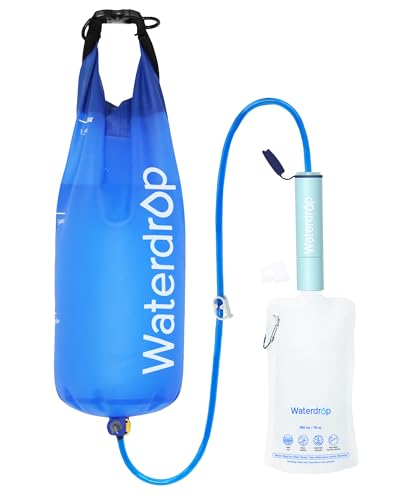
Best gravity option: Waterdrop Gravity Water Filter Straw
| Organic Integrity Score | 68 / 100 |
| Configuration | 0.1 micron ultrafiltration membrane, gravity fed with hanging bag |
| Published performance | Micron rating only; no log reduction figures or protocols named |
| Best for | Group camping, where volume beats portability |
A different format solving a real problem: filtering enough water for several people without standing over it.
Gravity systems hang a bag of untreated water above a container and let head pressure do the work. For a group camp that is far more practical than a squeeze filter, because you fill the bag once and come back to clean water rather than working the filter for every liter.
The membrane is 0.1 micron ultrafiltration, which is the same threshold as our top pick and the right specification for bacteria and protozoa.
What holds the score down is evidence. The listing gives the micron rating and stops. No log reduction figures, no protocol named, no organisms listed. Since 0.1 micron is the correct pore size, the physics are probably fine; we simply have not been shown any measurement, and two competitors here publish theirs.
Gravity systems are also slower than the specification suggests once the membrane starts to load, and they need backflushing to maintain flow.
What we liked: Gravity feed suits groups and base camps. 0.1 micron is the right threshold. Filters volume without effort.
Keep in mind: Publishes a micron rating and nothing else. Slows as the membrane loads. Bulkier than a squeeze or straw filter.
Best for: Group camping and base camps.
Read the claim first: GLACIER FRESH RV/Marine Filter
| Organic Integrity Score | 62 / 100 |
| Configuration | Inline RV and marine hose filter, GAC and KDF, 20 micron, two pack |
| Published performance | 97.9% chlorine reduction by independent lab; fluoride reduction also claimed |
| Best for | Buyers who want the media and can discount one claim |
A well-bought RV filter that does one thing better than most of the category and one thing considerably worse.
The good part: it publishes a specific figure, 97.9 percent chlorine reduction, attributed to independent laboratory testing, and states its micron rating plainly at 20 microns. A number with a decimal place usually comes from a real test.
The problem is the sentence beside it. The listing says the GAC and KDF media “can effectively reduce fluoride to protect your teeth, bones, and digestive system”. Granular carbon and KDF do not meaningfully remove fluoride. Fluoride is a small dissolved ion, and removing it requires reverse osmosis or activated alumina. We set this out in our guide to what each filter type is certified for.
The added health framing makes it worse rather than better, since it attaches a benefit to a mechanism that does not work.
No NSF/ANSI standard is named anywhere, which by the standards of this category is a further gap: two competitors name theirs.
The hardware is ordinary and fine. GAC and KDF at 20 microns is the correct build for a hose filter, it comes as a two pack, and on chlorine and taste it will do the job. The score reflects the gap between the product and the paragraph.
What we liked: Publishes a specific chlorine figure with a decimal place. States its micron rating. Two pack at a low price. Correct media for the job.
Keep in mind: Claims fluoride reduction, which GAC and KDF do not deliver. Adds a health benefit to that claim. No NSF/ANSI standard named.
Best for: Chlorine and taste at a hookup, ignoring the fluoride line.
What we left out and why
Kohree and similar “NSF Certified” hose filters. Several RV filters put NSF certification in the title with no standard number anywhere in the listing. As with every category we cover, letters without a number tell you that something was certified without telling you what.
Filter bottles. LifeStraw, Waterdrop and others sell bottles with the filter built into the lid. Convenient, and a different product with a different trade-off between capacity and weight, so a different comparison.
Purifiers. Devices addressing viruses through chemistry, ultrafiltration or UV are a separate category and the right answer for travel in regions with poor sanitation. Nothing in this guide is sold as a purifier.
The limit of this method applies here with one addition. We read what each listing claims and how far it substantiates it, and we have not tested these filters. In this category the consequence of a wrong purchase is different from the rest of our water coverage: a filter that underperforms on chlorine gives you unpleasant water, and a filter that underperforms on organisms makes you ill. Where a listing gave us no measurement at all, we have said so plainly rather than assuming the physics work out.
How to use and maintain a portable filter
- Fit it at the spigot, not at the RV. Putting the filter at the tap end means the hose is filled with filtered water rather than storing unfiltered water between uses.
- Use the hose protector. The flexible section stops the filter’s weight levering against the fitting, which is what cracks housings.
- Flush before the first fill. Run water through for a minute or two; new carbon sheds fines.
- Dry and store it between trips. A wet filter in a warm locker grows biofilm. KDF slows that and does not stop it.
- Replace each season, or sooner with heavy use. There is no indicator.
- Backflush regularly. Most come with a syringe. Flow slowing is the membrane loading, not the filter failing, and backflushing restores it.
- Pre-filter silty water. A bandana or coffee filter over the intake dramatically extends membrane life in turbid water.
- Never let it freeze. Ice splits hollow fibers and a split filter passes water while filtering nothing, with no visible sign. On winter trips it sleeps in your bag.
- Keep clean and dirty separate. Mark the bags or bottles. Cross-contaminating the clean side defeats the filter entirely.
- Dry it fully before storage. A damp membrane in storage grows mold.
- Add chemical treatment for viruses where sanitation is poor. The filter handles bacteria and protozoa; it does not handle viruses.
What it costs to run
Two very different cost profiles hide behind one category name.
RV filters are consumables. No indicator, no way to test them, replaced each season or when the taste returns. Multipacks are the sensible purchase and most of these ship as two or four.
Backcountry filters are near-permanent if looked after. Membranes are rated in thousands of gallons and backflushing restores flow rather than replacing the unit. The realistic end of life is not exhaustion but a freeze, a drop, or losing it.
Questions about portable water filters
Can I use an RV filter for backpacking?
No. RV hose filters are typically 20 micron and target chlorine, taste and sediment in water that is already treated. They do not remove bacteria or protozoa, and using one on stream water would be dangerous.
What does 99.9999% mean on a backpacking filter?
It is a log reduction figure. Each nine is a factor of ten, so 99.9999 percent is 6-log. The EPA guide standard for a microbiological purifier asks for 6-log against bacteria and 3-log against protozoan cysts.
Do these filters remove viruses?
No. Viruses are around 0.02 micron and pass through a 0.1 micron membrane. Filters handle bacteria and protozoa; addressing viruses needs chemical treatment, ultrafiltration or UV. That is the difference between a filter and a purifier.
What is the difference between absolute and nominal micron ratings?
Absolute means essentially every pore is at or below the stated size. Nominal is an average, so some pores are larger. For organism removal, absolute is the rating that matters.
Why must a hollow fiber filter not freeze?
Water inside the fibers expands as it freezes and splits them. A split filter still passes water while filtering nothing, and there is no visible sign, so a filter that may have frozen should be replaced.
Where should the RV filter go, at the tap or the RV?
At the tap. Filtering at the spigot means the hose holds filtered water rather than storing unfiltered water between uses.
Do RV filters remove fluoride?
No, despite one product in this guide claiming it. Granular carbon and KDF do not remove fluoride. That requires reverse osmosis or activated alumina.
How do I know when a backpacking filter is spent?
Flow slows as the membrane loads, and backflushing restores it. Genuine end of life is usually damage or freezing rather than exhaustion, since membranes are rated for thousands of gallons.
Organic Connection is reader supported. We check every product against its stated certification and say plainly when a claim cannot be verified. How we research and rate.