Last updated: August 31, 2026
We may earn a commission when you buy through links on this page, at no extra cost to you. How we research and rate.
The short version
Our top pick is 365 by Whole Foods Market Organic Oregano, with an Organic Integrity Score of 90 out of 100. It uses the regulated phrase “USDA certified organic” in a two-line listing, and it is the cheapest product here.
Dried herbs are one of the few categories where organic certification buys something concrete, specific and checkable — and none of the five listings we read mentions it.
Whole spices and dried herbs carry a real microbial risk, because they are grown in soil, dried in open air and handled repeatedly. The conventional industry manages that with two treatments: irradiation, and fumigation with ethylene oxide. Organic certification prohibits both.
That prohibition is the single most substantive thing the organic seal delivers on a jar of oregano. It is worth more than the flavor language and the sourcing stories that fill these listings, and not one of them says it out loud.
What organic certification prohibits on a spice
This is unusually concrete, which is why it is worth setting out properly.
Irradiation. Conventional spices are frequently treated with ionizing radiation to reduce bacterial load. It is effective, it is permitted in the United States, and retail spices treated this way are required to carry the radura symbol and a statement. Organic certification prohibits it outright.
Ethylene oxide fumigation. ETO is a gas used to sterilize spices, and it is the older and more contentious method. It is classified as a carcinogen, its use on food is banned in the European Union, and the United States permits it subject to residue limits. Organic certification prohibits it.
Synthetic anti-caking agents and the usual list of synthetic processing aids are likewise excluded.
What organic producers use instead is generally steam sterilization, which achieves microbial control with heat and moisture rather than radiation or gas. It is permitted, it is more expensive, and it can dull volatile aroma compounds slightly, which is the honest trade-off.
Set against the categories we have audited recently, this is the strong end of what organic certification can mean. On salt it cannot apply at all. On many packaged foods it governs farming a long way upstream. On dried herbs it governs a specific processing step, and it forbids two named treatments that are otherwise standard.
Why nobody advertises it
We can only speculate about the reason, and two explanations seem plausible.
The first is that naming a treatment you do not use draws attention to a treatment the reader had not thought about. Telling shoppers that conventional oregano may have been fumigated with a carcinogen is a strong argument for organic, and it is also an unpleasant thing to introduce next to a photograph of a herb jar.
The second is simpler: spice marketing has settled on flavor and provenance as its vocabulary, and processing detail sits outside it. Every listing here talks about aroma, cuisine and sourcing, because that is the genre.
Either way the effect on a buyer is the same. The most defensible reason to pay more for organic herbs is invisible on the page, so the decision gets made on brand feel instead. That is the pattern this site exists to interrupt, and it applies here more sharply than in most categories because the underlying fact is so clear-cut.
Volatile oils are what you are actually buying
Beyond certification, the real quality question in dried herbs is one no listing here quantifies either.
A dried herb’s flavor lives in its volatile oil content, and that degrades with time, heat, light and air. It is why a jar of oregano bought two years ago tastes like green dust, and why the same herb from a fresh batch tastes sharp and resinous.
Volatile oil content is measurable and the spice trade does measure it, expressing it as a percentage by volume. None of these listings publishes a figure, which is consistent with what we found in saffron, where one seller in five named the ISO standard that grades it and the rest used undefined letter grades.
Two proxies are available to a shopper. Package size against your usage is the more useful: a 16 oz bulk bag of oregano is excellent value and terrible value simultaneously, depending on whether you finish it within a year. And whole versus ground matters, because whole leaves retain volatile oils considerably longer than ground powder, which has vastly more surface area exposed to air.
The practical rule: buy whole leaf where the recipe allows, buy the smallest jar you will actually use up, and crush between your fingers as you add it.
One listing says organic in the body and not the title
Across this cluster of guides we have repeatedly found the organic claim sitting in the title, where it captures searches, and vanishing from the body, where it would need supporting. Frontier Co-op does the reverse.
Its title reads “Frontier Co-Op Mediterranean Oregano, Fancy-Grade, 16 Oz, Bulk Bag” — no organic claim at all. The first feature bullet then describes “Frontier Co-op Organic Fancy Grade Oregano”.
That is the more conservative arrangement, and it is mildly odd commercially, since the title is where the word would earn its keep. We read it as a listing that has not been carefully aligned rather than as anything meaningful about the product, and we note it because the inverse pattern is so common that its opposite is worth remarking on.
“Fancy grade” is worth a caution of its own. It sounds like a specification and it is a trade descriptor without a standardized definition, in the same family as the “Grade A+” saffron language. It generally indicates larger, cleaner leaf material, and nothing about it is measurable from the listing.
What we looked for
We read every feature bullet on every listing in full and scored on what each manufacturer put in writing.
Whether irradiation or ETO is addressed. The concrete prohibition organic certification delivers here, and the thing most worth saying.
The exact organic wording. “USDA certified organic” is the regulated phrase; brand slogans about being an organic company are not the same claim.
Whole leaf versus ground, since it determines how long the flavor survives.
Package size against realistic use, because bulk value is only value if you finish it.
Sourcing disclosure, where a company describes how it buys rather than asserting that it cares.
Best organic dried herbs compared
 |  |  |  |  | |
| Product | 365 Organic Oregano | Simply Organic Oregano | Simply Organic Italian Seasoning | Frontier Co-op Oregano | McCormick Gourmet Variety |
| Organic Integrity Score | 90 / 100 | 84 / 100 | 82 / 100 | 76 / 100 | 66 / 100 |
| Organic wording | “USDA certified organic” | “Premium organic”, brand claim | “Premium organic blend” | Body only, not title | Title only |
| Irradiation / ETO addressed | No | No | No | No | No |
| Sourcing disclosed | No | Direct, fair prices, no middleman | Direct, fair prices, no middleman | Co-op structure | No |
| Size | 0.35 oz | 0.75 oz | 0.95 oz blend | 16 oz bulk | 4-jar pack |
| Listing issues | None | None | Duplicated bullet | Title/body mismatch | One bullet only |
| Price | $3.58 $3.99 −10%$10.23 / ounce View on Amazon | $5.43$7.24 / ounce View on Amazon | $5.43$5.72 / ounce View on Amazon | $14.93$0.93 / ounce View on Amazon | $16.64 $20.81 −20%$3.78 / ounce View on Amazon |
Price and availability as of September 4, 2026 1:10 am EDT. Product prices and availability are accurate as of the date/time indicated and are subject to change. Any price and availability information displayed on Amazon.com at the time of purchase will apply to the purchase of this product.
Best overall: 365 by Whole Foods Market Organic Oregano
| Organic Integrity Score | 90 / 100 |
| Certification | “USDA certified organic”, stated in those words |
| Size | 0.35 oz |
| Listing | Two bullets, both factual |
| Best for | Everyday cooking, in a jar you will finish while it still tastes of something |
Two lines of listing copy, and one of them is the regulated phrase. That is the entire case and it is enough.
The bullets read “0.35 ounce organic oregano” and “USDA certified organic”. No flavor poetry, no brand mission, no provenance narrative. Just the size and the certification, stated in the form that refers to the finished product rather than to the company’s philosophy.
It is also the cheapest product in this comparison by a considerable margin, which repeats a pattern we keep finding: across ketchup, stevia, salt and now dried herbs, the supermarket own-brand has consistently used the regulated wording while premium competitors reach for atmosphere.
The small jar is a genuine advantage rather than a limitation. Dried herbs lose volatile oils steadily once opened, so 0.35 oz of oregano that you finish in six months delivers more flavor than a bulk bag that sits for three years. Buying small and often is the correct strategy with dried herbs, and this is priced to make that easy.
What it does not do is anything beyond the basics. No processing statement, no origin, no volatile oil figure, no indication of whole leaf versus cut and sifted. And like every listing here, it says nothing about irradiation or ETO, which is the argument it could most usefully have made.
- Uses “USDA certified organic”, the regulated phrase, in a two-line listing.
- Cheapest product in this comparison by a wide margin.
- Small jar suits how dried herbs actually degrade.
- No unsupported flavor or health claims.
- Says nothing about irradiation, ETO or steam treatment.
- No origin, grade or volatile oil information.
- Does not state whether the leaf is whole or ground.
- Own-brand, so tied to one retailer’s supply.
Best for: Everyday cooking, bought small and replaced often.
Best sourcing disclosure: Simply Organic Oregano
| Organic Integrity Score | 84 / 100 |
| Organic wording | “Premium organic oregano”; brand described as all-organic |
| Sourcing | Direct from partners, fair prices, no middleman |
| Size | 0.75 oz |
| Best for | Buyers who want the sourcing chain described, not just asserted |
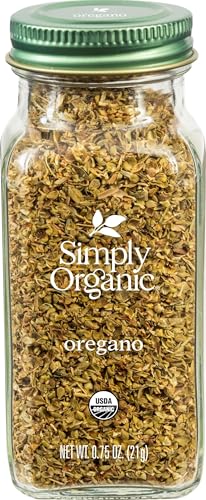
The best-known dedicated organic spice brand, and the only listings here that describe how the company buys rather than simply claiming to care.
The sourcing bullet is specific in a way that matters: “Simply Organic works directly with sourcing partners whenever possible, paying fair prices directly to them, without a middleman, to maximize the grower’s return.” That describes a mechanism. It names direct trade, it names the absence of an intermediary, and it states where the benefit lands. Compare it with “ethically committed” or “people and planet before profits” and the difference in information content is obvious.
“Whenever possible” is a hedge and an honest one. A spice company sourcing from many origins cannot buy everything directly, and saying so is better than implying it can.
The certification wording is where it slips behind our top pick. Simply Organic describes itself as “the original, all-organic spice brand” and the product as “premium organic oregano”. Both are brand-level claims rather than the regulated product-level phrase. The company is genuinely an organic specialist and the products are certified, so this is a matter of wording rather than substance, and wording is what we score.
At 0.75 oz the jar is double our top pick’s and still small enough to finish. It costs more per ounce than the own-brand, which is the usual premium for a specialist producer with a sourcing program.
- Describes its sourcing mechanism rather than asserting ethics.
- Hedges honestly with “whenever possible”.
- Dedicated organic spice brand with a long record.
- 0.75 oz is a realistic jar size for a common herb.
- Uses brand-level organic language rather than the regulated phrase.
- No mention of irradiation, ETO or steam treatment.
- No origin or volatile oil information.
- More expensive per ounce than the own-brand equivalent.
Best for: Buyers who want to know how the company sources, and will pay a little for it.
Best blend, with a listing error: Simply Organic Italian Seasoning
| Organic Integrity Score | 82 / 100 |
| Contents | Oregano, marjoram, thyme, rosemary, basil, sage |
| Also stated | Kosher, non-GMO |
| Size | 0.95 oz |
| Best for | One jar covering six herbs, if you cook Italian occasionally |
The practical purchase for a small kitchen, and the reason is arithmetic rather than flavor.
Six herbs in one jar means one thing to store, one thing to replace and one expiry date to track, instead of six jars each losing volatile oils on their own schedule. For anyone who cooks Italian food occasionally rather than constantly, a blend is the honest answer: individual jars of marjoram and sage bought for one recipe will be stale long before they are finished.
The listing names all six herbs in the title, which is the right level of disclosure for a blend, and adds kosher and non-GMO. Non-GMO is close to meaningless on dried herbs, since there are no commercially grown genetically modified culinary herbs, but it is a real certification rather than an invented one.
Two things hold it below the single herb. A blend does not state proportions, so you do not know whether you are buying mostly oregano with a suggestion of sage or something balanced. That is standard across seasoning blends and it is still information you do not have.
And the listing contains a straightforward error: the Italian Seasoning description bullet appears twice, word for word. It changes nothing about the product and it is the sort of carelessness we note, because a page that has not been proofread is a weak signal about everything else on it.
The sourcing language is the same strong disclosure as its sibling above, which is what keeps the score in the eighties.
- Names all six herbs in the blend.
- One jar to store and replace instead of six.
- Same direct sourcing disclosure as the single-herb product.
- Kosher and non-GMO stated.
- One feature bullet is duplicated word for word.
- Blend proportions are not stated.
- Non-GMO is close to meaningless on culinary herbs.
- No processing, origin or irradiation statement.
Best for: Occasional Italian cooking, where six separate jars would go stale.
Best bulk value: Frontier Co-op Mediterranean Oregano
| Organic Integrity Score | 76 / 100 |
| Organic wording | Absent from the title; “Organic Fancy Grade” in the body |
| Size | 16 oz bulk bag |
| Structure | Co-operative, stated mission |
| Best for | High-volume cooking or batch preserving, not a domestic spice rack |
By far the most oregano here, and the value case depends entirely on a question about your own kitchen.
Per ounce this is dramatically cheaper than the small jars. Sixteen ounces of dried oregano is an enormous quantity, though: several years of normal domestic use, over which volatile oils will fade steadily regardless of how well you store it. Bulk is genuine value for a restaurant, a large household, someone making batches of sauce for freezing, or anyone splitting an order. For a spice rack it is a slow way to buy stale oregano.
The certification arrangement is the notable oddity, and it runs the opposite way to almost everything else we audit. The title carries no organic claim while the body describes “Frontier Co-op Organic Fancy Grade Oregano”. Nothing about that is misleading; it just means the word is absent from the place it would sell hardest.
The co-operative structure is a real distinction, and the mission language, “united by our mission to put people and planet before profits”, is the weakest kind of sourcing statement precisely because Simply Organic shows what a specific one looks like. A co-op is a form of ownership, which is more concrete than most ethics claims, and the listing does not explain what it means for growers.
“Fancy grade” carries no standardized meaning, as noted earlier.
- Dramatically cheaper per ounce than any jar here.
- Co-operative ownership, a real structural distinction.
- Suits batch cooking, preserving or splitting with others.
- Makes no claim in the title it does not support in the body.
- 16 oz is years of domestic use, over which flavor fades.
- Organic claim appears only in the body, not the title.
- “Fancy grade” has no standardized definition.
- Mission language is vague where a competitor is specific.
Best for: Batch cooks, large households and anyone splitting a bag.
One bullet, four jars: McCormick Gourmet Organic Variety Pack
| Organic Integrity Score | 66 / 100 |
| Contents | Oregano, garlic powder, crushed rosemary, thyme |
| Listing | One feature bullet, listing the four contents |
| Organic wording | In the title; the body repeats the word without elaboration |
| Best for | Setting up a kitchen from nothing, if convenience outweighs disclosure |
A four-jar starter set from the most recognizable spice brand in America, sold with the least information on this page.
The entire body copy is one bullet: “Four favorite herbs and seasonings: McCormick Gourmet Organic Garlic, Thyme, Oregano and Rosemary.” That is a contents list. There is no sourcing, no processing, no origin, no certification statement beyond the repeated word, and no explanation of what the Gourmet line means.
The concept is sound. Four separate jars covering the common Mediterranean herbs is a reasonable way to stock an empty kitchen, and garlic powder is genuinely useful alongside the leaf herbs.
The price is the problem relative to what it tells you. It is the most expensive item here, and per ounce it is far above the single jars, while disclosing considerably less than a supermarket own-brand costing a fraction as much.
McCormick is a very large and long-established company and there is no reason to doubt the certification. Our scoring is about what a buyer can read, and on that measure this is the thinnest listing in the comparison.
- Four separate jars covering common Mediterranean herbs.
- Includes garlic powder, useful alongside leaf herbs.
- Widely available, familiar brand, easy to replace individually.
- Sensible starter set for an empty kitchen.
- A single feature bullet, which is just a contents list.
- Most expensive item here, and by a wide margin per ounce.
- No sourcing, processing, origin or certification detail.
- Says nothing about irradiation or ETO, like everything else here.
Best for: Stocking an empty kitchen quickly, accepting that the page tells you little.
What we left out and why
We left out herb seeds and live plants, which appear in searches for organic herbs and are a different purchase entirely. Growing your own is the one reliable way to get herbs with full volatile oil content, and it belongs alongside our vegetable seed coverage rather than here.
We left out medicinal and tea herbs sold as supplements, which are governed by different rules and different quality questions, and which we treat under supplement testing.
We left out single spices we have already covered separately, including turmeric, Ceylon cinnamon and saffron, each of which has quality questions specific enough to need its own comparison.
And we left out ground spice blends whose ingredient list included anti-caking agents or “natural flavors”, since the point of buying organic herbs is generally to avoid exactly those.
How to keep dried herbs tasting of something
Storage matters more here than in almost any pantry category, because what degrades is precisely what you bought.
- Buy small. A jar you finish in six months beats a bulk bag you use for three years, whatever the price per ounce says.
- Prefer whole leaf over ground where the recipe allows. Ground herbs have vastly more surface area exposed to air and fade far faster.
- Check the jar is full. Dried herbs settle, and a jar that looks half empty on arrival has usually just been packed by weight rather than volume.
- Buy blends for herbs you use rarely, and single jars for the two or three you use constantly.
- Away from the stove. The cupboard above the hob is the worst place in the kitchen and the most common one.
- Dark and airtight. Light degrades volatile oils and color; glass jars in a closed cupboard are fine, clear jars on an open rack are not.
- Never shake a jar over a steaming pot. Steam enters the jar, moisture follows, and clumping and mold follow that. Tip into your hand first.
- Do not decant into a prettier container unless it seals as well as the original.
- Crush between your fingers as you add. It ruptures the cell structure and releases aroma that would otherwise stay locked in the leaf.
- Add dried herbs early in cooking, not at the end. They need heat and liquid to release flavor, which is the opposite of fresh herbs.
- Test an old jar by rubbing a pinch and smelling it. If it smells of nothing, it will taste of nothing, and no quantity will fix that.
- Replace annually for leaf herbs, sooner for anything ground.
What the certification actually buys
Bringing the practical numbers together, since the case for organic herbs rests on a processing prohibition rather than on anything visible in the jar.
Two conclusions worth carrying away. The first is that organic certification on dried herbs is doing genuine, specific work, and it is work no seller in this comparison chose to describe. If you have been paying the premium without knowing why, this is the why.
The second is that certification and freshness are separate axes. A certified organic jar that has sat in a warm cupboard for three years is worse to cook with than a conventional jar opened last month. Buy organic if the processing prohibition matters to you, and buy small either way.
Questions about organic dried herbs
What does organic certification actually change for dried herbs?
It prohibits two treatments the conventional spice trade routinely uses for microbial control: irradiation, and fumigation with ethylene oxide. It also excludes synthetic anti-caking agents and processing aids. Organic producers generally use steam sterilization instead. This is one of the categories where the seal buys something specific and checkable.
Are conventional spices irradiated?
Many are. Irradiation is permitted in the United States for spices and is used to reduce bacterial load. Retail products treated this way are required to carry the radura symbol and a statement. Organic certification prohibits it entirely.
What is ethylene oxide and why does it matter?
A gas used to sterilize spices. It is classified as a carcinogen, its use on food is banned in the European Union, and the United States permits it subject to residue limits. Organic certification prohibits it, which is arguably the strongest single argument for buying organic herbs.
Why do organic spice listings not mention any of this?
We do not know. Not one of the five listings we read referred to irradiation, ethylene oxide, fumigation or steam treatment. They discuss flavor, cuisine, sourcing ethics and brand history instead, which means the most defensible reason to pay the premium is invisible on the page.
Whole leaf or ground?
Whole leaf where the recipe allows. Grinding vastly increases the surface area exposed to air, so ground herbs lose volatile oils far faster. Crush whole leaves between your fingers as you add them, which releases aroma without the long storage penalty.
How long do dried herbs last?
About a year for leaf herbs and less for anything ground, judged by flavor rather than safety. Dried herbs do not spoil, they go inert. Rub a pinch and smell it: if there is no aroma, there will be no flavor, and adding more will not help.
Is bulk buying worth it?
Only if you will use it. A 16 oz bag is dramatically cheaper per ounce and is several years of normal domestic use, over which flavor fades regardless of storage. It suits batch cooking, large households or splitting an order, and it is a slow way to acquire stale oregano for anyone else.
Does non-GMO mean anything on herbs?
Very little. There are no commercially grown genetically modified culinary herbs, so the certification is real but answers a question that does not arise. It is not a reason to choose one jar over another.
Are seasoning blends worse value than single herbs?
Not necessarily. A blend does not state its proportions, which is a genuine information gap, but for herbs you use rarely it prevents six jars going stale while you finish one recipe. Buy single jars for the herbs you use constantly and blends for occasional cooking.
Where should I store dried herbs?
Dark, airtight and away from heat. The cupboard directly above the hob is the most common storage spot and the worst one. Never shake a jar over a steaming pan, since the steam that enters brings the moisture that causes clumping and mold.
Does organic mean fresher?
No. Certification governs how the herb was grown and processed, not how long it has been in a jar. A certified organic herb that has sat in a warm cupboard for three years will taste of less than a conventional one opened last month. Freshness and certification are separate things to check.
Organic Connection is reader supported. We read every product listing in full and say plainly when a claim cannot be verified. How we research and rate.