Last updated: September 11, 2026
We may earn a commission when you buy through links on this page, at no extra cost to you. How we research and rate.
The short version
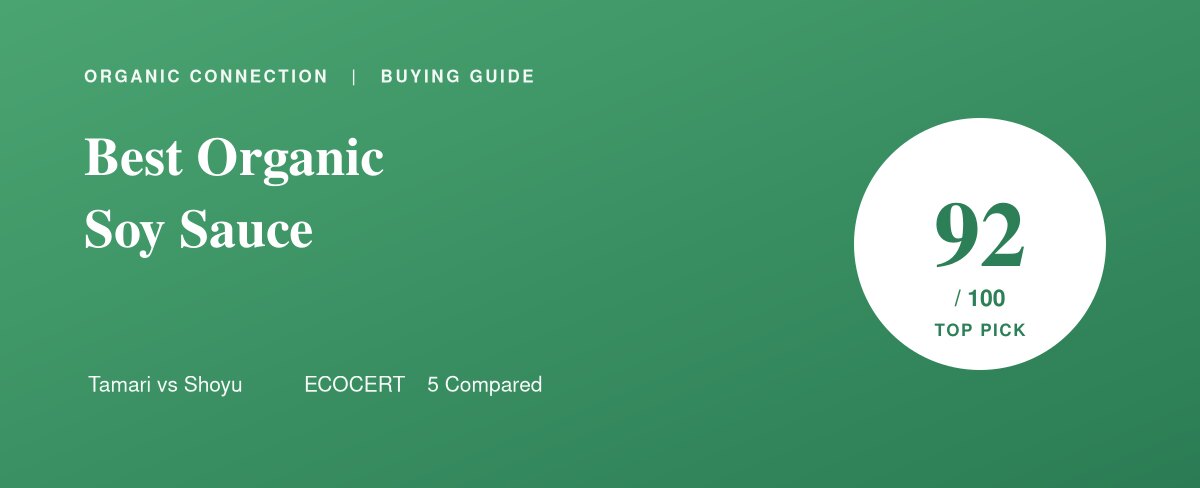
Our top pick is Weekend Foods Organic Tamari Soy Sauce, with an Organic Integrity Score of 92 out of 100, because it does two things almost nothing in this aisle does: it names its certifying body, and it lists every ingredient.
Before you buy anything here, one distinction settles most of the decision.
Shoyu is brewed from soybeans and wheat. Tamari is brewed with little or no wheat. That is why tamari is the gluten-free soy sauce and shoyu is not, and it is also why they taste different — tamari is rounder and less sharp.
Four of the five bottles ranked here are tamari. One is not, and its listing never mentions wheat in any form.
Best organic soy sauce compared
 |  |  |  |  | |
| Product | Weekend Foods Tamari | Eden Organic Tamari | San-J Organic Tamari | Kikkoman Organic | 365 Organic Soy Sauce |
| Organic Integrity Score | 92/ 100 | 88/ 100 | 84/ 100 | 80/ 100 | 74/ 100 |
| Our rating | 4.6 | 4.4 | 4.2 | 4.0 | 3.7 |
| Certifier named | ECOCERT | No | No | No | No |
| Organic wording | USDA Organic | Organic | Organic | USDA certified organic | Organic |
| Ingredients listed | Three, named | Soybeans named | Whole soy named | No | No |
| Wheat addressed | No wheat, stated | Gluten free, title | No wheat, stated | Not mentioned | Not mentioned |
| Brewing claimed | No | Naturally fermented | Specially brewed | No | No |
| Best for | Buyers who want | Buyers who care | Heavy users and anyone | Buyers who want | Price, from a reliable |
| Price | $13.19$0.81 / fluid ounce View on Amazon | $10.50$1.05 / ounce View on Amazon | $42.99$0.67 / fluid ounce View on Amazon | $11.99$0.47 / fluid ounce View on Amazon | $3.29 $3.68 −11%$0.33 / fluid ounce View on Amazon |
Related reading
- Organic Food and Pantry hub
- Best Organic Barbecue Sauce
- our organic product database — compare brands across every guide
Price and availability as of September 16, 2026 7:10 am EDT. Product prices and availability are accurate as of the date/time indicated and are subject to change. Any price and availability information displayed on Amazon.com at the time of purchase will apply to the purchase of this product.
Tamari, shoyu, and the wheat
Two words on a bottle carry more practical information than any certification in this category.
Shoyu is the standard Japanese soy sauce, brewed from roughly equal parts soybeans and wheat. The wheat contributes sugars that ferment into the sweeter, sharper aromatic notes people recognize as soy sauce. It contains gluten.
Tamari originated as the liquid that pooled during miso production. It is brewed with little or no wheat, which makes it darker, thicker, less sharp and rounder in flavor — and makes gluten-free versions possible.
That is the whole reason gluten-free soy sauce exists. It is not a special process applied to ordinary soy sauce; it is a different traditional product.
Four listings here say tamari in the product name. The fifth is Kikkoman Organic Soy Sauce, which is shoyu, and its listing does not mention wheat, gluten or the distinction anywhere.
We are not saying that is misleading. Shoyu containing wheat is entirely normal and the ingredient panel will say so. We are saying that in an aisle where four neighboring bottles are marketed on being gluten free, a bottle that is not gluten free is the one that most needs to say so, and this one says nothing.
Brewed or hydrolyzed: the real quality fork
This is the distinction that separates a two-dollar bottle from a ten-dollar one, and organic certification settles it without saying so.
Traditionally brewed soy sauce is fermented. Soybeans and, in shoyu, wheat are inoculated with Aspergillus oryzae koji mold, then held in brine for months while enzymes break proteins into amino acids and starches into sugars. The flavor is built by that process.
Chemically hydrolyzed soy sauce skips it. Defatted soy protein is broken down with acid, neutralized, and finished in days rather than months. The result is thin and harsh, so caramel color, corn syrup and preservatives are typically added to make it resemble the brewed product.
Here is the useful part. A certified organic soy sauce is brewed. The acid hydrolysis route and the additives it depends on — caramel coloring, corn syrup, chemical preservatives — do not survive organic handling standards. So the seal answers the brewing question even though no listing frames it that way.
Three listings say so anyway. San-J describes its product as “specially brewed” with “no artificial flavor additives or colors”. Eden says “naturally fermented”. Kikkoman’s tamari line uses “naturally brewed”, though not on the organic bottle we scanned.
If you are buying non-organic soy sauce, “naturally brewed” on the label is the phrase to look for, and the ingredient list is the check: caramel color and corn syrup are the signature of the fast route.
Whole soybeans or defatted meal
A second quality marker, named by two brands and invisible everywhere else.
Commodity soy sauce is usually brewed from defatted soybean meal — what remains after the oil has been extracted for use elsewhere. It ferments perfectly well and it is cheaper, because the valuable oil has already been sold.
Traditional brewing uses whole soybeans. The fat that comes with them breaks down during fermentation into compounds that contribute body and aroma, which is why whole-bean sauces taste rounder.
San-J states “Made with 100% Whole Soy” in its product name. Eden states “whole U.S.A. Non-GMO organic soybeans”, adding an origin to the same claim.
Neither is a certification. Both are checkable statements about a real production choice, and both cost the manufacturer something to make.
Soy is also worth noting as a crop. It is among the most heavily genetically engineered commodities grown in North America, which means organic certification does unusually concrete work here — the same argument we made about canola oil. Eden names non-GMO explicitly on top of the organic claim, which in this crop is pointed at the right issue rather than padding a badge count.
What we looked for
We read every feature bullet on every listing in full and scored on what each manufacturer put in writing.
Whether a certifying body is named. One listing does.
Whether the ingredients are listed rather than described.
Whether the wheat question is addressed, in either direction.
Whether the soybeans are described — whole or defatted, origin, non-GMO.
Whether brewing is claimed rather than assumed.
Reading the seals on organic soy sauce: what each one does and does not cover
Certification names are easy to confuse and easy to trade on. Below is what each of these marks covers, and the part of the picture it says nothing about.
| Certification | Covers | Key exclusion |
| USDA Organic | Farming and handling: no synthetic pesticides or fertilizers, no GMOs, no sewage sludge or irradiation, audited yearly by an accredited certifier | Three different tiers share the one seal, and it makes no claim about worker pay, food miles, or nutrition |
| COSMOS Organic | Cosmetics: organic content thresholds, permitted processes and ingredients, and packaging rules | Its sister grade, COSMOS Natural, carries the same name and requires no minimum organic content at all |
Read the word after COSMOS before you read anything else. The Organic grade sets a real floor, at least 95% of the plant content certified organic. The Natural grade sets none at all, and is a permitted-ingredients standard rather than an organic one. Both marks are issued by the same body, look alike on a bottle, and are frequently quoted in listings as simply “COSMOS certified”, which tells you nothing.
Best overall: Weekend Foods Organic Tamari Soy Sauce
| Organic Integrity Score | 92 / 100 |
| Certification | USDA Organic, Ecocert, Non-GMO |
| Ingredients | Three: organic soybeans, water, salt |
| Wheat | None, stated explicitly |
| Packaging | Glass bottle |
| Best for | Buyers who want a certification they can trace and a recipe they can see |
One feature bullet, and it contains both of the things this site has spent months asking listings to provide.
“USDA Organic & ECOCERT Certified — Made with just 3 ingredients: organic soybeans, water, and salt. No wheat, no additives, and certified organic.”
The certifier first. ECOCERT is an accredited certification body, and naming it means a reader can look up who performed the audit rather than trusting an unattributed seal. Across every category we have scored — cosmetics, supplements, pantry, cured meat, pet food — this has happened twice. Once on Brazil nuts, and here.
The ingredient list second. Three ingredients, named, which for a tamari is the complete recipe. In one clause it forecloses wheat, caramel color, corn syrup, preservatives and flavor enhancers — the entire list of things that separate brewed soy sauce from the fast industrial version — without needing a claim for each.
Stating “no wheat” explicitly is the right call for a tamari. Tamari is usually wheat-free and not always, and a buyer avoiding gluten should not have to infer it from the product category.
The glass bottle is a minor point and a real one. Soy sauce is salty and acidic, it sits open for months, and glass is inert.
Deductions are for the surrounding language. The bullet opens with an emoji. “All-natural” in the title has no definition, and “clean, wholesome flavor” is atmosphere sitting immediately after a genuinely precise ingredient list. There is no brewing claim, no origin for the soybeans, and no sodium figure.
Its sales rank is also modest, which usually signals a newer listing.
- Names ECOCERT, one of only two certifier attributions we have found.
- Lists all three ingredients rather than describing them.
- States “no wheat” explicitly rather than relying on the word tamari.
- Glass bottle for a salty, acidic, long-open condiment.
- USDA Organic in the regulated form.
- “All-natural” and “clean, wholesome” have no definitions.
- No brewing or fermentation claim.
- No origin for the soybeans and no sodium figure.
- Single bullet, opening with an emoji; modest sales rank.
What the listing discloses: On the Weekend Foods label: USDA organic certification, Ecocert as the certifying agent, Non-GMO Project Verified and a single-ingredient formula. Not stated: where it was grown or made.
Best sourcing: Eden Organic Tamari Soy Sauce
| Organic Integrity Score | 88 / 100 |
| Soybeans | Whole, U.S.A. grown, non-GMO, organic — four attributes in one phrase |
| Process | Naturally fermented |
| Gluten | Gluten free, in the title |
| Best for | Buyers who care where the soybeans came from and how they were used |
One bullet, and it is the densest sentence in the comparison.
“A naturally fermented soy sauce made from whole U.S.A. Non-GMO organic soybeans.”
Count the claims. Naturally fermented rules out the acid hydrolysis route. Whole soybeans rather than defatted meal, which is the traditional and more expensive input. U.S.A. gives an origin. Non-GMO addresses the dominant fact about the soy crop. Organic covers the farming.
Five substantive claims in seventeen words, with no adjective doing decorative work. That is efficient writing, and every element is checkable.
The whole-bean claim is the one we weight highest after fermentation. Commodity soy sauce is generally brewed from the meal left after oil extraction; whole beans bring fat that breaks down into aroma compounds during the long ferment. It is a real production choice with a real cost.
Naming the United States as the origin matters in this specific crop too, because it lets a buyer connect the non-GMO claim to a jurisdiction where genetically engineered soy is the overwhelming default.
What is missing: no certifying body, no ingredient list, no sodium figure, no explicit wheat statement in the body (gluten free appears in the title), and no fermentation time. It is one bullet, and a second would have gone a long way.
Its sales rank is weak, which is worth knowing on a product that sits open in a cupboard for months.
- Five checkable claims in a single short sentence.
- Names whole soybeans rather than defatted meal.
- States a country of origin for the beans.
- Naturally fermented, which rules out the hydrolyzed route.
- Non-GMO stated in a crop where it matters.
- No certifying body named.
- No ingredient list or sodium figure.
- Wheat addressed only via “gluten free” in the title.
- A single bullet, and a weak sales rank.
What the listing discloses: The listing is explicit about an origin of the USA, and silent on whether the USDA seal applies.
Biggest bottle: San-J Organic Tamari, 25% Less Sodium
| Organic Integrity Score | 84 / 100 |
| Soybeans | 100% whole soy, no wheat, both stated |
| Process | Specially brewed; no artificial flavor additives or colors |
| Sodium | 25 percent less, reference not quantified |
| Size | 64 oz, by far the largest here |
| Best for | Heavy users and anyone reducing sodium without losing flavor |
Two bullets, both about the product, from a company that has been brewing tamari for a long time.
“Made with 100% whole soy and no wheat” answers both quality questions in one clause: whole beans rather than defatted meal, and no wheat, which is what makes the gluten-free claim work.
“No artificial flavor additives or colors” is the right exclusion for this category specifically. Caramel color and flavor enhancers are the signature of hydrolyzed soy sauce, so ruling them out is a statement about the production route rather than a generic clean-label gesture. Combined with “specially brewed”, it is a clear account of how the sauce was made.
The eight generations claim is company history, and unlike most brand-heritage bullets it is at least tied to a specific practice — brewing method — rather than to a founder’s values.
At 64 oz this is far and away the largest bottle, and for anyone who cooks with soy sauce regularly the price per ounce is the best on the page despite the highest sticker.
Two deductions. “25% Less Sodium” is a relative claim, and the listing never says less than what or publishes a milligram figure — the same gap we found across organic soup. And “richer, bolder, more complex taste than typical soy sauce” is an unsupported comparative against an unnamed reference.
No certifying body is named, and the organic claim lives in the title rather than in the bullets.
- States 100% whole soy and no wheat in one clause.
- Rules out artificial colors and flavor additives, the markers of hydrolyzed soy sauce.
- Claims brewing explicitly rather than leaving it implied.
- Best price per ounce here at 64 oz.
- “25% less sodium” with no reference and no milligram figure.
- “Richer, bolder, more complex than typical soy sauce” is an unsupported comparative.
- Organic claim appears in the title only.
- No certifying body; a 64 oz bottle is a long commitment.
What the listing discloses: San-J leaves the basics open, including whether the USDA seal applies and where it was grown or made.
Correct wording, no detail: Kikkoman Organic Soy Sauce
| Organic Integrity Score | 80 / 100 |
| Organic claim | “USDA certified organic”, the regulated phrasing |
| Type | Shoyu — brewed with wheat, not stated in the listing |
| Feature bullets | Two; one restates the product name |
| Best for | Buyers who want traditional shoyu flavor and do not avoid gluten |
The best known name in soy sauce, with the correct organic wording and nothing else at all.
Its two bullets read: “Kikkoman organic soy sauce” and “USDA certified organic.”
The second is the regulated phrasing applied to the product, which is more than three of the four other listings manage. It is exactly the right form and it is the entire disclosure.
The more important point is what the listing is not saying. This is soy sauce, not tamari — the traditional Japanese style brewed with wheat alongside soybeans. That is a legitimate and delicious product, and it is the reason ordinary soy sauce tastes the way it does.
It also contains wheat, and the listing does not mention wheat, gluten or the tamari distinction anywhere. On a search results page where four adjacent bottles are marketed on being gluten free, that omission is the one most likely to cause a problem for a reader who is not paying close attention.
The ingredient panel will state it. The listing does not.
Beyond the certification there is no brewing claim, no soybean description, no origin, no sodium figure and no ingredient information. It is a good bottle of shoyu from a company that has been making it since the seventeenth century, sold on a name.
- “USDA certified organic”, the correct regulated phrasing.
- Traditional shoyu style, which is what most recipes assume.
- Strong sales rank and wide availability.
- Good value per ounce at 25.4 oz.
- Contains wheat, and the listing never says so.
- Does not distinguish itself from the tamari bottles around it.
- One of two bullets restates the product name.
- No brewing, soybean, origin or sodium information.
What the listing discloses: Everything we check for is on the Kikkoman listing: USDA organic certification and an origin of Japan.
Cheapest, one bullet: 365 Organic Soy Sauce
| Organic Integrity Score | 74 / 100 |
| Feature bullets | One: “10 oz organic soy sauce” |
| Organic claim | “Organic”, the bare adjective |
| Size | 10 oz |
| Best for | Price, from a reliable own-brand organic program |
The cheapest bottle on this page, with a single bullet that restates the product name and the volume.
“10 oz organic soy sauce.” That is the entire listing body.
The certification is real and this own-brand runs a functioning organic program, so the seal means what it says. The price is genuinely excellent — a fraction of the tamari bottles above.
What is absent is everything a buyer would use to choose between soy sauces: no tamari or shoyu designation, no wheat statement, no brewing claim, no soybean description, no ingredient list, no certifier, no sodium figure.
The same own-brand also sells a shoyu and a reduced-sodium shoyu under near-identical listings, which suggests the copy is applied across the range rather than written per product. We noticed the same pattern in this brand’s canned tomatoes, where two SKUs carried noticeably different wording quality.
If you want cheap certified organic soy sauce and are content to read the panel for the rest, this is the bottle. On a comparison scored by what the manufacturer published, one restated sentence sits at the bottom of the organic products.
- Cheapest bottle here by a wide margin.
- Genuinely certified organic from an established own-brand program.
- Strong sales rank.
- Claims nothing it cannot support.
- A single bullet restating the product name and volume.
- No tamari or shoyu designation, and no wheat statement.
- Bare “organic” rather than the certified form.
- No brewing, soybean, ingredient or sodium information.
What the listing discloses: Sparse documentation from 365 by Whole Foods Market — nothing on whether the USDA seal applies and where it was grown or made.
What we left out and why
San-J Tamari Lite, the non-organic version. Worth naming because our scanner found no claims at all in either its title or its body — a bottle from a company that writes good copy elsewhere, with nothing on the page. It is also priced within pennies of the organic bottles, which makes the absence of any claim harder to explain.
Two products that were not in stock at the time of our scan, including a well-regarded organic 50% less sodium tamari and a widely sold naturally brewed tamari. We do not rank products a reader cannot buy today.
Coconut aminos. A soy-free alternative made from coconut sap, considerably sweeter and lower in sodium. A different product with a different flavor, not a substitute in most recipes.
Nama shoyu and cedar-aged specialty bottles. Genuinely interesting products at prices that put them in a different comparison.
Buying and keeping soy sauce
- Tamari if you avoid gluten, or if you prefer a rounder, less sharp flavor. Confirm “no wheat” rather than relying on the word tamari alone.
- Shoyu for the sharper, more aromatic flavor most recipes assume. It contains wheat.
- Look for “brewed” or “naturally fermented”. Organic certification effectively guarantees it, and on a non-organic bottle the phrase is what distinguishes brewing from acid hydrolysis.
- Check for caramel color and corn syrup on the panel. They are the signature of the fast industrial route.
- “Whole soybeans” beats defatted meal for flavor, and two listings here say which they use.
- Reduced-sodium soy sauce is still a high-sodium product. A 25 or 50 percent reduction from a very salty base leaves a salty sauce.
- Relative claims need a reference. None of the listings here publishes milligrams, so read the panel.
- Diluting regular soy sauce with a little water achieves much the same thing at lower cost, with some loss of body.
- Treat soy sauce as your salt in a dish rather than as a seasoning on top of it, and season the rest accordingly.
- Refrigerate after opening. Soy sauce will not spoil at room temperature, and it darkens and loses aroma noticeably faster in a warm cupboard.
- Buy a size you will finish in a few months. A 64 oz bottle is excellent value only if it does not sit half full for a year.
- Glass is better than plastic for a long-open salty, acidic condiment.
- The flavor fades before anything goes wrong. If it tastes flat and one-dimensional, it is old rather than unsafe.
What the field adds up to
One listing names its certifier, which is one more than most categories manage. One lists its ingredients. Two say how the sauce was made. None publishes a sodium figure, in a product that is essentially salt with flavor.
The rule for this aisle is short. Tamari or shoyu decides the wheat question, brewed or hydrolyzed decides the quality question, and organic certification quietly answers the second one for you. Everything else is on the panel.
Questions about organic soy sauce
What is the difference between tamari and soy sauce?
Shoyu, the standard Japanese soy sauce, is brewed from soybeans and wheat in roughly equal parts. Tamari originated as the liquid from miso production and is brewed with little or no wheat, which makes it darker, rounder and less sharp — and makes gluten-free versions possible.
Is all tamari gluten free?
Not automatically. Tamari is usually wheat-free and some versions contain a small amount, so look for an explicit “no wheat” or gluten-free statement rather than relying on the word tamari alone.
What does “naturally brewed” mean?
That the sauce was fermented — soybeans inoculated with koji mold and held in brine for months while enzymes break down proteins and starches. The alternative is acid hydrolysis, which produces a thin, harsh liquid in days and is typically corrected with caramel color and corn syrup.
Does organic certification guarantee brewed soy sauce?
In practice, yes. The acid hydrolysis route and the additives it depends on do not survive organic handling standards, so a certified organic soy sauce is brewed. No listing frames it that way, and it is one of the more useful things the seal does here.
What is the difference between whole soybeans and defatted soybean meal?
Defatted meal is what remains after the oil has been extracted, and it is cheaper because the oil has already been sold. Whole soybeans bring fat that breaks down during fermentation into compounds contributing body and aroma. Two listings in this comparison state which they use.
Does organic matter more for soy than for other crops?
It does concrete work. Soy is among the most heavily genetically engineered crops grown in North America, so a conventional bottle is most likely made from engineered beans. Organic certification prohibits genetically engineered inputs.
Is reduced-sodium soy sauce actually low in sodium?
No. A 25 or 50 percent reduction from a very salty base still leaves a salty product. The relative claims in this comparison also come without milligram figures, so read the nutrition panel.
Should soy sauce be refrigerated?
After opening, yes. It will not spoil at room temperature because of the salt, and it darkens and loses aroma considerably faster in a warm cupboard. The flavor fades long before anything goes wrong.
Are coconut aminos a substitute?
Not a direct one. Coconut aminos are made from coconut sap, are soy-free and lower in sodium, and are noticeably sweeter with less depth. They work in some dishes and change the character of others.
Organic Connection is reader supported. We read every product listing in full and say plainly when a claim cannot be verified. How we research and rate.