Last updated: September 30, 2026
We may earn a commission when you buy through links on this page, at no extra cost to you. How we research and rate.
The short version
After researching the certifications, sweeteners and ingredient lists of the organic barbecue sauces you can actually buy right now, our top pick is 365 by Whole Foods Market Organic Texas True. It is USDA certified organic, it is the best-selling sauce in its category, and it costs a fraction of the specialty bottles, which earned it our highest Organic Integrity Score of 94 out of 100. For a sweeter, thicker glaze the 365 Memphis Madness is the same sauce line in the flavor most people picture, and for no added cane sugar at all, Primal Kitchen.
With BBQ sauce, “organic” matters, but so does the sweetener, because many sauces are mostly sugar or high-fructose corn syrup. We flag each sauce’s certification and how it is sweetened.
Best organic barbecue sauce compared
| Best Choice | |||||
 |  |  |  |  | |
| Product | 365 Texas True | 365 Memphis Madness | Primal Kitchen | Date Lady | Red Duck |
| Organic Integrity Score | 94/ 100 | 92/ 100 | 87/ 100 | 82/ 100 | 79/ 100 |
| Our rating | 4.7 | 4.6 | 4.4 | 4.1 | 4.0 |
| Sweetener | Organic sugar, molasses | Organic sugar, molasses | No cane sugar | Dates only | Molasses |
| Best for | Best overall | Sweet and thick | Whole30 and keto | Date-sweetened | Smoky |
| Certification | USDA Organic, vegan | USDA Organic, vegan | Non-GMO Project Verified, Whole30 | Organic, kosher, vegan | Organic, non-GMO |
| Price | $3.29$0.18 / ounce View on Amazon | $3.29$0.18 / ounce View on Amazon | $22.95$0.88 / ounce View on Amazon | $21.49$0.98 / ounce View on Amazon | $14.99$0.88 / fluid ounce View on Amazon |
Price and availability as of October 11, 2026 7:10 pm EDT. Product prices and availability are accurate as of the date/time indicated and are subject to change. Any price and availability information displayed on Amazon.com at the time of purchase will apply to the purchase of this product.
Nutrition facts side by side
Scores are ours, based on independent research of certification, sweetener, ingredients, and value, using the same 10-criteria method we apply to every product. See how we research and rate.
What each certification on an organic barbecue sauce label actually covers
The labels on these products are not interchangeable, and several of them cover things that have nothing to do with each other. Here is what each one actually buys you.
| Certification | Covers | Key exclusion |
| USDA Organic | Farming and handling: no synthetic pesticides or fertilizers, no GMOs, no sewage sludge or irradiation, audited yearly by an accredited certifier | Three different tiers share the one seal, and it makes no claim about worker pay, food miles, or nutrition |
| GOTS | Organic fiber from farm to finished textile, plus dyeing, finishing, wastewater and labor criteria | Has a weaker second tier, “made with organic”, that needs only 70% organic fiber and carries the same name |
| Non-GMO Project | Testing and supply-chain traceability showing the ingredients are not genetically engineered | Sets no limit on synthetic pesticides or fertilizers, so it is not an organic claim |
The mark most often mistaken for an organic claim is Non-GMO Project Verified. It is a real standard with real testing, and it verifies exactly one thing: that the ingredients are not genetically engineered. It sets no limit on synthetic pesticides, synthetic fertilizers, or anything else about how the crop was grown. USDA Organic already prohibits GMOs outright, so on a certified organic product the butterfly adds independent verification rather than a new promise. On a product carrying only the butterfly, the pesticide question has not been asked.
Key things to look for in organic barbecue sauce
Great organic BBQ sauce is about certification, sweetener, and real ingredients. Here is what matters.
1. USDA organic certification
It rules out high-fructose corn syrup, GMO ingredients, and artificial flavors and colors.
2. How it is sweetened
Look for organic honey, maple, dates, or balsamic, or unsweetened, rather than piles of refined sugar or HFCS.
3. Real, recognizable ingredients
Organic tomatoes, vinegar, and spices, with a short ingredient list you can actually read.
4. The flavor profile you want
Classic sweet-tangy, smoky, spicy, or regional styles like Carolina gold or Hawaiian.
Sweetener matters as much as the seal
Barbecue sauce is where “organic” and “healthy” can quietly part ways. A sauce can be USDA organic and still be built largely on organic cane sugar, so the amount and type of sweetener is worth as much attention as the seal. Some of the best organic sauces are fully unsweetened or use only a touch of organic honey, maple, dates, or balsamic vinegar for a rounder sweetness with less refined sugar, which suits keto, paleo, and Whole30 eaters and anyone watching added sugar. Others lean classic and sweet, which is fine if that is the flavor you want, just check the label.
Our scoring reflects both. We reward genuine USDA organic certification, organic tomatoes and clean recognizable ingredients, and a sweetening approach that is honest and moderate rather than sugar-forward, while still noting which sauces are classic-sweet for people who prefer that. That way you can match a sauce to your taste and your diet, whether you want no added sugar at all or a traditional sweet-and-tangy glaze.
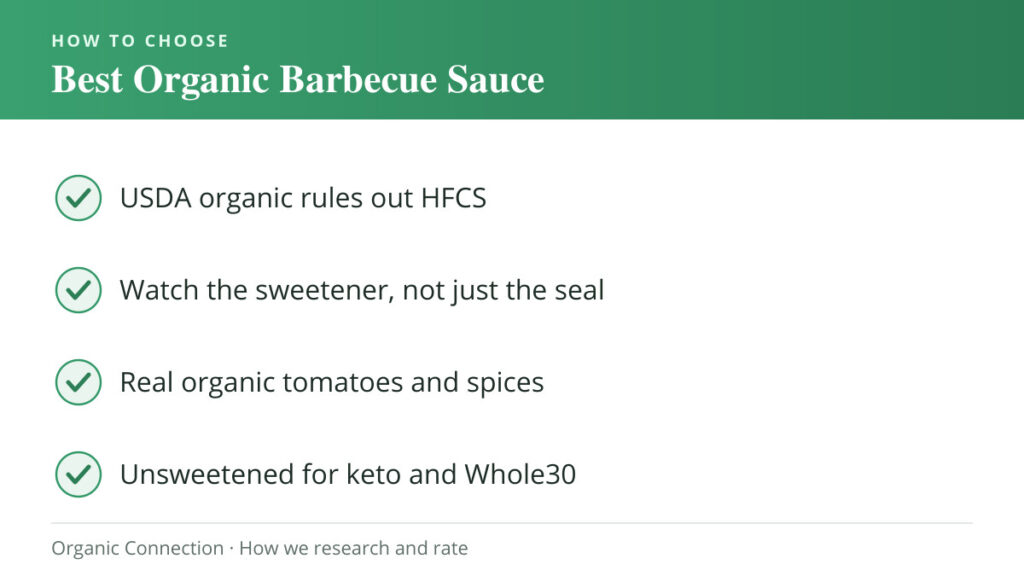
How to choose organic barbecue sauce
- Confirm USDA organic. It rules out HFCS, GMOs, and artificial additives.
- Read the sweetener. Unsweetened or organic honey/maple/dates beats piles of refined sugar or HFCS.
- Check the ingredient list. Short, recognizable, organic tomatoes and spices.
- Pick your style. Classic sweet-tangy, smoky maple, spicy, or a regional flavor.
- Match your diet. Unsweetened for keto, paleo, or Whole30; classic for traditional taste.
Who should buy organic barbecue sauce
Taste and sugar tolerance decide this. Our top pick is the unsweetened organic sauce to try first. If you want a classic sweet-tangy sauce, a Whole30 option, a smoky maple, or a specialty flavor, we have a pick for each.
Best overall: 365 by Whole Foods Market Organic Texas True Barbecue Sauce
| Organic Integrity Score | 94 / 100 |
| Certification | USDA Organic, vegan, stated on the label |
| Sweetener | Organic sugar and organic molasses |
| Style | Texas: thinner, peppery, less sweet than Kansas City |
| Best for | The cheapest genuinely certified organic sauce on the shelf |
This is the best-selling barbecue sauce in its category on Amazon and one of the cheapest, and it is properly USDA certified organic. Those three facts rarely arrive together.
Texas style means a thinner, more peppery sauce with less sugar than the Kansas City sauces most people picture when they think barbecue. It clings less and tastes more of tomato and black pepper, which suits brisket and beef better than it suits chicken.
There is no story here about single-origin tomatoes or a family recipe, because a store brand does not need one. What it has instead is the seal, a short ingredient list, and a price that makes the organic version an easy swap rather than a treat.
What we liked: USDA organic at supermarket-brand pricing, the top seller in its category, and a peppery Texas profile that is not just sugar.
Keep in mind: Thinner than a Kansas City sauce, so it runs off ribs. If you want the thick sweet glaze, look at the Memphis version below.
Best sweet and thick: 365 by Whole Foods Market Organic Memphis Madness Barbecue Sauce
| Organic Integrity Score | 92 / 100 |
| Certification | USDA Organic, vegan, stated on the label |
| Sweetener | Organic sugar and organic molasses |
| Style | Memphis: sweeter and thicker, closer to the sauce most people expect |
| Best for | Ribs, pulled pork, and anything you want to glaze |
The same certification and the same price as our top pick, in the flavor most people actually mean when they say barbecue sauce: sweeter, thicker, and built to cling.
It sits a point behind only because a sweeter sauce is a narrower one. Texas style works as a table sauce, a marinade base and a glaze; Memphis style is a glaze, and a very good one.
What we liked: Certified organic, cheap, thick enough to stay on ribs, and the flavor most people are looking for.
Keep in mind: Sweeter than the Texas version, so it burns faster over direct heat. Sauce in the last few minutes, not at the start.
Best for Whole30 and keto: Primal Kitchen Organic BBQ Sauce
| Organic Integrity Score | 87 / 100 |
| Certification | Non-GMO Project Verified, gluten-free, Whole30 and paleo approved |
| Sweetener | No cane sugar and no corn syrup |
| Style | Tangy rather than sweet |
| Best for | Anyone cutting added sugar without giving up the sauce |
Primal Kitchen is the one to buy if the sugar is the reason you are reading this page. No cane sugar, no high-fructose corn syrup, and the Whole30 and paleo approvals to back the claim up.
Its listing is also the most carefully worded here, and that cuts both ways. It states Non-GMO Project Verified, which is third-party testing rather than a self-declaration, and it is precise about what is absent. What it does not put in the description is a USDA organic certifier, though the product is titled organic.
It is also comfortably the most expensive sauce on this page, at roughly seven times the price per ounce of our top pick.
What we liked: Genuinely no added cane sugar, Non-GMO Project Verified, and a tangy profile that does not taste like a diet compromise.
Keep in mind: The price. And if you want a sweet glaze, this is not that sauce — that is the point of it.
Best date-sweetened: Date Lady Organic BBQ Sauce
| Organic Integrity Score | 82 / 100 |
| Certification | Organic, kosher, gluten-free, vegan |
| Sweetener | Dates, and nothing else |
| Style | Sweet, fruity, thick |
| Best for | Sweetness from whole fruit rather than refined sugar |
Every other sauce here sweetens with sugar, molasses or nothing. This one sweetens with dates, which is a genuinely different answer rather than a marketing angle: you get the sweetness plus the fiber and potassium that come with the fruit.
It scores mid-table because the listing says organic and kosher without naming who certified either, and because it costs about six times what the 365 sauces do.
What we liked: Date-sweetened rather than sugar-sweetened, kosher and vegan, and a thick fruity sauce that works as a glaze.
Keep in mind: Sweet is still sweet — dates are sugar with company. And no certifier is named on the listing.
Best smoky: Red Duck Smoked Applewood Molasses Organic BBQ Sauce
| Organic Integrity Score | 79 / 100 |
| Certification | Organic, non-GMO, gluten-free |
| Sweetener | Molasses |
| Style | Applewood smoke over molasses |
| Best for | Smoke flavor without a smoker |
If what you want from a barbecue sauce is smoke rather than sweetness, this is the one on this page that delivers it. Applewood over molasses gives a darker, less sugary result than the supermarket sauces.
It scores lowest here on the two things this site measures hardest. Its listing names no certifying body, only the word organic, and it is the slowest seller of the five by a wide margin — roughly eighteen times further down its category than our top pick.
What we liked: Real applewood smoke, molasses rather than corn syrup, and a small-batch profile you cannot get from a store brand.
Keep in mind: No certifier named, a thin sales record, and five times the price of our top pick.
Getting the most from your BBQ sauce
For grilling, brush sauce on only in the last few minutes, since the sugars in barbecue sauce burn quickly over direct heat; apply it too early and it chars before the food is done. Use sauce as a finishing glaze, a dipping sauce, or a base for pulled meats and jackfruit, and thin it with a splash of water or vinegar if you want a lighter coating. Unsweetened sauces are great for marinating because there is no sugar to scorch. Refrigerate after opening and use within the timeframe on the label. If you want a sweeter unsweetened sauce, stir in a little organic honey or maple to taste.
The regional styles, and which one you actually want
“Barbecue sauce” describes at least six distinct things, and most people buy the wrong one at least once because the label leads with a brand rather than a style. Sweetness, acidity and thickness are the three axes that matter.
| Style | Base | Character | Best on |
| Kansas City | Tomato + molasses or sugar | Thick, sweet, smoky. The default supermarket style. | Ribs, chicken, burnt ends, anything you want glazed |
| Texas | Tomato, thinner, less sweet | Peppery, beef-forward, cumin and chili | Brisket, beef ribs, sausage |
| Eastern Carolina | Vinegar + pepper, no tomato | Thin, sharp, barely sweet. Cuts fat rather than coating it. | Pulled pork, whole hog |
| South Carolina | Yellow mustard | Tangy, golden, mildly sweet | Pork shoulder, chicken thighs, sausage |
| Alabama white | Mayonnaise + vinegar | Creamy, sharp, peppery. No tomato at all. | Smoked chicken, turkey. Also a dressing. |
| Japanese style | Soy, mirin, ginger, garlic | Savory and umami-led rather than sweet-smoky | Chicken, salmon, vegetables, stir-fries |
If you have only ever bought Kansas City style and found barbecue sauce too sweet, the answer is usually a Carolina vinegar or mustard sauce rather than a low-sugar version of what you already dislike. The organic shelf skews heavily toward Kansas City, which is worth knowing before you conclude the category is not for you.
Sugar: the number that decides everything
Barbecue sauce is among the highest-sugar condiments in the supermarket, and serving sizes on the label bear little relation to how anyone actually uses it.
| Type | Sugar per 2 tbsp | Note |
| Conventional Kansas City style | 12–16 g | Often HFCS as the first or second ingredient |
| Organic Kansas City style | 8–13 g | Cane sugar, molasses or honey instead of HFCS |
| Organic no-sugar-added | 0–2 g | Usually sweetened with dates, monk fruit or balsamic |
| Carolina vinegar | 1–4 g | Naturally low; the style, not a reformulation |
| Alabama white | 1–2 g | Fat rather than sugar carries the flavor |
Twelve grams per two tablespoons is three teaspoons of sugar, and a properly sauced rack of ribs uses far more than two tablespoons. The organic versions are genuinely better here — cane sugar and molasses instead of high-fructose corn syrup — but let us be plain about what that changes: it is a better-sourced sugar, not less sugar. If sugar load is your concern, choose a vinegar or mustard style, or a no-sugar-added formulation, rather than assuming organic solves it.
What organic certification removes from a barbecue sauce
This is the category where the organic seal earns its keep more than most, because conventional barbecue sauce carries a specific set of ingredients that organic rules prohibit outright.
- High-fructose corn syrup — frequently the first ingredient in mainstream sauces. Prohibited under organic rules.
- Caramel color class III and IV — the ammonia-process caramels that give sauce its deep mahogany look. Their manufacture forms small amounts of 4-methylimidazole (4-MEI), which California added to its Proposition 65 list of known carcinogens in January 2011, requiring a warning above roughly 29 micrograms of daily exposure. The listing was based on a National Toxicology Program mouse study using doses far above realistic dietary exposure, and it remains contested — but organic sauces avoid the question entirely, coloring with tomato, molasses and spice instead.
- Artificial flavor and preservatives — sodium benzoate and artificial smoke flavorings.
- Synthetic pesticide residues on the tomatoes, which make up the bulk of most sauces.
Keep in mind: “natural smoke flavor” on an organic label is not a loophole. Liquid smoke is condensed real wood smoke, filtered to remove tars — it is closer to smoking the food than to a synthetic flavoring, and it is permitted in organic products for that reason. It is one of the few “flavor” ingredients that deserves less suspicion than it gets.
Grilling with sauce: the part that affects your health more than the ingredients
Cooking meat at high heat forms heterocyclic amines and polycyclic aromatic hydrocarbons — compounds the National Cancer Institute describes as mutagenic, meaning they cause DNA changes that may raise cancer risk. Charring and flare-ups are what produce them, and sugary barbecue sauce burns readily, so how you use the sauce matters more than which jar you bought.
- Sauce at the end, not the start. Apply in the last 10 to 15 minutes of cooking. Sugar begins to burn around 300°F, well below grilling temperature, so sauce applied early is scorched long before the meat is done.
- Marinate first. Studies have found that marinating meat for at least 30 minutes can cut HCA formation substantially — reported reductions run as high as 99% in some conditions. Olive oil, vinegar, citrus, herbs and spices appear to do the work, possibly by acting as a barrier between the meat and the heat as much as by any chemical effect.
- Cook lower and slower. A lower flame reduces both HCAs and PAHs by limiting charring and dripping-fat flare-ups.
- Herbs and spices help. Rosemary, garlic and fruit-based marinades have been associated with lower HCA production — which is one of the better arguments for a spice-forward sauce over a purely sweet one.
- Reserve clean sauce for the table. Never brush from a container that has touched raw meat, and set aside a separate portion before you start.
Reading a barbecue sauce label
Ingredients are listed by weight, which makes the first three lines the whole story.
- Tomato paste or tomato purée first is what you want. It means tomato is doing the work.
- Any sugar first — cane sugar, molasses, honey, or the organic equivalents — means you are buying a sweetener with tomato in it, however good the branding.
- “Organic tomato concentrate” versus “organic tomato purée”: concentrate is reconstituted, purée is not. Neither is a problem, but purée generally tastes fresher and less cooked.
- Watch for water high in the list, which signals a thinner sauce padded out and thickened with gum.
- Xanthan gum is common even in clean sauces and is harmless; it stops separation. Its presence is not a mark against a product.
- Worcestershire and soy mean the sauce is not vegan or gluten-free by default. Check both if either matters to you.
Storage, shelf life and making it stretch
- Refrigerate after opening, always — the acidity helps but does not make it shelf stable once air is in the jar.
- Opened commercial sauce keeps roughly 4 to 6 months refrigerated. Organic sauces without synthetic preservatives sit at the shorter end.
- Freezing works well. Portion into an ice-cube tray, then bag the cubes — useful if you buy a large jar and cook for one or two.
- Separation is normal in low-gum sauces. Shake and use.
- Discard on any mold, fizzing or fermented smell. A darkening color on its own is oxidation, not spoilage.
- Stretching a jar: thin a thick Kansas City sauce with cider vinegar and a splash of water for a mop or a marinade, which uses a third of the sauce for the same coverage and lowers the sugar concentration on the surface where it burns.
How we researched this guide
We are a research-based review site. We compared each sauce against its certification (USDA organic, and where present Whole30), sweetener and ingredient quality, flavor profile, and the weight of aggregated customer feedback, then scored each with our 10-criteria Organic Integrity Score. No brand paid to be included or ranked. Read the full method on our How We Research and Rate page.
Where the calories hide in a marinade
Barbecue sauce is among the most sugar-dense condiments on a supermarket shelf, and the way it is used makes it more consequential than the panel suggests.
Typical barbecue sauce runs 12 to 16 grams of sugar per two-tablespoon serving, which puts it in the same range as many desserts by concentration. Molasses, cane sugar, honey or fruit concentrate provide both the sweetness and the sticky texture that defines the product, so the sugar is doing structural work rather than being an optional addition.
The serving size on the panel is two tablespoons. A rack of ribs or a batch of pulled pork uses considerably more, and sauce used as a marinade and again as a glaze doubles it. Unlike ketchup, barbecue sauce is frequently a cooking ingredient applied by the cup rather than a condiment applied by the spoon.
The practical point is about where it goes. Sauce brushed on at the end sits on the surface and most of it is eaten. Sauce used as a marinade largely stays in the dish or the bag, so the calorie contribution is smaller than the quantity used suggests. That distinction is worth more than any label comparison.
Sugar also burns. Sauce applied early over direct heat blackens before the meat is cooked, which is both a culinary and a practical argument for applying it in the last few minutes and using less.
Vinegar-based and mustard-based regional styles carry a fraction of the sugar of the thick tomato-molasses style, and are worth knowing about if this is a regular part of your cooking.
Honest summary: genuinely sugar-dense, used in quantities well beyond the stated serving, and best applied late and thinly rather than swapped for a diet version.
Common questions about organic barbecue sauce
What is the best organic barbecue sauce?
Our overall pick is Primal Kitchen Classic BBQ Sauce, because it is USDA certified organic and unsweetened, made with real ingredients and no cane sugar or corn syrup. For a classic sweet-tangy sauce, Annie’s Organic Original is our pick, and for Whole30, Tessemae’s Matty’s.
Why does the sweetener matter in BBQ sauce?
Barbecue sauce is often built on high-fructose corn syrup or lots of refined sugar. Even organic sauces can be sugar-forward, so checking whether a sauce is unsweetened or sweetened with organic honey, maple, or dates matters as much as the organic seal for anyone watching added sugar.
Is there a no-sugar organic BBQ sauce?
Yes. Unsweetened organic sauces like Primal Kitchen Classic contain no added cane sugar or corn syrup and are keto, paleo, and Whole30 friendly, relying on organic tomatoes, vinegar, and spices for flavor instead of sweetness.
Is organic BBQ sauce Whole30 or keto friendly?
Some are. Look for sauces specifically labeled Whole30 Certified or Keto Certified with no refined sugar, such as Tessemae’s Matty’s or Primal Kitchen Classic. Many organic sauces sweetened with cane sugar or maple are not compliant, so read the label.
How do I keep BBQ sauce from burning on the grill?
Brush sauce on only in the last few minutes of grilling, because the sugars burn quickly over direct heat. Apply it as a finishing glaze rather than at the start, and use unsweetened sauces for marinating since they have no sugar to scorch.
What are the different barbecue sauce styles?
Six main ones. Kansas City is thick, sweet and tomato-molasses based — the default supermarket style. Texas is thinner and peppery, built for beef. Eastern Carolina is vinegar and pepper with no tomato at all, sharp enough to cut through pulled pork. South Carolina is mustard-based. Alabama white is mayonnaise and vinegar, used on smoked chicken. Japanese style is soy, mirin and ginger, savory rather than sweet. If you find barbecue sauce too sweet, a Carolina vinegar or mustard sauce is usually the answer rather than a low-sugar Kansas City.
How much sugar is in barbecue sauce?
Conventional Kansas City style runs 12 to 16 g per two tablespoons — three to four teaspoons of sugar — and often lists high-fructose corn syrup first. Organic versions of the same style run 8 to 13 g using cane sugar or molasses. That is a better-sourced sugar, not less sugar. Carolina vinegar and Alabama white styles are naturally low at 1 to 4 g, and no-sugar-added organic sauces sweetened with dates or monk fruit run 0 to 2 g.
What does organic certification remove from barbecue sauce?
High-fructose corn syrup, artificial flavors and preservatives, synthetic pesticide residues on the tomatoes, and caramel color classes III and IV. Those ammonia-process caramels form small amounts of 4-methylimidazole, which California added to its Proposition 65 carcinogen list in 2011. The listing rests on a mouse study using doses far above realistic dietary exposure and remains contested, but organic sauces sidestep it by coloring with tomato, molasses and spice.
Is “natural smoke flavor” bad in an organic sauce?
No, and it is one of the few flavor ingredients that deserves less suspicion than it gets. Liquid smoke is condensed real wood smoke, filtered to remove tars — closer to smoking the food than to a synthetic flavoring, which is why organic rules permit it.
When should you put barbecue sauce on while grilling?
In the last 10 to 15 minutes. Sugar begins burning around 300°F, well below grilling temperature, so sauce applied at the start is scorched long before the meat is cooked. Reserve a clean portion for the table before you start, and never brush from a container that has touched raw meat.
Does grilling with barbecue sauce cause cancer?
The sauce is not the issue; the charring is. High-heat cooking of meat forms heterocyclic amines and polycyclic aromatic hydrocarbons, which the National Cancer Institute describes as mutagenic. Sugary sauce burns readily, which adds to it. Marinating for at least 30 minutes has been found to cut HCA formation substantially, with reported reductions as high as 99% in some conditions, and cooking over a lower flame reduces both HCAs and PAHs by limiting char and flare-ups.
How do you read a barbecue sauce label?
Ingredients run by weight, so the first three lines tell you everything. Tomato paste or purée first is what you want. Any sugar first means you are buying a sweetener with tomato in it. Water high in the list signals a thin sauce padded out and thickened with gum. Xanthan gum itself is harmless and simply prevents separation. Worcestershire or soy means the sauce is not vegan or gluten-free by default.
How long does barbecue sauce last after opening?
Roughly 4 to 6 months refrigerated, with organic sauces lacking synthetic preservatives at the shorter end. Always refrigerate once opened. It freezes well in ice-cube trays if you buy large jars and cook for one or two. Separation in low-gum sauces is normal — shake and use. Discard on mold, fizzing or a fermented smell; darkening alone is just oxidation.
- Organic Food & Pantry hub
- Best Organic Maple Syrup
- Best Organic Honey
- Best Organic Canned Tomatoes
- How we research and rate products
- every product we have reviewed — filter by USDA Organic, GOTS, Fair Trade and more
- Best Organic Ketchup
Price and availability as of October 11, 2026 7:10 pm EDT. Product prices and availability are accurate as of the date/time indicated and are subject to change. Any price and availability information displayed on Amazon.com at the time of purchase will apply to the purchase of this product.
Looking for other organic products?
We have checked more than 800 products across food, household goods, gardening, personal care and pet, every one against its stated certification. Browse all reviews.
Organic Connection is reader-supported. When you buy through links on this page we may earn a commission, at no extra cost to you. As an Amazon Associate we earn from qualifying purchases. We are not paid to feature or rank any product. How we research and rate.