Last updated: September 30, 2026
We may earn a commission when you buy through links on this page, at no extra cost to you. How we research and rate.
The short version
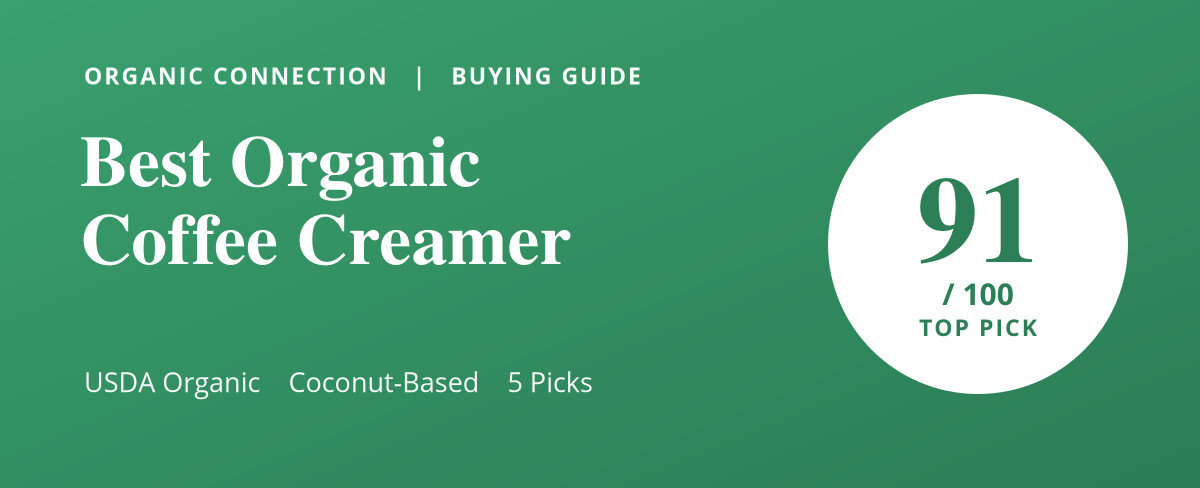
After researching the ingredients and certifications of the most popular organic coffee creamers, our top pick is Native Forest Simple Organic Coconut Milk. It is USDA organic, built on organic coconut, and free of gums, fillers, and added sugar, which is why it earned our highest Organic Integrity Score of 92 out of 100. For a superfood-boosted option, Anthony’s Organic Coconut Creamer is our pick, and for a versatile DIY base, Anthony’s Organic Coconut Milk Powder is the best choice.
One honest note up front: genuinely USDA-organic coffee creamers are less common than you would think, and almost all of them are coconut-based, because the popular refrigerated liquid creamers (and most “natural” ones) are not certified organic. So this guide focuses on the truly organic options, which happen to be shelf-stable, dairy-free, and coconut-forward. We flag each pick’s form and certification.
Best organic coffee creamer compared
| Best Choice | Best Value | |||
 |  |  |  | |
| Product | Native Forest | Anthony’s Creamer | Anthony’s Powder | Laird Superfood |
| Organic Integrity Score | 92/ 100 | 88/ 100 | 86/ 100 | 77/ 100 |
| Our rating | 4.6 | 4.4 | 4.3 | 3.9 |
| Best for | Best overall | Superfood boost | DIY / multi-use | Clean organic creamer |
| Form | Canned coconut milk | Powder creamer | Coconut milk powder | Liquid, unsweetened |
| Certification | Certified Organic, Non-GMO, Kosher | USDA Organic, Non-GMO, Gluten-free | Non-GMO, Gluten-free, Vegan | — |
| Price | $44.28 $47.99 −8%$0.27 / fluid ounce View on Amazon | Currently unavailable See buying options | $19.19$1.20 / ounce View on Amazon | Currently unavailable See buying options |
Price and availability as of October 11, 2026 7:10 pm EDT. Product prices and availability are accurate as of the date/time indicated and are subject to change. Any price and availability information displayed on Amazon.com at the time of purchase will apply to the purchase of this product.
Scores are ours, based on independent research of certification, ingredients, and performance, using the same 10-criteria method we apply to every product. See how we research and rate.
The certification map for organic coffee creamer, and what each one actually excludes
Certification names are easy to confuse and easy to trade on. Below is what each of these marks covers, and the part of the picture it says nothing about.
| Certification | Covers | Key exclusion |
| USDA Organic | Farming and handling: no synthetic pesticides or fertilizers, no GMOs, no sewage sludge or irradiation, audited yearly by an accredited certifier | Three different tiers share the one seal, and it makes no claim about worker pay, food miles, or nutrition |
| Certified Vegan | No animal ingredients or animal-derived processing aids, and no animal testing | Not an organic, safety or nutritional claim |
The USDA seal is a farming standard, and only a farming standard. It is enforced, it is audited annually, and it genuinely prohibits synthetic pesticides, synthetic fertilizers and GMOs. It says nothing about what the people who grew the crop were paid, how far the product traveled, or whether it is good for you. Organic sugar is organic. It is still sugar.
Key things to look for in an organic coffee creamer
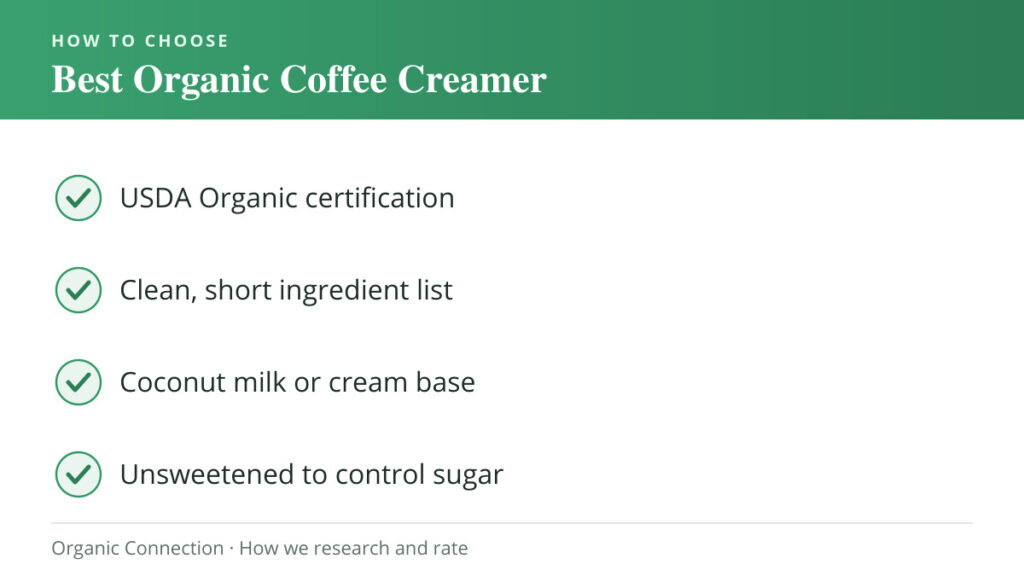
A good organic creamer is about clean ingredients and how it performs in your cup. Here is what matters.
1. USDA organic certification
It confirms the ingredients were grown without synthetic pesticides; without the seal, “natural” is just marketing.
2. Clean, short ingredient list
Favor creamers built on organic coconut with few or no gums, fillers, or added sugars.
3. Liquid, powder, or DIY base
Ready liquid creamers are convenient, powders are shelf-stable and travel well, and pure coconut milk lets you control everything.
4. Sweetened vs unsweetened
Unsweetened lets you control sugar; lightly sweetened options add organic flavor if you prefer.
Why most organic creamers are still coconut-based
Scan the refrigerated creamer aisle and most of the big brands, including many labeled “plant-based” or “natural”, are not USDA organic, and commonly contain seed oils, gums and additives. The creamers carrying a genuine organic seal have long been dominated by coconut, because organic coconut milk, cream and powder produce a rich dairy-free creamer without needing synthetic stabilizers.
That picture has widened since early 2025. Organic Valley launched a line of certified-organic oat creamers made with oats from US organic family farms, in vanilla, caramel, oatmeal cookie and cinnamon spice, at around 30 calories per serving; Sown makes an organic oat creamer in a cardboard carton that performs well for foam; and organic dairy half-and-half has been on shelves for years for anyone who never needed dairy-free in the first place. Califia, Elmhurst, Forager, Nutpods and Sown between them cover almond, oat, cashew and almond-coconut with no added sweeteners, though organic certification varies line by line rather than brand by brand.
So the honest position is narrower than “organic means coconut”: coconut remains the strongest category for shelf-stable and powdered creamers with genuinely short ingredient lists, which is why our picks land there, but certified-organic oat and dairy options now exist and are worth knowing about if coconut flavor is the thing putting you off. Check the seal on the individual carton, because several of these brands run organic and non-organic lines under the same logo.
Our scoring rewards real USDA organic certification, clean and short ingredient lists, and how well the creamer performs in coffee, so you get an organic creamer that is genuinely clean, not just organic-sounding.
What is actually in commercial oat drinks
Oat drinks look like a short simple product and most are engineered more than people realize. Knowing what each additive is doing makes the label readable.
| Ingredient | Why it is there | Worth knowing |
| Rapeseed or canola oil | Adds creaminess and mouthfeel | Common in barista versions; some people specifically want to avoid added oils |
| Gellan or xanthan gum | Stops separation, holds texture | Generally well tolerated; a minority report bloating |
| Dipotassium phosphate | Emulsifier and acidity buffer; stops curdling in coffee | The reason barista blends do not split in hot acidic coffee |
| Tricalcium phosphate | Calcium fortification carrier | Useful if you are replacing dairy for calcium |
| Enzymes | Break oat starch into sugars | Not usually listed as an ingredient, and it changes the product substantially |
The enzyme point is the one that surprises people. Oat drinks are made by treating oat starch with enzymes that break it down into simpler sugars, chiefly maltose. That is how a product with no added sugar tastes sweet and creamy. It is not deceptive, the label is accurate, and maltose has a high glycaemic index, so an unsweetened oat drink can still affect blood sugar more than the “no added sugar” claim implies. If you are managing blood glucose, this matters more than the additive list does.
Glyphosate and why organic helps here. Oats are one of the two main crops where glyphosate is used as a pre-harvest desiccant, sprayed shortly before harvest to dry the crop. Independent testing has found detectable glyphosate in some conventional oat drinks, with many others testing non-detect. USDA organic certification prohibits glyphosate entirely, so an organic oat drink removes the question rather than leaving you to compare parts per billion. For oat-based products specifically, this is the strongest single argument for buying organic.
What a minimal product looks like. Oats, water, salt, and nothing else. It will separate, it will be thinner, and it will not foam well for coffee. Whether that is better depends entirely on what you want it for; a barista blend is engineered to do a job that a two-ingredient oat drink genuinely cannot.
How to choose an organic coffee creamer
- Look for the USDA Organic seal. It is the only verification that “organic” is real.
- Read the ingredients. Favor organic coconut with minimal gums, oils, or added sugar.
- Pick your format. Ready liquid for convenience, powder for shelf life and travel, coconut milk for full control.
- Choose your sweetness. Unsweetened to control sugar, lightly sweetened for flavor.
- Mind separation. Natural coconut creamers can separate; a quick stir or froth fixes it.
Who should buy organic coffee creamer
How you take your coffee decides this. For most cups, reach for our top pick. If you want a superfood-boosted creamer, a versatile DIY powder, or pure organic coconut milk to control everything, we have a pick for each.
Best overall: Native Forest Simple Organic Coconut Milk
| Organic Integrity Score | 92 / 100 |
| Certification | Certified Organic, Non-GMO, Kosher |
| Form | Canned coconut milk (coconut + water) |
| Best for | The purest, additive-free option |
Native Forest Simple is our pure pick. It is USDA-organic canned coconut milk with just two ingredients, organic coconut and filtered water, no guar gum or additives, pressed from organic coconuts, so you get the cleanest possible creamer to splash into coffee, and it doubles for curries, soups, and desserts.
It leads this page because its listing names Non-GMO Project and certified organic, which is more than anything else here puts in writing.
What we liked: USDA organic, just coconut and water with no gums, versatile for coffee and cooking, and about as clean as it gets.
Keep in mind: It is rich, coconut-forward coconut milk, and must be refrigerated after opening.
What the listing discloses: Native Forest states Non-GMO Project Verified and kosher certification, and does not say whether the USDA seal applies and where it was grown or made.
Best superfood: Anthony’s Organic Coconut Creamer
| Organic Integrity Score | 88 / 100 |
| Certification | USDA Organic, Non-GMO, Gluten-free |
| Form | Powdered coconut creamer with superfoods |
| Best for | A functional, shelf-stable creamer |
Anthony’s Organic Coconut Creamer is our superfood pick. This organic, non-GMO powdered creamer blends organic coconut with MCTs and superfoods for a shelf-stable, dairy-free creamer that dissolves into coffee for a smooth, lightly creamy cup, ideal if you like a functional boost and long pantry storage.
What we liked: Organic and non-GMO, MCTs and superfoods, shelf-stable and travel-friendly, and dissolves smoothly.
Keep in mind: It is a powder you stir in, and it carries a mild coconut flavor.
What the listing discloses: Anthony’s documents USDA organic certification, and leaves where it was grown or made unsaid.
Best DIY base: Anthony’s Organic Coconut Milk Powder
| Organic Integrity Score | 86 / 100 |
| Certification | Non-GMO, Gluten-free, Vegan |
| Form | Dehydrated coconut milk powder |
| Best for | Coffee, cooking, and DIY creamer |
Anthony’s Organic Coconut Milk Powder is our DIY pick. It is simply dehydrated organic coconut milk with organic tapioca and acacia, gluten-free, non-GMO, vegan, and shelf-stable with no added sugar, so you can stir it into coffee as a creamer or use it in cocoa, curries, smoothies, and baking, controlling the strength yourself.
It scores in the middle because it is a plain multi-use ingredient rather than a purpose-built creamer, but for versatility and control at a good price, it is a great pantry staple.
What we liked: Organic and gluten-free, no added sugar, extremely versatile for coffee and cooking, and long shelf life.
Keep in mind: It is a multi-use ingredient, so you adjust the amount to get your preferred creaminess.
What the listing discloses: Beyond the organic claim itself, Anthony’s does not say whether the USDA seal applies and where it was grown or made.
Clean organic creamer: Laird Superfood Organic Unsweetened Creamer
| Organic Integrity Score | 77 / 100 |
| Certification | — |
| Form | Liquid, coconut-based, unsweetened |
| Best for | An all-around clean organic creamer |
Laird Superfood is still a reasonable buy because it is genuinely USDA organic and remarkably clean. It is built on organic coconut milk and cream with organic acacia fiber, sea salt, and a touch of organic lion’s mane, unsweetened with no added sugar, and free of the gums and fillers found in many creamers, giving a smooth, subtly rich coffee without a strong coconut punch.
The trade-off is that a clean coconut creamer can separate and has a light coconut note. For a certified-organic, unsweetened, clean liquid creamer, it is easy to recommend for that.
What we liked: USDA organic, unsweetened, no added sugar or gums, and a smooth, subtly rich result in coffee.
Keep in mind: As a natural creamer it can separate (just stir or froth), and it carries a light coconut note.
What the listing discloses: Beyond the organic claim itself, Laird Superfood does not say whether the USDA seal applies and where it was grown or made.
Organic creamers by base: what each one does in coffee
Base ingredient decides almost everything about how a creamer behaves — how it tastes, whether it splits, how it foams, and what it does to your blood sugar. This is the comparison the big creamer roundups leave out, and it matters more than brand.
| Base | In the cup | Splits? | Best for |
| Coconut | Richest mouthfeel of any plant base; distinct coconut note that fades in dark roasts | Rarely, if warmed | Anyone wanting a certified-organic, additive-free option; powders travel well |
| Oat | Closest to dairy in body and sweetness; foams best of the plant bases | Only if unbuffered | Lattes and foam. Watch the glycaemic point below. |
| Almond | Thin, slightly nutty; least rich | Frequently | Low calorie counts; not for anyone chasing creaminess |
| Cashew | Smooth and neutral, more body than almond | Occasionally | A middle ground when coconut flavor is unwanted |
| Organic dairy (half-and-half, cream) | The reference point everything else imitates | Only if the milk is old or the coffee very acidic | People who never needed dairy-free and simply want organic |
Keep in mind: “creamer” and “milk” are not interchangeable on the shelf. Creamers are formulated with more fat and more emulsifier specifically to survive hot acidic coffee. A carton of organic oat milk will thin out and sometimes curdle where an organic oat creamer holds together.
The oat creamer glycaemic problem
Oat has become the default non-dairy creamer — it accounts for roughly a third of non-dairy orders in US coffee shops — and it carries a wrinkle that almost no creamer guide mentions.
Oat drinks and oat creamers are made by treating oat starch with enzymes that break it into simpler sugars, principally maltose. That is how a product with zero added sugar tastes sweet and creamy. But maltose has a glycaemic index of about 105, higher than pure glucose. Fat and fiber in the finished product pull that down, but oat milk still lands around GI 69, against roughly the low 30s for dairy, almond and soy.
The label is not lying when it says no added sugar. The sugar was not added; it was manufactured out of the starch that was already there. If you are managing blood glucose, this is the single most useful thing to know about oat-based creamers, and it applies to organic and conventional alike — certification does not change the enzymology.
Two ways around it: choose a coconut, almond or cashew base, or look for oat products labeled “cold-pressed” or explicitly free of enzymatic treatment, which run lower. Check the ingredient list for “oat concentrate”, “oat syrup” or “maltose” — several products showing 0 g added sugar still declare 4–7 g of total sugars from exactly this process.
Added sugar: what a tablespoon actually costs you
Creamer is measured in tablespoons on the label and in glugs in real life, which is where the numbers get away from people. A flavored creamer at 5 g of sugar per tablespoon, poured at a realistic three tablespoons, puts 15 g of sugar in a cup of coffee — comparable to a small fizzy drink, before any second cup.
| Type | Typical sugar per tbsp | Note |
| Unsweetened coconut or nut creamer | 0–1 g | What we recommend as a default |
| Organic dairy half-and-half | ~0.5 g | Naturally occurring lactose, not added sugar |
| Unsweetened oat creamer | 1–2 g | From enzymatic maltose, as above |
| Organic flavored creamer | ~3 g | Better than conventional, still sugar |
| Conventional flavored creamer | ~5 g | Plus seed oils and synthetic flavor |
If you want flavor without the sugar load, the reliable move is an unsweetened base plus something you control: a split vanilla pod steeped in the bottle, a cinnamon stick in the grounds, or a pinch of cocoa. It costs less than flavored creamer and you decide the sweetness.
What “non-dairy” legally means on a creamer
This trips up people buying for a milk allergy, and it is worth stating plainly. In the US, a product can be labeled “non-dairy” and still contain sodium caseinate, which is a milk protein. The FDA permits it as long as the milk derivation is disclosed, which is usually done in small type in the ingredient list rather than on the front of the bottle. Classic powdered coffee whiteners are the common example.
For lactose intolerance this is often fine, because caseinate contains negligible lactose. For a genuine milk protein allergy it is not fine at all. The words that actually mean no milk protein are “dairy-free”, “vegan”, or a certified vegan mark — not “non-dairy”. Every product in this guide is genuinely free of milk protein, but the distinction is worth carrying to the rest of the aisle.
Why creamer curdles in coffee, and how to stop it
Splitting is the most common complaint with plant creamers and it is almost always one of three things.
- Acidity. Light roasts and single-origin African coffees sit lower on the pH scale, and plant proteins destabilize in acid. The same creamer that splits in a bright Ethiopian will behave perfectly in a dark roast. If your creamer curdles, changing the coffee often fixes it faster than changing the creamer.
- Temperature shock. Cold creamer hitting near-boiling coffee curdles far more readily than creamer at room temperature. Pouring the creamer into the cup first and the coffee on top solves most of it, because the creamer warms gradually instead of being shocked.
- Missing buffer. Barista formulations contain dipotassium phosphate, which raises pH and stops the proteins dropping out. Minimal two-ingredient products have no buffer by design. That is a legitimate trade-off, not a defect — but it means the cleanest label and the best behavior in coffee are rarely the same bottle.
Coconut creamers have a fourth quirk that is not curdling and gets mistaken for it: the fat solidifies below about 24°C, so a bottle from the fridge shows white flecks. Warm it briefly or shake it hard and it re-emulsifies. Nothing has spoiled.
How to store creamer and how long it really lasts
- Shelf-stable cartons keep unopened for months in a cupboard, then 7–10 days refrigerated after opening — considerably shorter than dairy drinkers expect.
- Powdered creamers last 12–24 months sealed and are the practical choice for travel, camping and offices. Once opened, keep them dry; coconut milk powder clumps permanently if it takes on moisture.
- Organic dairy half-and-half follows the printed date, typically a week or so after opening.
- Freezing works for coconut and dairy in ice-cube trays, and does not work for oat or almond, which separate irreversibly on thawing.
- Trust smell over the date. Plant creamers sour rather than curdling visibly, so the first sign is usually a sharp, faintly fermented note rather than anything you can see.
How to get the best organic creamer in your coffee
Natural coconut creamers have no synthetic stabilizers, so they can separate; a quick stir, a handheld frother, or blending fixes it and adds a nice foam. Powders dissolve best if you mix them into a splash of hot coffee first, then top up. If you want sweetness, add your own organic sweetener or a little organic maple syrup so you control the sugar. Refrigerate liquid creamers and opened coconut milk, and keep powders sealed in a cool, dry place. If you want less coconut flavor, use a smaller amount or a coconut creamer specifically blended to be neutral.
How we researched this guide
We are a research-based review site. We compared each creamer against its certification, ingredient cleanliness, format, and the weight of aggregated customer feedback, then scored each with our 10-criteria Organic Integrity Score. No brand paid to be included or ranked. Read the full method on our How We Research and Rate page.
The calories that arrive one spoon at a time
Coffee creamer is a small product with a large cumulative effect, and the arithmetic is worth doing because almost nobody does it.
A tablespoon of flavored liquid creamer typically carries 35 calories and 5 grams of sugar. That is genuinely modest. The difficulty is that the stated serving is a tablespoon and the actual pour is routinely two or three, and that a coffee habit is by definition repeated. Three coffees a day at two tablespoons each is around 200 calories and 30 grams of sugar, every day, in something categorised mentally as an addition to a drink rather than as food.
Over a year that is a substantial quantity arriving entirely unrecorded, and it is the clearest example on this site of how small unmeasured additions outweigh the products people scrutinise.
The non-dairy versions deserve specific attention. Many conventional creamers contain no dairy and no cream, and are built from water, sugar or corn syrup solids, and hydrogenated or refined oil, with emulsifiers for texture. Organic versions generally use better ingredients, which is a real improvement in composition and not a reduction in calories.
The practical alternatives are unglamorous and effective: pour from a measuring spoon rather than the bottle, use unsweetened milk or a splash of cream instead of a flavored creamer, or move the sweetness to a zero-calorie option, which our monk fruit guide covers.
Honest summary: individually trivial, cumulatively significant, entirely unrecorded by most people, and the single easiest place to remove a few hundred calories a day without changing anything you would notice.
Common questions about organic coffee creamer
What is the best organic coffee creamer?
Our overall pick is Laird Superfood Organic Unsweetened Creamer, because it is USDA organic, unsweetened, and free of gums and added sugar. For a superfood boost, Anthony’s Organic Coconut Creamer is our pick, and for a DIY base, Anthony’s Organic Coconut Milk Powder.
Why are most organic creamers coconut-based?
The popular refrigerated liquid creamers are generally not certified organic and often contain seed oils, gums, and additives. The creamers that do carry a USDA Organic seal are almost all built on organic coconut, which makes a rich, dairy-free creamer without synthetic stabilizers.
Is there an organic dairy coffee creamer?
Organic dairy half-and-half exists but is usually refrigerated and not sold shelf-stable online, so the practical organic options you can order are coconut-based. If you want organic dairy, look for organic half-and-half at the grocery store.
Do organic creamers separate in coffee?
Natural coconut creamers can separate because they skip synthetic stabilizers. A quick stir, a handheld frother, or blending re-combines them and often adds a pleasant foam.
Are organic coffee creamers healthier?
They avoid synthetic pesticides and typically skip the additives and added sugars in many conventional creamers, which many people prefer. They are still a coconut fat, so use to taste; unsweetened versions let you control sugar.
Is there a certified organic oat creamer?
Yes, and this changed recently. Organic Valley launched certified-organic oat creamers in early 2025 using oats from US organic family farms, and Sown makes an organic oat creamer that foams well. Before that the organic creamer shelf was almost entirely coconut. Check the seal on the individual carton though, because several brands run organic and non-organic lines under the same branding.
Does oat creamer raise blood sugar?
More than most alternatives, yes. Oat drinks are made by using enzymes to break oat starch into maltose, which has a glycaemic index around 105 — higher than pure glucose. The finished product lands near GI 69, against roughly the low 30s for dairy, almond and soy. This is true of organic oat creamer as well, since certification does not change the processing. Coconut, almond or cashew bases avoid it.
Does “non-dairy” creamer contain milk?
It can. US labeling permits a product to be called non-dairy while containing sodium caseinate, a milk protein, as long as the milk derivation is disclosed in the ingredient list. That is usually fine for lactose intolerance but not for a milk protein allergy. The terms that genuinely mean no milk protein are dairy-free, vegan, or a certified vegan mark.
Why does my creamer curdle in coffee?
Usually acidity or temperature. Light and single-origin roasts are more acidic and destabilize plant proteins, so the same creamer that splits in a bright coffee behaves in a dark roast. Cold creamer hitting near-boiling coffee also shocks it — pour the creamer into the cup first and the coffee on top. Barista formulations add dipotassium phosphate as a pH buffer specifically to prevent this, which is why the cleanest ingredient list and the best coffee performance are rarely the same bottle.
Why does coconut creamer have white flecks?
Coconut fat solidifies below about 24°C, so a bottle straight from the fridge often shows small white specks. That is not curdling and not spoilage. Shake it hard or warm it briefly and it re-emulsifies.
How long does organic creamer last after opening?
Shelf-stable plant creamers keep about 7 to 10 days refrigerated once opened, noticeably shorter than dairy drinkers expect. Powdered creamers last 12 to 24 months sealed and are the practical option for travel or an office. Trust smell over the printed date — plant creamers sour with a sharp fermented note before anything is visible.
Can you freeze coffee creamer?
Coconut and dairy creamers freeze acceptably in ice-cube trays. Oat and almond do not — they separate irreversibly on thawing and no amount of shaking brings them back.
- Organic Food and Pantry hub
- Best Organic Instant Coffee
- Best Organic Oat Milk
- How we research and rate products
- all our reviewed products in one place — sortable by Organic Integrity Score
Price and availability as of October 11, 2026 7:10 pm EDT. Product prices and availability are accurate as of the date/time indicated and are subject to change. Any price and availability information displayed on Amazon.com at the time of purchase will apply to the purchase of this product.
Looking for other organic products?
We have checked more than 800 products across food, household goods, gardening, personal care and pet, every one against its stated certification. Browse all reviews.
Organic Connection is reader-supported. When you buy through links on this page we may earn a commission, at no extra cost to you. As an Amazon Associate we earn from qualifying purchases. We are not paid to feature or rank any product. How we research and rate.