Last updated: September 30, 2026
We may earn a commission when you buy through links on this page, at no extra cost to you. How we research and rate.
The short version
After researching the ingredients, sourcing, and certifications of the most popular organic oat milks, our top pick is Pacific Foods Organic Oat Milk Original. It is USDA organic, creamy and versatile, widely available, and a good source of calcium and vitamin D, which is why it earned our highest Organic Integrity Score of 94 out of 100. For the cleanest, lowest-sugar option, Willa’s Unsweetened Organic Oat Milk is our pick, and for a simple no-gum recipe, Rise Brewing is the best choice.
The main things that separate organic oat milks are the ingredient list (how many additives, gums, and oils) and whether they are USDA organic, which matters because conventional oats are frequently flagged for glyphosate. We flag each pick’s ingredients and best use. All are shelf-stable and dairy-free.
Best organic oat milk compared
| Best Choice | Best Value | ||||
 |  |  |  |  | |
| Product | Pacific Foods | Oatsome | Willa’s Barista | Willa’s Unsweetened | Rise Brewing |
| Organic Integrity Score | 94/ 100 | 92/ 100 | 81/ 100 | 80/ 100 | 77/ 100 |
| Our rating | 4.7 | 4.6 | 4.1 | 4.0 | 3.9 |
| Best for | Best overall | Value | Barista / lattes | Cleanest / low sugar | No gums |
| Style | Original | Original multipack | Barista blend | Unsweetened | Original, no gums |
| Certification | USDA Organic, Non-GMO, Vegan | USDA Organic, Non-GMO, Gluten-free | Gluten-free, Vegan, Organic | Non-GMO, Vegan, Organic | — |
| Price | $3.99 $4.59 −13%$0.12 / fluid ounce View on Amazon | Currently unavailable See buying options | Currently unavailable See buying options | $35.99$0.19 / fluid ounce View on Amazon | Currently unavailable See buying options |
Price and availability as of October 11, 2026 7:10 pm EDT. Product prices and availability are accurate as of the date/time indicated and are subject to change. Any price and availability information displayed on Amazon.com at the time of purchase will apply to the purchase of this product.
Scores are ours, based on independent research of certification, ingredient cleanliness, sweetness, and performance, using the same 10-criteria method we apply to every product. See how we research and rate.
The certification map for organic oat milk, and what each one actually excludes
Most shoppers read a certification as a general signal of quality. Every one of them is narrower than that, and the gaps between them are where the marketing lives.
| Certification | Covers | Key exclusion |
| USDA Organic | Farming and handling: no synthetic pesticides or fertilizers, no GMOs, no sewage sludge or irradiation, audited yearly by an accredited certifier | Three different tiers share the one seal, and it makes no claim about worker pay, food miles, or nutrition |
| Gluten-Free Certified | Testing to below 10 parts per million of gluten, stricter than the FDA threshold of 20 ppm | A gluten threshold and nothing more; unrelated to organic content or nutrition |
USDA Organic is three claims wearing one seal. “100% Organic” means every ingredient is certified. Plain “Organic”, the version you will see most often, means at least 95% by weight, with the remainder drawn from an approved national list. “Made with organic ingredients” means 70%, and that wording may not carry the USDA seal at all. The phrase on the front of the pack tells you which of the three you are holding, and the gap between them is not small.
Key things to look for in organic oat milk
Good organic oat milk is about clean ingredients and how it behaves in your cup or bowl. Here is what matters.
1. USDA organic (glyphosate-free oats)
Organic oats are grown without glyphosate and synthetic pesticides, which matters for a drink you may have daily.
2. A short, clean ingredient list
Favor oat milks with just oats, water, and salt, and minimal gums, added oils, or sugar.
3. Sweetened vs unsweetened
Unsweetened lets you control sugar; barista blends and flavored versions add a little for froth or taste.
4. The right one for the job
Original for cereal and smoothies, barista blends for frothing lattes, unsweetened for baking and cooking.
Is organic oat milk worth it?
Oats are one of the clearer reasons to buy organic, because conventional oats and oat products have repeatedly shown up in testing for residues of glyphosate, a herbicide sometimes sprayed pre-harvest. USDA-organic oat milk is made from oats grown without glyphosate and synthetic pesticides. Beyond that, oat milks vary a lot in cleanliness: the best use just oats, water, and salt, while others add seed oils, gums, and sugar, so reading the label matters as much as the organic seal.
Our scoring rewards genuine USDA certification, a short and clean ingredient list, honest sweetness, and real-world performance in coffee, cereal, and cooking, so you get an oat milk that is both organic and genuinely clean.
What is actually in commercial oat drinks
Oat drinks look like a short simple product and most are engineered more than people realize. Knowing what each additive is doing makes the label readable.
| Ingredient | Why it is there | Worth knowing |
| Rapeseed or canola oil | Adds creaminess and mouthfeel | Common in barista versions; some people specifically want to avoid added oils |
| Gellan or xanthan gum | Stops separation, holds texture | Generally well tolerated; a minority report bloating |
| Dipotassium phosphate | Emulsifier and acidity buffer; stops curdling in coffee | The reason barista blends do not split in hot acidic coffee |
| Tricalcium phosphate | Calcium fortification carrier | Useful if you are replacing dairy for calcium |
| Enzymes | Break oat starch into sugars | Not usually listed as an ingredient, and it changes the product substantially |
The enzyme point is the one that surprises people. Oat drinks are made by treating oat starch with enzymes that break it down into simpler sugars, chiefly maltose. That is how a product with no added sugar tastes sweet and creamy. It is not deceptive, the label is accurate, and maltose has a high glycaemic index, so an unsweetened oat drink can still affect blood sugar more than the “no added sugar” claim implies. If you are managing blood glucose, this matters more than the additive list does.
Glyphosate and why organic helps here. Oats are one of the two main crops where glyphosate is used as a pre-harvest desiccant, sprayed shortly before harvest to dry the crop. Independent testing has found detectable glyphosate in some conventional oat drinks, with many others testing non-detect. USDA organic certification prohibits glyphosate entirely, so an organic oat drink removes the question rather than leaving you to compare parts per billion. For oat-based products specifically, this is the strongest single argument for buying organic.
What a minimal product looks like. Oats, water, salt, and nothing else. It will separate, it will be thinner, and it will not foam well for coffee. Whether that is better depends entirely on what you want it for; a barista blend is engineered to do a job that a two-ingredient oat drink genuinely cannot.
How to choose an organic oat milk
- Look for USDA organic. It confirms glyphosate-free, pesticide-free oats.
- Read the ingredients. Favor oats, water, and salt with minimal gums, oils, or added sugar.
- Match it to your use. Original for cereal and smoothies, barista for lattes, unsweetened for cooking.
- Check the sugar. Even unsweetened oat milk has some natural sugar from oats; added sugar is what to watch.
- Mind storage. Shelf-stable until opened, then refrigerate and use within about a week.
Who should buy organic oat milk
Coffee and cereal want different cartons. For general use, our top pick handles it. If you want the cleanest low-sugar option, a simple no-gum recipe, a barista blend for lattes, or the best value, we have a pick for each.
Best overall: Pacific Foods Organic Oat Milk Original
| Organic Integrity Score | 94 / 100 |
| Certification | USDA Organic, Non-GMO, Vegan |
| Style | Original, shelf-stable |
| Best for | An all-around versatile organic oat milk |
Pacific Foods is our top pick because it balances clean organic sourcing, versatility, and availability. This USDA-organic, non-GMO oat milk is creamy and mild with a short ingredient list, fortified with calcium and vitamin D, and it performs everywhere, over cereal, in smoothies, in coffee, and in baking, from a trusted brand you can find almost anywhere.
The trade-off is that it uses a touch of gellan gum for texture, which the very cleanest options skip. For a genuinely organic, versatile, easy-to-find everyday oat milk, it is our first choice.
What we liked: USDA organic and non-GMO, creamy and versatile, fortified with calcium and vitamin D, and widely available at a fair price.
Keep in mind: It includes a little gellan gum for texture, which the most minimalist oat milks leave out.
What the listing discloses: You are told USDA organic certification for Pacific Foods; you are not told where it was grown or made.
Best value: Oatsome Organic Oat Milk
| Organic Integrity Score | 92 / 100 |
| Certification | USDA Organic, Non-GMO, Gluten-free |
| Style | Original, 1-liter multipack |
| Best for | Stocking up at a low cost per liter |
Oatsome is our value pick. It is a USDA-organic oat milk sold in shelf-stable 1-liter cartons by the case, giving a low cost per liter, so households that go through a lot of oat milk can stock the pantry and always have some on hand, creamy and versatile for everyday use.
It scores at the value end because it is a straightforward everyday oat milk bought in bulk rather than a specialty clean-label or barista product, but for organic oat milk at the best price per liter, it is a smart buy.
What we liked: USDA organic, convenient 1-liter cartons by the case, shelf-stable, and a low cost per liter.
Keep in mind: It is an everyday oat milk in bulk rather than an ultra-clean or barista-specific formula.
What the listing discloses: Oatsome lists USDA organic certification. The gap is where it was grown or made.
Best barista: Willa’s Organic Barista Oat Milk
| Organic Integrity Score | 81 / 100 |
| Certification | Gluten-free, Vegan, Organic |
| Style | Barista blend, low sugar |
| Best for | Frothing lattes and cappuccinos |
Willa’s Barista is our pick for coffee. This USDA-organic barista blend is formulated to steam and froth like a proper latte oat milk, using maple sugar for just about 3 grams of sugar per cup, half the sugar of many barista oat milks, with no oils or gums, so you get café-style foam with a cleaner label.
It scores in the value range on our clean-ingredient metric because a barista blend adds a little sweetener for froth and flavor, but for organic latte foam without a sugar bomb, it is the standout.
What we liked: USDA organic, steams and froths well, low sugar from maple, and no oils or gums.
Keep in mind: Barista blends add a touch of sweetener, so it is not unsweetened.
What the listing discloses: You are told an origin of the USA for Willa’s; you are not told whether the USDA seal applies.
Best clean / low sugar: Willa’s Unsweetened Organic Oat Milk
| Organic Integrity Score | 80 / 100 |
| Certification | Non-GMO, Vegan, Organic |
| Style | Unsweetened, 4 ingredients |
| Best for | The cleanest, lowest-sugar oat milk |
Willa’s is our pick for clean eating. Its unsweetened original has just four simple ingredients with no oils, gums, or added sugar, only about 1 gram of sugar per cup, plus plant protein and prebiotic fiber from whole oats, and it is certified organic, glyphosate-free, non-GMO, and vegan, made in the USA.
It scores just below our top pick because a no-gum oat milk can be thinner and needs a shake, but for the cleanest, lowest-sugar organic oat milk, it is our pick.
What we liked: USDA organic and glyphosate-free, just four ingredients, no oils or gums, very low sugar, and real oat fiber and protein.
Keep in mind: Without gums it is thinner and can separate, so shake before using.
What the listing discloses: Willa’s commits to kosher certification but stops short of whether the USDA seal applies and where it was grown or made.
Best no-gum recipe: Rise Brewing Organic Oat Milk
| Organic Integrity Score | 77 / 100 |
| Certification | — |
| Style | Original, no gums or stabilizers |
| Best for | A simple, pure oat milk |
Rise Brewing is our pick for a simple recipe. Its USDA-organic oat milk is made from organic oats, water, a little organic sunflower oil, and sea salt, with no gums, stabilizers, or fillers, giving a clean, pure oat milk that works in coffee, cereal, smoothies, and cooking from a brand known for its oat-milk lattes.
It scores in the middle because it uses a touch of sunflower oil for texture (rather than being oil-free like Willa’s), but for a clean, gum-free organic oat milk, it is excellent.
What we liked: USDA organic, no gums or fillers, a clean simple recipe, and versatile in coffee and cooking.
Keep in mind: It includes a little sunflower oil for texture, so it is not strictly oil-free.
What the listing discloses: Beyond the organic claim itself, RISE Brewing Co does not say whether the USDA seal applies and where it was grown or made.
How to use organic oat milk
Shelf-stable oat milk keeps in the pantry until opened, then refrigerate and use within about a week; shake before pouring, especially gum-free brands that separate. For lattes, use a barista blend that steams and froths; for cereal, smoothies, and baking, an original or unsweetened works well and swaps one-to-one for dairy milk. Unsweetened versions are best for savory cooking and controlling sugar. Note that oat milk naturally contains some sugar from the oats even when unsweetened, so the number to watch on the label is added sugar.
Fortification: where organic oat milk is often weaker than conventional
This is the trade-off that organic oat milk guides consistently avoid, and it deserves stating plainly because it runs against the usual direction of these recommendations.
Cow’s milk supplies roughly 276–300 mg of calcium per 240 ml cup, plus iodine, B12, riboflavin and vitamin D. Oat milk supplies almost none of that naturally — everything nutritional on the carton beyond carbohydrate has been added. Mainstream conventional brands fortify heavily: Oatly Original lists around 350 mg of calcium per serving and Califia Barista around 340 mg, both at or above dairy. Many organic and minimal-ingredient oat milks, by contrast, list zero, because their whole positioning is a short ingredient list.
| Nutrient | Look for per 240 ml | Why |
| Calcium | ≥300 mg (≥25% DV) | Matches or beats cow’s milk. Calcium carbonate and tricalcium phosphate are the usual, stable forms. |
| Vitamin D | ≥2.5 mcg (10–25% DV) | Calcium absorption depends on it; fortifying one without the other is half a job |
| Vitamin B12 | Any amount, if you are dairy-free | Not present in oats at all. A real gap for vegans. |
| Riboflavin (B2) | Any amount | Dairy is a major source in most diets; oat milk is not |
| Iodine | Rarely stated | Studies of plant milks have found iodine at a small fraction of cow’s milk levels, with most unfortified. Worth knowing if dairy was your main source. |
Keep in mind: if oat milk is an occasional coffee splash, none of this matters. If it has replaced dairy entirely — especially for a child, a teenager, or anyone at risk of low bone density — an unfortified organic oat milk is a nutritional step down from the conventional carton next to it, and a cleaner ingredient list does not compensate. The honest recommendation is to buy a fortified organic oat milk where one exists, and if you prefer a minimal unfortified product, get calcium, B12, D and iodine deliberately from elsewhere rather than by accident.
Protein: oat milk is not a milk substitute nutritionally
| Per 240 ml | Protein | Carbs | Glycaemic index |
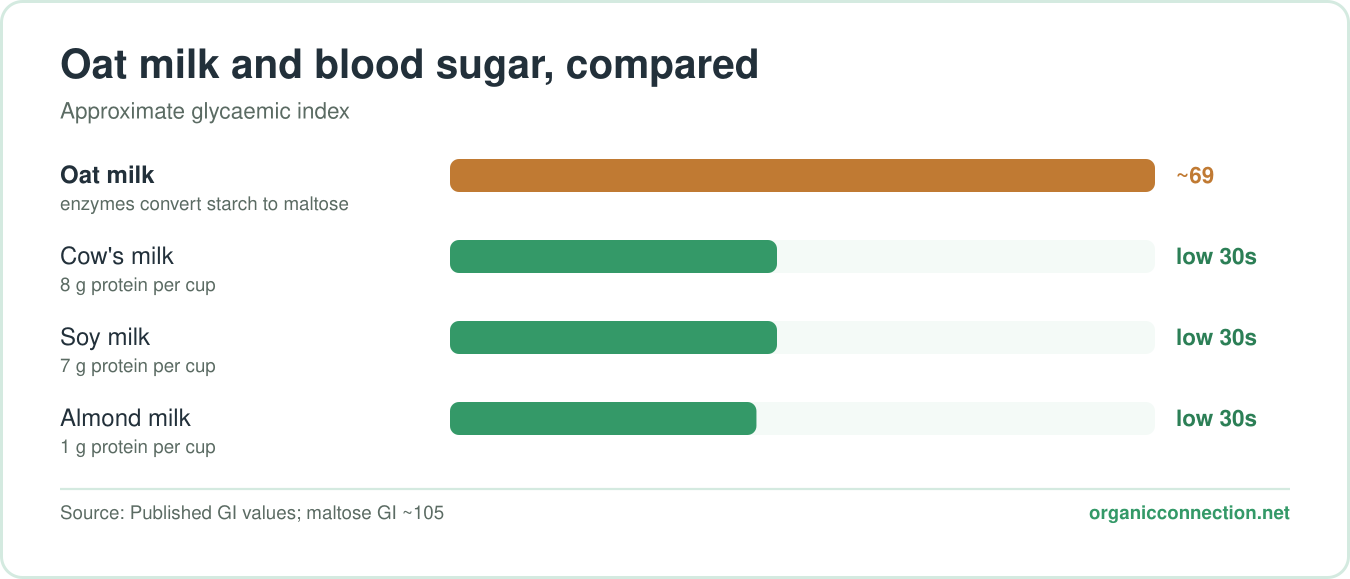
| Cow’s milk | 8 g | 12 g | Low 30s |
| Soy milk | 7 g | 4 g | Low 30s |
| Oat milk | 1–3 g | 16 g | ~69 |
| Almond milk | 1 g | 1–2 g | Low 30s |
The glycaemic figure is the one to sit with. As covered above, enzymes break oat starch into maltose, which has a glycaemic index of about 105 — higher than pure glucose. Fat and fiber pull the finished drink down to around GI 69, but that is still roughly double dairy, almond or soy. “No added sugar” is accurate and beside the point: the sugar was manufactured from the starch rather than added to it.
If you want a plant milk that behaves nutritionally like dairy, soy is the only one that comes close on protein and sits low on the glycaemic scale. Oat wins on taste and texture in coffee, which is a legitimate reason to choose it — just not a nutritional one.
What makes a barista oat milk foam
Barista versions cost more and the difference is real, not marketing.
- Added oil — usually rapeseed or sunflower, at around 1.5–3%. Fat stabilizes the foam bubble walls. This is why a fat-free oat milk cannot make a decent microfoam however you steam it.
- Dipotassium phosphate — an acidity buffer that raises pH and stops oat proteins dropping out when they meet hot acidic coffee. It is the reason barista blends do not curdle.
- Slightly higher protein or added pea protein in some brands, giving more structure to the foam.
- Steaming technique still matters: stop at 55–60°C. Oat milk scorches above about 65°C and the foam collapses, unlike dairy which tolerates more heat.
A minimal oat milk with three ingredients will taste cleaner and behave worse in coffee. That is a real trade rather than a defect, and it is worth owning two cartons if you care about both.
Making oat milk at home, and why it goes slimy
Homemade oat milk is cheap and almost always disappointing on the first attempt. The reason is starch gelatinization — heat and over-blending burst the oat starch granules, which then form a mucilaginous gel.
- Use cold or iced water. Warm water starts gelatinization before you begin.
- Blend for 30 seconds, no more. Longer is the single most common mistake.
- Do not squeeze the bag. Let it drip. Squeezing forces starch through the mesh, which is exactly what you are trying to leave behind.
- Use rolled oats, not instant or steel-cut. Instant releases starch immediately; steel-cut barely releases anything.
- Never heat homemade oat milk directly — it thickens into wallpaper paste. Add it to something already hot, off the heat.
- Keeps 3–5 days refrigerated and separates naturally. Shake before use.
Homemade oat milk will also be unfortified, low in protein and just as high in maltose-derived sugars as commercial oat milk. It is cheaper and has no gums; it is not more nutritious.
Gluten, oats and cross-contamination
Oats do not contain gluten, but they are routinely grown in rotation with wheat and processed on shared equipment, so ordinary oat milk is not safe for celiac disease. Look for certified gluten-free on the carton — that requires purity-protocol or tested oats below 20 ppm, and it is a separate certification from organic. A product can be USDA organic and still carry wheat traces.
Separately, a minority of people with celiac disease react to avenin, the oat protein itself, even with certified gluten-free oats. If oat milk causes symptoms despite a gluten-free certification, that is a recognized phenomenon rather than a labeling failure.
Storage and handling
- Shelf-stable cartons keep months unopened in a cupboard, then 7–10 days refrigerated once opened — shorter than most people assume from a dairy habit.
- Chilled cartons follow their printed date and last about 5–7 days after opening.
- Do not freeze. Oat milk separates irreversibly on thawing and no amount of shaking or blending restores it.
- Separation in gum-free products is normal. Shake hard; it re-suspends.
- Trust smell over date. Oat milk sours with a sharp, faintly fermented note well before it looks wrong, and it goes off faster than dairy once opened because there is no acidity holding bacteria back.
- Keep the carton closed in the fridge door only if you finish it quickly — the door is the warmest part of the fridge, and oat milk is less tolerant of that than milk is.
How we researched this guide
We are a research-based review site. We compared each oat milk against its certification, ingredient cleanliness, sugar, and the weight of aggregated customer feedback on taste and performance, then scored each with our 10-criteria Organic Integrity Score. No brand paid to be included or ranked. Read the full method on our How We Research and Rate page.
Oat milk against the other milks, in calories and protein
Oat milk has become the default plant milk in coffee, and it is worth knowing how it compares nutritionally because it sits at one end of the range rather than in the middle.
Unsweetened oat milk runs around 120 calories a cup, against roughly 30 to 40 for unsweetened almond, 80 for soy and 150 for whole dairy milk. It is the most calorie-dense of the common plant milks, and the reason is the process: enzymes break oat starch into shorter sugars to create the sweetness and body that make it work in coffee. Those sugars are why it froths well and why it carries more calories.
Protein is the other half of the comparison. Oat milk supplies around 3 grams a cup, soy around 7 to 8, dairy around 8, almond around 1. If a plant milk is contributing meaningfully to your protein intake, soy is the one doing it.
None of this makes oat milk a poor choice. Two lattes a day is perhaps 100 extra calories over almond milk, which matters if you are counting closely and is trivial if you are not. Oat milk is also the plant milk most people actually enjoy, and a coffee you like without sugar beats a coffee you tolerate with two spoons in it.
The distinction worth policing is sweetened versus unsweetened, which adds sugar to a product that is already sweet from processing, and barista versions, which add oil for texture and a few more calories.
Honest summary: the richest of the common plant milks, low in protein, and entirely reasonable in the quantities most people use. Choose soy if protein matters, almond if calories do.
Common questions about organic oat milk
What is the best organic oat milk?
Our overall pick is Pacific Foods Organic Oat Milk Original, because it is USDA organic, creamy, versatile, fortified, and widely available. For the cleanest low-sugar option, Willa’s Unsweetened is our pick, and for a no-gum recipe, Rise Brewing.
Why buy organic oat milk?
Conventional oats have repeatedly been flagged for glyphosate residue, a herbicide sometimes sprayed pre-harvest. USDA-organic oat milk is made from oats grown without glyphosate and synthetic pesticides, which matters for a drink you may have every day.
Which oat milk is best for coffee?
A barista blend is formulated to steam and froth like café oat milk. Our organic pick is Willa’s Organic Barista, which foams well with lower sugar than many barista oat milks.
Does oat milk have a lot of sugar?
Oat milk naturally contains some sugar from the oats even when unsweetened, typically a few grams per cup. The number to watch is added sugar; unsweetened and low-sugar organic oat milks keep it minimal.
How long does oat milk last once opened?
Shelf-stable cartons keep in the pantry until opened, then should be refrigerated and used within about seven days. Gum-free oat milks separate naturally, so shake well before each use.
Is organic oat milk fortified with calcium?
Often not, and this is the one place where organic oat milk can be nutritionally weaker than conventional. Mainstream brands fortify heavily — Oatly Original lists around 350 mg calcium per serving, Califia Barista around 340 mg, both at or above cow’s milk at 276 to 300 mg. Many organic and minimal-ingredient oat milks list zero, because a short ingredient list is their whole positioning. Look for at least 300 mg calcium and 2.5 mcg vitamin D per 240 ml if oat milk has replaced dairy.
Does oat milk have B12 and iodine?
Only if fortified, and many organic ones are not. Oats contain no B12 at all, and studies of plant milks have found iodine at a small fraction of cow’s milk levels with most products unfortified. If dairy was your main source of either, switching to an unfortified oat milk quietly removes them. Get them deliberately from a supplement or other foods rather than assuming the carton covers it.
How much protein is in oat milk?
1 to 3 g per 240 ml, against 8 g for cow’s milk and 7 g for soy. Oat milk is not a protein food. If you want a plant milk that behaves nutritionally like dairy, soy is the only one that comes close on protein while staying low on the glycaemic scale.
Does oat milk spike blood sugar?
More than the alternatives. Enzymes break oat starch into maltose, which has a glycaemic index around 105 — higher than pure glucose. Fat and fiber bring the finished drink to about GI 69, roughly double dairy, almond or soy in the low 30s. “No added sugar” is accurate but beside the point: the sugar was manufactured from the starch rather than added to it, and organic certification does not change the processing.
What makes barista oat milk different?
Added oil, usually rapeseed or sunflower at around 1.5 to 3%, which stabilizes foam bubble walls — a fat-free oat milk cannot make good microfoam however you steam it. Plus dipotassium phosphate, an acidity buffer that stops oat proteins dropping out in hot acidic coffee. Steam to 55 to 60°C only; oat milk scorches above about 65°C and the foam collapses, unlike dairy.
Why does my homemade oat milk go slimy?
Starch gelatinization. Heat and over-blending burst the oat starch granules, which form a mucilaginous gel. Use cold or iced water, blend for no more than 30 seconds, and let the bag drip rather than squeezing it — squeezing forces starch through the mesh. Use rolled oats rather than instant or steel-cut, and never heat homemade oat milk directly; add it to something already hot, off the heat.
Is oat milk gluten-free?
Not automatically. Oats contain no gluten but are grown in rotation with wheat and processed on shared equipment, so ordinary oat milk is unsafe for celiac disease. Look for certified gluten-free, which requires purity-protocol or tested oats below 20 ppm — a separate certification from organic. A minority of people with celiac disease also react to avenin, the oat protein itself, even with certified gluten-free oats.
How long does oat milk last after opening?
7 to 10 days refrigerated for shelf-stable cartons, and 5 to 7 days for chilled ones — shorter than a dairy habit prepares you for, because there is no acidity holding bacteria back. Do not freeze it; oat milk separates irreversibly on thawing. Separation in gum-free products is normal and shakes out. Trust smell over date, since it sours with a sharp fermented note before it looks wrong.
- Organic Food and Pantry hub
- Best Organic Oatmeal
- Best Organic Coffee Creamer
- How we research and rate products
- our full product index — search by brand, product or certification
Price and availability as of October 11, 2026 7:10 pm EDT. Product prices and availability are accurate as of the date/time indicated and are subject to change. Any price and availability information displayed on Amazon.com at the time of purchase will apply to the purchase of this product.
Looking for other organic products?
We have checked more than 800 products across food, household goods, gardening, personal care and pet, every one against its stated certification. Browse all reviews.
Organic Connection is reader-supported. When you buy through links on this page we may earn a commission, at no extra cost to you. As an Amazon Associate we earn from qualifying purchases. We are not paid to feature or rank any product. How we research and rate.