Last updated: September 30, 2026
We may earn a commission when you buy through links on this page, at no extra cost to you. How we research and rate.
The short version
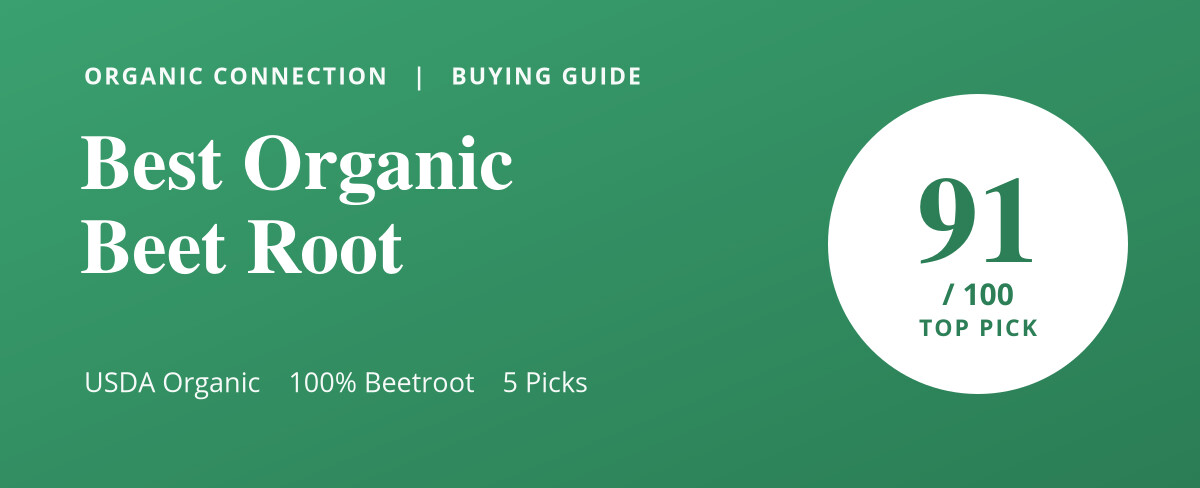
After researching the certifications, form, and purity of the most popular organic beet root supplements, our top pick is KOS Organic Beetroot Capsules. It is USDA certified organic (CCOF), 100% beetroot with no fillers, and an easy 1500 mg capsule, which is why it earned our highest Organic Integrity Score of 90 out of 100. For a versatile powder, Anthony’s Organic Beet Root Powder is our pick, and for a concentrated extract, Zazzee 20:1 is the best choice.
With beet root, “organic” matters because beets readily take up what is in the soil, and the cleanest products are USDA organic, 100% beetroot with no additives. We flag each product’s certification and form.
Best organic beet root compared
| Best Choice | Best Value | ||||
 |  |  |  |  | |
| Product | KOS Capsules | Zazzee 20:1 Extract | Organic Beetroot Powder | Anthony’s Powder | Complete Natural Capsules |
| Organic Integrity Score | 90/ 100 | 89/ 100 | 88/ 100 | 87/ 100 | 84/ 100 |
| Our rating | 4.5 | 4.5 | 4.4 | 4.4 | 4.2 |
| Form | Capsules (1500 mg) | 20:1 extract capsules | Powder (8 oz) | Juice powder (1 lb) | Capsules (620 mg) |
| Best for | Best overall | Concentrated dose | Smoothies | Versatile powder | Simple, affordable organic |
| Certification | USDA Organic, CCOF, Non-GMO | USDA Organic, Non-GMO, Vegan | USDA Organic | USDA Organic, Non-GMO, Gluten-free | Non-GMO, Vegan, Organic |
| Price | $21.99$0.12 / count View on Amazon | $27.97$0.23 / count View on Amazon | $16.99$2.12 / ounce View on Amazon | $22.19$1.39 / ounce View on Amazon | $12.95$0.13 / count View on Amazon |
Price and availability as of October 11, 2026 7:10 pm EDT. Product prices and availability are accurate as of the date/time indicated and are subject to change. Any price and availability information displayed on Amazon.com at the time of purchase will apply to the purchase of this product.
Scores are ours, based on independent research of certification, purity, form, and value, using the same 10-criteria method we apply to every product. See how we research and rate.
Reading the seals on organic beet root: what each one does and does not cover
A seal is a specific promise about a specific thing. These are the promises behind the marks on this page, in plain terms, along with the question each one leaves unanswered.
| Certification | Covers | Key exclusion |
| USDA Organic | Farming and handling: no synthetic pesticides or fertilizers, no GMOs, no sewage sludge or irradiation, audited yearly by an accredited certifier | Three different tiers share the one seal, and it makes no claim about worker pay, food miles, or nutrition |
| Kosher | Ingredients and production comply with Jewish dietary law, verified by a rabbinic agency that inspects the facility | A dietary-law standard: it makes no claim about pesticides, GMOs or farming practice |
Kosher and organic answer entirely different questions. A kosher mark, OU, OK, Star-K and others, confirms that ingredients and production follow Jewish dietary law, verified by an agency that inspects the facility. It is a rigorous supply-chain audit and it says nothing about pesticides, GMOs or farming. The two seals appear together often precisely because neither substitutes for the other.
Key things to look for in organic beet root
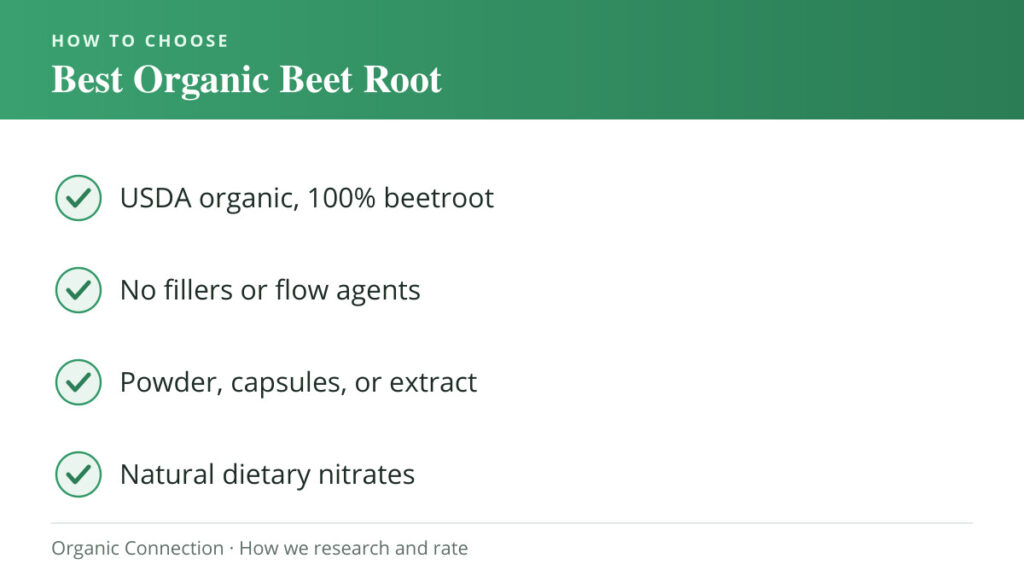
Clean beet root is about certification, purity, and form. Here is what matters.
1. USDA organic certification
Because beets absorb soil content, organic certification verifies clean growing without synthetic inputs.
2. 100% beetroot, no fillers
The best products are pure beetroot with no flow agents, artificial colors, or unnecessary additives.
3. The right form
Powder to mix into drinks, capsules for measured convenience, or a concentrated extract for a stronger dose.
4. Honest potency labeling
Look for a clear serving size in mg, and for extracts, the concentration ratio (like 20:1).
Powder, capsules, or extract?
All three deliver beet root; the difference is convenience and concentration. Powder is the most versatile: you stir it into water, juice, smoothies, or lattes, control your own dose, and get the fullest whole-food profile, though it has an earthy taste and stains. Capsules pre-measure the beetroot into a tasteless, portable dose, ideal for travel or anyone who dislikes the flavor, but you take several to match a scoop of powder. Concentrated extracts (like a 20:1 ratio) pack more beetroot into a smaller capsule, so you get a stronger dose with fewer pills, though a concentrate is more processed than plain powder.
None is “best” outright; it depends on how you like to take supplements. Our scoring rewards genuine USDA organic certification, 100% beetroot purity with no fillers, and honest potency labeling across every form, so whether you want to mix a scoop into your pre-workout drink, swallow a couple of capsules, or take a concentrated extract, you get clean, verifiable beet root rather than a diluted or additive-laden product.
What the nitrate evidence actually shows
Beetroot has better human evidence behind it than most supplements in this category, and the effect is specific and time-limited in a way the marketing rarely conveys.
The mechanism. Beetroot is rich in dietary nitrate. Bacteria on the tongue reduce it to nitrite, and the body converts that to nitric oxide, which relaxes and dilates blood vessels. That is a well-characterized pathway, not a vague antioxidant story.
The blood pressure numbers. A systematic review and meta-analysis found inorganic nitrate and beetroot juice produced greater reductions in systolic blood pressure, around 4.4 mmHg, than in diastolic, around 1.1 mmHg. A larger umbrella review drawing on many studies and roughly 2,000 participants found consistent reductions in both systolic and diastolic pressure across acute, short-term, and medium-term periods.
The honest limitation. Evidence does not support a sustained reduction across a full 24 hours. The effect appears to peak within hours of intake and fade, which means beetroot behaves as a repeated short-acting input rather than something that resets your baseline. Practically, that argues for daily consistent intake rather than occasional use, and against treating it as equivalent to medication.
Timing for exercise. The performance research generally uses intake around two to three hours before activity, which is when plasma nitrite peaks. Taking it immediately before a session is too late for the pathway to work.
Two practical warnings. Antibacterial mouthwash kills the oral bacteria that perform the first conversion step and can blunt or abolish the effect, which is a genuinely odd interaction worth knowing. And beeturia, harmless red or pink urine and sometimes stool, is common and not a cause for concern. If you take blood pressure medication, adding a reliable vasodilator is worth mentioning to your doctor.
How to choose organic beet root
- Insist on USDA organic. Beets absorb soil content, so clean growing matters.
- Check for 100% beetroot. No fillers, flow agents, or artificial colors.
- Pick your form. Powder for versatility, capsules for convenience, extract for a concentrated dose.
- Read the serving size. A clear mg per serving, and the ratio for extracts.
- Mind the taste and stain. Powder is earthy and stains; capsules avoid both.
Who should buy organic beet root
Format matters as much as dose here. If capsules suit you, our top pick is the USDA organic one. If you want a versatile powder, a concentrated extract, a simple budget capsule, or a smoothie powder, we have a pick for each.
Best overall: KOS Organic Beetroot Capsules
| Organic Integrity Score | 90 / 100 |
| Form | Capsules, 1500 mg, 180 count |
| Certification | USDA Organic, CCOF, Non-GMO |
| Best for | An all-around clean, convenient beet root supplement |
KOS is worth a look because it pairs strong certification with clean convenience. It is USDA certified organic (by CCOF), 100% organic beetroot powder in capsules with no fillers, made in a GMP-certified facility, vegan and keto-friendly, delivering a substantial 1500 mg dose per serving in easy, tasteless capsules that skip the earthy flavor and staining of powder, at 180 capsules for good value.
The trade-off is that capsules are a fixed dose and you swallow a couple per serving. For a genuinely certified organic, 100% beetroot, no-filler supplement in a convenient capsule, it remains a good buy.
What we liked: USDA organic (CCOF), 100% beetroot with no fillers, GMP-made, vegan, 1500 mg dose, and no taste or stain.
Keep in mind: Capsules are a fixed dose, so for a custom amount or the fullest whole-food profile, powder is more flexible.
What the listing discloses: KOS commits to a USDA organic claim and CCOF as the certifying agent but stops short of where it was grown or made.
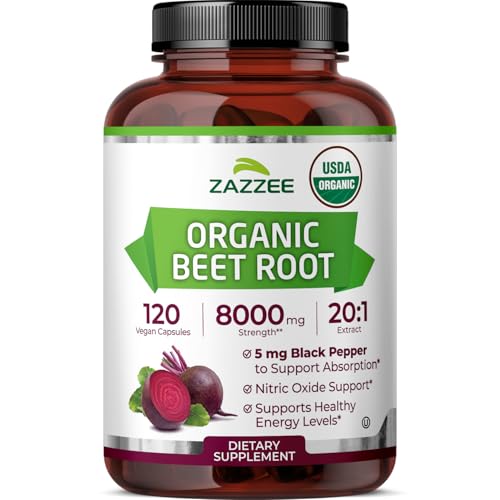
Best concentrated extract: Zazzee USDA Organic Beet Root 20:1 Extract
| Organic Integrity Score | 89 / 100 |
| Form | 20:1 extract capsules, 120 count |
| Certification | USDA Organic, Non-GMO, Vegan |
| Best for | A concentrated dose in fewer capsules |
Zazzee is our concentrated-extract pick. It is USDA certified organic beet root as a potent 20:1 extract, meaning it is about 20 times more concentrated than standard beetroot powder, so a couple of capsules deliver a strong dose, paired with organic black pepper extract to support absorption, vegan and Kosher, at 120 quick-release capsules and a four-month supply.
It scores in the middle because a concentrated extract is more processed than plain whole-food powder (a trade for potency), but for a strong, certified organic dose in fewer capsules, it is a standout.
What we liked: USDA organic, potent 20:1 concentration, added black pepper for absorption, vegan and Kosher, and a long supply.
Keep in mind: A 20:1 extract is more processed than plain beetroot powder, so it trades whole-food form for concentration.
What the listing discloses: Zazzee states USDA organic certification, and does not say where it was grown or made.
Best for smoothies: Organic Beetroot Powder
| Organic Integrity Score | 88 / 100 |
| Form | Fine powder, 8 oz |
| Certification | USDA Organic |
| Best for | Smoothies, juices, lattes, and baking |
This organic beetroot powder is our smoothie pick. It is USDA certified organic, pure beetroot finely ground and blended to dissolve smoothly into smoothies, juices, lattes, and baking, keeping its natural color, taste, and texture, in a manageable 8 oz size, ideal if you want a versatile powder to add a nutrient and vibrant color boost to drinks and recipes without committing to a large bag.
It scores at the value end here because it is a smaller, less established option than our top powder and has the usual earthy taste and staining, but for a fine, smoothie-friendly certified organic beet powder, it is a good choice.
What we liked: USDA organic, finely blended to mix smoothly, keeps natural color and flavor, and a manageable 8 oz size.
Keep in mind: It is a smaller, less established option with the usual beet taste and staining of any powder.
What the listing discloses: AARNA ORGANIC lists a USDA organic claim and a single-ingredient formula. The gap is where it was grown or made.
Best powder: Anthony’s Organic Beet Root Powder
| Organic Integrity Score | 87 / 100 |
| Form | Juice powder, 1 lb bag |
| Certification | USDA Organic, Non-GMO, Gluten-free |
| Best for | Mixing into drinks, smoothies, and recipes |
Anthony’s is our powder pick. It is USDA certified organic beet root juice powder, 100% beetroot with nothing added, Non-GMO, gluten-free, and vegan, in a generous 1 lb bag, giving you the most versatile form and the fullest whole-food profile: stir it into water, juice, smoothies, lattes, or baking, control your own dose, and get great value per serving from a trusted bulk-ingredient brand.
What we liked: USDA organic, 100% beetroot, versatile powder, big 1 lb bag, and great value per serving.
Keep in mind: Powder is earthy-tasting, stains surfaces and hands red, and needs mixing, so capsules are cleaner for some.
What the listing discloses: Fully documented: Anthony’s states a USDA organic claim and an origin of the USA.
Simple, affordable organic beet: Complete Natural Products Organic Beet Root Capsules
| Organic Integrity Score | 84 / 100 |
| Form | Capsules, 620 mg, 100 count |
| Certification | Non-GMO, Vegan, Organic |
| Best for | A simple, affordable organic beet capsule |
Complete Natural Products is our budget capsule pick. It is USDA certified organic, pure beetroot powder in plant-based capsules, Non-GMO and vegan, made in the USA, giving a simple, no-frills, tasteless way to take beet root at an accessible price and 100 capsules per bottle, ideal for anyone who wants certified-organic beetroot in capsule form without paying for a concentrated extract.
It leads this page because its listing names USDA, which is more than anything else here puts in writing.
What we liked: USDA organic, pure beetroot, plant-based capsules, made in the USA, and an accessible price.
What the listing discloses: Fully documented: Complete Natural Products states a USDA organic claim and an origin of the USA.
How to use beet root
For powder, start with about a teaspoon (build up gradually) stirred into water, juice, a smoothie, or a pre-workout drink; many athletes take it 60 to 90 minutes before exercise. For capsules or extracts, follow the label serving. Beet root is a food-based supplement, so it is gentle for most people, though it can turn urine or stool pink or red, which is harmless (called beeturia). Store powder sealed away from moisture and light to preserve color and potency. If you take blood-pressure medication, are pregnant, or have kidney concerns (beets are high in oxalates), check with your doctor first. This is general information, not medical advice.
The mouthwash problem: how beetroot actually works
Beetroot’s effects depend on a conversion chain that most supplement marketing never mentions, and one link in it is easy to break by accident.
Dietary nitrate from beetroot is not itself active. Swallowed nitrate is absorbed, concentrated in the salivary glands and secreted back into the mouth, where nitrate-reducing bacteria on the tongue convert it to nitrite. Only then, on reaching the acidic stomach and the circulation, is nitrite further reduced to nitric oxide — the molecule that relaxes blood vessels and improves oxygen efficiency in muscle.
Keep in mind: that middle step is performed entirely by your oral bacteria, and antiseptic mouthwash destroys them. Research has found that sterilizing the oral cavity with antiseptic mouthwash produces an acute increase in blood pressure through loss of nitrate-reducing bacteria, and that if the oral flora is disrupted, the bioconversion simply fails and no nitric oxide is formed. If you use chlorhexidine or a strong antibacterial mouthwash, you may be neutralizing your beetroot supplement entirely. The same applies to tongue scraping immediately after taking it, and to antibiotics.
Related and encouraging: nitrate-rich beetroot juice appears to shift the oral microbiome favorably in older adults, decreasing Prevotella and increasing Neisseria, and a study of periodontitis patients found the blood-pressure-lowering effect of beetroot juice was impaired in periodontitis and recovered after periodontal treatment. Oral health and this supplement are more entwined than anyone expects.
Dose, timing and what to expect
This is where most beetroot products fall down, because the effective dose is defined by nitrate content and the majority of labels do not state it.
| Goal | Typical study dose | Timing |
| Exercise performance | ~6.4–12.8 mmol nitrate (roughly 400–800 mg) | 2–3 hours before, when plasma nitrite peaks |
| Blood pressure | Similar dose, taken daily | Any time, consistently; effects build over days |
| Concentrated “shots” | Often ~400 mg nitrate in 70 ml | The most reliable way to hit a known dose |
- Single doses do little for blood pressure. The cardiovascular effect builds with consistent daily intake over one to two weeks, and studies commonly run a fortnight.
- The blood pressure effect is modest and age-dependent. Research has found older people with elevated baseline pressure showing a reduction of around 4 mmHg in mean arterial pressure, with the effect absent in young healthy adults. It is a genuine effect in the right population and not a substitute for medication.
- For exercise, take it 2–3 hours before, not on the way out the door. Plasma nitrite peaks in that window.
- Loading works better than a single hit — several days of daily intake before an event outperforms one dose on the day.
Why most beetroot powders contain almost no nitrate
This is the buying insight that matters more than brand. Nitrate content in beetroot products varies by more than an order of magnitude, and nothing on a typical label tells you where a product sits.
- Nitrate concentration depends on the growing conditions — soil nitrogen, season, variety — far more than on processing. Two organic powders from the same brand can differ substantially batch to batch.
- Beetroot juice concentrate is the most reliable form, because it is the form used in nearly all the research and is often standardized for nitrate.
- “20:1 extract” figures describe concentration, not nitrate. An extract can be concentrated for betalains, color or solids while carrying little nitrate.
- Capsules rarely deliver a research dose. Reaching 400 mg of nitrate from typical capsules would mean swallowing a great many; they suit convenience and betalain intake rather than the nitric oxide effect.
- Buy products that state nitrate content in mg or mmol. Few do, and the ones that do are usually the ones worth buying — it signals the manufacturer is testing rather than assuming.
Note also that organic certification has no bearing on nitrate content. If anything, conventional beetroot grown with high synthetic nitrogen fertilizer may test higher in nitrate, which is an awkward but honest point: the reason to buy organic beetroot is soil and pesticide practice, not potency.
Beeturia, and the other things beetroot does
- Pink or red urine and stool after beetroot is called beeturia and affects roughly 10–14% of people. It is harmless and caused by betalain pigments passing through unmetabolized. It is genuinely alarming the first time.
- It can be a signal. Beeturia is more common in people with iron deficiency or low stomach acid, because both affect betalain breakdown. Persistent beeturia in someone who did not previously experience it is a reasonable prompt to have iron checked — not a diagnosis, but worth mentioning to a doctor.
- Do not confuse it with blood. If you have not eaten beetroot, red urine or stool needs medical attention rather than reassurance.
- Digestive effects — beetroot is high in fiber and can cause loosening at high intake, particularly from juice.
Who should be careful
- Kidney stones. Beetroot is high in oxalate, and people with a history of calcium oxalate stones are usually advised to limit high-oxalate foods. This is the most substantive caution in the category and rarely appears in beetroot marketing. Beet greens are higher still than the root.
- Blood pressure medication. Beetroot lowers blood pressure through the same broad mechanism as nitrate-based medications. If you take antihypertensives, and particularly if you take nitrates for angina or PDE5 inhibitors such as sildenafil, discuss it with your doctor before supplementing — additive vasodilation is a real interaction rather than a theoretical one.
- Low blood pressure — the same effect is unwelcome if you already run low.
- Pregnancy — beetroot as food is fine; concentrated supplements lack safety data.
- Infants under 6 months should not be given beetroot or other high-nitrate vegetables, because of the risk of methaemoglobinaemia.
Storage and use
- Powder keeps 1–2 years sealed, about 6 months opened. It is hygroscopic and clumps permanently once damp — never dip a wet spoon in.
- Store airtight and away from light. Betalains are the pigment and they degrade with light and heat; powder fading from deep magenta toward brown has oxidized.
- Do not add it to anything hot. Betalains are heat-sensitive, so stir powder into cold or warm liquid rather than cooking with it.
- Acid stabilizes the color — a squeeze of lemon in a beetroot smoothie keeps it vivid and improves the taste.
- Taste management: beetroot is earthy from geosmin, the same compound that makes soil smell like soil. Apple, ginger, citrus and berries mask it well; water does not.
- Refrigerated juice keeps only a few days once opened. Concentrated shots keep longer but should still be refrigerated after opening.
How we researched this guide
We are a research-based review site. We compared each product against its certification (USDA organic), purity and ingredient list, form and potency, and the weight of aggregated customer feedback, then scored each with our 10-criteria Organic Integrity Score. No brand paid to be included or ranked. Read the full method on our How We Research and Rate page.
Powder against juice, and the nitrate question
Beetroot powder is bought largely on the strength of the beet juice research, and the translation between the two is the thing worth checking.
The research concerns dietary nitrate, which the body converts to nitric oxide, producing modest reductions in blood pressure and small improvements in exercise efficiency. That literature is solid and it is covered in our organic beet juice guide.
Whether powder delivers the same depends entirely on processing. Nitrate content survives drying reasonably well in principle, but varies considerably with the beets used, the drying method and whether the product is a whole-root powder or an extract. Few products state a nitrate figure, which makes dose comparison against the trials difficult. The studies overwhelmingly used juice or concentrated shots at known nitrate doses.
None of this is a weight mechanism in any case. Improved exercise efficiency means marginally less oxygen consumed for the same work, which is useful for performance and is not increased energy expenditure. If the powder helps you train harder, the training does the work.
Powder does have a genuine practical advantage: it is shelf-stable, cheaper per serving than juice, and carries far less sugar, since a serving of powder is a few grams rather than a cup of liquid. For anyone taking this daily, that difference is worth having.
Honest summary: the same nitrate rationale as juice with less certainty about dose, a substantial sugar and cost advantage, and no direct effect on weight in either form.
Common questions about organic beet root
What is the best organic beet root supplement?
Our overall pick is KOS Organic Beetroot Capsules, because it is USDA certified organic (CCOF), 100% beetroot with no fillers, and a convenient 1500 mg capsule. For a versatile powder, Anthony’s is our pick, and for a concentrated dose, Zazzee’s 20:1 extract.
Is beet root powder or capsules better?
They deliver the same beet root. Powder is the most versatile and whole-food, mixing into drinks and recipes, but has an earthy taste and stains. Capsules are tasteless, portable, and pre-measured but a fixed dose. Choose based on whether you value flexibility or convenience.
What is beet root good for?
Beet root is rich in natural dietary nitrates that the body converts to nitric oxide, which is why it is popular for supporting healthy circulation, exercise performance, and energy. It also provides antioxidants from its betalains. It is a food-based supplement, not a medicine.
Why choose organic beet root?
Because beets are root vegetables that readily absorb what is in their soil, choosing USDA organic verifies they were grown without synthetic pesticides or fertilizers. The best products are also 100% beetroot with no fillers, flow agents, or artificial colors.
Does beet root turn your urine red?
It can. Some people experience pink or red urine or stool after eating beets or taking beet root, a harmless effect called beeturia. It is not a cause for concern, though if you are unsure, mention it to your doctor.
Does mouthwash stop beetroot from working?
It can, and this is the most overlooked thing about beetroot supplements. Dietary nitrate is inactive until bacteria on your tongue convert it to nitrite, which is then reduced to nitric oxide. Research has found that sterilizing the mouth with antiseptic mouthwash produces an acute increase in blood pressure through the loss of these nitrate-reducing bacteria — if the oral flora is disrupted, the conversion fails and no nitric oxide is formed. Chlorhexidine and strong antibacterial mouthwashes are the ones to avoid alongside beetroot.
How much beetroot do you need for the effect?
Studies typically use around 6.4 to 12.8 mmol of nitrate, roughly 400 to 800 mg. Concentrated shots commonly supply about 400 mg in 70 ml, which is the most reliable way to hit a known dose. For exercise, take it 2 to 3 hours beforehand when plasma nitrite peaks. For blood pressure, take it daily — the effect builds over one to two weeks rather than working from a single dose.
Do beetroot powders actually contain nitrate?
Often very little. Nitrate content varies by more than an order of magnitude depending on soil nitrogen, season and variety, and almost no label states it. Juice concentrate is the most reliable form because it is what the research used. “20:1 extract” describes concentration of solids or betalains, not nitrate. Capsules rarely deliver a research dose. Buy products that state nitrate in mg or mmol — few do, and those that do are usually testing rather than assuming.
Does organic beetroot have more nitrate?
No, and possibly less. Nitrate content tracks soil nitrogen, so conventional beetroot grown with high synthetic nitrogen fertilizer may test higher. The reason to buy organic beetroot is soil and pesticide practice, not potency — an honest point that beetroot marketing tends to skip.
Why is my urine pink after eating beetroot?
Beeturia, which affects roughly 10 to 14% of people and is harmless — betalain pigments passing through unmetabolized. It is more common in people with iron deficiency or low stomach acid, since both affect betalain breakdown, so new persistent beeturia is a reasonable prompt to have iron checked. Important caveat: if you have not eaten beetroot, red urine or stool needs medical attention rather than reassurance.
Who should not take beetroot supplements?
Anyone with a history of calcium oxalate kidney stones, since beetroot is high in oxalate and beet greens higher still. Also anyone on blood pressure medication, and especially on nitrates for angina or PDE5 inhibitors such as sildenafil, where additive vasodilation is a real interaction. People with naturally low blood pressure, and infants under six months, who should not have high-nitrate vegetables at all because of methaemoglobinaemia risk.
How much does beetroot lower blood pressure?
Modestly, and mainly in the people who need it. Research has found older adults with elevated baseline pressure showing around a 4 mmHg reduction in mean arterial pressure, with the effect absent in young healthy adults. It builds over daily use rather than appearing after one dose, and it is not a substitute for prescribed medication.
Can you cook with beetroot powder?
Not if you want the color or the betalains. They are heat-sensitive, so stir powder into cold or warm liquid rather than cooking with it. A squeeze of lemon stabilizes the color and improves the taste. Beetroot’s earthiness comes from geosmin, the compound that makes soil smell like soil — apple, ginger, citrus and berries mask it well, water does not.
- Organic Supplements hub
- Best Organic Spirulina
- Best Organic Sea Moss
- How we research and rate products
- our searchable product database — compare all 800+ picks side by side
- Third-party testing for supplements, explained
Price and availability as of October 11, 2026 7:10 pm EDT. Product prices and availability are accurate as of the date/time indicated and are subject to change. Any price and availability information displayed on Amazon.com at the time of purchase will apply to the purchase of this product.
Looking for other organic products?
We have checked more than 800 products across food, household goods, gardening, personal care and pet, every one against its stated certification. Browse all reviews.
Organic Connection is reader-supported. When you buy through links on this page we may earn a commission, at no extra cost to you. As an Amazon Associate we earn from qualifying purchases. We are not paid to feature or rank any product. Beet root is a dietary supplement, not a treatment for any condition; consult your doctor before use if you have a health concern. How we research and rate.