Last updated: September 30, 2026
We may earn a commission when you buy through links on this page, at no extra cost to you. How we research and rate.
The short version
After researching the certifications, fabric composition, and construction of the organic cotton leggings available in the US, our top pick is Pact Women’s Everyday Legging. It is made from GOTS-certified organic cotton with a third-party audited supply chain, uses roughly 92 percent organic cotton with 8 percent elastane for recovery, and has a contoured elastic waistband that stays put, which is why it earned our highest Organic Integrity Score of 91 out of 100. For a cropped yoga cut, the Go-To Cropped Legging is our pick, and for a 7/8 length, the Go-To 7/8 Legging is the best choice.
With leggings, the choice you are really making is cotton versus synthetic performance fabric, and they suit genuinely different purposes. We flag each product’s certification and cut.
Best organic cotton leggings compared
| Best Choice | Best Value | ||||
 |  | |  |  | |
| Product | Pact Everyday Legging | Pact Go-To Cropped | Pact Go-To 7/8 | Pact Go-To Legging | Pact Everyday Legging (Color) |
| Organic Integrity Score | 91/ 100 | 88/ 100 | 84/ 100 | 80/ 100 | 76/ 100 |
| Our rating | 4.6 | 4.4 | 4.2 | 4.0 | 3.8 |
| Length | Full length | Cropped | 7/8 | Full length | Full length |
| Best for | Best overall | Yoga and warm weather | Ankle-skimming cut | Mid-rise everyday | Color options |
| Certification | Fair Trade, Organic | Fair Trade, Organic | Fair Trade, Organic | Fair Trade | Fair Trade, Organic |
| Fabric | Approximately 92% organic cotton, 8% elastane | Organic cotton with elastane, mid rise | Organic cotton with elastane, mid rise | Organic cotton with elastane | Organic cotton with elastane |
| Price | $29.99 View on Amazon | $32.99 View on Amazon | $29.99 View on Amazon | $32.99 View on Amazon | $29.99 View on Amazon |
Price and availability as of October 12, 2026 1:10 am EDT. Product prices and availability are accurate as of the date/time indicated and are subject to change. Any price and availability information displayed on Amazon.com at the time of purchase will apply to the purchase of this product.
Scores are ours, based on independent research of certification, fabric composition, construction, supply chain transparency, and value, using the same 10-criteria method we apply to every product. See how we research and rate.
What each certification on an organic cotton leggings label actually covers
Certification names are easy to confuse and easy to trade on. Below is what each of these marks covers, and the part of the picture it says nothing about.
| Certification | Covers | Key exclusion |
| GOTS | Organic fiber from farm to finished textile, plus dyeing, finishing, wastewater and labor criteria | Has a weaker second tier, “made with organic”, that needs only 70% organic fiber and carries the same name |
| OEKO-TEX Standard 100 | Laboratory testing of the finished textile against limits for more than 1,000 harmful substances | Says nothing at all about whether the fiber was organically grown |
Standard 100 answers “what is in this fabric”, not “how was it grown”. That is a useful question and the testing behind it is rigorous, covering formaldehyde, heavy metals, azo dyes and a long list besides. But a product can pass it while having been grown with every pesticide the organic standards prohibit, because those residues do not survive to the finished textile. Treat it as a floor for chemical safety and look elsewhere for the farming claim.
Key things to look for in organic cotton leggings
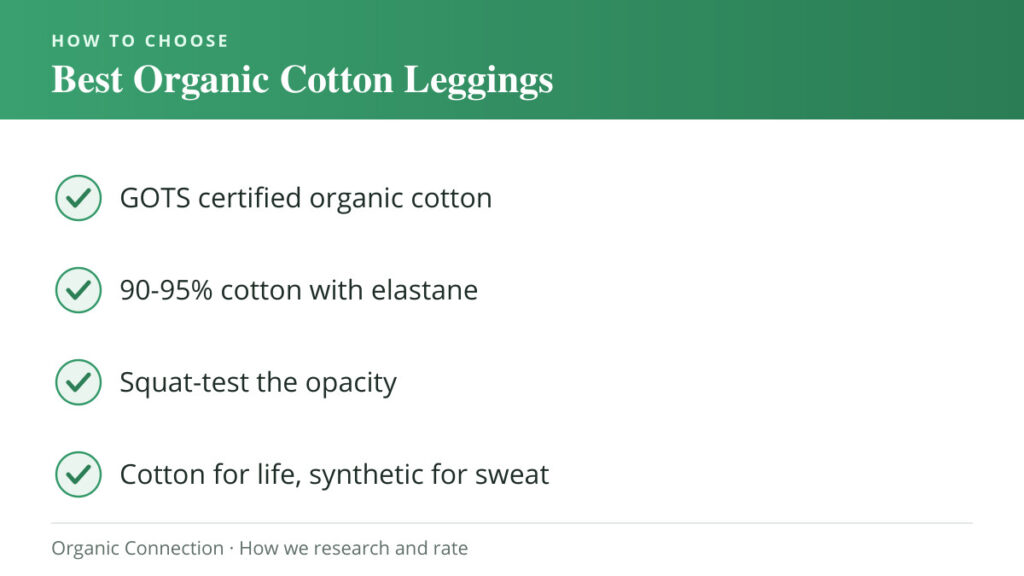
Great organic leggings are about certification, fabric composition, opacity, and waistband construction. Here is what matters.
1. GOTS certification
It covers organic fiber content plus dyeing, finishing, restricted chemicals, wastewater, and labor standards, not just the crop.
2. Around 90 to 95 percent cotton
Enough elastane (5 to 10 percent) to give recovery and stop bagging at the knee, without turning it into a synthetic garment.
3. Genuine opacity
Cotton knits can go sheer under stretch. Squat-test opacity is the single most common complaint in this category.
4. A waistband that stays put
A wide contoured elastic band beats a thin drawstring casing. This is what determines whether you spend the day pulling them up.
Cotton versus performance fabric, honestly
It is worth being direct about this, because a lot of sustainable fashion marketing implies organic cotton leggings replace your gym leggings, and they do not. Polyester and nylon leggings wick moisture off the skin and dry fast, which is precisely why they dominate athletic wear. Cotton absorbs moisture and holds it, so in a sweaty workout organic cotton leggings become heavy, damp, and cold once you stop moving. If you are running, doing HIIT, or working out hard in heat, synthetic is the correct fabric and choosing cotton for environmental reasons will just make you uncomfortable.
Where organic cotton wins is everything else, and that is most of the time leggings are actually worn. For working from home, errands, travel, sleeping, gentle yoga or stretching, and cool-weather layering, cotton is more comfortable against skin, less prone to trapping odor, and does not shed microplastic fibers into the wash every cycle, which polyester does at meaningful rates. There is also a chemistry dimension: conventional cotton is one of the most pesticide-intensive crops grown, and conventional textile finishing permits azo dyes and formaldehyde-based treatments that GOTS restricts. Given leggings sit in full contact with a large area of skin for hours, that restriction is worth something. The sensible conclusion is to own both and use each for what it is good at, rather than treating one as a replacement for the other.
How to choose organic cotton leggings
- Look for GOTS certification. “Made with organic cotton” covers the fiber only; GOTS covers processing and labor too.
- Check the composition. Around 90 to 95 percent cotton with 5 to 10 percent elastane is the useful range.
- Read opacity reviews specifically. Cotton knits vary, and this is the most common disappointment.
- Prefer a wide contoured waistband. Thin bands roll and slide; wide ones stay.
- Buy for everyday, not for hard training. Use synthetic for sweat and cotton for life.
Who should buy organic cotton leggings
The right legging depends on the length and the occasion. If you want an everyday full-length GOTS-certified legging, our top pick fits. If you want a cropped yoga cut, a 7/8 length, a color option, or a longer inseam, we have a pick for each.
Best overall: Pact Women’s Everyday Legging
| Organic Integrity Score | 91 / 100 |
| Fabric | Approximately 92% organic cotton, 8% elastane |
| Certification | Fair Trade, Organic |
| Best for | Everyday wear, working from home, travel, and layering |
The Everyday Legging is our top pick because it gets the composition and the certification right at the same time. GOTS certification means the organic cotton is verified along with the dyeing, finishing, restricted chemical inputs, and labor conditions, and Pact states its whole supply chain is third-party audited against that standard. The fabric is roughly 92 percent organic cotton with 8 percent elastane, which is enough stretch for genuine recovery, so they do not bag at the knee by mid-afternoon, without becoming a synthetic garment. The contoured elastic waistband is wide enough to stay in place rather than rolling.
The trade-off is what cotton is: they absorb sweat rather than wicking it, so they are not workout leggings, and they soften and relax slightly through a day of wear, which is normal for cotton and reverses in the wash. Sizing also runs a little generous, so size down if you want them close-fitting.
What we liked: Full GOTS certification with an audited supply chain, high organic cotton percentage with real recovery, comfortable wide waistband, and genuinely soft against skin.
Keep in mind: Not for sweaty workouts, they relax slightly with wear, and sizing runs generous.
What the listing discloses: Pact is explicit about Fair Trade, and silent on whether the USDA seal applies and where it was grown or made.
Best for yoga: Pact Women’s Go-To Cropped Legging
| Organic Integrity Score | 88 / 100 |
| Fabric | Organic cotton with elastane, mid rise |
| Certification | Fair Trade, Organic |
| Best for | Gentle yoga, stretching, and warm weather |
The cropped cut ends above the ankle, which is the practical choice for yoga, pilates, and stretching where you want to see your ankle alignment, and for warm weather generally. It uses the same GOTS-certified organic cotton fabric and mid-rise contoured elastic waistband as our top pick, so the comfort and certification carry over; only the length changes.
The trade-off is that cropped is a less versatile length. It looks deliberate with trainers and slightly odd with boots, and in cold weather the gap at the ankle is noticeable. For gentle yoga this is fine; for hot vinyasa, cotton is still the wrong fabric regardless of the cut.
What we liked: Same GOTS-certified fabric and comfortable waistband in a cut that suits floor work and warm weather.
Keep in mind: Less versatile length across seasons, and still cotton, so not for a sweaty class.
What the listing discloses: Pact commits to Fair Trade but stops short of whether the USDA seal applies and where it was grown or made.
Best 7/8 length: Pact Women’s Go-To 7/8 Leggings
| Organic Integrity Score | 84 / 100 |
| Fabric | Organic cotton with elastane, mid rise |
| Certification | Fair Trade, Organic |
| Best for | An ankle-skimming cut that works with most shoes |
The 7/8 length sits just above the ankle bone, which is the most flattering and versatile of the three cuts here: it works with trainers, flats, and ankle boots without bunching, and it avoids both the bunching of a full-length and the awkwardness of a crop. Pact markets this one specifically on opacity, which is the right thing to emphasize in a cotton legging, and the mid-rise waistband is the same comfortable construction.
The trade-off is availability. Pact’s color and pattern options on this cut rotate frequently and specific shades sell out, which is a common frustration in reviews. Sizing also runs generous here as across the line.
What we liked: The most versatile length, GOTS certified, and explicitly designed for opacity, which matters in cotton.
Keep in mind: Colors and patterns rotate and sell out, and sizing runs generous.
What the listing discloses: Pact is explicit about Fair Trade, and silent on whether the USDA seal applies and where it was grown or made.
Best mid-rise everyday: Pact Women’s Organic Cotton Go-To Legging
| Organic Integrity Score | 80 / 100 |
| Fabric | Organic cotton with elastane |
| Certification | Fair Trade |
| Best for | Full-length wear at a mid rise |
The full-length Go-To is the alternative to the Everyday Legging for anyone who prefers a mid-rise waistband to a higher one. Same GOTS-certified organic cotton, same audited supply chain, same soft hand; the difference is where it sits on the waist, which is genuinely a matter of body shape and preference rather than quality.
It scores slightly below the Everyday Legging because the higher, wider contoured band on that pair does a better job of staying put through a day of bending and sitting, which is the most common practical complaint about any legging. If you dislike a high waistband, this is the better choice regardless of the score.
What we liked: Same GOTS certification and cotton quality in a mid-rise cut for those who prefer it.
Keep in mind: The mid-rise band is more prone to sliding than the wider high-rise waistband.
What the listing discloses: Pact is explicit about Fair Trade, and silent on whether the USDA seal applies and where it was grown or made.
Best color range: Pact Women’s Everyday Legging, Color Options
| Organic Integrity Score | 76 / 100 |
| Fabric | Organic cotton with elastane |
| Certification | Fair Trade, Organic |
| Best for | Anyone who does not want another pair of black leggings |
This is the same Everyday Legging construction in Pact’s rotating seasonal color range, and it earns a place here simply because most organic cotton activewear is relentlessly black, gray, and oatmeal. GOTS certification is particularly relevant on colored garments, since it restricts the azo dyes permitted in conventional textile dyeing, so a certified colored legging is a meaningfully different product from a conventionally dyed one.
It scores lowest here for practical reasons rather than quality: colored cotton fades faster than black with washing, particularly if dried in direct sun or a hot dryer, and specific shades come and go so a pair you like may not be repeatable. Wash colored cotton inside out, cool, and air dry out of direct sunlight.
What we liked: GOTS-certified dyeing on colors, which matters more than on black, and a break from the standard neutrals.
Keep in mind: Colors fade faster than black and specific shades are frequently discontinued.
What the listing discloses: Pact commits to Fair Trade but stops short of whether the USDA seal applies and where it was grown or made.
Care, and making them last
Elastane is the component that fails first in any legging, and heat is what kills it. Wash cool, always, and skip the dryer or use the lowest heat setting; a single hot cycle does more damage to recovery than months of wear. Turn leggings inside out before washing, which protects the outer surface from abrasion and slows color fade. Skip fabric softener, which leaves a coating that reduces cotton’s breathability and degrades elastic, and skip bleach entirely on colored cotton.
Cotton leggings relax slightly during a day of wear and recover in the wash, which is normal and not a defect; if a pair no longer recovers after washing, the elastane has degraded and they are near the end of their life. Rotating between two or three pairs rather than wearing one repeatedly extends all of them, because the fibers recover between wears. On opacity, the practical test is to put them on and squat in front of a mirror in good light before removing tags, since cotton knits vary between dye lots and this is much easier to check at home than to judge from a product photo. If a pair is borderline, wearing them a size up makes sheerness worse, not better, since more stretch means thinner fabric.
Opacity: the specification that decides everything
The single most common complaint about leggings has nothing to do with fiber and everything to do with fabric weight. Cotton leggings that go sheer when stretched are the reason people abandon the category, and it is entirely predictable from the spec.
| Weight | Behavior | Suitable for |
| Under 200 gsm | Sheer when stretched; shows everything in a squat | Layering under dresses and tunics only |
| 220–260 gsm | The industry range for reliable opacity with stretch | Everyday wear and light activity |
| 280 gsm and above | Genuinely opaque, more structure, warmer | Winter, and anyone who wants certainty |
How to test before you commit: put them on, squat fully in front of a mirror in bright light, and look. Manufacturers use stretch-opacity lab tests plus real-wearer trials under strong lighting for exactly this, and the domestic version works fine. Do it in daylight or under a bright bulb, not in a dim bedroom, and check the seat and the back of the thigh where the fabric stretches most.
Color matters too. Black is the most forgiving; light grays, pastels and heather marls are the most likely to go sheer at a given weight, because thin spots show more against a pale ground. If a brand offers the same legging in several colors, the pale ones need more gsm to perform equally.
What to look for in the construction
- A gusset. A diamond or triangular gusset panel at the crotch is the mark of a properly designed legging: it removes the four-seam intersection that causes both seam failure and unflattering pull, and it adds coverage exactly where the fabric is under most tension. Cheap leggings skip it.
- Flatlock or coverstitch seams rather than overlocked ones, which sit proud and chafe on longer wear.
- A double-layer waistband, which resists rolling down far better than a single layer with elastic inside.
- High rise if you want it to stay put during movement; mid-rise leggings roll at the waist on most people during exercise.
- 5–10% elastane is the working range. Below 5%, cotton leggings bag out at the knees and seat within hours; above about 10%, breathability suffers and the garment starts behaving like a synthetic.
- No side seam is a design preference rather than a quality marker, though seamless construction does reduce chafing on long wear.
PFAS in activewear, and where organic cotton stands
Independent testing over recent years has found PFAS — used for water and stain resistance — in a range of activewear, which is part of why “PFAS-free” has become a claim worth looking for rather than assuming.
Keep in mind: plain organic cotton leggings are a low-risk product here, because the treatments that carry PFAS are applied for performance properties that cotton leggings do not claim. The place to be attentive is any legging marketed as moisture-wicking, water-repellent, odor-resistant or stain-resistant, whatever the base fiber. Those functions are what the chemistry is for. GOTS certification prohibits PFAS along with formaldehyde resins, restricted azo dyes and optical brighteners, so a GOTS legging closes the question — and OEKO-TEX Standard 100 tests the finished fabric for harmful substances, which is a different and complementary assurance.
Cotton and performance: setting expectations
We should be straightforward about this, since it applies to every product in this guide.
- Cotton absorbs sweat and holds it. It does not wick. For running, HIIT or hot yoga, cotton leggings get heavy, cling and stay wet, and no certification changes that.
- Cotton stretches out during wear and recovers only in the wash. Knee and seat bagging by the end of a long day is normal for cotton-dominant fabric, not a defect — elastane content determines how much.
- Where cotton wins is everyday comfort, breathability in ordinary conditions, softness against skin, and being the right answer for eczema, contact dermatitis or anyone who reacts to synthetics. It also holds odor far less stubbornly than polyester, which harbors the bacteria responsible.
- For gentle yoga, pilates, walking, travel and daily wear, cotton leggings are genuinely more comfortable than technical fabric. That is a large share of how most people actually use leggings.
- Own both if you train hard. It is not a compromise so much as two different garments.
Sizing, shrinkage and pilling
- Expect 3–5% shrinkage on the first wash unless the garment states it is pre-shrunk, mostly in length. Wash cool from the outset to limit it.
- Buy your true size. Sizing down for compression accelerates seam stress and makes sheerness worse, since the fabric is under more tension.
- Pilling happens at the inner thigh first, from friction. It is normal on cotton, and worse on softer, lower-twist yarns — the ones that feel best in the shop. A fabric shaver deals with it without damage.
- Elastane degrades with heat, so a legging that has “gone baggy” has usually had its elastane cooked in a dryer rather than worn out.
Care
- Wash cool, 30°C, inside out, on a gentle cycle. Inside out reduces surface pilling and protects color.
- Never tumble dry. This is the single biggest factor in how long leggings last, because heat destroys elastane far faster than wearing them does.
- No fabric softener. It coats fibers, reduces breathability and degrades elastane.
- Hang to dry by the waistband or lay flat. Hanging by one leg stretches it permanently.
- Wash after every workout, but everyday-wear leggings do not need washing after each use — over-washing wears cotton out faster than wearing it does.
- Wash with like fabrics. Zips and hooks in the same load abrade knit fabric and cause snags and thin spots.
- Rotate several pairs. Elastane needs about 24 hours to recover shape between wears, so rotation extends the life of all of them.
How we researched this guide
We are a research-based review site. We compared each product against its certification (GOTS), fabric composition and elastane content, construction including waistband and opacity, supply chain transparency, and the weight of aggregated customer feedback on fit, comfort, and durability, then scored each with our 10-criteria Organic Integrity Score. No brand paid to be included or ranked. Read the full method on our How We Research and Rate page.
Common questions about organic cotton leggings
What are the best organic cotton leggings?
Our overall pick is the Pact Women’s Everyday Legging, because it uses GOTS-certified organic cotton with a third-party audited supply chain, roughly 92% cotton with 8% elastane for genuine recovery, and a wide contoured waistband that stays in place. For a cropped yoga cut, the Go-To Cropped Legging is our pick, and for an ankle-skimming length, the Go-To 7/8.
Why do organic cotton leggings contain elastane?
Because cotton has no elastic recovery on its own, so a pure cotton legging would stretch out at the knee and seat within hours and never return to shape. Around 5 to 10 percent elastane provides that recovery. The trade-off is that elastane is synthetic, which is why the good options keep it as low as they practically can.
Are organic cotton leggings see-through?
They can be, and this is the most common complaint in the category, because cotton knits thin out under stretch more than dense synthetic fabrics do. Read opacity reviews for the specific product and color, test by squatting in good light before removing tags, and do not size up hoping for more coverage, since more stretch makes sheerness worse.
Do cotton leggings shed microplastics?
Far less than synthetic ones. Polyester and nylon leggings shed plastic microfibers into wastewater with every wash, at meaningful rates. A legging that is roughly 92 percent organic cotton sheds mostly cotton, with only the small elastane fraction contributing synthetic fiber, which is one of the stronger environmental arguments for cotton in this category.
What GSM makes leggings squat-proof?
220 to 260 gsm is the industry range for reliable opacity with stretch, and 280 gsm and above is genuinely opaque. Under 200 gsm goes sheer when stretched and should be treated as a layering piece only. Test before committing: squat fully in front of a mirror in bright daylight, checking the seat and back of the thigh where the fabric stretches most.
Why do light-colored leggings go sheer?
Thin spots show far more against a pale ground. Black is the most forgiving color; light grays, pastels and heather marls are the most likely to go sheer at any given fabric weight. If a brand offers the same legging in several colors, the pale ones need more gsm to perform equally.
What is a gusset and why does it matter?
A diamond or triangular panel at the crotch that removes the four-seam intersection found in cheaper leggings. It prevents both seam failure and unflattering pull, and adds coverage exactly where fabric is under most tension. Its presence is one of the clearest markers of a properly designed legging.
How much elastane should organic cotton leggings have?
5 to 10%. Below 5%, cotton leggings bag out at the knees and seat within hours. Above about 10%, breathability suffers and the garment starts behaving like a synthetic. GOTS permits a small synthetic percentage precisely because cotton alone cannot recover its shape.
Do organic cotton leggings contain PFAS?
Plain organic cotton leggings are low risk, because the treatments carrying PFAS are applied for performance properties cotton leggings do not claim. Be attentive to any legging marketed as moisture-wicking, water-repellent, odor-resistant or stain-resistant, whatever the base fiber — those functions are what the chemistry is for. GOTS prohibits PFAS along with formaldehyde resins and restricted azo dyes.
Are cotton leggings good for working out?
For gentle yoga, pilates, walking and daily wear, yes — and they are more comfortable than technical fabric for those. For running, HIIT or hot yoga, no: cotton absorbs sweat and holds it rather than wicking, so it gets heavy, clings and stays wet. It also stretches out during wear and recovers only in the wash, so knee and seat bagging by evening is normal rather than a defect.
Why do my leggings pill on the inner thigh?
Friction, and it is normal on cotton. It is worse on softer, lower-twist yarns — which are the ones that feel best in the shop. A fabric shaver removes it without damaging the garment. Washing inside out reduces surface pilling considerably.
What makes leggings lose their shape?
Heat, almost always. Elastane degrades with heat far faster than with wear, so leggings that have gone baggy have usually been tumble dried. Wash at 30°C inside out, never tumble dry, skip fabric softener, hang to dry by the waistband rather than one leg, and rotate several pairs so the elastane has around 24 hours to recover between wears.
- Organic Household hub
- Best Organic Cotton Socks
- Best Organic Cotton Underwear
- The Complete Guide to Organic Cotton and Textiles
- our organic home and textile database — compare certifications across brands
- Best Organic Cotton Bras
Price and availability as of October 12, 2026 1:10 am EDT. Product prices and availability are accurate as of the date/time indicated and are subject to change. Any price and availability information displayed on Amazon.com at the time of purchase will apply to the purchase of this product.
Looking for other organic products?
We have checked more than 800 products across food, household goods, gardening, personal care and pet, every one against its stated certification. Browse all reviews.
Organic Connection is reader-supported. When you buy through links on this page we may earn a commission, at no extra cost to you. As an Amazon Associate we earn from qualifying purchases. We are not paid to feature or rank any product. How we research and rate.