Last updated: September 11, 2026
Some links in this guide point to our product reviews, which may earn us a commission at no extra cost to you. How we research and rate.
Organic milk costs roughly twice what conventional milk does, and it also, oddly, lasts about three times as long in an unopened carton. Most people assume those two facts are connected, that organic milk is somehow purer and therefore keeps longer. They are not connected at all, and the real explanation says something useful about how to read every dairy label in the aisle. This guide covers what genuinely differs between organic and conventional milk, what the evidence supports, why the date is so far away, and where the money is and is not well spent.
What organic certification actually changes on a dairy farm
USDA organic certification for milk is specific and enforceable, and it comes down to four requirements.
No synthetic growth hormones
Conventional dairies may use recombinant bovine growth hormone (rBST) to increase yield. Organic prohibits it entirely. This is the difference most shoppers have heard of, though many conventional dairies have also stopped using it in response to consumer pressure, which is why so much conventional milk now carries an “rBST-free” claim.
No routine antibiotics
Organic cows can and must be treated when sick, that is a welfare requirement, but a treated animal is permanently removed from organic milk production. Conventional dairies can treat and return animals to the milking herd after a withdrawal period. Note that all milk, organic and conventional, is tested for antibiotic residues and tankers testing positive are rejected, so this is a difference in farming practice rather than in what ends up in the carton.
Organic feed and no GMOs
Cows must be fed certified organic feed grown without synthetic pesticides or genetically modified seed. Given how much a dairy cow eats, this is the largest agricultural difference by volume and the main driver of the cost gap.
Pasture requirement
Organic dairy cows must graze on pasture for at least 120 days a year and get at least 30 percent of their dry matter intake from grazing during that period. This is a genuine welfare and land-use difference, though “at least 120 days” is a floor rather than a description of an idyllic pasture-based farm, and enforcement on very large organic dairies has been criticized.
Does organic milk differ nutritionally?
Here the honest answer is: slightly, in one measurable way, and not dramatically.
The finding that holds up across multiple studies is fatty acid composition. Organic milk tends to contain a somewhat higher proportion of omega-3 fatty acids and a lower omega-6 to omega-3 ratio than conventional milk. The mechanism is straightforward and has nothing to do with the organic seal as such: it is grass. Cows eating pasture produce milk with more omega-3s than cows eating grain-heavy rations, and because organic rules mandate grazing, organic milk averages more pasture in the diet. Conventional grass-fed milk shows the same effect. The difference is real but modest in absolute terms, and milk is not a major source of omega-3s in most diets regardless.
Other claimed differences are weaker. Protein, calcium, and lactose content are essentially the same. Some studies report higher conjugated linoleic acid and certain antioxidants in organic milk, again largely a pasture effect, with inconsistent results. There is no good evidence that organic milk produces different health outcomes. If someone tells you organic milk will transform your health through nutrient density, that claim runs well ahead of what the research shows, which is the same pattern we describe across categories in Is Organic Worth It?
The stronger case for organic milk is not nutritional. It is that you are paying for a farming system: no synthetic hormones, no GMO feed, no synthetic pesticides on the feed crops, mandated pasture time, and different antibiotic rules. Whether that system is worth double the price is a values question, and a legitimate one, but it should be argued on those grounds rather than on nutrition.
Why the taste is different, and why some people dislike it
A significant number of people find organic milk tastes slightly cooked, or sweeter, or just “off” compared with the conventional milk they grew up with. This is real and it is the ultra-pasteurization again, not the farming.
Heating milk to 280 °F causes Maillard reactions between milk sugars and proteins, producing faint caramelized notes, and it denatures whey proteins in a way that subtly changes mouthfeel. To someone used to standard pasteurized milk, UHT milk tastes marginally cooked. Most people stop noticing within a week or two; some never stop noticing. It also affects performance in the kitchen: UHT milk is slightly less reliable for making yogurt and some cheeses, because the denatured proteins behave differently, which is why home cheesemakers specifically seek out non-UHT milk.
The practical upshot is that if you dislike organic milk’s taste, you may not dislike organic milk at all, you may dislike ultra-pasteurization. Non-UHT organic milk exists, usually from smaller regional dairies and typically sold in the refrigerated case with a normal short date. If you can find it, it tastes like conventional fresh milk while meeting organic standards. That is the single most useful thing in this article for anyone who tried organic milk once and went back.
Reading the dairy aisle
Several claims sit alongside “organic” and they answer different questions. Knowing which is which is more useful than ranking them.
- USDA Organic: organic feed, no GMOs, no synthetic hormones, restricted antibiotics, mandated pasture. Legally defined and audited.
- Grass-fed: relates to diet, and it is the claim most directly linked to the omega-3 difference. Not the same as organic; a grass-fed cow can eat pesticide-treated pasture. “100% grass-fed” is stronger than “grass-fed.”
- rBST-free / no artificial hormones: addresses one specific practice. Common on conventional milk and genuinely meaningful, but far narrower than organic.
- Pasture-raised: not legally defined for dairy, so its strength depends entirely on the brand’s own standard.
- A2: refers to a milk protein variant, not to farming practice at all. Some people who find regular milk hard to digest report doing better on A2, though the evidence is mixed. It is orthogonal to organic; a milk can be both, either, or neither.
- Ultra-pasteurized / UHT: a processing method, appearing on both organic and conventional milk. Tells you about shelf life and taste, nothing about farming.
The combination worth looking for, if you want the actual nutritional edge rather than just the seal, is organic and 100% grass-fed and not ultra-pasteurized. That combination is uncommon and usually regional, but it delivers the fatty acid profile, the farming standards, and the fresh taste at once. We apply the same “which question does this seal answer?” logic across categories in our guide to reading labels.
Is it worth the money?
Milk is a genuinely difficult case on cost, and we will not pretend otherwise. The organic premium on dairy is among the steepest in the store, frequently 60 to 100 percent, and unlike grains or oils there is no cheap workaround: you cannot buy frozen or bulk milk. For a household with children drinking milk daily, converting to organic is one of the single largest line-item increases in a grocery bill.
Our view, consistent with the priority framework we use elsewhere: dairy sits in the second tier rather than the first. The highest-return organic conversions are the daily staples where the premium is small and the exposure difference is well documented, grains, flour, oats, cooking oil, coffee, and spices, as covered in our glyphosate guide. Milk is a reasonable next step once those are handled, and it is a stronger candidate for households with young children, who drink far more milk per kilogram of body weight than adults.
If the full premium is out of reach, there are sensible middle positions. Conventional milk labeled rBST-free addresses the hormone question specifically at little or no extra cost. Conventional grass-fed milk captures most of the fatty acid difference without the organic premium. Buying organic milk for the children and conventional for coffee is a perfectly rational split. And if the choice is between organic milk and no milk, or between organic milk and cutting vegetables from the basket, buy the conventional milk and spend the difference on produce. Perfect is the enemy of good here, as it is throughout this topic.
Is organic milk worth the extra cost
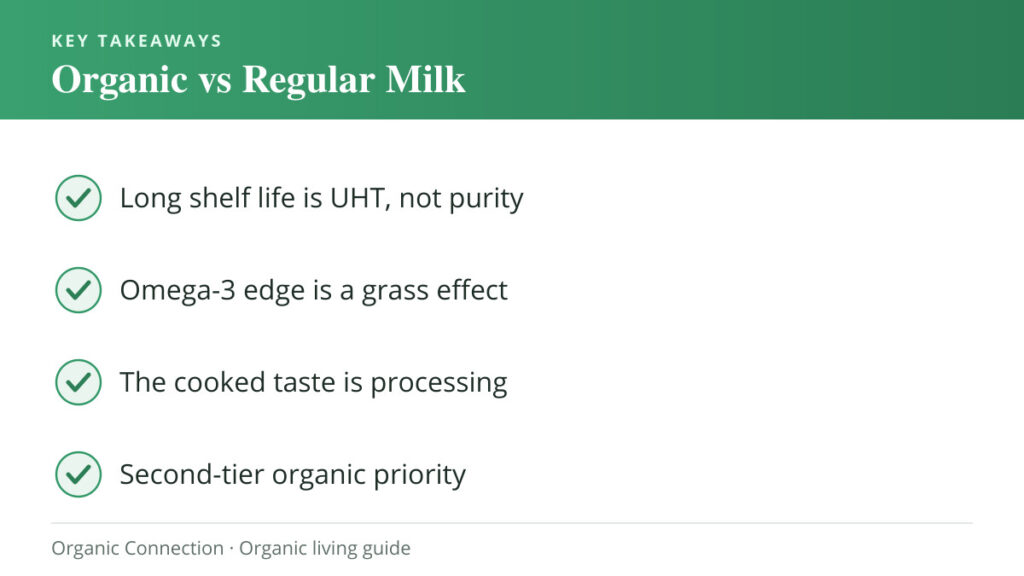
Organic milk differs from conventional in four defined ways: no synthetic growth hormones, stricter antibiotic rules, organic non-GMO feed, and mandated pasture time. Its nutritional edge is real but modest, essentially a grass effect that conventional grass-fed milk shares. Its famously long shelf life has nothing to do with any of that and everything to do with ultra-pasteurization, which is also why it can taste faintly cooked. If you disliked organic milk, try a non-UHT organic brand before concluding the category is not for you. And on cost, treat dairy as a second-tier conversion after the cheap high-frequency staples, with rBST-free or grass-fed conventional as legitimate middle options.
Common questions about organic milk
Why does organic milk last so much longer?
Because most organic milk is ultra-pasteurized, heated to around 280 °F for two seconds rather than 161 °F for fifteen seconds, which kills virtually all bacteria including heat-resistant spores. That gives an unopened carton 30 to 90 days instead of about 20. It is a processing choice driven by longer distribution distances, not a result of organic farming, and conventional UHT milk lasts equally long.
Is organic milk healthier than regular milk?
Slightly, in one measurable way. Organic milk averages a higher proportion of omega-3 fatty acids and a better omega-6 to omega-3 ratio, but this is a grass effect from the mandated pasture requirement, and conventional grass-fed milk shows the same benefit. Protein, calcium, and lactose are essentially identical, and there is no good evidence of different health outcomes.
Why does organic milk taste different?
Ultra-pasteurization, not the farming. Heating milk to 280 °F causes Maillard reactions that produce faint caramelized notes and denatures whey proteins in a way that subtly changes mouthfeel. If you dislike the taste, look for non-UHT organic milk, usually from smaller regional dairies with a normal short date, which tastes like conventional fresh milk.
Does conventional milk contain antibiotics?
All milk, organic and conventional, is tested for antibiotic residues and tankers testing positive are rejected, so residues are not the difference. What differs is farm practice: conventional dairies may treat a cow and return her to the milking herd after a withdrawal period, while an organic cow treated with antibiotics is permanently removed from organic production.
Is grass-fed milk the same as organic milk?
No. Grass-fed describes diet and is the claim most directly linked to the higher omega-3 content. Organic describes a whole farming system including feed, hormones, antibiotics, and pesticides on feed crops. A grass-fed cow can graze pasture treated with synthetic inputs, and organic milk is not necessarily fully grass-fed. The strongest combination is organic and 100% grass-fed.
Keep reading
- Is Organic Worth It? An Honest Cost Breakdown
- Glyphosate in Food: Where It Shows Up
- How to Read an Ingredient List
- Best Organic Oat Milk
- every product we have reviewed — filter by USDA Organic, GOTS, Fair Trade and more
- Organic Food and Pantry hub
- our organic product database — compare brands across every guide
Organic Connection is reader-supported. When you buy through links in our reviews we may earn a commission, at no extra cost to you. As an Amazon Associate we earn from qualifying purchases. We are not paid to feature or rank any product. This page is informational and is not medical advice. How we research and rate.