
Last updated: September 30, 2026
We may earn a commission when you buy through links on this page, at no extra cost to you. How we research and rate.
The short version
After researching the certifications, azadirachtin content, and labeling of the most popular organic neem oils, our top pick is Bonide Captain Jack’s Neem Max. It is a cold-pressed concentrate with a registered EPA label and the highest azadirachtin content in this guide, which is why it earned our highest Organic Integrity Score of 93 out of 100. For pure cold-pressed neem with no additives, Plantonix Neem Bliss is our pick, and for beginners, the Captain Jack’s ready-to-use spray is the best choice.
Neem oil is the most misunderstood product in organic gardening, because two very different things are sold under the same name and only one of them reliably kills pests. We flag each product’s extraction, azadirachtin status, and format.
Best organic neem oil compared
| Best Choice | Best Value | ||||
 |  |  |  |  | |
| Product | Captain Jack’s Neem Max 16 oz | Plantonix Neem Bliss 16 oz | Verdana Organic Neem | Captain Jack’s Neem Oil 16 oz | Captain Jack’s RTU 32 oz |
| Organic Integrity Score | 93/ 100 | 90/ 100 | 88/ 100 | 84/ 100 | 80/ 100 |
| Our rating | 4.7 | 4.5 | 4.4 | 4.2 | 4.0 |
| Extraction | Cold-pressed | Cold-pressed | Cold-pressed | Clarified extract | Clarified extract |
| Best for | Best overall | Pure single ingredient | USDA organic | Budget concentrate | Beginners |
| Format | Concentrate | Pure oil | Pure oil | Concentrate | Ready to use |
| Certification | — | Not stated on the listing | USDA Organic | — | — |
| Price | $18.16 $21.99 −17% View on Amazon | $23.99$1.50 / fluid ounce View on Amazon | $19.90$1.24 / fluid ounce View on Amazon | $20.40 $22.99 −11%$1.28 / ounce View on Amazon | $11.47 View on Amazon |
Price and availability as of October 11, 2026 7:10 pm EDT. Product prices and availability are accurate as of the date/time indicated and are subject to change. Any price and availability information displayed on Amazon.com at the time of purchase will apply to the purchase of this product.
Scores are ours, based on independent research of extraction method, azadirachtin retention, certification and registration, label clarity, format, and value, using the same 10-criteria method we apply to every product. See how we research and rate.
The organic neem oil certifications, and the question each one leaves open
Most shoppers read a certification as a general signal of quality. Every one of them is narrower than that, and the gaps between them are where the marketing lives.
| Certification | Covers | Key exclusion |
| USDA Organic | Farming and handling: no synthetic pesticides or fertilizers, no GMOs, no sewage sludge or irradiation, audited yearly by an accredited certifier | Three different tiers share the one seal, and it makes no claim about worker pay, food miles, or nutrition |
| OMRI Listed | Review of an input, a fertilizer, pesticide or soil amendment, as allowed in certified organic production | Reviews the product, not the farm: it cannot make your garden or your crop organic |
OMRI Listed is about the input, not the farm. The Organic Materials Review Institute reviews a fertilizer, pesticide or amendment and confirms it is permitted in certified organic production. That is genuinely useful when you are deciding what to put on your own soil. What it does not do is certify the manufacturer, the crop you grow with it, or your garden, and only an accredited certifier can do the last of those.
Key things to look for in organic neem oil
Good neem oil comes down to extraction, azadirachtin, certification, and whether it is a concentrate or ready to use. Here is what matters.
1. Cold-pressed, not clarified extract
Cold-pressed neem keeps its azadirachtin. Clarified hydrophobic extract has had most of it stripped and works largely by smothering.
2. A stated azadirachtin content
The best products state the concentration on the label. Silence usually means the number is not a selling point. See the figures to aim for below.
3. OMRI listing or an EPA registration
OMRI listing confirms it is permitted in certified organic production. An EPA registration number means the pest claims have been reviewed.
4. Concentrate versus ready-to-use
Concentrate is far cheaper per gallon and lets you control the rate. Ready-to-use costs more but removes the mixing step and the guesswork.
What neem actually controls, and what it does not
Neem is genuinely useful and routinely oversold. Knowing the difference will save you money and disappointment.
What it works on. Neem is most effective against soft-bodied sucking insects: aphids, whitefly, spider mites, thrips, mealybugs, and scale crawlers. It also has real activity as a fungicide on powdery mildew, black spot, and rust, largely because the oil film prevents spore germination. Against leaf-chewing larvae it acts as an antifeedant and growth disruptor, so caterpillars stop eating and fail to moult rather than dying immediately.
What it does not do. Neem is not a knockdown insecticide. If you spray an aphid colony expecting to walk past dead insects an hour later, you will conclude it does not work. Effects appear over three to seven days, and you will usually need two or three applications a week apart to break a pest cycle. It also has poor activity against hard-bodied adult beetles and does essentially nothing to insects it does not physically contact or that do not feed on treated tissue.
The part most guides skip. Neem is not harmless to beneficial insects. It is relatively low-risk to adult bees compared with synthetic insecticides, but it can harm bees directly sprayed and it does affect larvae in treated pollen. Spray at dusk or very early morning when pollinators are not flying, never on open flowers in bloom, and never in the middle of a hot sunny day, which also causes leaf burn. Treat it as a targeted intervention on a specific infestation, not a routine preventive drench over an entire garden.
Azadirachtin concentration: the numbers to look for
This is the single most useful thing to understand when comparing neem products, and almost no packaging explains it.
Azadirachtin content is quoted either in parts per million or as a percentage, and the two are easy to convert: 1,000 ppm equals 0.1%. Commercial neem oils on the home-garden market run from roughly 300 ppm at the weak end to 3,000 ppm or higher for concentrated cold-pressed products, and some horticultural concentrates go considerably beyond that.
| Azadirachtin level | What it means | Realistic use |
| Not stated | Usually a clarified extract with most azadirachtin stripped | Smothering and fungicide only |
| 300 ppm (0.03%) | Low end of the market | Light nuisance pressure, frequent reapplication |
| 1,000 ppm (0.1%) | A reasonable working minimum | General aphid and whitefly control |
| 3,000 ppm (0.3%) | Good cold-pressed concentrate | Mites, thrips, established infestations |
| 0.5% to 1%+ in the finished spray | The target concentration once diluted | Reliable insect growth disruption |
Two things follow from this. First, a product that does not state azadirachtin at all is almost always a clarified hydrophobic extract, which works by smothering rather than by growth disruption, and that is worth knowing before you blame yourself for a failed treatment. Second, what matters is the concentration in the finished spray after dilution, not the number on the concentrate bottle, so a high-azadirachtin concentrate diluted heavily can end up weaker than a modest one used at full label rate. Follow the label rate rather than improvising.
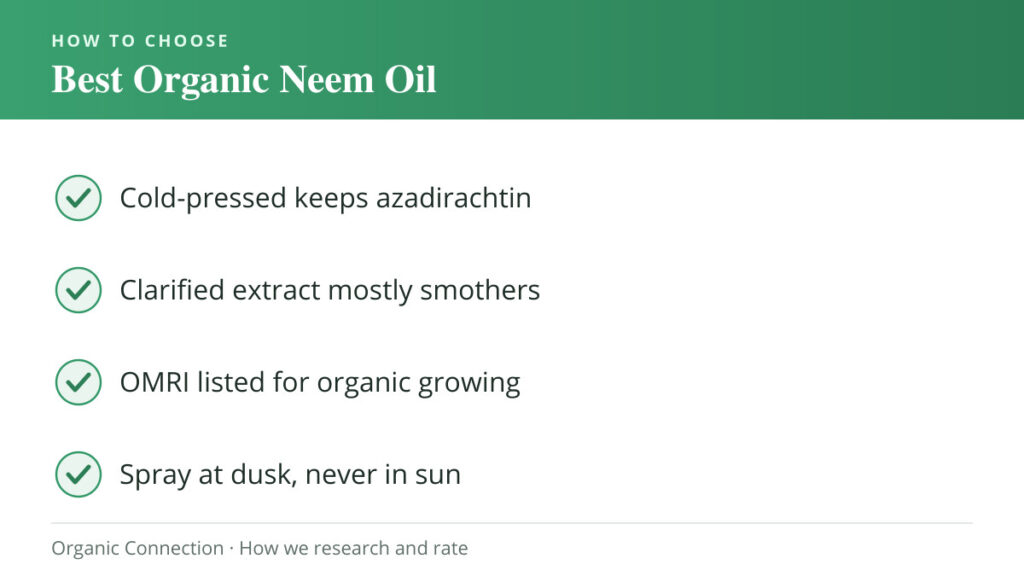
How to choose organic neem oil
- Buy cold-pressed if you want actual insecticidal activity from azadirachtin.
- Check for OMRI listing if you are growing to organic standards.
- Choose concentrate unless you have only a few houseplants; the cost difference is large.
- Look for a stated azadirachtin percentage, and treat its absence as informative.
- Buy a size you will use in a year. Neem degrades, and azadirachtin breaks down faster than the oil itself.
Who should buy organic neem oil
The right neem depends on scale and confidence. If you want the strongest pest control and will mix a concentrate, our top pick fits. If you want pure single-ingredient oil for garden or personal use, a USDA-certified organic option, a budget concentrate, or a no-mixing spray, we have a pick for each.
Best overall: Bonide Captain Jack’s Neem Max, 16 oz Concentrate
| Organic Integrity Score | 93 / 100 |
| Extraction | Cold-pressed, azadirachtin retained |
| Certification | — |
| Best for | Insecticide, fungicide, miticide and nematicide use |
Neem Max is our top pick because it is the product that actually does what people think all neem oil does. It is cold-pressed rather than clarified, so the azadirachtin is retained, and Bonide states the content on the label rather than leaving you to guess. It is OMRI listed for organic gardening and carries a full EPA registration, which means the pest claims on the label have been reviewed rather than simply asserted. Because it works as a drench as well as a foliar spray, it also reaches root-zone problems like fungus gnat larvae and nematodes that a surface spray cannot touch.
The trade-off is that it is a genuine pesticide and needs to be treated like one. It has a strong garlic-sulfur smell, it must be diluted correctly, and over-application or spraying in bright sun will burn leaves. It is also more expensive per bottle than the clarified concentrates, though not per gallon of finished spray.
What we liked: Genuine cold-pressed neem with stated azadirachtin, OMRI listed and EPA registered, and effective as both a spray and a soil drench.
Keep in mind: Strong smell, requires careful dilution, and will scorch foliage if applied in hot sun.
What the listing discloses: Bonide leaves the basics open, including whether the USDA seal applies and where it was grown or made.
Best pure single ingredient: Plantonix Neem Bliss, 16 fl oz
| Organic Integrity Score | 90 / 100 |
| Extraction | Cold-pressed, unrefined |
| Certification | Not stated on the listing |
| Best for | Gardeners who want nothing but neem seed oil |
Neem Bliss is pure cold-pressed neem seed oil from India with nothing added, OMRI listed for organic use, and known for a high azadirachtin content. If you want a single-ingredient product you can dilute yourself, this is the cleanest option here. It is also the most versatile: the same bottle serves as a garden spray, a soil drench, an ingredient in homemade soap, and a hair and skin oil, which none of the EPA-registered garden products can legally claim.
The trade-off is that pure neem oil solidifies below roughly 70°F, so you will often need to stand the bottle in warm water before use, and it does not mix with water on its own. You must add an emulsifier, usually a small amount of mild liquid soap, or it will separate in the sprayer and leave oil patches on foliage. It also has no EPA registration, so there is no reviewed label telling you which pests and rates are approved.
What we liked: Genuinely pure cold-pressed neem, OMRI listed, high azadirachtin, and usable for garden, skin, and hair.
Keep in mind: Solidifies when cool, needs an emulsifier to mix, and has no EPA-reviewed pest label.
What the listing discloses: No organic certification appears anywhere on the plantonix listing.
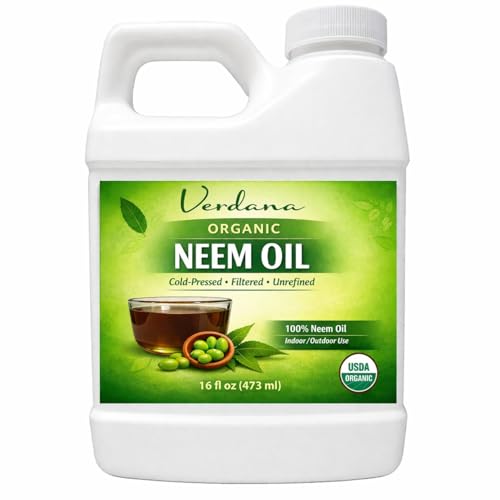
Best USDA organic: Verdana Organic Cold Pressed Neem Oil
| Organic Integrity Score | 88 / 100 |
| Extraction | Cold-pressed, filtered, unrefined |
| Certification | USDA Organic |
| Best for | Buyers who want a USDA seal on the bottle |
Verdana is the pick if a USDA organic seal specifically is what you are after. It is cold-pressed, filtered, unrefined, non-GMO, and nothing is added or removed. Because it is filtered, it is a little cleaner-running through a sprayer than some unfiltered oils, and it is sold in sizes from 8 oz up to a gallon, so you can match the bottle to the size of your garden rather than over-buying.
The trade-off is the same as any pure oil: it needs warming and emulsifying, and it carries no EPA registration for pest claims. Filtering also removes some of the sediment that carries additional neem compounds, which purists argue slightly reduces efficacy compared with a completely unfiltered oil. In practice the difference is small.
What we liked: USDA organic certification, cold-pressed and unrefined, filtered for easier spraying, and a wide range of bottle sizes.
Keep in mind: Needs warming and an emulsifier, no EPA pest label, and filtering removes some sediment.
What the listing discloses: Fully documented: Verdana states USDA organic certification, an origin of the USA and a single-ingredient formula.
Best budget concentrate: Bonide Captain Jack’s Neem Oil, 16 oz Concentrate
| Organic Integrity Score | 84 / 100 |
| Extraction | Clarified hydrophobic extract |
| Certification | — |
| Best for | Powdery mildew and general-purpose spraying |
This is the standard garden-center neem, and it earns its place because it is cheap, widely available, already emulsified, and genuinely good at what it does well. As a clarified hydrophobic extract it works mainly by smothering and by forming a film that prevents fungal spore germination, which makes it a strong choice for powdery mildew, black spot, and rust, and perfectly serviceable on aphids and mites. It mixes with water without fuss and does not solidify in the shed.
The trade-off is the one this whole guide is about: most of the azadirachtin has been removed, so the growth-disrupting and antifeedant effects are much weaker than a cold-pressed product. If your problem is fungal, this is arguably the better buy. If your problem is a stubborn mite or thrip population, Neem Max will do more.
What we liked: Inexpensive, OMRI listed and EPA registered, pre-emulsified for easy mixing, and very effective as a fungicide.
Keep in mind: Clarified extract with most azadirachtin removed, so weaker insecticidal action than cold-pressed neem.
What the listing discloses: Beyond the organic claim itself, Bonide does not say whether the USDA seal applies and where it was grown or made.
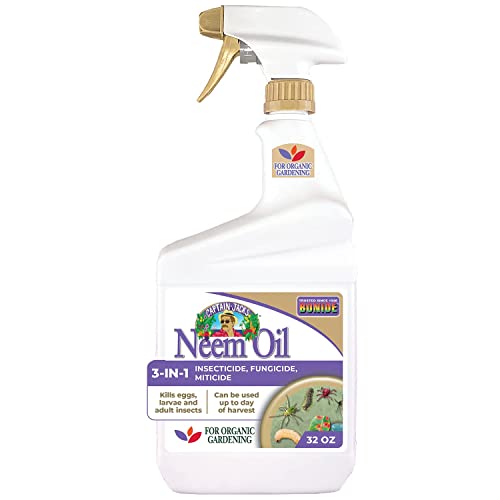
Best for beginners: Bonide Captain Jack’s Neem Oil, 32 oz Ready-to-Use
| Organic Integrity Score | 80 / 100 |
| Extraction | Clarified hydrophobic extract, pre-diluted |
| Certification | — |
| Best for | Houseplants and small patio gardens |
If you have a dozen houseplants and a fungus gnat problem, buying a concentrate, a measuring jug, and a pump sprayer is overkill. This arrives pre-mixed at the correct rate in a trigger bottle, which removes the two most common ways people go wrong with neem: mixing it too strong and burning the foliage, or mixing it too weak and concluding it does not work. It is OMRI listed and EPA registered, so the label tells you exactly which plants and pests it is approved for.
It scores lowest here purely on economics and strength. You are paying several times more per gallon of finished spray than with a concentrate, and like the concentrate above it is a clarified extract, so azadirachtin content is low. For a windowsill of houseplants that is a fair trade; for a vegetable plot it is an expensive way to buy water.
What we liked: Correctly diluted out of the bottle, OMRI listed and EPA registered, and the simplest possible starting point.
Keep in mind: Much more expensive per gallon than concentrate, and low in azadirachtin.
What the listing discloses: Beyond the organic claim itself, Bonide does not say whether the USDA seal applies and where it was grown or made.
How to mix and apply neem oil without burning your plants
Most neem failures are application failures. If you are using a concentrate, follow the label rate rather than eyeballing it, since stronger is not better and will scorch leaves. If you are using pure cold-pressed oil, the standard starting mix is about one to two teaspoons of oil per quart of warm water plus roughly half a teaspoon of a mild liquid soap as an emulsifier. Add the soap to the water first, then the oil, then shake hard. Mix only what you will use in a few hours, because neem emulsions separate and azadirachtin degrades quickly in water.
Spray at dusk or in early morning, never in direct sun and never above about 85°F, both to avoid leaf burn and to keep it away from foraging pollinators. Do not spray open blooms. Cover the undersides of leaves, which is where mites, aphids, and whitefly actually live and where a careless spray misses entirely. Always test one leaf on an unfamiliar plant and wait 24 hours before treating the whole thing; neem is rough on some ferns, and on plants with fine hairs.
Expect to repeat. A single application almost never resolves an infestation, because neem acts on moulting and feeding rather than killing outright. Plan on treatments every five to seven days for two or three rounds to break the life cycle. For soil pests like fungus gnat larvae, use a cold-pressed product as a drench rather than a foliar spray. Store neem somewhere cool and dark, keep the cap tight, and buy a bottle size you will finish within a year, since azadirachtin degrades with time, light, and heat.
Dilution chart and treatment schedules by pest
Neem fails more often from wrong dilution and wrong timing than from being the wrong product. These are working figures for pure cold-pressed neem; if you are using a branded concentrate, its label rate overrides everything here and is legally binding.
| Purpose | Pure neem per quart | Per gallon | Frequency |
| Preventive maintenance | ½ tsp | 2 tsp | Every 2 to 3 weeks |
| Aphids, whitefly | 1 tsp | 4 tsp (about 1½ tbsp) | Every 5 to 7 days, 2 to 3 rounds |
| Spider mites | 1 to 1½ tsp | 1½ to 2 tbsp | Every 4 to 5 days, 3 to 4 rounds |
| Thrips, mealybugs, scale | 1½ tsp | 2 tbsp | Every 5 to 7 days, 3 rounds |
| Powdery mildew, black spot | 1 tsp | 4 tsp | Every 7 days until clear |
| Soil drench, fungus gnats | 1 tsp | 4 tsp | Every 7 days, 3 waterings |
Add roughly half a teaspoon of mild liquid soap per quart as an emulsifier in every mix, and always add soap to the water first, then the oil.
Why spider mites need the tightest schedule. Neem does not kill eggs. Spider mite eggs hatch in roughly three to five days in warm conditions, so a weekly spray lets a whole generation mature between treatments. Treating every four to five days catches each hatch before it can reproduce, and this is the single most common reason people report that neem “does not work on mites”. Expect three or four rounds minimum.
After the infestation clears. Drop to a preventive rate every two to three weeks rather than stopping entirely, particularly on houseplants and in greenhouses where pests re-establish quickly. Do not run preventive sprays continuously outdoors on flowering plants, since that is exactly the pattern most likely to harm pollinators for no benefit.
Test before you commit. Spray one leaf, wait 24 hours, and check for burn before treating a whole plant. Neem is rough on ferns, on plants with fine hairs, and on new soft growth. Never exceed the label rate on the assumption that stronger works faster; it does not, and it scorches foliage.
How we researched this guide
We are a research-based review site. We compared each product against its extraction method, azadirachtin retention and label disclosure, OMRI listing and EPA registration status, ingredient list, format and dilution requirements, cost per gallon of finished spray, and the weight of aggregated gardener feedback on real-world efficacy, then scored each with our 10-criteria Organic Integrity Score. No brand paid to be included or ranked. Always read and follow the product label, which is the legally binding instruction for any pesticide. Read the full method on our How We Research and Rate page.
Common questions about organic neem oil
What is the best organic neem oil?
Our overall pick is Bonide Captain Jack’s Neem Max, because it is cold-pressed so the azadirachtin is retained, states its content on the label, is OMRI listed and EPA registered, and works as both a foliar spray and a soil drench. For pure single-ingredient oil, Plantonix Neem Bliss is our pick, and for beginners, the Captain Jack’s ready-to-use spray.
What is the difference between cold-pressed neem and clarified neem extract?
Cold-pressed neem retains azadirachtin, the compound that disrupts insect moulting and feeding. Clarified hydrophobic extract has had most of the azadirachtin removed and works mainly by smothering pests and forming a film that blocks fungal spores. Both are sold as neem oil. Cold-pressed is better on insects; clarified extract is cheap, easy to mix, and very good on mildew.
How long does neem oil take to work?
Three to seven days, and usually two or three applications a week apart. Neem is not a knockdown insecticide. It disrupts moulting and stops insects feeding, so you see the population decline over days rather than finding dead insects an hour after spraying. People who expect instant results usually conclude it has failed.
Is neem oil safe for bees?
Lower risk than synthetic insecticides, but not harmless. Neem can harm bees that are directly sprayed and can affect larvae through treated pollen. Spray at dusk or very early morning when pollinators are not flying, never treat plants in open bloom, and use it as a targeted response to a specific infestation rather than a routine preventive spray.
Why did neem oil burn my plant’s leaves?
Almost always because it was mixed too strong, or applied in direct sun or high heat. Neem is an oil, and oil on a leaf in bright sunlight scorches it. Follow the label rate exactly, spray at dusk or dawn, avoid application above about 85°F, and always test a single leaf and wait a day before treating a whole plant.
How much azadirachtin should neem oil have?
Aim for a product stating at least 1,000 ppm, which is 0.1%, and 3,000 ppm or higher for serious infestations. Note that 1,000 ppm equals 0.1%, which makes label comparison easier. What actually matters is the concentration in the finished spray after dilution, so follow the label rate rather than assuming a high-strength concentrate can be watered down further.
How do you mix neem oil with water?
Neem does not emulsify on its own, so add roughly half a teaspoon of a mild liquid soap per quart of warm water first, then add one to two teaspoons of pure neem oil, then shake hard. Warm water matters because pure neem solidifies below about 70°F. Mix only what you will use within a few hours, since the emulsion separates and azadirachtin degrades quickly once in water.
How often should you spray neem oil?
It depends on the pest. Aphids and whitefly want every five to seven days for two or three rounds. Spider mites want every four to five days for three or four rounds, because neem does not kill eggs and mite eggs hatch within three to five days. Once clear, drop to a preventive spray every two to three weeks.
Can you use neem oil on vegetables you are going to eat?
Yes, it is permitted in organic growing and widely used on food crops, but follow the label’s pre-harvest interval and wash produce before eating. Avoid spraying anything you will harvest within the interval stated on the product, and remember neem has a strong garlic-sulfur smell that can linger on leafy crops sprayed shortly before picking.
- Organic Gardening hub
- Best Natural Weed Killer
- Best Organic Fertilizer
- Organic Gardening for Beginners
- Organic Product Database — search every product we have reviewed, by certification
- Best Organic Insect Repellent
Price and availability as of October 11, 2026 7:10 pm EDT. Product prices and availability are accurate as of the date/time indicated and are subject to change. Any price and availability information displayed on Amazon.com at the time of purchase will apply to the purchase of this product.
Looking for other organic products?
We have checked more than 800 products across food, household goods, gardening, personal care and pet, every one against its stated certification. Browse all reviews.
Organic Connection is reader-supported. When you buy through links on this page we may earn a commission, at no extra cost to you. As an Amazon Associate we earn from qualifying purchases. We are not paid to feature or rank any product. Always read and follow the product label. How we research and rate.