Last updated: September 30, 2026
We may earn a commission when you buy through links on this page, at no extra cost to you. How we research and rate.
The short version
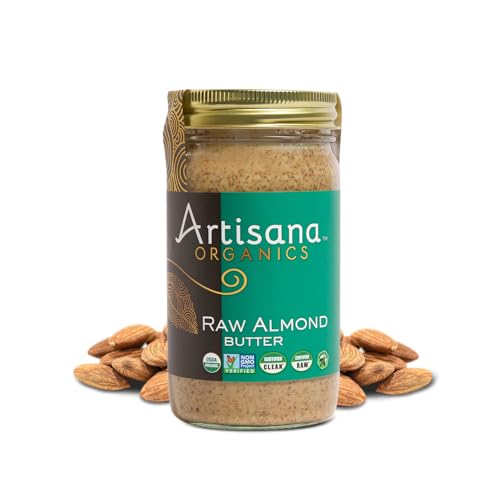
After researching the certifications, ingredient lists, and processing of the most popular organic almond butters, our top pick is Artisana Organics Raw Almond Butter. It is USDA certified organic, a single ingredient with no added oil, sugar, or salt, and made from raw California almonds ground at low temperature, which is why it earned our highest Organic Integrity Score of 93 out of 100. For the best value, MaraNatha Organic Raw Creamy Almond Butter is our pick, and for a deeper roasted flavor, Once Again Organic Roasted is the best choice.
Almond butter is one of the easiest categories to buy well, because a good jar has exactly one ingredient and the label tells you everything. We flag each product’s certification, ingredient count, and whether it is raw or roasted.
Best organic almond butter compared
| Best Choice | Best Value | ||||
 |  |  |  |  | |
| Product | Artisana Raw 14 oz | Artisana Snack Packs | Once Again Roasted | MaraNatha Raw Creamy 12 oz | Living Tree Raw 8 oz |
| Organic Integrity Score | 93/ 100 | 86/ 100 | 80/ 100 | 77/ 100 | 76/ 100 |
| Our rating | 4.7 | 4.3 | 4.0 | 3.9 | 3.8 |
| Best for | Best overall | Lunchboxes | Roasted flavor | Best value | Artisan texture |
| Style | Raw, skin on | Raw, single serve | Roasted, creamy | Raw, creamy | Raw, small batch |
| Certification | USDA Organic, Non-GMO, Kosher | Non-GMO, Kosher, Gluten-free | — | — | — |
| Price | See buying options | $24.54$2.32 / ounce View on Amazon | $24.84$1.55 / ounce View on Amazon | $25.72$2.14 / ounce View on Amazon | Currently unavailable See buying options |
Price and availability as of October 11, 2026 7:10 pm EDT. Product prices and availability are accurate as of the date/time indicated and are subject to change. Any price and availability information displayed on Amazon.com at the time of purchase will apply to the purchase of this product.
Scores are ours, based on independent research of certification, ingredient purity, sourcing, processing method, packaging, and value, using the same 10-criteria method we apply to every product. See how we research and rate.
The certification map for organic almond butter, and what each one actually excludes
Seals accumulate on a package faster than meaning does. This is what each of the marks you will see here certifies, and what it leaves out.
| Certification | Covers | Key exclusion |
| USDA Organic | Farming and handling: no synthetic pesticides or fertilizers, no GMOs, no sewage sludge or irradiation, audited yearly by an accredited certifier | Three different tiers share the one seal, and it makes no claim about worker pay, food miles, or nutrition |
| GOTS | Organic fiber from farm to finished textile, plus dyeing, finishing, wastewater and labor criteria | Has a weaker second tier, “made with organic”, that needs only 70% organic fiber and carries the same name |
| Non-GMO Project | Testing and supply-chain traceability showing the ingredients are not genetically engineered | Sets no limit on synthetic pesticides or fertilizers, so it is not an organic claim |
| Kosher | Ingredients and production comply with Jewish dietary law, verified by a rabbinic agency that inspects the facility | A dietary-law standard: it makes no claim about pesticides, GMOs or farming practice |
Non-GMO and organic are not two grades of the same thing. The butterfly certifies an absence of genetic engineering and stops there; the USDA seal prohibits genetic engineering as one clause among many, alongside synthetic pesticides, synthetic fertilizers, sewage sludge and irradiation. That makes organic the broader claim by some distance. Where both appear together, the butterfly is adding batch testing on top of a standard that had already banned GMOs.
Key things to look for in organic almond butter
Great almond butter is about certification, ingredient count, processing, and packaging. Here is what matters.
1. USDA organic certification
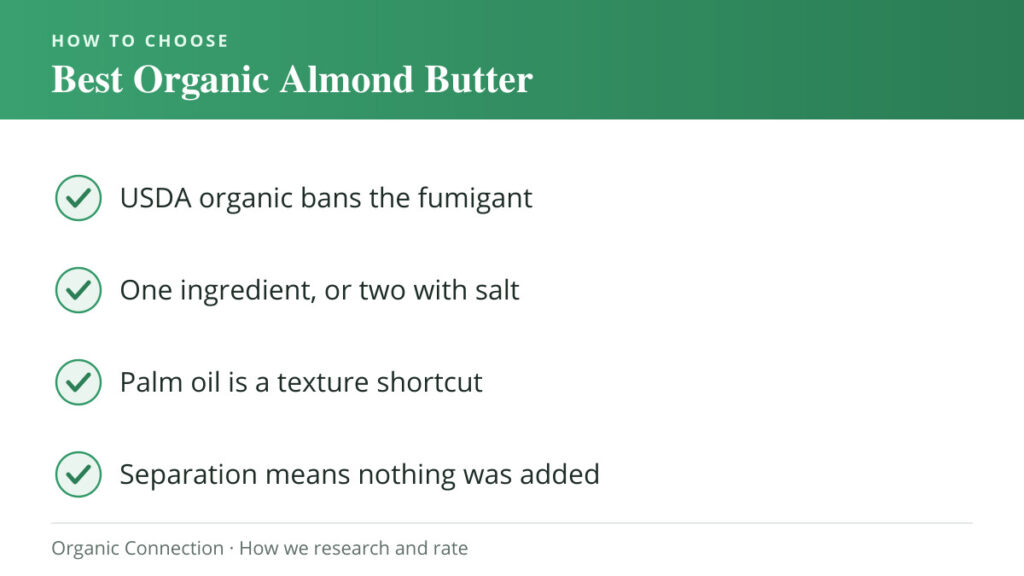
Conventional almonds are a high-input crop and are commonly fumigated with propylene oxide. Organic certification prohibits both the synthetic pesticides and the fumigant.
2. One ingredient, or two with salt
Organic almonds. That is the whole list. Added palm oil, sugar, or emulsifiers are patching over a product that should not need patching.
3. Raw versus roasted
Raw is milder, paler, and slightly sweeter. Roasted is darker, nuttier, and more familiar. Neither is better; they are different products.
4. Glass over plastic
Glass does not absorb oils, does not scratch, and keeps the butter tasting clean over the weeks it takes to finish a jar.
Skinned, unskinned, raw, roasted: what actually changes
Almond butter looks like a simple product, and the differences between jars are more meaningful than the label suggests.
Raw versus roasted. Raw almond butter is ground from unroasted almonds and tastes mild, faintly sweet, and grassy, with a paler color. Roasted almond butter is darker, deeper, and much nuttier, because roasting drives the Maillard reaction that creates almost all of what we recognize as “nutty” flavor. Nutritionally the difference is minor, and worth putting plainly: roasting slightly reduces some heat-sensitive nutrients but also improves digestibility and shelf stability. If you are choosing raw for health reasons, the gain is smaller than the marketing implies. Choose on taste.
Skin on or off. Most almond butter is made with the skins on, which is why it is speckled brown. The skin carries most of the almond’s polyphenols and its fiber, and also its slight bitterness and darker color. Blanched almond butter, made from skinned almonds, is pale, smoother, and sweeter, and is what most commercial almond butters used in confectionery are made from. Skin-on is the better nutritional buy and the more common one in organic ranges.
Why the oil separates, and why that is good. A jar of real almond butter separates because it contains nothing but ground almonds, and almonds are roughly half fat. The layer of oil on top is a sign the product has not been stabilized with palm oil or hydrogenated fat. Stir it in. Storing the jar upside down between uses makes the next stir far easier, and refrigerating after the first stir keeps it homogenous, at the cost of making it harder to spread.
What is actually in almond butter
Figures are per two-tablespoon (32 g) serving of plain unsweetened almond butter, which is the standard serving on most labels.
| Per 2 tbsp | Almond butter | Peanut butter |
| Calories | About 202 | About 188 |
| Protein | About 6.7 g | About 7.1 g |
| Fiber | Higher | Lower |
| Vitamin E | Substantially higher | Lower |
| Magnesium | Higher | Lower |
| Calcium | About 56 mg per tbsp | About 7 mg per tbsp |
| Dominant fat | Monounsaturated, oleic acid | Monounsaturated |
The honest reading of that table is that these two foods are far more similar than the price gap suggests. Almond butter costs roughly twice as much and gives you slightly fewer grams of protein, slightly more calories, and a meaningfully better mineral profile, particularly calcium, magnesium, and vitamin E. It is a genuinely good food and it is not a nutritional transformation over peanut butter.
Where almond butter does have a clear edge. Aflatoxins are toxic compounds produced by Aspergillus molds and classed as carcinogenic. Peanuts grow underground, which makes them considerably more susceptible to the mold that produces them, and commercial peanut products are routinely tested against a legal limit of 20 parts per billion in the US. Almonds are tree nuts, grown above ground, and carry substantially lower aflatoxin levels as a result. That is a real structural advantage rather than a marketing one, and it is the strongest argument for choosing almond over peanut if that concern matters to you.
And where the organic question bites hardest. Conventional almonds in the US are routinely fumigated with propylene oxide, a treatment prohibited under USDA organic rules, and conventional almond growing is pesticide-intensive. For almonds specifically, the organic premium buys you more than it does on many crops.
How to choose organic almond butter
- Confirm USDA organic, which rules out propylene oxide fumigation as well as synthetic pesticides.
- Read the ingredient list. One item, or two with salt. Reject palm oil and added sugar.
- Pick raw or roasted deliberately, on flavor rather than on health claims.
- Prefer glass jars for taste and for stirring without scratching.
- Buy a size you will finish in a month or two, since natural nut butters go rancid faster than stabilized ones.
Who should buy organic almond butter
The right jar depends on how you eat it. If you want the cleanest raw single-ingredient butter, our top pick fits. If you want the best cost per ounce, a roasted flavor, a small-batch artisan texture, or portable packs for lunchboxes and travel, we have a pick for each.
Best overall: Artisana Organics Raw Almond Butter, 14 oz
| Organic Integrity Score | 93 / 100 |
| Ingredients | Organic raw almonds |
| Certification | USDA Organic, Non-GMO, Kosher |
| Best for | Clean everyday use on toast, in smoothies, and in baking |
Artisana is our top pick because it is the strictest interpretation of what almond butter should be: organic California almonds, ground at low temperature, in a glass jar, with nothing else in it at all. No salt, no oil, no sugar. The low-temperature grinding preserves the mild, clean, faintly sweet character of raw almonds, and the texture is genuinely smooth rather than gritty, which is harder to achieve without roasting than most people realize. It is USDA organic, non-GMO, and kosher.
The trade-off is that a completely unstabilized raw butter separates aggressively, and the first stir on a new jar is real work. It is also among the more expensive options per ounce, and the unsalted raw flavor is genuinely plain, which people expecting a roasted nutty punch sometimes find underwhelming.
What we liked: A single organic ingredient, low-temperature ground, glass jar, and a clean smooth texture without any stabilizer.
Keep in mind: Separates heavily and needs a serious first stir, costs more per ounce, and the raw flavor is mild.
What the listing discloses: Artisana lists a USDA organic claim, kosher certification and a single-ingredient formula. The gap is where it was grown or made.
Best for lunchboxes: Artisana Organics Raw Almond Butter Snack Packs
| Organic Integrity Score | 86 / 100 |
| Ingredients | Organic raw almonds |
| Certification | Non-GMO, Kosher, Gluten-free |
| Best for | Lunchboxes, hiking, and travel |
Same almond butter as our top pick, in 1.06 oz squeeze pouches. For lunchboxes, hikes, long flights, and gym bags this solves a real problem, because a glass jar of oil-separating nut butter is one of the worst things you can put in a rucksack. The pouches are USDA organic, single-ingredient, and portion-controlled, which also makes them useful if you are tracking intake.
It scores lowest here on cost and packaging waste rather than on the food itself. You pay a substantial premium per ounce over a jar, and ten single-use plastic pouches is a meaningful step down environmentally from one reusable glass jar, which is worth acknowledging on a site about organic buying. Use them where portability genuinely matters, and buy jars for home.
What we liked: Our top-pick almond butter in a genuinely portable format, USDA organic and single-ingredient.
Keep in mind: A large price premium per ounce, and single-use plastic pouches.
What the listing discloses: Artisana is explicit about kosher certification and a single-ingredient formula, and silent on whether the USDA seal applies and where it was grown or made.
Best roasted: Once Again Organic Creamy Almond Butter, Roasted
| Organic Integrity Score | 80 / 100 |
| Ingredients | Organic dry roasted unblanched almonds; salt free, unsweetened |
| Certification | — |
| Best for | People switching over from peanut butter |
If raw almond butter has ever struck you as bland, this is the jar to buy. Once Again dry roasts unblanched almonds and mills them until creamy, which develops the deep, toasty flavor most people actually want from a nut butter and makes it the easiest transition for anyone moving across from peanut butter. It is USDA Organic, salt free and unsweetened, so the jar is still just almonds.
The allergen disclosure is unusually complete and worth reading. The listing states the butter is made in a peanut-free facility, and then adds that the same facility processes soy and sesame and that the equipment also runs other tree nuts. Naming the shared equipment rather than stopping at “peanut free” is the more useful half, and almost no nut butter listing offers it.
The trade-off is the roast itself. It costs a little on heat-sensitive nutrients and some of the polyphenol content in the skins, and it is less versatile in delicate baking where the roasted flavor dominates. It also separates less dramatically than raw butters, which is convenient and comes from the roasting rather than from any stabilizer.
What we liked: Dry roasted unblanched almonds, salt free and unsweetened, and an allergen statement that names the shared equipment rather than stopping at the headline.
Keep in mind: Roasting reduces some heat-sensitive nutrients, the flavor can overwhelm delicate baking, and stock has been intermittent.
What the listing discloses: Once Again is thin on detail, and does not say whether the USDA seal applies and where it was grown or made.
Best value: MaraNatha Organic Raw Creamy Almond Butter, 12 oz
| Organic Integrity Score | 77 / 100 |
| Ingredients | Organic almonds |
| Certification | — |
| Best for | Everyday household use at a sensible price |
MaraNatha is the most widely available organic almond butter in the US and the easiest recommendation for a household that gets through a jar every couple of weeks. It is USDA organic, made from almonds with no added sugar or salt, and priced meaningfully below the artisan brands. The creamy grind is consistent and it performs exactly as you want on toast, in oatmeal, and in sauces.
The trade-off is that it is a large-scale product and tastes like one. It is perfectly good, and it lacks the distinct character of the small-batch options. Check the label carefully when buying, because MaraNatha sells both organic and non-organic lines in near-identical packaging, and it is genuinely easy to pick up the wrong jar in a hurry.
What we liked: USDA organic with no added sugar or salt, consistent creamy texture, wide availability, and the best price of the jarred options.
Keep in mind: Flavor is competent rather than distinctive, and the organic and conventional jars look very similar.
What the listing discloses: Little to verify on the MARANATHA listing: no word on whether the USDA seal applies and where it was grown or made.
Best artisan texture: Living Tree Alive & Raw Organic Almond Butter, 8 oz
| Organic Integrity Score | 76 / 100 |
| Ingredients | Organic raw almonds |
| Certification | — |
| Best for | People who care about texture above all |
Living Tree slices its almonds rather than grinding them, which produces a texture unlike anything else here: lighter, more open, and less pasty than a conventional stone-ground butter. It is made in small batches from raw organic almonds with no sugar added, and the flavor is noticeably fresher than the mass-market jars, which is what you would expect from a product turned over quickly rather than sitting in distribution.
The trade-off is cost and size. An 8 oz jar at artisan pricing is the most expensive almond butter here per ounce by a wide margin, and the unusual texture is polarizing: people who want a dense, smooth, spreadable butter for toast often find it too loose. Buy it if texture and freshness are what you are paying for, not as an everyday staple.
What we liked: A genuinely distinctive sliced-almond texture, small-batch freshness, and organic raw almonds with nothing added.
Keep in mind: The most expensive per ounce, only 8 oz per jar, and the texture divides opinion.
What the listing discloses: Sparse documentation from Living Tree Community Foods — nothing on whether the USDA seal applies and where it was grown or made.
How to store almond butter and stop the separation
The oil layer on top of a new jar is a feature, not a fault. It means nothing has been added to hold the butter together. The trick is to deal with it once, properly, rather than fighting it every time. Open the jar, and before you take any out, stir it thoroughly with a narrow spatula or a butter knife, scraping from the bottom and working the oil back through until the color is uniform. This takes a couple of minutes on a full jar and is much easier if you let the jar sit at room temperature first.
After that first stir, put the jar in the refrigerator. Cold slows the oil from separating again and roughly doubles how long the butter stays fresh, at the cost of making it firmer to spread. If you keep it in the cupboard instead, store it upside down between uses, so the oil migrates back through the butter rather than pooling on top.
Natural almond butter with no preservatives keeps around three months unopened in a cupboard and about three to four weeks at room temperature once opened, or two to three months refrigerated. It goes rancid rather than moldy, so the warning sign is smell: fresh almond butter smells sweet and nutty, while rancid almond butter smells sharp, like old paint or crayons. Always use a clean dry spoon, since crumbs and water introduced into the jar are what actually spoil it.
How we researched this guide
We are a research-based review site. We compared each product against its certification (USDA organic and, where present, Non-GMO Project Verified), ingredient count, presence of added oils, sugar or emulsifiers, sourcing, processing temperature, packaging material, and the weight of aggregated customer feedback on flavor and texture, then scored each with our 10-criteria Organic Integrity Score. No brand paid to be included or ranked. Almonds are a major allergen, and this page is informational rather than medical advice. Read the full method on our How We Research and Rate page.
Almond butter, absorption and the calories you do not get
Almond butter carries roughly 195 calories in two tablespoons, and there is a specific, well-documented reason that number overstates what you actually absorb.
Researchers at the USDA measured the metabolisable energy of almonds directly rather than calculating it from macronutrients, and found the figure was around 20% lower than the label value. The explanation is structural: almond cell walls are tough, and a proportion of the fat stays locked inside fragments that pass through undigested. The calories are present in the food and never enter your metabolism.
Processing changes this considerably, which is the practical part. The more finely almonds are ground, the more cell walls are ruptured and the more fat becomes available. Whole almonds show the largest gap between label and absorbed calories; chopped almonds less; almond butter less again, because grinding into a smooth paste is precisely the process that breaks cells open. Almond butter still shows some effect, but noticeably less than whole nuts.
So if this particular property is what you are after, whole almonds deliver it best and butter is the compromise you make for convenience and texture.
Beyond that, almond butter behaves like the other nut butters: satiating, useful for displacing less filling snacks, and easy to over-serve because it is soft and spreadable. Almonds also carry more vitamin E and calcium than most nuts, which is a real if modest nutritional edge over peanut butter.
The honest position: a good food whose label calories are somewhat pessimistic, with the discount shrinking the smoother the grind. Measure the serving, and buy the version whose ingredient list is almonds.
Common questions about organic almond butter
What is the best organic almond butter?
Our overall pick is Artisana Organics Raw Almond Butter, because it is USDA certified organic, contains organic almonds and absolutely nothing else, is ground at low temperature, and comes in a glass jar. For the best value, MaraNatha Organic Raw Creamy is our pick, and for a roasted flavor, Once Again Organic Roasted.
Why does my almond butter separate?
Because it contains nothing but ground almonds, and almonds are about half fat. Separation is evidence the product has not been stabilized with palm oil or hydrogenated fat. Stir it thoroughly once when you open the jar, then refrigerate it, or store the jar upside down between uses so the oil works back through.
Is raw or roasted almond butter better?
They are different rather than better or worse. Raw is milder, paler, and slightly sweeter, and retains marginally more heat-sensitive nutrients. Roasted is darker and much nuttier, spreads more easily, and is the easier switch from peanut butter. The nutritional gap is smaller than marketing suggests, so choose on taste.
Is organic almond butter worth the extra cost?
For almonds specifically, the case is stronger than for many crops. Conventional almond growing is pesticide-intensive, and conventional US almonds are routinely fumigated with propylene oxide, which USDA organic rules prohibit. You are also usually buying a cleaner ingredient list, since organic ranges are less likely to include palm oil and added sugar.
How long does almond butter last once opened?
About three to four weeks at room temperature, or two to three months in the refrigerator, since there are no preservatives. It goes rancid rather than moldy. Fresh almond butter smells sweet and nutty; if it smells sharp, waxy, or like old paint, throw it out. Always use a clean dry spoon.
Is almond butter healthier than peanut butter?
Marginally, and less dramatically than the price gap implies. Per two tablespoons almond butter has slightly fewer grams of protein and slightly more calories, but meaningfully more vitamin E, magnesium, fiber, and around eight times the calcium. It also carries substantially lower aflatoxin risk, since almonds grow above ground while peanuts grow underground where the mold thrives. Both are good foods.
Why is almond butter so expensive?
Almonds themselves cost far more than peanuts, mostly because they are a water-intensive tree crop with a long establishment period and a harvest concentrated in California, while peanuts are an annual legume. Organic certification adds cost on top, and single-ingredient butters cannot be bulked out with palm oil or sugar the way cheaper spreads are.
What is “no stir” almond butter, and is it worse?
No-stir products have been stabilized, usually with palm oil, so the oil does not separate. It is a convenience feature that comes at the cost of an extra ingredient you do not need, and palm oil carries its own environmental questions. Separation is a sign of purity rather than a fault, and one thorough stir when you open the jar solves it permanently if you then refrigerate.
Can you make almond butter at home?
Yes, and it is the cheapest way to get a genuinely fresh single-ingredient butter. Roast a pound of organic almonds at around 350°F for ten minutes, then blend in a food processor for ten to fifteen minutes, scraping down regularly. It will look like sand, then a ball, then suddenly turn smooth as the oil releases. Add nothing. It keeps around two weeks refrigerated.
- Organic Food & Pantry hub
- Best Organic Peanut Butter
- Best Organic Nuts
- How to Build an Organic Pantry
- every product we have reviewed — filter by USDA Organic, GOTS, Fair Trade and more
- Best Organic Tahini
Price and availability as of October 11, 2026 7:10 pm EDT. Product prices and availability are accurate as of the date/time indicated and are subject to change. Any price and availability information displayed on Amazon.com at the time of purchase will apply to the purchase of this product.
Looking for other organic products?
We have checked more than 800 products across food, household goods, gardening, personal care and pet, every one against its stated certification. Browse all reviews.
Organic Connection is reader-supported. When you buy through links on this page we may earn a commission, at no extra cost to you. As an Amazon Associate we earn from qualifying purchases. We are not paid to feature or rank any product. This page is informational and is not medical advice. How we research and rate.