Last updated: October 26, 2026
We may earn a commission when you buy through links on this page, at no extra cost to you. We were not sent samples and no brand paid for placement. How we research and rate.
The short version
Pet food is one of the few non-human categories where the USDA organic seal genuinely applies, which means a dog treat can be certified to the same standard as your own food. Most treats marketed as organic are not, and the distinction is easy to check once you know it exists.
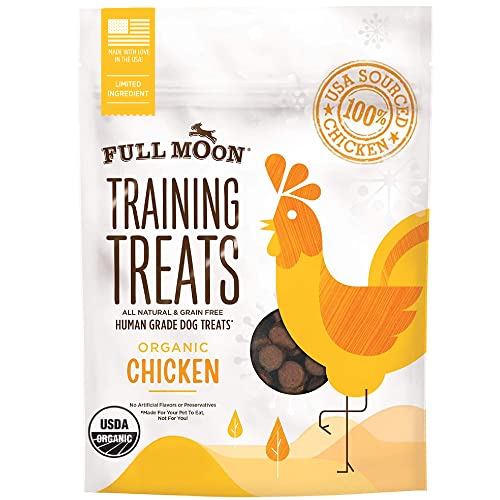
Our top pick is Full Moon USDA Organic Chicken Training Treats, which carries the actual seal, uses a short recognizable ingredient list, and comes in a small soft format that suits training better than anything else here. A Better Treat Freeze Dried Organic Pumpkin is the pick for single-ingredient simplicity, and Dog Mamma’s is a certified organic biscuit for dogs who prefer something crunchy.
An honest note on the whole category: treats are not nutrition. They exist for training and for the relationship, and the most consequential thing you can get right is how many you give rather than which brand you buy. A dog eating a third of its daily calories in treats has a problem no ingredient list will fix.
Best organic dog treats compared
Five treats, scored on the same criteria. The Organic Integrity Score is out of 100 and our rating is that score expressed out of five. Prices update automatically.
| Best Choice | Best Value | ||||
 |  |  |  |  | |
| Product | Full Moon Training | Dog Mamma’s | A Better Treat Pumpkin | Grandma Lucy’s | Wag Expedition |
| Organic Integrity Score | 94/ 100 | 92/ 100 | 90/ 100 | 85/ 100 | 83/ 100 |
| Our rating | 4.7 | 4.6 | 4.5 | 4.3 | 4.2 |
| Certification | USDA Organic | USDA Organic | Gluten-free, Organic | — | Non-GMO, Organic |
| Format | Small soft treats | Baked biscuit | Freeze dried pieces | Oven baked | Baked biscuit |
| Suits training | Yes, designed for it | Limited | Yes, breaks easily | Limited | Limited |
| Best for | Training and everyday | Certified organic biscuit | Single ingredient simplicity | Dogs who like a firmer treat | Convenience and price |
| Price | $9.99$26.64 / lb View on Amazon | Currently unavailable See buying options | $16.99 View on Amazon | $29.95$17.11 / lb View on Amazon | $9.08 $9.99 −9%$14.53 / lb View on Amazon |
- Organic Household hub
- our organic product database — compare brands across every guide
Price and availability as of October 27, 2026 1:10 am EDT. Product prices and availability are accurate as of the date/time indicated and are subject to change. Any price and availability information displayed on Amazon.com at the time of purchase will apply to the purchase of this product.
What organic actually means on a dog treat
This is a category where the certification question has a clearer answer than most, and where most products still fail it.
The USDA seal does apply to pet food
The National Organic Program covers agricultural products, and pet food made from agricultural ingredients falls within it. A dog treat can be certified organic under the same rules and the same accredited certifiers as human food, and products that are certified may display the USDA Organic seal.
That means the tier system works identically to the grocery aisle. “Organic” on the front requires at least 95% organic ingredients. “Made with organic chicken” means at least 70%. Our organic label tiers guide sets out what each level permits, and it applies here without modification.
Most organic-looking treats are not certified
The gap between products using organic language and products carrying the seal is very wide in this aisle. A great many treats describe themselves as natural, human grade, wholesome or made with organic ingredients without holding certification, and none of those terms is regulated in the way the seal is.
“Human grade” in particular is worth understanding, because it sounds like the strongest claim on the shelf and means something quite different. It refers to a product manufactured in a facility meeting human food standards, which is a genuine and useful thing. It says nothing at all about how the ingredients were farmed, and a human grade treat can be entirely conventional.
The two claims are complementary rather than interchangeable, and a product carrying both is telling you more than one carrying either.
What the seal does not cover
Organic certification governs farming and processing. It does not assess whether a treat is nutritionally appropriate, whether the calorie density suits your dog, or whether the format presents a choking risk. Those are separate questions and this page weights them separately.
What actually makes a good treat
Certification decides whether a product belongs on this page. These four things decide whether it is a good treat.
A short, recognizable ingredient list
The best treats have between one and six ingredients, all of them foods. Long lists in this category usually indicate a formed and extruded product held together with binders, humectants to keep it soft, and preservatives to give it shelf life. None of those are dangerous in themselves, and a shorter list is easier to troubleshoot if your dog reacts.
Single-ingredient treats are the simplest case: freeze-dried chicken is chicken. For a dog with a suspected food sensitivity, they are the only sensible option, because you can be certain what you introduced.
Calorie density and size
This is the specification that most affects daily use and is most often omitted. A training session might involve fifty repetitions, and a treat that is 15 calories each makes that impossible within the 10% rule. Treats designed for training are deliberately small and low calorie, often two to five calories apiece.
Large biscuits and jerky strips are for occasional use. They are not training tools, however good the ingredients.
Format and safety
Soft treats can be torn into smaller pieces, which effectively doubles or triples the number of rewards from the same calories. Hard biscuits cannot. Freeze-dried pieces are light and break easily, which is why they suit training.
Hard chews and bones present a genuine fracture risk to teeth, and dense compressed chews can cause obstruction if swallowed in large pieces. Neither is a certification question and both matter more than the ingredient list.
Made in a country with meaningful oversight
Country of origin for both manufacturing and ingredients is worth checking. This is not xenophobia about sourcing; it is a response to a documented history of contamination incidents in imported pet treats, particularly jerky products, that prompted extended FDA investigation.
Best overall: Full Moon USDA Organic Chicken Training Treats
| Organic Integrity Score | 94 / 100 |
| Certification | USDA Organic |
| Format | Small soft training treats |
| Main ingredient | Organic chicken |
| Best for | Training, and the treat most dogs will get most often |
Full Moon is our top pick because it is one of the few products in the aisle carrying the actual USDA Organic seal rather than organic-sounding language, and because the format matches how treats are genuinely used.
Training treats need to be small, soft and low in calories, because a productive session involves a lot of repetitions. These are all three, and they tear easily into halves for a small dog, which extends a bag considerably and keeps you inside the 10% rule.
The ingredient list is short and readable, led by organic chicken, without the humectants and binders that keep many soft treats pliable. Manufacturing is in the United States, which given the history of imported jerky problems is worth having.
The trade-off is cost per treat against a bulk biscuit, and the fact that soft treats have a shorter open-bag life than baked ones. Reseal them properly and use within a few weeks.
Best certified biscuit: Dog Mamma’s Organic Peanut Butter Banana
| Organic Integrity Score | 92 / 100 |
| Certification | USDA Organic |
| Format | Baked biscuit |
| Flavor | Peanut butter and banana |
| Best for | Dogs who prefer a crunchy treat, with certification intact |
Plenty of dogs simply prefer a crunchy biscuit, and finding one that is genuinely certified rather than merely wholesome-sounding is harder than it should be. Dog Mamma’s is certified organic and the ingredient list is short enough to read in a glance.
One thing worth checking on any peanut butter treat, and worth stating plainly: xylitol is highly toxic to dogs, and some human peanut butters contain it as a sweetener. Commercial dog treats do not use it, but if you make your own or share from a jar, read the label every time. This is one of the few genuine emergencies in dog nutrition.
As a training treat it is limited. Biscuits are harder to break down into small pieces and higher in calories per reward, so treat these as an occasional biscuit rather than a session tool.
Best single ingredient: A Better Treat Freeze Dried Organic Pumpkin
| Organic Integrity Score | 90 / 100 |
| Certification | Gluten-free, Organic |
| Ingredients | Single ingredient, freeze dried |
| Format | Light pieces that break easily |
| Best for | Dogs with suspected food sensitivities, and elimination diets |
If your dog reacts to things and you are trying to work out what, a single-ingredient treat is the only sensible option, because it is the only one where you know exactly what you introduced. This is the cleanest example here.
Freeze drying preserves the ingredient without cooking it into something else, and the resulting pieces are light and brittle, so they break into small rewards easily. Pumpkin is also a sensible choice for dogs with sensitive digestion, being high in fiber and gentle.
A Better Treat make several single-ingredient organic options in the same range, including chicken and sweet potato, which is useful if you are rotating proteins or your dog turns out not to like pumpkin.
Scored slightly below Full Moon because the listing states organic without displaying the USDA seal specifically, and we have not treated those as identical claims.
Best firm treat: Grandma Lucy’s Organic Oven Baked
| Organic Integrity Score | 85 / 100 |
| Certification | — |
| Format | Oven baked, sold as a two-piece bundle |
| Best for | Dogs who like something firmer, and buying two varieties at once |
Grandma Lucy’s is a long-established small pet food company and the oven-baked treats have a firmer texture that suits dogs who lose interest in soft ones. The bundle format means two varieties, which is useful if your dog is fussy or you want to rotate.
It is the most expensive option here per ounce, and the certification claim is a general organic one rather than a displayed USDA seal, which is why it scores below Dog Mamma’s despite being a comparable product.
Firm baked treats are also the format where breakage in transit is most common, so expect some crumbs at the bottom of the bag. Those are perfectly usable as training rewards, which is arguably a bonus.
Best value: Wag Expedition Human Grade Organic Biscuits
| Organic Integrity Score | 83 / 100 |
| Certification | Non-GMO, Organic |
| Manufacturing | Human grade facility |
| Best for | The lowest price with an organic claim attached |
Amazon’s own pet brand, and the cheapest way onto this page. It carries both an organic claim and a human grade manufacturing claim, which as discussed above are different things and better together than either alone.
It scores lowest here on credential specificity. The listing states organic and non-GMO without displaying a USDA seal or naming a certifier, and after the sponsored-placement problem in this category we do not assume equivalence.
As a bulk everyday biscuit for a dog who is not sensitive to anything and gets treats in moderation, it is perfectly reasonable and considerably cheaper than the alternatives. If certification is the specific reason you came to this page, the Full Moon or Dog Mamma’s are the ones actually carrying it.
Calories, and the arithmetic nobody does
This is the section that matters most for your dog’s health, and it is the one no treat brand puts on the front of the bag.
The 10% rule in practice. Treats should be at most a tenth of daily calories. A 10 lb dog needs roughly 250 calories a day, so 25 from treats. A 30 lb dog needs around 550, so 55. A 70 lb dog needs around 1,000, so 100. Those numbers are smaller than they sound once you look at what a biscuit contains.
A single large biscuit can be 30 to 50 calories, which is two days of treat allowance for a small dog in one go. Training treats at three to five calories each let you give twenty rewards for the same budget, which is why format matters more than brand.
Reduce meals if treats increase. If you are doing a lot of training, take the treat calories off the daily food rather than adding them on top. Most dogs will not notice a slightly smaller bowl; they will notice the training.
Break everything. Dogs respond to the event of being rewarded, not the size of the reward. A treat torn into four pieces is four rewards. This single habit does more for treat-related weight gain than any ingredient choice.
Obesity is the most common preventable health problem in dogs, and treats are the usual route in. If your dog is gaining weight, the bag on the counter is a more likely cause than the food in the bowl.
Ingredients and formats worth avoiding
Separate from certification, a few things are worth knowing about regardless of what a treat costs.
Xylitol is the genuine emergency. It causes a rapid, dangerous drop in blood sugar in dogs and can cause liver failure. It appears in some human peanut butters, sugar-free products and baked goods, and not in commercial dog treats. If you share human food, this is the one to check every single time.
Cooked bones splinter and can perforate the gut. This applies to leftovers rather than to commercial products, and it is worth stating because it remains a common cause of emergency visits.
Very hard chews, including antlers, hooves and dense nylon, fracture teeth. Veterinary dentists see this constantly. A reasonable rule is that if you cannot make a dent in it with a thumbnail, it is hard enough to break a tooth.
Rawhide is chemically processed and can swell in the stomach or cause obstruction if a large piece is swallowed. There are better options, and none of the treats on this page are rawhide.
Long ingredient lists with multiple sweeteners and dyes. Color is for the human buying it; dogs do not care. It adds nothing and gives you more variables if something disagrees with them.
Using treats well
Time them precisely. A reward given within a second or two of the behavior teaches something. The same treat given fifteen seconds later teaches nothing, or teaches whatever the dog was doing at that moment.
Vary the value. Keep an ordinary treat for routine requests and something better for hard asks, like recall away from something interesting. Dogs discriminate between rewards and work harder for the good ones.
Use meals as training currency. For a dog doing a lot of training, measuring out the daily kibble and hand-feeding it through sessions costs nothing in extra calories and works well for most food-motivated dogs.
Do not use treats to end a behavior you dislike. Offering a treat to stop barking rewards the barking. This is the most common accidental training people do.
Store them properly. Soft and freeze-dried treats degrade once opened. Reseal, keep cool, and buy a size you will use in a few weeks rather than a bulk bag that goes stale.
Reading a pet treat label
Pet food labeling is regulated differently from human food, and knowing which parts are meaningful saves a lot of time in the aisle.
The ingredient list works the same way as human food: descending order by weight before cooking. That last qualification matters, because ingredients high in water, such as fresh chicken, weigh more raw than they contribute to the finished product. A treat listing “chicken” first and “chicken meal” third may contain more chicken protein from the meal.
The guaranteed analysis gives minimum protein and fat and maximum fiber and moisture. It is a legal minimum rather than an actual figure, so a treat guaranteeing 20% protein may contain considerably more. It is useful for comparison between products and not as a precise nutritional statement.
Calorie content is where pet labeling is weakest. Many treat packages state calories per kilogram rather than per treat, which is useless without weighing one. Products that state calories per piece are being genuinely helpful, and it is worth favoring them for that reason alone.
The AAFCO statement appears on complete foods and generally not on treats, because treats are not formulated to be complete. Its absence on a treat is expected rather than a warning sign. Where it appears on a treat, it usually means the product is intended as a meal topper or supplement.
Country of origin is frequently split between where a product was manufactured and where the ingredients came from, and a bag can honestly say “made in USA” while sourcing ingredients elsewhere. Both lines are worth reading, particularly on jerky products.
How treats fit alongside the rest of the diet
The most common mistake in this category is treating treats as a nutrition decision. They are a behavior and relationship tool, and the nutrition happens in the bowl.
The 90% that matters. A complete and balanced food is formulated to supply everything a dog needs in the proportions it needs them. Treats are not, and they are not supposed to be. Once treats exceed about a tenth of intake, they start displacing that balanced formulation with something incomplete, which is a separate problem from the calories.
This is why the 10% rule is a nutritional guideline and not just a weight one, and it is the reason a dog eating a third of its calories in premium organic treats is worse off than one eating ordinary food with occasional biscuits.
Where treats genuinely add value is training, enrichment and medication. A food-motivated dog learns faster with good rewards, a stuffed toy or slow feeder occupies a bored dog constructively, and a treat wrapped around a tablet solves a problem every owner eventually faces.
Vegetables are an underused option. Carrot sticks, green beans and cucumber are extremely low in calories, most dogs like them, and they let you reward generously without touching the treat budget. Buying them organic is a straightforward extension of the same reasoning applied to your own food, and our Dirty Dozen and Clean Fifteen guide covers where that spending goes furthest.
Grapes and raisins must be avoided entirely, along with onions, garlic and chocolate, which is worth stating alongside the vegetable suggestion rather than assuming it is common knowledge.
Common questions about organic dog treats
Can dog treats really be USDA organic certified?
Yes. Pet food made from agricultural ingredients falls under the National Organic Program, so treats can be certified by the same accredited bodies as human food and display the USDA seal. The tier rules are identical, with “organic” requiring at least 95% organic ingredients.
Is “human grade” the same as organic?
No, and the two are frequently confused. Human grade refers to manufacturing in a facility meeting human food standards. It says nothing about how ingredients were farmed. A human grade treat can be entirely conventional, and the claims are complementary rather than interchangeable.
How many treats can I give my dog per day?
Treats should be no more than 10% of daily calories. That is roughly 25 calories for a 10 lb dog, 55 for a 30 lb dog and 100 for a 70 lb dog. A single large biscuit can be 30 to 50 calories, which is why training-size treats matter.
Are organic treats better for a dog with allergies?
Not inherently. Food sensitivities are usually reactions to a specific protein, and organic chicken causes the same reaction as conventional chicken. What helps is a single-ingredient treat, because it lets you control exactly what the dog is exposed to.
What ingredient is genuinely dangerous in treats?
Xylitol, which causes a dangerous drop in blood sugar and can cause liver failure in dogs. It is not used in commercial dog treats but appears in some human peanut butters and sugar-free products, so check before sharing anything from your own kitchen.
Are hard chews and antlers safe?
They are a common cause of fractured teeth, and veterinary dentists see the results regularly. A reasonable test is whether you can dent it with a thumbnail. If not, it is hard enough to break a tooth.
Do treats need to be a complete food?
No, and they are not meant to be. Treats are supplementary and the 90% of the diet that is a complete and balanced food does the nutritional work. This is why keeping treats to 10% matters for balance as well as for weight.
Why do some treat packets not state calories per treat?
Pet labeling often gives calories per kilogram, which is useless without weighing a piece. Products stating calories per treat are being genuinely helpful and worth favoring, since the per-treat figure is the only one you can act on during a training session.
Can I give my dog vegetables instead of treats?
Yes, and it is underused. Carrot, green beans and cucumber are very low in calories and most dogs accept them, which lets you reward generously without spending the treat budget. Avoid grapes, raisins, onions, garlic and chocolate entirely, as all are toxic to dogs.
Looking for other organic products?
We have checked more than 800 products across food, household goods, gardening, personal care and pet, every one against its stated certification. Browse all reviews.
Organic Connection participates in the Amazon Services LLC Associates Program, an affiliate advertising program designed to provide a means for sites to earn advertising fees by advertising and linking to Amazon.com. This article is general information, not veterinary advice. If your dog has a health condition or a suspected food allergy, speak to your vet.