Last updated: September 30, 2026
We may earn a commission when you buy through links on this page, at no extra cost to you. How we research and rate.
The short version
After researching the certifications, milling, and packaging of the most popular organic ground flaxseeds, our top pick is Spectrum Essentials Organic Ground Flaxseed, 24 oz. It is USDA certified organic and Non-GMO Project Verified, cold-milled on proprietary equipment designed to keep the oil from heating, and packed in a resealable bag, which is why it earned our highest Organic Integrity Score of 92 out of 100. For brown flax, the Organic Flaxseed Meal 16 oz is our pick, and for the best value, the 32 oz four-pack is the best choice.
Flaxseed is the category where the milling date matters more than the brand, because ground flax goes rancid faster than almost anything else in a pantry and most people store it exactly wrong. We flag each product’s certification, milling method, and packaging.
Best organic ground flaxseed compared
| Best Choice | Best Value | ||||
 |  |  |  |  | |
| Product | Spectrum 24 oz | Bob’s Red Mill Organic Flaxseed Meal | Golden 32 oz x4 | Anthony’s 2.5 lb | Badia 16 oz |
| Organic Integrity Score | 92/ 100 | 89/ 100 | 86/ 100 | 84/ 100 | 78/ 100 |
| Our rating | 4.6 | 4.5 | 4.3 | 4.2 | 3.9 |
| Variety | Golden | Brown | Golden | Golden | Golden |
| Best for | Best overall | Wholemeal baking | Best value | Large single bag | Lowest price |
| Certification | USDA Organic, Non-GMO Project Verified, Gluten-Free Certified | USDA Organic, Non-GMO Project Verified, Gluten-free | — | USDA Organic, Non-GMO, Gluten-free | USDA Organic, Non-GMO, Gluten-free |
| Price | $12.17$0.51 / ounce View on Amazon | Currently unavailable See buying options | $47.24$0.37 / ounce View on Amazon | $20.19$0.50 / ounce View on Amazon | $4.28$0.27 / ounce View on Amazon |
Price and availability as of October 12, 2026 1:10 am EDT. Product prices and availability are accurate as of the date/time indicated and are subject to change. Any price and availability information displayed on Amazon.com at the time of purchase will apply to the purchase of this product.
Nutrition facts side by side
Scores are ours, based on independent research of certification, milling method, packaging and light protection, variety suitability, price per pound, and freshness handling, using the same 10-criteria method we apply to every product. See how we research and rate.
The certification map for organic ground flaxseed, and what each one actually excludes
Certification names are easy to confuse and easy to trade on. Below is what each of these marks covers, and the part of the picture it says nothing about.
| Certification | Covers | Key exclusion |
| USDA Organic | Farming and handling: no synthetic pesticides or fertilizers, no GMOs, no sewage sludge or irradiation, audited yearly by an accredited certifier | Three different tiers share the one seal, and it makes no claim about worker pay, food miles, or nutrition |
| Non-GMO Project | Testing and supply-chain traceability showing the ingredients are not genetically engineered | Sets no limit on synthetic pesticides or fertilizers, so it is not an organic claim |
| Kosher | Ingredients and production comply with Jewish dietary law, verified by a rabbinic agency that inspects the facility | A dietary-law standard: it makes no claim about pesticides, GMOs or farming practice |
| Gluten-Free Certified | Testing to below 10 parts per million of gluten, stricter than the FDA threshold of 20 ppm | A gluten threshold and nothing more; unrelated to organic content or nutrition |
Non-GMO and organic are not two grades of the same thing. The butterfly certifies an absence of genetic engineering and stops there; the USDA seal prohibits genetic engineering as one clause among many, alongside synthetic pesticides, synthetic fertilizers, sewage sludge and irradiation. That makes organic the broader claim by some distance. Where both appear together, the butterfly is adding batch testing on top of a standard that had already banned GMOs.
Key things to look for in organic ground flaxseed
Good flaxseed meal comes down to certification, milling, packaging, and freshness. Here is what matters.
1. USDA organic certification
Flax is a broadacre crop, and organic certification rules out synthetic pesticides and pre-harvest desiccation practices used in some conventional production.
2. Cold milling
Grinding generates heat, and heat accelerates oxidation of the omega-3 oil. Brands that mill cold and say so are protecting what you are buying.
3. Resealable, opaque packaging
Light and air are what destroy ground flax. A resealable opaque bag beats a paper sack or a clear jar.
4. A date on the bag
Ground flax has a genuinely limited life. Check the best-before date and buy from somewhere with turnover.
Golden versus brown, and what flax actually delivers
Two questions come up constantly, and both have clearer answers than the marketing suggests.
Golden versus brown. Nutritionally they are very close: both are high in alpha-linolenic acid, both are rich in lignans, both provide around 3 grams of fiber per two-tablespoon serving. The differences are sensory. Golden flax is milder, slightly nuttier, and lighter in color, which makes it far less noticeable in pale baking, pancakes, and light-colored smoothies. Brown flax is earthier and more assertive and disappears better into wholemeal bread, oats, and darker dishes. Choose on what you are putting it in, not on a nutritional difference that is largely marketing.
What the evidence supports. Flax has genuinely good evidence behind two things. It is one of the richest plant sources of alpha-linolenic acid, and it is by a wide margin the richest known dietary source of lignans, a class of phytestrogen. Meta-analyses of flaxseed trials have found modest but consistent reductions in LDL cholesterol and in blood pressure, particularly with whole ground seed rather than flax oil, and the fiber content gives it a well-established laxative effect.
The ALA caveat worth knowing. Alpha-linolenic acid is an omega-3, but it is not the same as the EPA and DHA in oily fish. The body converts ALA to EPA and DHA at a low and variable rate, commonly cited at under 10% for EPA and considerably less for DHA. Flax is a genuinely good food and it is not a substitute for fish or an algal supplement if EPA and DHA are what you are after. This distinction gets glossed over constantly.
Practical cautions. Introduce it gradually, since a sudden increase in soluble fiber causes bloating and gas, and drink enough water with it or it can do the opposite of what you want. Flax may affect blood clotting in large amounts, so mention it to your doctor if you take anticoagulants or have surgery planned. Its lignans are phytestrogenic, and while normal food amounts are considered fine, anyone with a hormone-sensitive condition should raise it with a clinician. Nothing here is medical advice.
What the evidence shows, with the numbers
Flaxseed has a substantially larger clinical literature behind it than most pantry staples, and the effect sizes are worth knowing before you decide how much to bother.
Cholesterol. An updated systematic review and dose-response meta-analysis pooling 62 randomized controlled trials across 3,772 participants found flaxseed supplementation significantly reduced total cholesterol and triglycerides. Notably, it had no effect on HDL. Sixty-two trials is an unusually deep evidence base for a food, and it is one of the strongest reasons to bother with flax at all.
Blood pressure. Multiple meta-analyses have found flaxseed reduces both systolic and diastolic blood pressure. Reported reductions range roughly from 2 to 15 mmHg systolic and 1 to 7 mmHg diastolic, with the size of the effect depending heavily on dose, how long people took it, and how raised their baseline pressure was. The wide range is a fair reflection of genuinely variable results rather than a precise figure.
What is doing the work. Three components, each with independent lipid-lowering plausibility: alpha-linolenic acid, phenolic compounds, and lignans. Flax is by a wide margin the richest known dietary source of lignans, principally secoisolariciresinol diglucoside (SDG), which are diphenolic phytestrogens with antioxidant and anti-inflammatory activity.
| Dose used in research | Detail |
| 30 g ground flaxseed daily | Common trial dose, about 3 tablespoons, run over 8 weeks |
| Typical everyday serving | 2 tablespoons, roughly 14 g |
| Lignan complex trials | Around 600 mg SDG daily for three months |
| Whole seed versus oil | Ground whole seed outperforms flax oil, which lacks lignans and fiber |
The practical read. Two tablespoons a day is a sensible everyday amount and sits below the 30 g used in many trials, so if you are eating flax specifically for lipids or blood pressure, three tablespoons is closer to what was actually studied. Build up slowly regardless, and note that ground whole seed is the form with the evidence behind it: flax oil delivers the ALA but leaves the lignans and fiber behind.
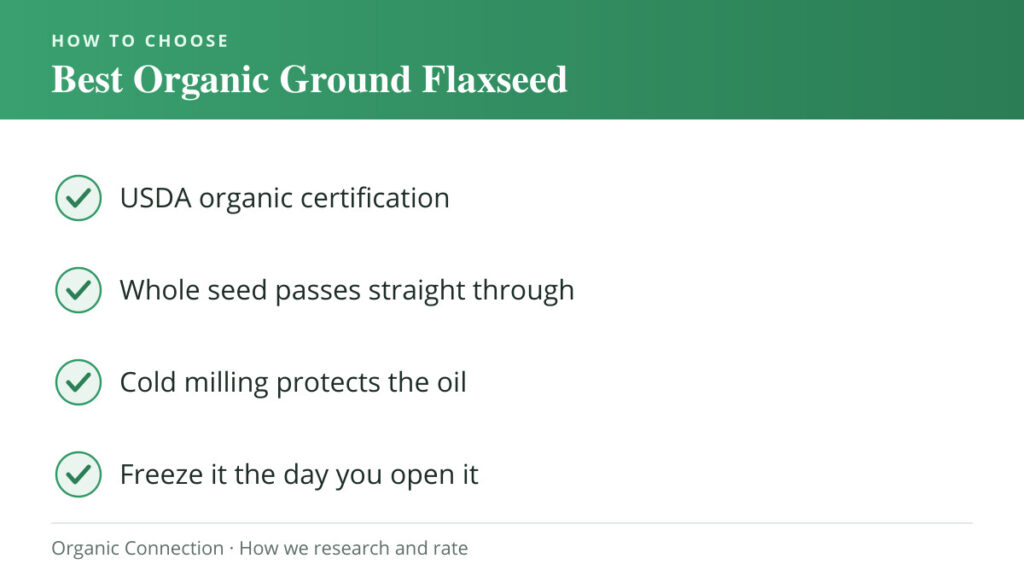
How to choose organic ground flaxseed
- Buy it ground, or buy whole seed and grind it yourself in small batches.
- Confirm USDA organic and look for cold milling on the label.
- Choose golden for pale baking, brown for wholemeal and darker dishes.
- Insist on resealable opaque packaging and check the date.
- Refrigerate or freeze it the moment you open the bag. This matters more than brand choice.
Who should buy organic ground flaxseed
The right bag depends on how you use it. If you want mild golden flax for everyday baking and smoothies, our top pick fits. If you want traditional brown flax, the best price per pound, a large resealable format, or a bulk supply, we have a pick for each.
Best overall: Spectrum Essentials Organic Ground Flaxseed, 24 oz
| Organic Integrity Score | 92 / 100 |
| Size | 24 oz |
| Per serving | 2.9 g omega-3 as ALA, 98 mg lignans, 3 g dietary fiber |
| Certification | USDA Organic, Non-GMO Project Verified, Gluten-Free Certified |
| Milling | Cold milled, described as slicing rather than crushing |
| Best for | Anyone who wants the nutrition actually quantified |
The only flaxseed listing in this comparison that publishes numbers, and it publishes three: 2.9 g of omega-3 as ALA, 98 mg of lignans and 3 g of dietary fiber per serving. Lignans in particular are almost never quantified anywhere, and flaxseed is the richest common dietary source of them.
It also explains its process rather than asserting quality. “Our proprietary cold milling process finely slices premium organic flaxseed rather than crushing it.” That distinction is real: flax oil is highly unsaturated and heat from milling is what starts it oxidizing, so a low-temperature process is the difference between fresh meal and stale meal.
The certification stack is named by program: USDA Organic, Non-GMO Project Verified and Certified Gluten-Free, with no preservatives. And it carries by far the strongest sales rank in the category.
What we liked: Three published figures including lignans, a cold-milling process explained rather than claimed, three named certification programs, and the best sales rank here.
Keep in mind: The ALA and fiber statements carry a regulatory asterisk, as all such claims do. Ground flax oxidizes once opened, so refrigerate it.
What the listing discloses: On the Spectrum label: a USDA organic claim, Non-GMO Project Verified and Certified Gluten-Free. Not stated: where it was grown or made.
Best brown flax: Bob’s Red Mill Organic Flaxseed Meal, 16 oz
| Organic Integrity Score | 89 / 100 |
| Ingredients | Organic whole ground brown flaxseed |
| Certification | USDA Organic, Non-GMO Project Verified, Gluten-free |
| Best for | Wholemeal bread, oats, and darker baking |
Traditional brown flax, cold-milled to the same standard, certified organic and gluten-free. The flavor is earthier and nuttier than golden, which is a genuine advantage in wholemeal bread, granola, bran muffins, and porridge, where it adds depth rather than sticking out. It is also the variety most recipes were originally written around, so if a recipe simply says flaxseed meal, this is what it means.
The trade-off is visibility. Brown flax speckles pale batters and turns light smoothies a murky greenish-brown, which bothers some people and is a real issue if you are trying to get flax into a fussy household. Its stronger flavor also comes through in delicate baking. Choose golden if either matters to you.
What we liked: The same cold-milled organic quality with a fuller nuttier flavor that suits wholemeal baking and oats.
Keep in mind: Visible specks and a stronger taste in pale foods and light smoothies.
What the listing discloses: Bob’s Red Mill commits to USDA organic certification and Non-GMO Project Verified but stops short of where it was grown or made.
Best value: Bob’s Red Mill Organic Golden Flaxseed Meal, 32 oz (Pack of 4)
| Organic Integrity Score | 86 / 100 |
| Ingredients | Organic whole ground golden flaxseed |
| Certification | — |
| Best for | Households using flax daily |
Four 32 oz resealable bags brings the price per pound down sharply while keeping three bags sealed while you work through the first. That last point is the reason this scores above the single large bag: with a perishable product, four separately sealed packages is materially better than one big one, because only the opened bag is exposed to air.
The trade-off is that eight pounds of ground flax is a great deal of a product with a limited life, and unless several people in the household eat it daily you are unlikely to finish it before quality declines. If you buy this, freeze the unopened bags immediately, which is the one storage step that genuinely preserves ground flax over months.
What we liked: Much better price per pound, and four separately sealed resealable bags rather than one large exposed one.
Keep in mind: Eight pounds is a lot of a perishable product; freeze the unopened bags on arrival.
What the listing discloses: Bob’s Red Mill is thin on detail, and does not say whether the USDA seal applies and where it was grown or made.
Best single large bag: Anthony’s Organic Flaxseed Meal, 2.5 lb
| Organic Integrity Score | 84 / 100 |
| Size | 2.5 lb single bag |
| Certification | USDA Organic, Non-GMO, Gluten-free |
| Milling | Cold milled, ground to an ultra fine powder |
| Best for | One large bag rather than a multipack |
The largest single bag on this page that is actually buyable, and it uses the regulated phrasing: USDA Certified Organic Ground Flaxseed Meal.
Two process details sit in the product name rather than the bullets, which is the wrong way round but still useful: cold milled, and ground to an ultra fine powder. Fineness matters more in flax than in most meals, because a coarser grind passes through less digested, and whole seeds largely pass through intact.
Beyond that the listing is thin. Two bullets, the second of which lists diets rather than describing the product, and no figures for omega-3, lignans or fiber.
What we liked: The regulated certification wording, cold milling, and a genuinely fine grind in the largest single bag here.
Keep in mind: No nutrition figures at all, and the process claims live in the title rather than the body. A 2.5 lb bag needs refrigerating once opened.
What the listing discloses: Anthony’s documents itself unusually well, stating USDA organic certification, an origin of California and a single-ingredient formula.
Best price: Badia Organic Ground Flax Seed, 16 oz
| Organic Integrity Score | 78 / 100 |
| Size | 16 oz |
| Certification | USDA Organic, Non-GMO, Gluten-free |
| Additives | None, stated |
| Best for | The lowest price per ounce in the comparison |
By a wide margin the cheapest bag here, from a brand better known for its spice rack than its superfoods, and with a sales rank that suggests plenty of people have noticed.
Its single bullet does the two things that matter: USDA Certified Organic in the regulated form, and no additives. On a single-ingredient product, confirming nothing else is in the bag is close to the whole story.
What is missing is everything else. No milling description, so no way to tell whether it was cold milled or heat generated during grinding. No omega-3, lignan or fiber figures. No origin. On our scoring that is the difference between this and the top of the table, and at this price the trade is a reasonable one to make knowingly.
What we liked: Cheapest per ounce here, the regulated certification wording, and an explicit no-additives statement.
Keep in mind: No milling method stated, which is the one process variable that matters in ground flax, and no nutrition figures.
What the listing discloses: Badia commits to USDA organic certification and a single-ingredient formula but stops short of where it was grown or made.
How to store and use ground flaxseed
Storage is the whole game with flax. Ground flaxseed exposed to air, light, and room temperature begins oxidizing within weeks, and rancid flax tastes sharp, bitter, and faintly of paint. The fix is simple and almost nobody does it: put the bag in the freezer the day you open it. Ground flax does not freeze solid, so you can spoon it straight from the freezer with no thawing, and it will keep good for six months to a year there versus a few weeks in a cupboard. Refrigeration is the second-best option. A warm pantry shelf is the worst.
Trust your nose before every use. Fresh flax smells faintly nutty and sweet. If it smells sharp, oily, or like old crayons, it has gone and no amount of masking in a smoothie will fix it. If you want maximum freshness, buy whole seed and grind a week’s worth at a time in a coffee or spice grinder; whole flax keeps for a year or more at room temperature because the hull protects the oil.
In the kitchen, two tablespoons a day is the usual serving. It goes into porridge, yogurt, and smoothies invisibly, especially the golden variety. Its most useful trick is as a vegan egg replacement: one tablespoon of ground flax whisked with three tablespoons of water, left to sit five to ten minutes until gel-like, replaces one egg in most baking. It also adds structure to gluten-free bread, and it can replace a portion of flour in muffins and pancakes.
Two practical points. Do not heat flax oil, and be aware that baking ground flax is fine, since the seed matrix protects the oil considerably better than free oil in a bottle. And introduce it gradually: going from none to three tablespoons a day will produce bloating and gas. Start with a teaspoon, build up over a couple of weeks, and drink plenty of water with it.
How we researched this guide
We are a research-based review site. We compared each product against its certification (USDA organic and, where present, Non-GMO Project Verified and certified gluten-free), milling method and temperature control, packaging material and resealability, variety and its suitability for different uses, price per pound, freshness handling relative to the product’s short shelf life, and the weight of aggregated customer feedback on grind consistency and taste, then scored each with our 10-criteria Organic Integrity Score. No brand paid to be included or ranked. Nothing here is medical advice; flax may affect blood clotting in large amounts and is phytestrogenic. Read the full method on our How We Research and Rate page.
Why ground matters, and what the fiber does
Flaxseed is one of the more genuinely useful additions in this category, and the single most important fact about it is mechanical rather than nutritional.
Whole flaxseeds have a hull tough enough that most of them pass through the digestive tract intact. Whatever is inside, the omega-3 fats, the lignans, the soluble fiber, is largely unavailable if the seed is not broken. Grinding is not a preference here; it is the difference between eating flaxseed and eating a small amount of roughage.
Ground flaxseed carries roughly 2 grams of fiber per tablespoon, split between soluble and insoluble. The soluble portion forms a gel in water in the same way psyllium and chia do, which slows gastric emptying and contributes modestly to fullness. A tablespoon is a useful contribution to a daily fiber target and not a large enough dose to change appetite dramatically.
The lignan content is the more distinctive thing about flax. Flaxseed is by a wide margin the richest dietary source of lignans, which are phytoestrogens studied in relation to hormone-sensitive conditions and cardiovascular markers. That research is unrelated to body weight and is the more interesting reason to eat it regularly.
A tablespoon is around 37 calories, mostly from fat, so it is a small addition rather than a free one.
Two practical notes. Ground flax goes rancid quickly because the fats are highly unsaturated, so buy small quantities or grind as needed, and keep it refrigerated. And increase intake gradually with adequate water, as with any added fiber.
Honest summary: a genuinely good source of fiber and by far the best source of lignans, with a modest satiety contribution, provided it is ground and stored properly.
Common questions about organic ground flaxseed
What is the best organic ground flaxseed?
Our overall pick is Spectrum Essentials Organic Ground Flaxseed, which scores highest here at 92, because its listing names USDA organic certification and Non-GMO Project verification. For brown flax, the Organic Flaxseed Meal, and for the best value, the 32 oz four-pack.
Should you buy flaxseed whole or ground?
Ground, or whole if you will grind it yourself. Whole flaxseeds pass through the digestive system largely intact because the hull resists chewing and stomach acid, so you get the fiber and very little of the omega-3 or lignans. Grinding your own from whole seed in small batches gives the best freshness, since whole seed keeps for a year or more.
Does ground flaxseed go bad?
Yes, faster than most pantry items. Flax is about 40% polyunsaturated oil, which oxidizes once the seed is broken open. Ground flax lasts only a few weeks at room temperature but six months to a year in the freezer. It smells faintly nutty when fresh and sharp or crayon-like when rancid.
Is golden or brown flaxseed better?
Nutritionally they are very close, with similar ALA, lignan, and fiber content. Golden is milder and lighter, so it hides better in pancakes, pale baking, and light smoothies. Brown is earthier and nuttier and suits wholemeal bread, granola, and oats. Choose on what you are cooking rather than on nutrition.
Is flaxseed a good source of omega-3?
It is the best plant source of alpha-linolenic acid, but ALA is not the same as the EPA and DHA in oily fish. The body converts ALA to EPA at a low rate, commonly cited under 10%, and to DHA at considerably less. Flax is genuinely valuable food, and it is not a replacement for fish or an algal supplement if EPA and DHA are your goal.
- Organic Food & Pantry hub
- Best Organic Chia Seeds
- Best Organic Hemp Hearts
- How to Build an Organic Pantry
- browse all our reviewed products — scores and certifications for 800+ products
Price and availability as of October 12, 2026 1:10 am EDT. Product prices and availability are accurate as of the date/time indicated and are subject to change. Any price and availability information displayed on Amazon.com at the time of purchase will apply to the purchase of this product.
Looking for other organic products?
We have checked more than 800 products across food, household goods, gardening, personal care and pet, every one against its stated certification. Browse all reviews.
Organic Connection is reader-supported. When you buy through links on this page we may earn a commission, at no extra cost to you. As an Amazon Associate we earn from qualifying purchases. We are not paid to feature or rank any product. This page is informational and is not medical advice. How we research and rate.