Last updated: September 30, 2026
We may earn a commission when you buy through links on this page, at no extra cost to you. How we research and rate.
The short version
After working through waterproofing chemistry, vinyl versus TPU, breathability and the difference between a protector and a pad, our top pick is Bioweaves GOTS Certified Organic Waterproof Mattress Protector. It uses GOTS-certified organic cotton jersey on both faces with an ultra-thin waterproof barrier between them, and it avoids vinyl, PVC and phthalates entirely. It earned our highest Organic Integrity Score of 89 out of 100.
There is a compromise built into this entire category. No waterproof protector can be fully organic, and knowing why lets you decide which version of that compromise you want.
Best organic mattress protector compared
| Best Choice | Best Value | ||||
 |  | |  | | |
| Product | Bioweaves GOTS | Naturepedic Organic | Naturepedic Organic | Bioweaves GOTS | Naturepedic Organic |
| Organic Integrity Score | 89/ 100 | 88/ 100 | 87/ 100 | 86/ 100 | 85/ 100 |
| Our rating | 4.5 | 4.4 | 4.4 | 4.3 | 4.3 |
| Waterproof | Yes, TPU barrier | Yes, TPU barrier | Yes, TPU barrier | No | — |
| Fabric | Organic cotton jersey | Organic stretch knit | Organic cotton | GOTS cotton, fabric and fill | — |
| Fits depth | 9 to 16 inches | 9 to 16 inches | Standard crib | Standard | — |
| Best for | Most beds, everyday use | Deep mattresses, secure fit | Cribs and toddler beds | No plastic at all | — |
| Certification | GOTS, Fair Trade, Certified Organic | GOTS, Organic | GOTS, Certified Organic | GOTS, Certified Organic, MADE SAFE | GOTS, Organic |
| Contents | Organic cotton jersey both faces, ultra-thin waterproof barrier, fits 9 to 16 inch depth | Fitted stretch knit organic cotton waterproof protector, 9 to 16 inch depth, Twin XL | Organic waterproof crib mattress pad, fitted for standard 28 x 52 inch crib | Quilted organic cotton mattress pad, GOTS-certified fabric and fill, King 76 x 80 inch | Fitted stretch knit organic waterproof protector, twin, 9 to 16 inch depth |
| Price | $69.00 View on Amazon | $199.00 View on Amazon | $219.00 View on Amazon | $349.00 View on Amazon | $129.00 View on Amazon |
Scores are ours, based on independent research of certification scope, barrier material, breathability, fit range, washability and value, using the same 10-criteria method we apply to every product.
What each certification on an organic mattress protector label actually covers
Most shoppers read a certification as a general signal of quality. Every one of them is narrower than that, and the gaps between them are where the marketing lives.
| Certification | Covers | Key exclusion |
| GOTS | Organic fiber from farm to finished textile, plus dyeing, finishing, wastewater and labor criteria | Has a weaker second tier, “made with organic”, that needs only 70% organic fiber and carries the same name |
| MADE SAFE | Screens every ingredient against a banned list covering human health and ecosystem harm | An ingredient-hazard screen; it does not verify organic farming or that the product works |
GOTS has a second tier that shares its name. The organic grade requires at least 95% certified organic fiber; the “made with organic” grade requires 70%, and both are labeled GOTS. It remains the strongest textile standard in the field, because it follows the fiber through dyeing, finishing, wastewater and working conditions rather than stopping at the farm. The percentage is on the label for a reason, and it is worth reading.
Protector, pad, encasement: three different things
The words are used interchangeably in listings and they describe genuinely different products.
A mattress protector is a thin fitted layer whose job is to keep liquid and dirt out of the mattress. It adds no comfort and should be barely noticeable.
A mattress pad is quilted and adds a layer of softness as well as some protection. Many are not waterproof at all, and the ones that are combine both functions.
An encasement zips fully around the mattress on all six sides. It is what you need for bed bugs or a serious dust mite allergy, because a fitted protector leaves the underside and sides exposed.
Choose by what you are actually solving. Spills and accidents call for a waterproof protector. A mattress that feels slightly too firm calls for a pad, or better, a mattress topper. Allergies or bed bugs call for an encasement, and nothing less will do.
What GOTS covers, and what it cannot cover here
Worth being precise, because this is a product where certification necessarily stops partway.
GOTS covers the cotton: certified organic fiber, restricted dyes and processing chemicals, wastewater treatment, and no chlorine bleaching or formaldehyde finishes. On a product that sits directly under your sheet, that processing standard is the substantive part.
What GOTS cannot cover is the waterproof membrane, because a plastic film is not a textile and cannot be organic. Brands handle this honestly or evasively. The honest ones certify the fabric, state clearly what the barrier is made of, and confirm it is free of vinyl, PVC and phthalates. The evasive ones describe the whole product as organic and hope you do not ask.
A non-waterproof quilted pad can be fully GOTS certified, fabric and fill, because there is no membrane involved. That is the only genuinely all-organic option in this category, and it protects against dust and wear rather than liquid.
Breathability is the specification that decides comfort
This is where cheap protectors ruin beds, and it is worth understanding before you buy.
A mattress protector sits between you and the mattress across the whole sleeping surface, so anything that traps heat and moisture is felt all night. Vinyl protectors are the worst offenders: they block vapor as well as liquid, so body moisture has nowhere to go and you wake up damp. They also crackle audibly with every movement, which people underestimate until they live with it.
A thin TPU film is different in kind. It is microporous enough to pass water vapor while blocking liquid water, which is the same principle as a technical rain jacket. Combined with cotton jersey faces that move moisture away, the result is a protector you genuinely stop noticing.
The practical test is what people report about sleeping hot. If a protector generates consistent complaints about heat or crackling, it is almost certainly vinyl-based regardless of what the marketing says about breathability.
Key things to look for in an organic mattress protector
1. What the waterproof barrier is made of
TPU, phthalate free and vinyl free, is what you want. Vinyl or PVC is the thing to avoid, for off-gassing, heat and noise alike.
2. GOTS certification on the fabric
The certification cannot extend to the membrane, but it should cover the cotton in contact with you. Check what the certification actually applies to.
3. Depth of the fitted skirt
Modern mattresses vary enormously in depth. A skirt rated to 16 inches fits almost anything; one rated to 12 will not stay on a deep pillow-top.
4. Machine washable and dryable
The entire point is that it can be washed. Check it tolerates a normal wash and dryer, since a protector needing special care will not get cleaned.
5. Waterproof or not, decided honestly
If you have no reason to expect liquid, a non-waterproof quilted pad can be fully organic. If you have children, pets or incontinence concerns, waterproof is the point and the membrane is a necessary compromise.
Who should buy an organic mattress protector
Buy one if you have a mattress worth protecting, which is most people — a protector is far cheaper than a mattress and dramatically extends its usable life. Buy waterproof if there is any realistic prospect of spills, accidents, children or pets in the bed.
Buy organic cotton specifically because this layer sits directly beneath you all night, so the GOTS processing standard is doing more than it would on an outer layer. Buy a fully organic quilted pad instead if you want no plastic at all and can accept that it is not waterproof. And buy an encasement rather than a protector if the problem is dust mite allergy or bed bugs, because a fitted protector will not solve either.
How to choose an organic mattress protector
Start by deciding whether you need waterproofing, since that determines whether a fully organic product is even possible. If you do, look for TPU and confirm the absence of vinyl and phthalates. Then check the fabric is GOTS certified and note precisely what the certification covers.
Measure your mattress depth and buy a skirt with room to spare, since a protector that pulls off a corner in the night is worse than none. Confirm it is machine washable and dryable. Then wash it before first use and every month or two thereafter, and treat it as the sacrificial layer it is meant to be.
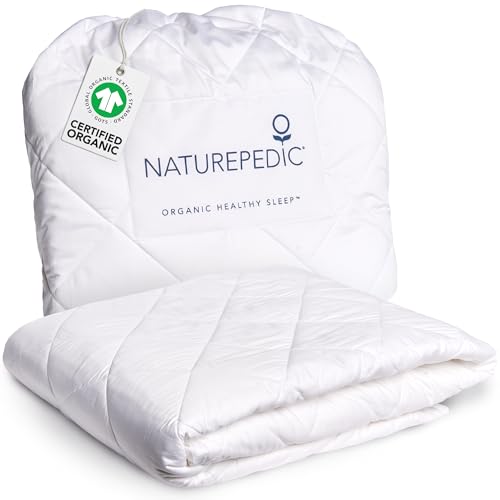
Best overall: Bioweaves GOTS Certified Organic Waterproof Mattress Protector
| Organic Integrity Score | 89 / 100 |
| Contents | Organic cotton jersey both faces, ultra-thin waterproof barrier, fits 9 to 16 inch depth |
| Certification | GOTS, Fair Trade, Certified Organic |
| Best for | Most beds where waterproofing is genuinely needed |
The compromise here is unavoidable, and this handles it about as well as it can be handled. Two layers of organic cotton jersey with a very thin waterproof film sandwiched between them means the cotton is what touches you on both sides, and the barrier is doing its job invisibly in the middle.
Crucially, the barrier is not vinyl. Naturepedic are explicit about the absence of PVC and phthalates, which addresses both the off-gassing concern and the practical misery of sleeping on plastic sheeting. The film passes water vapor while blocking liquid, so it does not trap body moisture the way vinyl protectors do, and it is silent in use.
Two honest points. It is expensive — considerably more than a supermarket protector — and what you are paying for is certification and the barrier material rather than better waterproofing. And it remains a product with a plastic layer in it. That is unavoidable in anything waterproof, and pretending otherwise would be dishonest.
What we liked: Organic cotton on both faces with the barrier hidden between. No vinyl, PVC or phthalates. Breathable and completely silent. Wide 9 to 16 inch depth range.
Keep in mind: Expensive relative to conventional protectors. Contains a plastic membrane, as all waterproof protectors must. Not an encasement, so sides and base stay exposed.
What the listing discloses: On the BIOWEAVES label: GOTS and Fair Trade. Not stated: whether the USDA seal applies and where it was grown or made.
Best fit: Naturepedic Organic Waterproof Mattress Protector Pad, Stretch Knit
| Organic Integrity Score | 88 / 100 |
| Contents | Fitted stretch knit organic cotton waterproof protector, 9 to 16 inch depth, Twin XL |
| Certification | GOTS, Organic |
| Best for | Deep mattresses and anyone whose protector keeps coming loose |
Stretch knit is the answer to the most common practical failure of mattress protectors, which is a corner pulling free in the night and bunching under you. A knit fabric with genuine stretch grips a deep mattress far better than a woven skirt with elastic, and it stays put through the tossing and turning that defeats cheaper designs.
The 9 to 16 inch depth range covers almost every modern mattress including deep pillow-tops, and the waterproof barrier is the same vinyl-free construction as our top pick.
Two considerations. Stretch knit is slightly thinner than the quilted pad above, so it protects without adding any cushioning at all — which is correct for a protector and worth knowing if you expected softness. And it is sold by size rather than as a universal fit, so confirm both dimensions and depth before ordering.
What we liked: Stretch knit genuinely stays put on deep mattresses. Wide depth range. Vinyl-free waterproof barrier. Highly absorbent surface.
Keep in mind: Adds no cushioning at all. Check size and depth carefully. Still contains a plastic membrane.
What the listing discloses: You are told GOTS for Naturepedic; you are not told whether the USDA seal applies and where it was grown or made.
Best for cribs: Naturepedic Organic Waterproof Crib Mattress Pad
| Organic Integrity Score | 87 / 100 |
| Contents | Organic waterproof crib mattress pad, fitted for standard 28 x 52 inch crib |
| Certification | GOTS, Certified Organic |
| Best for | Cribs and toddler beds |
Crib mattresses need waterproofing more than any other bed in the house, and they are also where the choice of barrier material matters most. Vinyl crib pads are common, cheap and exactly the thing to avoid for an infant sleeping ten hours a night with their face inches from the surface. This one is vinyl and phthalate free.
It is fitted for the standard 28 by 52 inch crib mattress, breathable rather than sweaty, and machine washable, which for a crib pad is not optional — it will be washed constantly.
Two points on safe sleep. The pad must fit tightly, exactly as a crib sheet must, and a loose or bunched pad is a hazard rather than a nuisance. And it goes under the fitted sheet, never on top, with nothing else added to the crib. As with crib sheets, buy at least two so one can always be in the wash.
What we liked: Vinyl and phthalate free, which matters most in a crib. Breathable rather than sweaty. Machine washable. Correct standard crib fit.
Keep in mind: Must fit tightly — a loose pad is a safety issue. Goes under the sheet, never on top. Buy two for the laundry cycle.
What the listing discloses: Naturepedic lists GOTS. The gap is whether the USDA seal applies and where it was grown or made.
Best fully organic: Bioweaves GOTS Quilted Mattress Protector
| Organic Integrity Score | 86 / 100 |
| Contents | Quilted organic cotton mattress pad, GOTS-certified fabric and fill, King 76 x 80 inch |
| Certification | GOTS, Certified Organic, MADE SAFE |
| Best for | Anyone who wants no plastic layer at all |
This is the only product here that is organic throughout, because it contains no waterproof membrane. Both the fabric and the fill are GOTS certified cotton, with no synthetic fabric treatments and no added flame retardants — which is a meaningful absence in bedding, where chemical flame retardants have historically been common.
Being quilted, it adds a slight softness on top of the mattress as well as protecting it from dust, skin cells and general wear. For an adult bed with no realistic prospect of spills, this is the choice that requires no compromise at all.
The limitation is stated plainly on the label: it is not waterproof. A spilled drink or an accident will go straight through into the mattress. If there is any chance of that — children, pets, illness, incontinence — this is the wrong product and one of the waterproof options above is right.
What we liked: Genuinely organic throughout, fabric and fill. No flame retardants or synthetic treatments. Adds a little softness. No plastic layer.
Keep in mind: Not waterproof at all. Bulkier to wash and dry than a thin protector. Wrong choice for children’s beds.
What the listing discloses: Naturepedic commits to GOTS but stops short of whether the USDA seal applies and where it was grown or made.
Best for single beds: Naturepedic Organic Waterproof Mattress Protector, Twin
| Organic Integrity Score | 85 / 100 |
| Contents | Fitted stretch knit organic waterproof protector, twin, 9 to 16 inch depth |
| Certification | GOTS, Organic |
| Best for | Children’s beds, guest rooms and incontinence protection |
Twin size is where waterproof protectors do their most useful work, since children’s beds are exactly where accidents happen. This is the same vinyl-free stretch knit construction sized for a single bed, and it is washable and reusable rather than disposable.
The absorbency matters here more than in an adult bed: a protector that holds liquid rather than letting it pool gives you time to deal with it, and this one is designed with that in mind. It is also a genuinely practical option for adult incontinence, where the alternative is often crackly vinyl sheeting.
Two practical points. For a child’s bed, buy two — the middle of the night is not when you want to discover the only protector is in the wash. And it protects the top surface only, so a serious accident can still reach the sides of the mattress; a full encasement is the answer where that is a recurring problem.
What we liked: Vinyl-free and silent, unlike most incontinence protection. Highly absorbent. Washable and reusable. Organic cotton against the sleeper.
Keep in mind: Buy two for a child’s bed. Protects the top surface only. Contains a plastic membrane.
What the listing discloses: Naturepedic states GOTS, and does not say whether the USDA seal applies and where it was grown or made.
Common questions about organic mattress protectors
Can a waterproof mattress protector be fully organic?
No. There is no natural fiber that blocks liquid while remaining breathable, so every waterproof protector contains a plastic membrane. The best available is GOTS-certified organic cotton on both faces with a thin, phthalate-free TPU barrier between them. Only a non-waterproof quilted pad can be organic throughout.
What is the difference between TPU and vinyl?
TPU is a thin thermoplastic polyurethane film that blocks liquid while passing water vapor, so it breathes and is silent. Vinyl or PVC needs plasticizers such as phthalates to stay flexible, blocks vapor as well as liquid so you sleep hot and damp, and crackles audibly. TPU is the one to look for.
Do I need a protector or an encasement?
A protector covers the top and sides and handles spills and general wear. An encasement zips fully around all six sides and is what you need for bed bugs or serious dust mite allergy, since a fitted protector leaves the underside and much of the sides exposed.
Will a mattress protector make me sleep hot?
A vinyl one will, because it traps body moisture as well as blocking liquid. A thin TPU membrane between cotton jersey faces is much closer to neutral, and most people stop noticing it. Consistent complaints about heat or crackling in reviews usually indicate a vinyl-based product.
What does GOTS certify on a mattress protector?
The cotton: certified organic fiber, restricted dyes and processing chemicals, wastewater treatment, and no chlorine bleaching or formaldehyde finishes. It cannot certify the waterproof membrane, since a plastic film is not a textile. Honest brands certify the fabric and state clearly what the barrier is.
How often should I wash a mattress protector?
Every month or two under normal use, and immediately after any spill or accident. It is a sacrificial layer and washing is the entire point, so check it tolerates a normal machine wash and tumble dry before buying — a protector requiring special care will not get cleaned.
Will it fit my mattress?
Check depth as well as length and width. Modern mattresses vary enormously, and a protector rated to 12 inches will not stay on a deep pillow-top. A 9 to 16 inch range covers almost everything. Stretch knit fabrics grip deep mattresses considerably better than woven skirts with elastic.
Do mattress protectors help with allergies?
Somewhat, and less than an encasement does. A protector creates a barrier over the top surface that dust mites and their allergens cannot easily cross, which helps. For a diagnosed dust mite allergy, a full zipped encasement is the product with actual evidence behind it, since it seals the whole mattress.
- Best Organic Mattress Topper
- Best Organic Crib Mattress
- Best Organic Cotton Sheets
- all our reviewed products in one place — sortable by Organic Integrity Score
Price and availability as of October 15, 2026 7:10 pm EDT. Product prices and availability are accurate as of the date/time indicated and are subject to change. Any price and availability information displayed on Amazon.com at the time of purchase will apply to the purchase of this product.
Looking for other organic products?
We have checked more than 800 products across food, household goods, gardening, personal care and pet, every one against its stated certification. Browse all reviews.
Organic Connection is reader-supported. When you buy through links on this page we may earn a commission, at no extra cost to you. As an Amazon Associate we earn from qualifying purchases. We are not paid to feature or rank any product. How we research and rate.