Last updated: September 11, 2026
Some links in this guide point to our product reviews, which may earn us a commission at no extra cost to you. How we research and rate.
You spend about a third of your life against your bedding and much of the rest wrapped in clothing, so the fibers you sleep and live in matter more than most people realize. Conventional cotton is one of the most pesticide-intensive crops in the world, and turning it into fabric involves a second round of harsh chemicals for dyeing and finishing. Organic textiles avoid both. This guide explains what makes a textile genuinely organic, why GOTS is the certification that counts, how organic cotton compares with other natural fibers, and how to build a cleaner bedroom and wardrobe.
Why conventional cotton is a problem
Cotton has an outsized environmental and chemical footprint. It occupies a small share of global farmland but accounts for a disproportionate share of insecticide use, because the plant is vulnerable to pests. Those synthetic pesticides and fertilizers affect the soil, water, and the farmworkers who grow and pick the crop. Then comes manufacturing: conventional textiles are typically bleached, dyed with synthetic dyes that can contain heavy metals, and finished with chemicals like formaldehyde-based resins to make them wrinkle-resistant. Traces of these can remain in the finished fabric that sits against your skin.
Organic cotton flips both halves of that equation. It is grown without synthetic pesticides, herbicides, or GMO seed, which protects soil, water, and farmers. And when it carries a full textile certification, the dyeing and finishing must meet strict environmental and toxicological limits too. The result is a fabric that is cleaner from field to finished product, which matters most for the items in prolonged contact with your body, sheets, pajamas, underwear, and anything your baby sleeps on.
GOTS: the certification that actually matters
Here is the single most important thing to know when shopping for organic textiles: “made with organic cotton” and “GOTS certified” are not the same claim. “Organic cotton” usually refers only to how the fiber was grown. GOTS, the Global Organic Textile Standard, certifies the entire supply chain. To be GOTS certified, a product must contain at least 95% certified organic fibers, and every processing step, spinning, weaving, knitting, dyeing, and finishing, must meet strict environmental and toxicological criteria, with banned inputs like formaldehyde, chlorine bleach, and many synthetic dyes. GOTS also enforces social criteria for fair labor in the factories.
So GOTS is doing what a plain organic-cotton claim cannot: guaranteeing that the fabric is both organically grown and cleanly manufactured. This is why our textile reviews look for GOTS first, whether it is the best organic cotton sheets, a duvet cover, pajamas, underwear, or a cotton blanket. If a product only says “organic cotton” with no GOTS seal, treat it as a partial claim, the fiber may be organic while the dyeing and finishing were conventional. Our full breakdown of these certifications lives in the certifications guide.
GOLS for latex, OEKO-TEX for safety
Two related seals round out the textile world. GOLS, the Global Organic Latex Standard, certifies organically grown natural latex, the mark to look for on mattresses and the best organic mattress toppers, as opposed to synthetic or blended foam sold as “natural.” OEKO-TEX Standard 100 tests finished fabric for harmful substances and certifies it is safe against skin, but, crucially, it is not an organic certification: it says nothing about how the fiber was grown. OEKO-TEX is a valuable safety backstop, especially in categories where true organic fiber is scarce, but it complements rather than replaces GOTS.
Organic cotton vs other natural fibers
Cotton is not the only natural fiber, and the others have different organic realities worth understanding.
Linen is made from flax, one of the most sustainable textile crops, because flax grows with little water and minimal pesticide. Ironically, that is why genuinely GOTS-organic linen barely exists: flax is already so low-input that few growers pursue organic certification. As we explain in our guide to the best organic linen sheets, the practical standard for clean linen is 100% European flax with OEKO-TEX certification, and where you specifically want a certified-organic fiber, GOTS hemp or cotton is the honest alternative. We would rather tell you that plainly than slap “organic” on a linen that is not certified.
Hemp is durable, breathable, and available as GOTS-certified organic, which makes it a genuine certified-organic alternative to linen with a similar textured, temperature-regulating feel. Wool can be certified organic (via GOTS for the processing and organic standards for the animals) and is prized for temperature regulation and as a natural flame barrier in bedding. Bamboo deserves a caution: while marketed as eco-friendly, most “bamboo” fabric is actually rayon/viscose produced with heavy chemical processing, so the raw plant being fast-growing does not make the finished fabric clean, look for closed-loop lyocell processing or, better, choose GOTS cotton or hemp instead.
Building a cleaner bedroom
The bedroom is the highest-value place to invest in organic textiles, because you spend hours there every night in direct skin contact. A sensible priority order:
- Sheets first. They touch you all night, so GOTS-certified organic cotton sheets (or clean 100% flax linen) are the top upgrade.
- Duvet cover and blanket. A GOTS duvet cover and cotton blanket extend the clean layer that surrounds you.
- The mattress and topper. A GOLS-latex or GOTS-wool mattress topper adds comfort and clean materials to whatever mattress you already own.
- Sleepwear. Organic cotton pajamas mean clean fabric against your skin for the whole night.
You do not have to replace everything at once. Start with the item closest to your skin for the longest time, usually the sheets, and expand outward as budget and replacement cycles allow. Because quality organic bedding is durable and often gets softer with washing, it tends to last for years, which improves the value over time.
Building a cleaner wardrobe (start with the base layers)
For clothing, apply the same skin-contact logic: prioritize the garments worn closest to your body and washed most often. Organic cotton underwear is the natural starting point, since it is in constant contact with sensitive skin, followed by t-shirts, base layers, and anything for babies or people with sensitive skin. You do not need an all-organic closet to benefit; converting the base layers captures most of the skin-contact advantage. For everything else, look for GOTS when you can, and choose durable, well-made pieces you will keep, since the most sustainable garment is the one you do not have to replace.
Caring for organic textiles so they last
Clean fabrics reward gentle care, which also keeps them out of the landfill longer:
- Wash cool or warm on gentle cycles, which is easier on fibers and saves energy.
- Skip fabric softener and bleach. Softener coats fibers and reduces absorbency and breathability; quality organic cotton and linen soften naturally with each wash.
- Use a gentle, ideally clean detergent, so you are not adding harsh residues back onto fabric you chose specifically to be clean.
- Line dry or tumble low to protect fibers and preserve fit.
- Wash new colored items with like colors the first few times.
Well cared for, GOTS cotton, hemp, and linen can last many years and only get more comfortable, which is exactly what makes organic textiles a sound long-term investment rather than a splurge.
What GOTS certification is worth
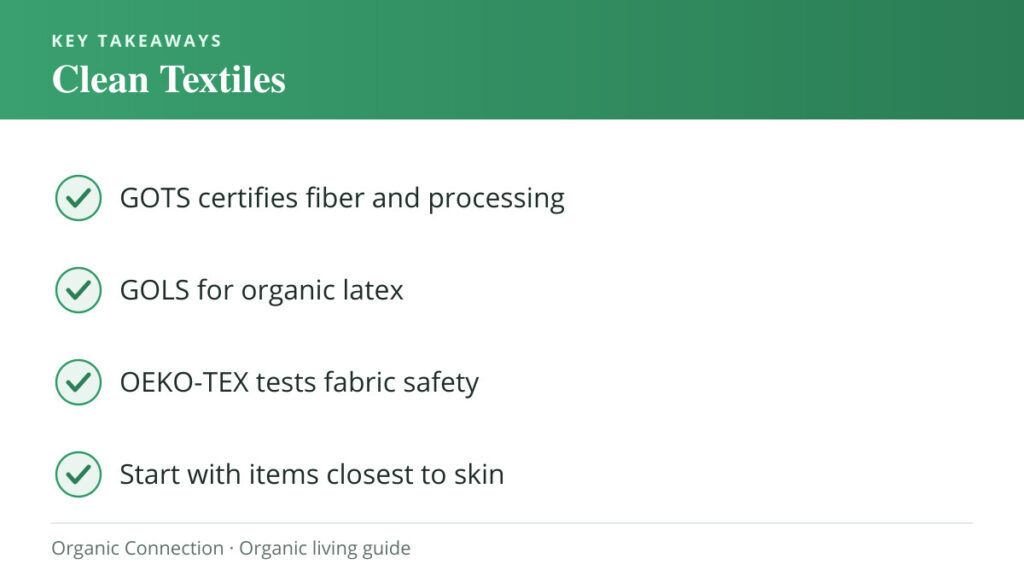
Conventional cotton is chemical-intensive in the field and again in the factory, and a plain “organic cotton” claim only addresses the first half. GOTS is the certification that verifies both organic fiber and clean processing, so it is the seal to look for on sheets, clothing, and bedding, with GOLS for latex and OEKO-TEX as a safety backstop where true organic fiber is rare. Prioritize the items closest to your skin for the longest time, sheets and base layers, and expand from there. For our specific picks in each category, follow the links above, and see the standard we hold every textile to in our rating method.
Common questions about organic cotton
What is the difference between “organic cotton” and GOTS certified?
“Organic cotton” usually refers only to how the fiber was grown, while GOTS (Global Organic Textile Standard) certifies the entire supply chain, at least 95% organic fiber plus clean, low-toxicity dyeing, finishing, and fair labor. Without GOTS, only the fiber may be organic while the manufacturing used conventional chemicals, so GOTS is the stronger claim.
Is organic cotton bedding worth it?
For many people, yes. You spend about a third of your life against your bedding, so GOTS-certified organic cotton sheets avoid the pesticide residue of conventional cotton and the harsh dyes and finishes of conventional textile processing. Quality organic bedding is also durable and softens with washing, improving its value over time.
Are there truly organic linen sheets?
Genuinely GOTS-organic linen is rare, because flax is already a very low-input crop and few growers pursue organic certification. The practical standard for clean linen is 100% European flax with OEKO-TEX certification, and where you want a certified-organic fiber specifically, GOTS-certified hemp or cotton is the honest alternative.
Is bamboo fabric actually eco-friendly?
Often less than it seems. While bamboo grows quickly, most “bamboo” fabric is really rayon or viscose made through heavy chemical processing, so the finished fabric is not necessarily clean. Look for closed-loop lyocell processing, or choose GOTS-certified cotton or hemp for a more reliably clean natural fabric.
How should I care for organic textiles?
Wash cool or warm on gentle cycles, skip bleach and fabric softener (softener coats fibers and reduces breathability), use a gentle detergent, and line dry or tumble low. Quality organic cotton, hemp, and linen soften naturally with washing and can last many years when cared for gently.
Keep reading
- What “Organic” Really Means: A Guide to Certifications
- Switching to Organic for Babies and Families
- Organic vs Natural vs Non-GMO: What Labels Actually Mean
- How we research and rate products
- our organic home and textile database — compare certifications across brands
- Organic Baby Essentials hub
- our organic product database — compare brands across every guide
Organic Connection is reader-supported. When you buy through links in our reviews we may earn a commission, at no extra cost to you. As an Amazon Associate we earn from qualifying purchases. We are not paid to feature or rank any product. How we research and rate.