Last updated: September 16, 2026
We may earn a commission when you buy through links on this page, at no extra cost to you. How we research and rate.
The short version
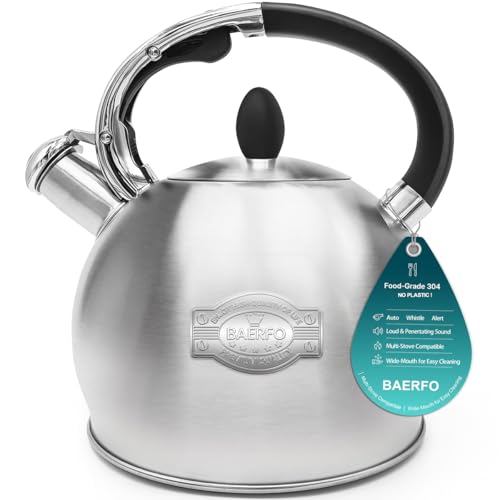
Reading what each listing will actually stand behind, our top pick is the BAERFO 2.64 Qt Whistling Stovetop Kettle. It is the only kettle on this page that names its steel as 304 stainless, 18/8 rather than leaving “stainless steel” to do the work, and it explains its own capsule base and how to use it on gas without scorching the sides. That earned it our highest Organic Integrity Score of 91 out of 100.
Two things are worth knowing before you spend anything here. “Stainless steel” is a family, not a specification — there are dozens of grades with different corrosion resistance, and four of these five listings do not say which one they used. And the plastic in a kettle is not in the body, which is obviously metal. It is in the handle, the knob and the whistle, which sit directly in the steam path. One listing addresses that. One names its grade. They are not the same listing.
What the listings leave out
| Best Choice | Best Value | ||||
 |
 |
 |
 |
 |
|
| Product | BAERFO 2.64 Qt | GIPFEL | Primula Stewart | Mr. Coffee Woodmont | WALDWERK |
| Organic Integrity Score | 91/ 100 | 88/ 100 | 85/ 100 | 82/ 100 | 77/ 100 |
| Our rating | 4.6 | 4.4 | 4.3 | 4.1 | 3.9 |
| Best for | Best overall | Plastic-free claim | Cheapest, best seller | Wooden handle | Compact size |
| Steel grade named | 304 / 18-8, stated | Not named | Not named | Not named | Not named |
| Plastic-free claim | Not stated | Plastic free and BPA free, stated | Not stated | Wood handle, no overall claim | Not stated |
| Capacity | 2.64 quart | Not stated | 1.5 quart | 2 quart | 1.5 quart |
| Induction | Capsule base, stated | Capsule base, stated | Not stated | Stated | Stated |
| Price | $22.50 View on Amazon |
$119.99 View on Amazon |
$17.99 View on Amazon |
$24.99 $29.99 −17% View on Amazon |
$29.99 View on Amazon |
Scores are ours, based on independent research of materials disclosure, construction, published specifications and value, using the same ten-criteria method we apply to every product.
“Stainless steel” is a family, not a specification
There are dozens of stainless grades and they are not interchangeable. The one you want in contact with boiling water is 304, also written 18/8 or 18-8 for its roughly 18% chromium and 8% nickel. That chromium is what forms the passive oxide layer that makes stainless stainless, and the nickel is what keeps the structure stable and corrosion-resistant in hot water.
The grade you often get instead, without being told, is 201. It substitutes manganese and nitrogen for much of the nickel, which makes it cheaper. It is also measurably less corrosion resistant, and it is likelier to pit and stain over time in a vessel that spends its life full of hot, sometimes hard water.
Neither grade is dangerous. Both are used in food equipment. But 304 is the one that will still look like a kettle in five years, and it is the reason the specification is worth wanting.
Four of the five listings here simply say “stainless steel”. One says 304 and 18/8. That single line is the most informative thing anyone on this page tells you, and it comes from the second cheapest kettle in the group rather than the one costing a hundred and twenty dollars.
The plastic in a kettle is not where you are looking for it
People buying a stainless kettle are usually leaving a plastic electric one behind, and the reasoning is sound: an electric kettle holds near-boiling water against a plastic reservoir and lid several times a day.
What is easy to miss is that a stovetop kettle can still have plastic in it, and in the worst place. The handle is often a polymer over a steel core. The lid knob is frequently plastic. And the whistle itself — the part steam is forced directly through, at 100°C, every single time you boil — is plastic on a good number of kettles at this price.
The materials that appear there are usually phenolic, nylon or silicone, all of which are stable at those temperatures and none of which is a scandal. But if plastic contact was your reason for changing kettles, the whistle is the piece that most deserves the question, and it is almost never specified.
One kettle here states plastic free. One has a wooden handle you can see in the photograph. The other three describe their handles in terms of comfort and say nothing about what they are.
What each claim on a kettle listing actually covers
| Claim | Covers | Key exclusion |
| 304 / 18-8 stainless | A named austenitic grade, roughly 18% chromium and 8% nickel | The specification that predicts corrosion resistance, and only one listing gives it |
| Stainless steel | The body is a steel alloy containing chromium | Covers grades from 201 to 316 with meaningfully different durability |
| Food grade | Materials permitted for food contact | A legal floor for anything sold to boil water, not a grade |
| Plastic free | No polymer components, including handle, knob and whistle | The claim that matters most on a kettle; one listing makes it |
| BPA free | No bisphenol A in any plastic parts | Says nothing about the steel, and nothing about which polymer replaced it |
| Capsule base / induction | A layered disc bonded to the bottom so the kettle works on induction | A performance feature, not a materials one |
| Non-reactive interior | The steel will not react with what is in it | True of all stainless; tells you nothing about grade or finish |
The two rows worth wanting each have one entry. One kettle names its grade. A different kettle claims plastic free. No kettle on this page does both, which is the honest summary of the category.
Best overall: BAERFO 2.64 Qt Whistling Stovetop Tea Kettle
| Organic Integrity Score | 91 / 100 |
| Capacity | 2.64 quart, with a marked fill line |
| Steel | 304 stainless, stated as 18/8 |
| Base | Capsule bottom for induction, electric, gas, ceramic and halogen |
| Best for | The only kettle here that tells you what it is made of |
BAERFO is our top pick for a reason that takes one line of its listing: it says 304 stainless steel and it says 18/8. Nobody else on this page names a grade, including the kettle costing five times as much.
The rest of the description is written the same way. It gives a capacity in quarts rather than calling itself large. It mentions a marked fill line. And it includes a piece of genuine use advice that reads like it came from someone who has used one: on gas, keep the flame low and centered under the base, because a flame licking up the sides leaves heat marks on the steel.
That is the tone of a listing written by people who know the product, and on this site that counts. At around twenty-two dollars it is also the second cheapest kettle here and the largest.
What we liked: The steel grade named twice, a real capacity figure, a fill line, a capsule base that covers every cooktop, and practical advice about flame placement.
Keep in mind: No plastic-free claim, so assume the handle and whistle are polymer. It is a slower seller than the Primula, so there is less accumulated feedback on how it wears.
Plastic-free claim: GIPFEL International Whistling Tea Kettle
| Organic Integrity Score | 88 / 100 |
| Materials claim | Plastic free, BPA free and food grade, stated; grade not named |
| Base | Induction capsule bottom |
| Design | German engineered, ergonomic handle |
| Best for | Removing polymer from the steam path entirely |
This is the only kettle on the page that says plastic free, and on a kettle that is the claim with the most substance behind it. It means the handle, the knob and the whistle — the parts that sit in the steam — are not polymer.
It also says BPA free and food grade, and describes an induction capsule bottom rather than just asserting induction compatibility.
What holds it back is the price against what it does not say. At roughly a hundred and twenty dollars it is five times the cost of our top pick, and it never names its steel grade. A kettle at that price telling you less about its own metal than a twenty-two dollar one is exactly the pattern this site keeps finding: cost and disclosure are unrelated.
It is also the slowest seller of the five by a wide margin, and gives no capacity figure at all.
What we liked: The only plastic-free statement here, BPA free and food grade alongside it, a proper induction capsule base, and a classic shape that will not date.
Keep in mind: No steel grade, no stated capacity, a very high price for a kettle, and a thin sales record.
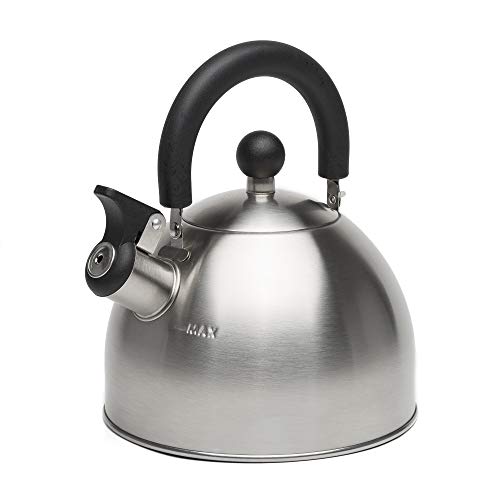
Cheapest and best selling: Primula Stewart Whistling Tea Kettle
| Organic Integrity Score | 85 / 100 |
| Capacity | 1.5 quart |
| Steel | Stainless steel, brushed finish; grade not named |
| Handle | Cool-touch folding handle |
| Best for | A working kettle for under twenty dollars |
The best-selling kettle in its category by a wide margin, and the cheapest thing on this page. For a great many households that combination is the whole decision, and there is nothing wrong with making it.
The folding handle is a genuinely good design: it drops out of the way so the kettle stores under a cabinet and does not sit over the spout catching steam.
The phrase to notice is “cool touch”. A handle that stays cool over a gas flame is not bare steel — it is polymer, or polymer over steel. The listing never says which, and on a kettle bought to get away from plastic, that is the omission that matters most. No grade is named either.
What we liked: The lowest price here, by far the strongest sales record, a folding handle that solves a real storage problem, and a loud clear whistle.
Keep in mind: “Cool touch” implies polymer without saying so, no steel grade, and no induction statement, so check your cooktop before buying.
Wooden handle: Mr. Coffee Woodmont 2-Quart Tea Kettle
| Organic Integrity Score | 82 / 100 |
| Capacity | 2 quart |
| Handle | Wood |
| Interior | Described as non-reactive and rust-resistant |
| Best for | A handle that is neither hot metal nor plastic |
The wooden handle is the point, and it is a real answer to the question the rest of the category dodges. Wood does not conduct heat the way steel does and it is not a polymer, which makes it the one visible material choice on this page you can verify from the photograph.
Two quarts is a sensible size, and induction compatibility is stated plainly rather than implied.
It scores mid-table because the listing stops there. “Non-reactive interior” is true of every stainless kettle ever made and tells you nothing about grade. There is no plastic-free claim covering the knob or whistle, which may well still be polymer even with a wooden handle.
What we liked: A wooden handle you can see and verify, a useful two-quart capacity, stated induction compatibility, and a familiar brand behind it.
Keep in mind: Wood needs keeping dry and will mark over years. No steel grade, and no claim about the knob or whistle. “Non-reactive” is filler.
Compact size: WALDWERK 1.5 Quart Stovetop Tea Kettle
| Organic Integrity Score | 77 / 100 |
| Capacity | 1.5 quart |
| Cooktops | Induction, gas, ceramic and electric, all listed |
| Materials claim | Stainless steel; nothing further |
| Best for | One or two people, a small burner, a small cabinet |
A compact 1.5 quart kettle that lists every cooktop it works on, which is more than several here manage. For one or two people it is the right size — boiling two quarts for one mug wastes time and gas.
It scores lowest because the listing is almost entirely about compatibility and almost nothing about substance. No steel grade, no plastic claim, no handle material, no finish detail. Compatibility is the easiest thing in the world to state and the least distinguishing, since every kettle here does it.
Stock has also been intermittent, which on a product with a modest sales record is worth factoring in.
What we liked: A genuinely useful small capacity, a complete and explicit cooktop list, and a clean shape.
Keep in mind: No materials disclosure beyond the words stainless steel, and availability has been patchy.
Capsule bases, induction, and why it matters even if you have gas
A capsule base is a sandwich — usually a disc of aluminum or magnetic steel bonded between layers — welded to the bottom of the kettle. It exists so induction cooktops can grip the metal magnetically, since the austenitic 304 that makes a good kettle body is only weakly magnetic.
It has a second benefit that applies on any cooktop. A thick layered base spreads heat across the bottom instead of concentrating it where the flame hits, which reduces the hot spot that discolors a thin kettle over time and helps it boil more evenly.
Two kettles here name a capsule base. Two more say induction safe without explaining how. One says nothing about induction at all, which on a modern kitchen purchase is worth checking before you buy.
Boil time is the number nobody publishes
Not one of these five listings tells you how long it takes to boil a full kettle, and that is the specification most buyers actually care about. It is also the hardest one to state honestly, because the answer depends on your burner far more than on the kettle.
Three things about the kettle do move the number. Capacity is the big one — a 2.64 quart kettle filled to the top has to heat nearly twice the water of a 1.5 quart one, so if you boil for a single mug the small kettle wins every morning of its life. Base diameter is the second: a wide flat bottom sits in more of the flame or more of the induction coil than a narrow tapered one. Wall thickness is the third, and it cuts both ways — thin steel comes to a boil faster and loses heat faster, thick steel is slower to start and holds temperature longer.
The practical advice is to buy the smallest kettle that covers your normal pour, and to fill it to what you need rather than to the top. A kettle you half-fill is not being wasted; it is being used correctly.
Spout caps, whistles, and pouring with one hand
This is the detail that separates a kettle you like from one you tolerate, and it is nearly invisible when you are comparing photographs.
To pour, the whistle has to open. On the better designs a lever or button on the handle lifts the spout cap, so the hand already holding the kettle opens it in the same motion. On the cheaper ones the cap is a hinged flap you flip up with your other hand — which is, at that moment, holding a kettle of boiling water over a counter. Some kettles have no mechanism at all and you simply pour through the whistle, which works but muffles the sound.
Whistle volume matters more than it sounds like it should, because the entire argument for a stovetop kettle over an electric one is that it will tell you when it is done. A quiet whistle in a house with a television on is a kettle that boils dry, and a kettle boiled dry warps its base and marks the cooktop underneath. If you have any hearing loss, treat a loud whistle as a requirement rather than a preference.
None of the five listings here describes its spout mechanism in enough detail to tell you which of the three types it is. Look at the handle in the product photograph: a lever or button near the top of the grip is the design you want.
What we left out, and why
Gooseneck kettles. The long narrow curved spout exists to control a slow, precise pour for pour-over coffee, and it is genuinely better at that job. It is worse at everything else — slower to fill, slower to empty, and awkward for anything you want to pour quickly. If pour-over is why you are shopping, buy a gooseneck rather than the best kettle here.
Enameled and cast iron kettles. An enamel coating over steel or iron avoids the grade question entirely, since nothing you boil touches the metal. It also chips, and a chipped enamel kettle is a rusting one. They are heavy, they hold heat well, and they are a different purchase with a different set of trade-offs than the ones on this page.
Electric kettles with stainless interiors. Faster and more efficient than anything here. If materials rather than the stovetop are your concern, an electric kettle with a fully stainless interior and no plastic in the water path solves the same problem, and we would rather say so than sell you the wrong object.
How to choose a stovetop kettle
Size to your actual use, not your maximum. A 1.5 quart kettle boils faster and stores smaller. Two and a half quarts makes sense if you fill flasks or cook with boiling water, and is otherwise a slower boil every morning.
Look at the handle in the photograph. If the listing says cool touch and the handle is not obviously wood or bare steel, it is polymer. That may be fine, but decide it rather than discover it.
Prefer a named grade where you can get one. 304 or 18/8 in writing is the single most useful thing a kettle listing can tell you, and it costs the seller nothing to say.
Check the whistle can be opened one-handed. A spout cap you have to lift with a cloth while holding a kettle of boiling water is a design most people only notice after buying.
Getting the most out of a stainless kettle
Descale it regularly. Limescale is the main thing that shortens a kettle’s life and dulls its inside. Half water, half white vinegar, brought to a boil and left to stand for an hour, will shift most of it.
Do not leave water standing in it. Sitting water is how even good stainless develops pitting and cloudy marks, particularly in hard water areas. Empty it after the last cup.
Keep the flame under the base, not up the sides. This is the advice BAERFO puts in its own listing and it is correct for every kettle here. Side-wall heat is what leaves the brown scorch marks that never fully polish out.
For exterior marks, a paste of baking soda and water is gentler than any scouring cream. Our baking soda guide covers which grades are genuinely food-safe.
Who should buy a stovetop kettle
Anyone replacing a plastic electric kettle. This is the main reason people arrive here, and a stainless stovetop kettle does remove the plastic reservoir from the equation — provided you also check the handle and whistle.
Anyone with a gas cooktop who wants something that will outlast three electric kettles. There is no element to fail and no circuitry to die.
Anyone who makes tea properly. A stovetop kettle gives you control over how far off the boil you pour, which matters for green and white tea. Our white tea guide covers the temperatures.
Less compelling if speed is your priority. An electric kettle is faster and more efficient, and if that matters more than materials, buy one with a stainless interior rather than a stovetop kettle you will resent.
How we researched this guide
We read all five listings in full, title and description, and recorded every materials claim. We noted which named a specific steel grade rather than saying stainless steel, and which addressed the handle, knob and whistle, since those are the polymer components on an otherwise metal object. We compared stated capacities, induction and capsule-base claims, and price against sales record. Scores reflect what each maker is willing to put in writing, not what we assume about the brand.
Common questions about stainless steel tea kettles
What does 18/8 stainless steel mean?
Roughly 18% chromium and 8% nickel, which is the composition of grade 304. The chromium forms the corrosion-resistant layer and the nickel stabilizes the structure. It is the grade you want in contact with boiling water.
Is 201 stainless steel safe for a kettle?
It is used in food equipment and is not dangerous. It has less nickel and less corrosion resistance than 304, so it is likelier to pit or stain over years of hot water. The issue is longevity rather than safety.
Do stainless steel kettles leach nickel?
In trace amounts, more so when new and when boiling acidic liquids, which you should not be doing in a kettle anyway. For people with a diagnosed nickel sensitivity it is worth knowing; for everyone else the quantities from boiling water are negligible.
Are stovetop kettles really plastic free?
The body is metal, but the handle, lid knob and whistle are frequently polymer. Only one kettle here states plastic free. If that is your reason for switching, look for the claim explicitly rather than assuming.
Can I use a stainless kettle on an induction cooktop?
Only if it has a magnetic base, usually a bonded capsule bottom, because 304 on its own is weakly magnetic. Two kettles here name a capsule base; one says nothing about induction at all.
What size kettle should I buy?
1.5 quarts suits one or two people and boils faster. Two to two and a half quarts makes sense for a household, for filling a thermos, or if you cook with boiling water regularly.
How do I descale a stainless kettle?
Fill with equal parts water and white vinegar, bring to a boil, turn off and leave for an hour, then rinse thoroughly and boil once with clean water before use.
Why has my kettle gone brown on the outside?
Heat marks from flames reaching up the sides rather than staying under the base. Keep the burner smaller than the kettle bottom. Light marks respond to a baking soda paste; deep ones are permanent.
Is a whistling kettle worth it?
On a stovetop, yes. Without one you either watch it or forget it, and a kettle boiled dry damages the base and the cooktop.
Are stovetop kettles better than electric ones?
For materials, usually, since there is no plastic reservoir. For speed and energy efficiency, no — an electric kettle wins on both. It is a genuine trade-off rather than an upgrade.
Can I put a stainless kettle in the dishwasher?
Better not to. Detergent dulls the exterior finish over time and does nothing for limescale inside, which is the actual problem. Wipe outside, descale inside.
Why does my new kettle smell of metal?
Manufacturing residue. Boil and discard two or three full kettles of water before the first use, ideally with a little vinegar in the first, and it will pass.
Related reading
- Best Organic White Tea
- Best Organic Loose Leaf Tea
- Best Stainless Steel Cookware
- Ceramic vs Stainless vs Cast Iron vs Carbon Steel
- Organic Product Database — search all 800+ products we have reviewed
- Best Gooseneck Kettles
- Best Glass Teapots