
Last updated: September 30, 2026
We may earn a commission when you buy through links on this page, at no extra cost to you. How we research and rate.
The short version
After researching the certifications, purity, and testing of the most popular organic tea tree oils, our top pick is Silk Road Organic Tea Tree Roll-On. It is USDA certified organic, 100 percent pure undiluted Melaleuca alternifolia, and Plant Therapy publishes GC/MS batch test reports, which is why it earned our highest Organic Integrity Score of 92 out of 100. For the best value, the Plant Therapy 30 mL bottle is our pick, and for a widely available alternative, Cliganic Organic Tea Tree Essential Oil is the best choice.
With tea tree oil, the things that separate a good bottle from a bad one are species verification, whether it has been diluted, and whether the seller publishes batch testing. We flag each product’s certification and testing.
Best organic tea tree oil compared
| Best Choice | Best Value | ||||
 |  |  |  |  | |
| Product | Silk Road Roll-On | Fiora Naturals 1 oz | Plant Therapy 30 mL | Cliganic Organic | Handcraft Blends 1 oz |
| Organic Integrity Score | 92/ 100 | 90/ 100 | 89/ 100 | 85/ 100 | 80/ 100 |
| Our rating | 4.6 | 4.5 | 4.5 | 4.3 | 4.0 |
| Purity | 100% pure | 100% undiluted | 100% undiluted | 100% pure | 100% pure |
| Best for | Best overall | Full-strength bottle | Best value | Widely available | Diffusing |
| Certification | USDA Organic, Non-GMO | USDA Organic, Vegan | USDA Organic | USDA Organic, Non-GMO Project Verified, Certified Vegan | USDA Organic |
| Species | Melaleuca alternifolia, named | — | Melaleuca alternifolia, 100% pure undiluted | Melaleuca alternifolia, 100% pure | Tea tree, 100% pure and natural |
| Price | $9.95 $11.70 −15%$30.15 / fluid ounce View on Amazon | $9.99 $12.88 −22% View on Amazon | $17.99 View on Amazon | $9.99 $12.99 −23% View on Amazon | $16.99 View on Amazon |
Price and availability as of October 11, 2026 7:10 pm EDT. Product prices and availability are accurate as of the date/time indicated and are subject to change. Any price and availability information displayed on Amazon.com at the time of purchase will apply to the purchase of this product.
Scores are ours, based on independent research of certification, species verification, purity, published testing, and value, using the same 10-criteria method we apply to every product. See how we research and rate.
The certification map for organic tea tree oil, and what each one actually excludes
Each certification below appears on at least one product on this page. They are not ranked against each other, because they measure different things, but knowing which is which changes what you buy.
| Certification | Covers | Key exclusion |
| USDA Organic | Farming and handling: no synthetic pesticides or fertilizers, no GMOs, no sewage sludge or irradiation, audited yearly by an accredited certifier | Three different tiers share the one seal, and it makes no claim about worker pay, food miles, or nutrition |
| Non-GMO Project | Testing and supply-chain traceability showing the ingredients are not genetically engineered | Sets no limit on synthetic pesticides or fertilizers, so it is not an organic claim |
| Certified Vegan | No animal ingredients or animal-derived processing aids, and no animal testing | Not an organic, safety or nutritional claim |
Non-GMO and organic are not two grades of the same thing. The butterfly certifies an absence of genetic engineering and stops there; the USDA seal prohibits genetic engineering as one clause among many, alongside synthetic pesticides, synthetic fertilizers, sewage sludge and irradiation. That makes organic the broader claim by some distance. Where both appear together, the butterfly is adding batch testing on top of a standard that had already banned GMOs.
Key things to look for in organic tea tree oil
Great tea tree oil is about species, certification, purity, and published testing. Here is what matters.
1. The botanical name Melaleuca alternifolia
Several unrelated plants are sold as “tea tree.” The label should name the species. Cajeput and niaouli are different oils.
2. USDA organic certification
Because “organic” is unregulated on cosmetics, the certification seal is the only claim that has been verified by anyone.
3. 100 percent pure and undiluted
One ingredient. A “tea tree blend” pre-diluted in an unnamed carrier is not the same product and is usually poor value.
4. Published GC/MS batch testing
Gas chromatography reports show the actual chemical profile of the batch, which is the strongest evidence a bottle is what it claims.
Why testing matters more than the seal here
Essential oils are among the easiest cosmetic products to adulterate, because the finished product is a clear liquid with a strong smell and no visual cues to quality. Common adulterations include cutting the oil with a cheap odorless carrier, blending in oil from related but cheaper Melaleuca species, or adding synthetic terpinen-4-ol, the compound responsible for most of tea tree’s antimicrobial activity, to hit a spec sheet without the rest of the natural profile. None of this is visible or reliably detectable by smell.
USDA organic certification confirms the plant material was grown without synthetic pesticides, which is worth having and is more than most sellers offer. What it does not confirm is that the bottle contains only that oil, or that the chemical profile is right. That is what gas chromatography-mass spectrometry (GC/MS) testing does: it separates and identifies the constituents so you can see the terpinen-4-ol percentage and whether anything unexpected is present. The international standard for tea tree oil sets a minimum terpinen-4-ol content and a maximum for 1,8-cineole, the compound most associated with skin irritation. Brands that publish per-batch GC/MS reports are giving you something no seal can, which is why our top picks here are the ones that do.
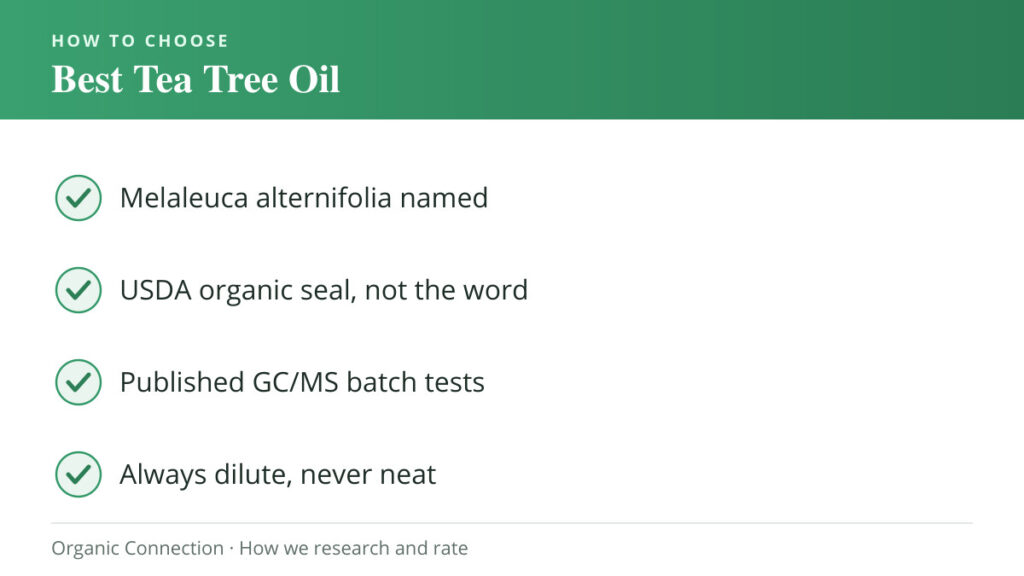
How to choose organic tea tree oil
- Check the botanical name. Melaleuca alternifolia, not just “tea tree.”
- Look for the USDA organic seal, not the word “organic” on the front.
- Prefer brands publishing GC/MS reports. Testing tells you more than certification in this category.
- Buy dark glass in a small size. Essential oils oxidize, and oxidized tea tree is more irritating.
- Always dilute before skin contact. 1 to 5 percent in a carrier oil, and patch test first.
Who should buy organic tea tree oil
The right bottle depends on how much you use. If you want the best-tested certified organic tea tree oil, our top pick fits. If you want a larger bottle for cleaning and hair use, a widely available alternative, a small trial size, or a one-ounce bottle at a lower price point, we have a pick for each.
Best overall: Silk Road Organic Tea Tree Roll-On
| Organic Integrity Score | 92 / 100 |
| Format | Roll-on, pre-diluted |
| Species | Melaleuca alternifolia, named |
| Dilution | 50/50 with certified organic caprylic/capric triglyceride from coconut |
| Origin | Leaves from Australia; bottled in the USA under NOP guidelines |
| Excludes | Water, alcohol, other additives |
| Best for | Safe topical use without measuring a carrier oil |
The only listing on this page to name the plant. Melaleuca alternifolia is the tea tree species, and it matters because several unrelated plants are sold as “tea tree” — naming the binomial removes the ambiguity entirely.
It is also the only one that tells you exactly what it is diluted with and in what proportion: 50/50 with certified organic caprylic/capric triglyceride, which is fractionated coconut oil. Pre-diluted is the right format for a roll-on, and stating the ratio means you know the strength rather than guessing.
That combination makes this the safest option here for direct application. Undiluted tea tree oil should not go on skin neat; a 50 percent dilution in a roll-on is ready to use.
The sourcing statement is precise too: leaves from Australia, where tea tree originates, steam distilled, and bottled in the USA under National Organic Program guidelines — naming the regulatory framework rather than just the seal.
It confirms no water, alcohol or other additives, which for a diluted product is the claim that matters, since alcohol is the cheap way to thin an oil.
What we liked: Names the species, states the dilution ratio and the carrier, names the origin and the NOP framework, and rules out water and alcohol.
Keep in mind: At 50 percent dilution this is not a substitute for a full-strength bottle if you want to make your own blends. Small format.
What the listing discloses: Fully documented: Silk Road Organic states USDA organic certification, an origin of the USA and a single-ingredient formula.
Full-strength bottle: Fiora Naturals USDA Organic Tea Tree Oil, 1 oz
| Organic Integrity Score | 90 / 100 |
| Size | 1 oz |
| Extraction | Steam distilled, unfiltered and undiluted |
| Certification | USDA Organic, Vegan |
| Excludes | Additives, fillers, synthetic ingredients, GMOs, parabens, synthetic fragrance, phthalates, sulfates |
| Best for | A full-strength bottle with the extraction method named |
Three words settle most of what matters in an essential oil, and this listing has all of them: steam-distilled, unfiltered and undiluted.
Undiluted is the important one. Essential oils are commonly sold pre-diluted in a carrier, which is perfectly legitimate and means you are buying mostly carrier oil. A bottle that states undiluted is telling you the strength is what you would expect, and it also means you must dilute it yourself before it touches skin — the listing says so, which is more responsible than most.
The certification is the regulated form, USDA Certified Organic, stated at the head of the first bullet rather than buried.
The exclusion list runs long and specific: no additives, fillers or synthetic ingredients, and separately free from GMOs, parabens, synthetic fragrances, phthalates and sulfates. Seven named categories.
The middle bullet slides into skincare copy — “natural glow”, “gentle yet effective properties” — which is not information, and the botanical name of the plant is never given.
What we liked: Steam distilled, unfiltered and undiluted all stated, USDA Certified Organic in the regulated form, and seven named exclusions.
Keep in mind: Undiluted oil must be diluted before skin contact. The species is never named, and one bullet is skincare atmosphere.
What the listing discloses: You are told USDA organic certification and a single-ingredient formula for Fiora Naturals; you are not told where it was grown or made.
Best value: Plant Therapy Organic Tea Tree Oil, 30 mL
| Organic Integrity Score | 89 / 100 |
| Species | Melaleuca alternifolia, 100% pure undiluted |
| Certification | USDA Organic |
| Best for | Cleaning, laundry, hair treatments, and heavier use |
Same oil, same testing, three times the volume, and a much better price per milliliter. This is the size to buy if you use tea tree beyond spot treatment: in a DIY surface spray, added to laundry for gym clothes, in a scalp treatment, or diluted for foot care. At those uses a 10 mL bottle disappears quickly.
The trade-off is oxidation. Essential oils degrade once opened, and oxidized tea tree oil is more likely to irritate skin than fresh, so a 30 mL bottle only makes sense if you will realistically use it within a year or so. Keep it tightly capped in a cool dark place, and if it starts smelling sharp and turpentine-like rather than clean and medicinal, retire it to cleaning duty.
What we liked: Same GC/MS-tested certified organic oil at a much better rate per milliliter, ideal for cleaning and hair use.
Keep in mind: Oxidizes over time once opened, and oxidized tea tree is more irritating to skin.
What the listing discloses: You are told USDA organic certification and a single-ingredient formula for Plant Therapy; you are not told where it was grown or made.
Most widely available: Cliganic Organic Tea Tree Essential Oil
| Organic Integrity Score | 85 / 100 |
| Species | Melaleuca alternifolia, 100% pure |
| Certification | USDA Organic, Non-GMO Project Verified, Certified Vegan |
| Best for | A reliable certified organic option at a fair price |
Cliganic is a carrier and essential oil specialist with genuine USDA organic certification and Non-GMO verification, and their tea tree is 100 percent pure with no additives. It is consistently in stock, priced below the specialist testing brands, and Cliganic’s batch consistency is good, which is why it appears in several of our oil guides including argan oil.
It scores below Plant Therapy for one specific reason: Cliganic does not publish per-batch GC/MS reports in the same accessible way, so you are relying on the certification and the brand’s reputation rather than on documentation you can check yourself. That is a reasonable position for most buyers, and a meaningful gap for anyone who wants verification.
What we liked: USDA organic and Non-GMO verified, 100% pure, consistent batches, and easier to find at a fair price.
Keep in mind: No readily accessible per-batch GC/MS reports, so verification relies on certification alone.
What the listing discloses: Cliganic is explicit about USDA organic certification, Non-GMO Project Verified and a single-ingredient formula, and silent on where it was grown or made.
Best for diffusing: Handcraft Blends Organic Tea Tree Essential Oil, 1 Fl Oz
| Organic Integrity Score | 80 / 100 |
| Species | Tea tree, 100% pure and natural |
| Certification | USDA Organic |
| Best for | Diffusing and larger-volume non-skin uses |
A full ounce at an accessible price makes this the practical choice if your main use is a diffuser, where you get through oil far faster than in skin application. Handcraft Blends is a high-volume essential oil brand, the oil is stated as 100 percent pure with no additives, and the larger bottle suits aromatic use where a 10 mL bottle would empty in weeks.
It scores lower on our certification-weighted method because the organic claim is less prominently backed by a USDA seal than our top picks, and there is no published GC/MS testing. For diffusing, where the oil never touches skin, that gap matters less than it would for topical use, which is exactly why we have placed it here rather than higher.
What we liked: A full ounce at an accessible price, well suited to diffuser use where volume matters.
Keep in mind: Weaker certification backing and no published batch testing; we would not choose it first for topical use.
What the listing discloses: Everything we check for is on the Handcraft Blends listing: a USDA organic claim, an origin of the USA and a single-ingredient formula.
How to use it safely
Dilution is the whole game. For skin, mix 1 to 3 drops of tea tree oil into a teaspoon of a carrier such as jojoba, fractionated coconut oil, or argan oil, which lands you around 1 to 5 percent. For a single blemish, a diluted dab on a cotton bud once or twice a day is enough. For fungal nail or athlete’s foot, a higher dilution applied consistently over weeks is the traditional approach, and consistency matters more than strength. Always patch test on your inner forearm for 24 hours before wider use, and stop if you get redness or itching, which is common with this oil.
Things not to do: never swallow it, since tea tree oil is toxic when ingested; never apply it undiluted to broken skin or sensitive areas; keep it well away from cats and dogs, for whom it is toxic even in small amounts and even via skin contact; and do not use it on children without medical advice. There is also some evidence associating repeated topical tea tree and lavender oil use with prepubertal gynecomastia in boys, so caution is warranted there. For household use it is genuinely effective diluted in a spray bottle with water and a little castile soap for bathroom surfaces, and a few drops in a laundry load helps with musty gym clothes, which we cover more broadly in our non-toxic home guide. Store it capped, upright, in dark glass, away from heat and light, and replace it when the smell turns sharp and turpentine-like.
ISO 4730: the specification that actually defines quality
Tea tree oil is one of the few essential oils with an international compositional standard, and it is far more informative than any marketing claim on a bottle.
ISO 4730 specifies the chemical profile of oil of Melaleuca, terpinen-4-ol type. The two figures that matter most:
| Component | Requirement | Why |
| Terpinen-4-ol | Minimum content specified (commonly cited as at least 30%; good oils run 30–48%) | The principal antimicrobial component — this is the active you are buying |
| 1,8-cineole | Capped (commonly cited at no more than 15%) | A skin irritant and allergen at higher levels |
The cineole cap is the interesting one. Research indicates 1,8-cineole at around 1.5% produced mild skin irritation, with irritation much reduced below about 0.375% — which is why the standard limits it rather than ignoring it. A cheap tea tree oil that stings more than expected is frequently a high-cineole oil rather than a strong one.
Keep in mind: “organic” tells you how the Melaleuca alternifolia was farmed. ISO 4730 compliance tells you what is actually in the bottle — and for a product used for its antimicrobial activity, that is the more useful claim. The best products state both, plus a GC/MS (gas chromatography–mass spectrometry) report for the batch. A bottle offering neither a compositional standard nor batch testing is asking you to take its word for the thing that matters.
Oxidation: the risk almost nobody mentions
This is the most practically important safety point about tea tree oil, and it is rarely on the label.
Tea tree oil becomes considerably more sensitizing as it ages. Exposure to air, light and heat degrades it, and the degradation products are the problem: ascaridole, formed by oxidation, and 1,2,4-trihydroxymenthane, found in aged oil, are both recognized sensitizers, alongside terpinolene, α-terpinene, α-phellandrene and limonene. Contact allergy to tea tree oil is well documented in the dermatology literature and is associated far more with oxidized oil than with fresh.
What follows practically:
- Buy small bottles. A 10 ml bottle used regularly is better than a 100 ml bottle used occasionally, however much better the unit price looks.
- Dark glass only — amber or cobalt. Clear glass or plastic is a bad sign in itself, and plastic degrades in contact with essential oils.
- Cool, dark storage. A bathroom cabinet is warm and humid and is the worst common location.
- Use within 12 months of opening, and note the date on the bottle. Some sources allow longer; 12 months is the conservative and sensible figure.
- Keep the cap tight and avoid decanting, since each transfer introduces air.
- Discard oil that smells sharp, turpentine-like or noticeably different from when you bought it, or that has thickened or darkened. Old tea tree oil is not weaker; it is more likely to cause a reaction.
- Refrigeration extends life, if you can keep it dry and bring it to room temperature before opening.
Dilution, and never using it neat
Tea tree oil is frequently recommended undiluted for spot treatment, and that is where most adverse reactions come from.
| Use | Concentration | In practice |
| Facial and sensitive skin | 1–2% | 2–4 drops per 10 ml carrier oil |
| Body, general topical | 3–5% | 6–10 drops per 10 ml carrier |
| Nails and feet | Up to 10% | Thicker skin tolerates more |
| Single small spot | Neat, briefly, on intact skin only | A cotton bud, one small area, not routinely |
| Large areas, broken skin, children | Never neat | Dilute always |
- Carrier oils — jojoba, sweet almond, fractionated coconut, or a plain unscented lotion. Water does not work; essential oils do not dissolve in it and will float as concentrated droplets.
- Patch test every new bottle, not just your first ever use. Apply diluted oil to the inner forearm, leave 24–48 hours, and check. Sensitization can develop after years of uneventful use, and a new bottle may have a different composition.
- Stop immediately on redness, itching, burning or blistering that persists after washing. Reactions to tea tree oil can be severe and, once sensitized, are usually permanent.
- Avoid eyes, inner ears and mucous membranes entirely.
Never swallow it — and keep it away from pets
Keep in mind: tea tree oil is toxic if ingested, and this applies to small quantities. Documented poisonings describe confusion, ataxia, drowsiness and central nervous system depression. It should never be taken internally, never used as a mouthwash unless in a product specifically formulated and sold for that purpose, and — most importantly — stored well out of reach of children, in a bottle with an integral drop restrictor. Essential oil ingestion is a recurring pediatric poisoning presentation, and small bottles of pleasant-smelling liquid are exactly the hazard they look like.
Pets are a separate and serious concern. Tea tree oil is toxic to cats and dogs, and cats are especially vulnerable because they lack certain liver enzymes needed to metabolize these compounds and groom anything applied to their coat. Concentrated tea tree oil applied to animals has caused tremors, ataxia, weakness, hypothermia and severe illness. Do not use tea tree oil on pets, do not use it in a diffuser in a small room a cat cannot leave, and treat spills where an animal might walk and then groom as a genuine problem. If a pet is exposed, contact a vet rather than waiting.
What it is genuinely good for
- Acne — the best-supported topical use. Trials comparing tea tree preparations with benzoyl peroxide have found comparable improvement in inflammatory lesions, with tea tree acting more slowly but producing fewer side effects such as dryness and peeling. That is a reasonable trade for many people.
- Fungal skin conditions — athlete’s foot and fungal nail have supportive evidence, particularly at higher concentrations, though nail infections need months of consistent use and often do not clear fully.
- Dandruff — shampoos containing tea tree oil have shown benefit in trials for mild to moderate dandruff.
- Head lice — some evidence, but this is an area where established treatments are more reliable and undertreating leads to reinfestation.
- Household cleaning — genuinely useful as an antimicrobial addition to cleaning solutions, and one of the safer applications since there is no skin contact.
- Wound care — do not. Broken skin increases absorption and sensitization risk, and there are better-evidenced options.
A note on a claim that circulates: a small 2007 case series raised the possibility that topical lavender and tea tree oil products might be linked to prepubertal gynaecomastia. Subsequent work has contested it and the evidence remains limited and disputed. It is not established, and it is not a reason for alarm — but it is a reasonable prompt to use diluted preparations sparingly on children rather than routinely, which is good practice anyway.
How we researched this guide
We are a research-based review site. We compared each product against its certification (USDA organic), species verification, purity and dilution status, published GC/MS batch testing, packaging, and the weight of aggregated customer feedback on potency and effectiveness, then scored each with our 10-criteria Organic Integrity Score. No brand paid to be included or ranked. Nothing here is medical advice. Read the full method on our How We Research and Rate page.
Common questions about organic tea tree oil
What is the best organic tea tree oil?
Our overall pick is Silk Road Organic Tea Tree Roll-On, which scores highest here at 92, because its listing names USDA organic certification and a single-ingredient formula. For the best value, the 30 mL size is our pick, and for a widely available alternative, Cliganic.
Can you put tea tree oil directly on skin?
You should not. Undiluted tea tree oil is a well-documented cause of contact dermatitis with repeated use. Dilute it to roughly 1 to 5 percent, which is 1 to 3 drops per teaspoon of a carrier oil such as jojoba or fractionated coconut oil, and patch test on your inner forearm for 24 hours before wider use.
What is GC/MS testing and why does it matter?
Gas chromatography-mass spectrometry separates and identifies the chemical constituents of an oil, showing the terpinen-4-ol content responsible for tea tree’s antimicrobial activity and revealing any adulterants. Essential oils are easy to dilute or adulterate undetectably, so published per-batch reports verify what a certification seal alone cannot.
Is tea tree oil safe around pets?
No. Tea tree oil is toxic to cats and dogs, including through skin contact and inhalation of concentrated vapor, and poisoning cases are well documented. Keep the bottle sealed and out of reach, avoid diffusing it around pets, and do not apply it to animals unless a veterinarian has specifically directed you to.
How long does tea tree oil last?
Roughly one to two years unopened, and around a year once opened if stored well. Essential oils oxidize on exposure to air, heat, and light, and oxidized tea tree oil is more likely to irritate skin than fresh oil. Keep it capped in dark glass in a cool cupboard, and retire it to cleaning use if the smell turns sharp and turpentine-like.
What is ISO 4730 tea tree oil?
An international standard specifying the chemical profile of oil of Melaleuca, terpinen-4-ol type. It sets a minimum terpinen-4-ol content — commonly cited as at least 30%, with good oils running 30 to 48% — and caps 1,8-cineole, commonly at no more than 15%. Terpinen-4-ol is the principal antimicrobial component; 1,8-cineole is a skin irritant at higher levels. It is a more useful claim than “organic”, which tells you how the plant was farmed rather than what is in the bottle.
Why does my tea tree oil sting?
Often high 1,8-cineole rather than strength. Research indicates cineole at around 1.5% produced mild skin irritation, much reduced below about 0.375%, which is why ISO 4730 caps it. A cheap tea tree oil that stings more than expected is frequently a high-cineole oil. Oxidized oil is the other common cause.
Does tea tree oil go bad?
It becomes more sensitizing rather than weaker, which is the important distinction. Air, light and heat degrade it into ascaridole and 1,2,4-trihydroxymenthane, both recognized sensitizers, alongside terpinolene, α-terpinene and limonene. Buy small dark glass bottles, store cool and dark rather than in a bathroom cabinet, use within 12 months of opening, and discard oil that smells sharp or turpentine-like or has thickened or darkened.
Can you use tea tree oil undiluted?
Only briefly on a single small spot of intact skin, and not routinely. Use 1 to 2% on the face and sensitive skin — about 2 to 4 drops per 10 ml of carrier oil — and 3 to 5% on the body. Never use it neat on large areas, broken skin or children, and never near eyes, inner ears or mucous membranes. Carrier oils work; water does not, since essential oils will float as concentrated droplets.
Should you patch test tea tree oil?
Every new bottle, not just your first ever use. Apply diluted oil to the inner forearm, leave 24 to 48 hours and check. Sensitization can develop after years of uneventful use, and a new bottle may have a different composition. Stop immediately on redness, itching, burning or blistering — reactions can be severe and, once sensitized, are usually permanent.
Is tea tree oil safe to swallow?
No. Tea tree oil is toxic if ingested, including in small quantities, with documented poisonings describing confusion, ataxia, drowsiness and central nervous system depression. Never take it internally or use it as a mouthwash unless in a product specifically formulated for that. Store it well out of reach of children in a bottle with an integral drop restrictor, since essential oil ingestion is a recurring pediatric poisoning presentation.
Is tea tree oil safe around cats and dogs?
No. Tea tree oil is toxic to both, and cats are especially vulnerable because they lack certain liver enzymes needed to metabolize these compounds and will groom anything on their coat. Concentrated exposure has caused tremors, ataxia, weakness and hypothermia. Do not apply it to pets, do not diffuse it in a small room a cat cannot leave, and contact a vet promptly if a pet is exposed.
Does tea tree oil work for acne?
It is the best-supported topical use. Trials comparing tea tree preparations with benzoyl peroxide have found comparable improvement in inflammatory lesions, with tea tree acting more slowly but causing fewer side effects such as dryness and peeling — a reasonable trade for many people. It also has supportive evidence for athlete’s foot, fungal nail and mild to moderate dandruff. Do not use it on wounds, where absorption and sensitization risk are higher.
- Organic Skincare & Beauty hub
- Best Organic Essential Oils
- Best Organic Jojoba Oil
- The Non-Toxic Home: Cleaning and Laundry
- our full product index — search by brand, product or certification
Price and availability as of October 11, 2026 7:10 pm EDT. Product prices and availability are accurate as of the date/time indicated and are subject to change. Any price and availability information displayed on Amazon.com at the time of purchase will apply to the purchase of this product.
Looking for other organic products?
We have checked more than 800 products across food, household goods, gardening, personal care and pet, every one against its stated certification. Browse all reviews.
Organic Connection is reader-supported. When you buy through links on this page we may earn a commission, at no extra cost to you. As an Amazon Associate we earn from qualifying purchases. We are not paid to feature or rank any product. This page is informational and is not medical advice. How we research and rate.