Last updated: September 30, 2026
We may earn a commission when you buy through links on this page, at no extra cost to you. How we research and rate.
The short version
After researching the certifications, purity, and form of the most popular organic psyllium husk products, our top pick is Yerba Prima Organic Psyllium Whole Husks. It is the only psyllium here whose listing names the certifying agent rather than just the standard — Certified Organic by QAI — and it lists the binders, fillers and sugars it leaves out, which is why it earned our highest Organic Integrity Score of 93 out of 100. For a fine powder that mixes smoothly into baking, Anthony’s Organic Psyllium Husk Powder is our pick, and for portable, tasteless dosing, Peak Performance USDA Organic Capsules are the only capsules here that name the USDA seal.
With psyllium, “organic” matters because the husk is consumed daily in quantity, and the cleanest products are USDA organic with no fillers, sweeteners, or artificial colors. We flag exactly what each product is and its form.
Best organic psyllium husk compared
| Best Choice | Best Value | ||||
 |  |  | 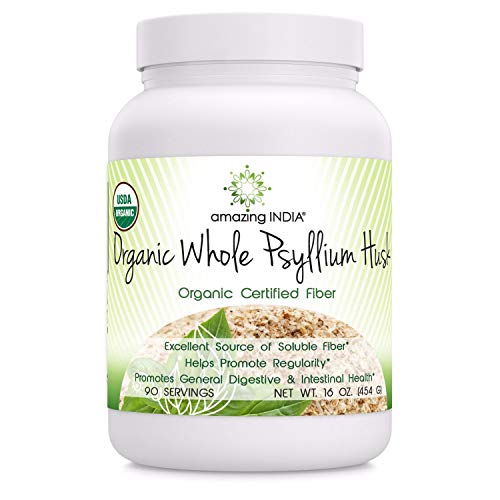 |  | |
| Product | Yerba Prima Whole Husks | Anthony's Powder | Anthony's Whole Husks | Amazing India Whole Husk | Peak Performance Capsules |
| Organic Integrity Score | 93/ 100 | 92/ 100 | 91/ 100 | 89/ 100 | 78/ 100 |
| Our rating | 4.7 | 4.6 | 4.6 | 4.5 | 3.9 |
| Form | Whole husks | Fine powder | Whole husks | Whole husk powder | Capsules |
| Best for | Names its certifier | Baking and mixing | Least processed | Whole-husk value | Convenience |
| Certification | Certified Organic by QAI | USDA Organic, Non-GMO, Gluten-free | USDA Organic, Non-GMO, Gluten-free | USDA Organic, Non-GMO, Gluten-free | USDA Organic |
| Price | $23.99 View on Amazon | $26.49$1.10 / ounce View on Amazon | $25.49$1.06 / ounce View on Amazon | $18.89$1.18 / ounce View on Amazon | $19.95$0.33 / count View on Amazon |
Price and availability as of October 11, 2026 7:10 pm EDT. Product prices and availability are accurate as of the date/time indicated and are subject to change. Any price and availability information displayed on Amazon.com at the time of purchase will apply to the purchase of this product.
Scores are ours, based on independent research of certification, purity, form, and value, using the same 10-criteria method we apply to every product. See how we research and rate.
What each claim on a psyllium label actually covers
Psyllium is supposed to be one ingredient, which makes the label easy to read and the claims easy to overstate. Here is what each one commits the seller to.
| Claim | Covers | Key exclusion |
| USDA Organic | The psyllium was grown and handled under the National Organic Program | Says nothing about husk purity, particle size, or heavy metals |
| “Organic” with no seal named | An assertion, often accurate | Not attributable. Four picks here name USDA and one names its certifying agent, QAI, so none of the current picks leave the claim unattributed |
| Whole husk | The intact outer husk, which swells into a gel and moves through the gut | Different from husk powder, which is milled and thickens a drink much faster |
| “100% pure” or single ingredient | No fillers, sweeteners or flavors added | Not a purity test. It describes the recipe, not what the crop carried |
| Non-GMO Project Verified | Independent verification of non-GMO sourcing | Psyllium has no commercial GM varieties, so on this crop it confirms a non-issue |
| Gluten free, vegan | That no gluten-containing grain and no animal-derived ingredient was added to the tub | True of psyllium husk generally. Neither distinguishes one tub from another |
| Third-party lab tested | Some testing occurred, which is more than most listings claim | Names neither the laboratory nor what was tested for. Heavy metals are the question worth asking of any imported husk |
| A capsule milligram figure | The weight of psyllium per capsule | Not a fiber dose. Several capsules equal one spoonful, which is where the cost per gram hides |
Key things to look for in organic psyllium husk
Clean psyllium is about certification, purity, and form. Here is what matters.
1. USDA organic certification
Verifies the psyllium was grown and processed to the organic standard, important for a daily fiber.
2. No additives
The best psyllium is 100% husk, with no artificial colors, sweeteners, flavors, or fillers found in some fiber brands.
3. The right form
Whole husk for texture and baking, fine powder for smooth mixing, or capsules for convenient measured doses.
4. Honest sourcing
Look for Non-GMO and vegan, gluten-free labeling and a transparent single-ingredient list.
Whole husk, powder, or capsules?
All three deliver the same fiber; the difference is texture and convenience. Whole husk is the least processed, has a slightly gritty texture, thickens strongly in liquid, and is great for baking (it binds gluten-free doughs) and for those who want the most natural form. Fine powder is whole husk ground down; it disperses more smoothly into water, smoothies, and batters and is easier to drink, though it thickens fast so you drink it right away. Capsules pre-measure the husk into an easy, tasteless, portable dose, ideal for travel or anyone who dislikes the texture, though you take several capsules to equal a spoonful.
Whichever form you choose, the organic and purity standards are the same: USDA certified organic, 100% psyllium with no additives. Our scoring rewards genuine certification, a clean single-ingredient list, and honest labeling across every form, so you can pick the texture you prefer without compromising on purity. Whatever the form, take psyllium with a full glass of water.
How to choose organic psyllium husk
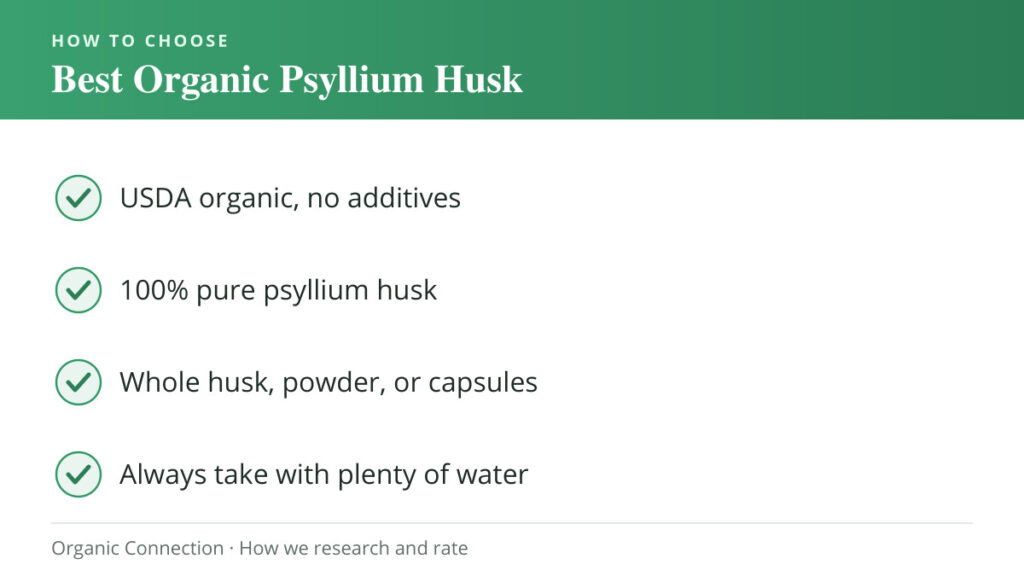
- Insist on USDA organic. It verifies clean growing and processing for a daily fiber.
- Check the ingredient list. It should read only “organic psyllium husk,” nothing else.
- Pick your form. Whole husk for baking and the most natural texture, powder for smooth mixing, capsules for convenience.
- Start low and hydrate. Begin with a small dose, always with a full glass of water, and increase gradually.
- Confirm Non-GMO and vegan. Quality organic psyllium is naturally both.
Who should buy organic psyllium husk
Whole husk and powder behave differently. Our top pick is the USDA organic whole husk. If you want a value baking powder, easy capsules, a whole-husk value size, or a fine powder for smoothies, we have a pick for each.
Best overall: Yerba Prima Organic Psyllium Whole Husks
| Organic Integrity Score | 93 / 100 |
| Form | Whole husks, 12 oz |
| Certification | Certified Organic by QAI, Non-GMO, gluten free |
| Best for | A whole-husk fiber with nothing else in the tub |
Yerba Prima is the oldest name on this page, making fiber supplements since 1980, and its listing is unusually direct about what is not in the canister: no binders, no fillers, no added sugar, no artificial flavors or colors. For a category where the product is supposed to be one ingredient, a list of absences is the most useful thing a label can offer.
The husks are whole rather than milled, which matters more than it sounds. Whole husk swells into a gel that moves through the gut intact; ground powder disperses faster and thickens a drink more aggressively. If you are taking psyllium for regularity rather than for baking, whole husk is the form to want.
The trade-off is texture. Whole husk is slightly gritty and thickens within a minute, so it wants mixing and drinking promptly with a full glass of water rather than sipping.
What we liked: It is the only pick here that names its certifying agent — Certified Organic by QAI — alongside an explicit list of what is excluded, from a brand that has been doing only this since 1980.
Keep in mind: Gritty texture that thickens fast, so it wants mixing and drinking promptly rather than sipping.
What the listing discloses: Yerba Prima states it is Certified Organic by QAI, a USDA-accredited certifying agent, alongside Non-GMO and gluten-free claims, and lists the binders, fillers and sugars it leaves out.
Best fine powder: Anthony’s Organic Psyllium Husk Powder
| Organic Integrity Score | 92 / 100 |
| Form | Finely ground powder, 1.5 lb bag |
| Certification | USDA Organic, Non-GMO, Gluten-free |
| Best for | Baking and smooth mixing at great value |
Anthony’s is our top pick. It is USDA certified organic, finely ground psyllium husk powder in a generous 1.5 lb bag, Non-GMO and gluten-free with no added sugars or other ingredients, and the fine grind mixes smoothly into water, smoothies, and especially gluten-free baking, where psyllium binds doughs, all at an excellent price per ounce from a trusted bulk-ingredient brand.
What puts it first is simply that its listing names USDA Certified Organic. That is a lower bar than it sounds, and most rivals here do not clear it.
What we liked: USDA organic, finely ground for smooth mixing and baking, big 1.5 lb bag, Non-GMO, and great value.
Keep in mind: Fine powder thickens fast, so drink it right away, and it comes in a bag rather than a canister.
What the listing discloses: Fully documented: Anthony’s states USDA organic certification, an origin of India and California and a single-ingredient formula.
Best least-processed: Anthony’s Organic Whole Psyllium Husks
| Organic Integrity Score | 91 / 100 |
| Form | Whole (unground) husks, 1.5 lb bag |
| Certification | USDA Organic, Non-GMO, Gluten-free |
| Best for | The most natural, least-processed husk |
Anthony’s Whole Husks is our least-processed pick. These are USDA certified organic whole (unground) psyllium husks in a 1.5 lb bag, Non-GMO and gluten-free with nothing added, the most natural, minimally processed form of psyllium, with a flakier texture that some prefer, great for those who want the husk exactly as it comes and like to control how they use it.
It scores at the value end here because unground husks have the most pronounced texture and mix less smoothly than powder, but for people who want the least-processed, purest form, it is exactly right.
What we liked: USDA organic, whole unground husks, Non-GMO and gluten-free, nothing added, and the most natural form in a big bag.
Keep in mind: Unground husks have the most texture and mix less smoothly, so they suit those who prefer whole husk over powder.
What the listing discloses: Everything we check for is on the Anthony’s listing: a USDA organic claim, an origin of India and California and a single-ingredient formula.
Best whole-husk value: Amazing India Organic Whole Psyllium Husk Powder
| Organic Integrity Score | 89 / 100 |
| Form | Whole husk powder, 16 oz |
| Certification | USDA Organic, Non-GMO, Gluten-free |
| Best for | A larger whole-husk supply at value |
Amazing India is our whole-husk value pick. It is USDA certified organic whole psyllium husk powder, Non-GMO, gluten-free, and made in the USA, offering 5 grams of fiber per serving in a generous 16 oz size, a clean single-ingredient husk at an accessible price for people who prefer whole husk over fine powder and want a larger supply.
It scores in the value range because it is a less established brand than our top picks and, like all whole husk, has a gritty texture, but for a certified organic whole-husk supply at good value, it is a solid choice.
What we liked: USDA organic, whole husk with 5g fiber per serving, Non-GMO, made in the USA, and good value in a larger size.
Keep in mind: It is a less established brand, and whole husk has the usual gritty texture that thickens quickly.
What the listing discloses: Amazing India documents itself unusually well, stating a USDA organic claim and an origin of the USA.
Best capsules: Peak Performance USDA Organic Psyllium Husk Capsules
| Organic Integrity Score | 78 / 100 |
| Form | Vegan capsules |
| Certification | USDA Organic |
| Best for | Portable, tasteless dosing with no mixing |
This is the only capsule product we found that puts USDA Organic on the label rather than the looser word organic, which in a supplement aisle full of unattributed claims is the reason it is here. The psyllium is from Plantago ovata seed, and the listing is explicit that it avoids the cheap insoluble bulking fibers that pad out many fiber supplements.
It is also the most allergen-conscious pick here: free of soy, milk, egg, shellfish, corn, wheat and peanuts, with no gluten and no preservatives. The company runs a one-for-one donation match with Vitamin Angels, which is not a certification but is a checkable commitment.
Capsules cost more per gram of fiber than loose husk, and that is the honest arithmetic: several capsules equal one spoonful. What you buy is the absence of texture and the ability to carry a dose in a bag.
What we liked: USDA Organic stated outright, a named plant source, a clear stance against cheap bulking fillers, and a broad allergen exclusion list.
Keep in mind: Several capsules equal a spoonful of husk, so it is the most expensive fiber per gram here. Take with a full glass of water.
What the listing discloses: Peak Performance names USDA Organic, the plant species, and a full allergen exclusion list — the most complete disclosure of any capsule product we looked at.
How to use psyllium husk safely
Start with a small dose, about a teaspoon, and always take psyllium with a full glass (8 oz or more) of water or other liquid, then drink more afterward; taking it with too little liquid can cause choking or blockage, so hydration is essential. Mix powder or husk and drink it promptly before it thickens, or swallow capsules with plenty of water. Increase your dose gradually over a week or two to let your system adjust and to minimize gas or bloating. If you take medications, space them a couple of hours from psyllium, since fiber can affect absorption, and check with your doctor if you have a digestive condition. In baking, psyllium is a powerful binder for gluten-free breads and doughs.
The one fiber with an FDA-authorized heart health claim
Most fiber supplements market themselves on general wellness language. Psyllium is unusual in having a health claim the FDA has authorized under its significant scientific agreement standard, codified at 21 CFR 101.81.
The finding: a daily intake of 7 grams of soluble fiber from psyllium seed husk, as part of a diet low in saturated fat and cholesterol, may reduce the risk of coronary heart disease by lowering total and LDL cholesterol in people with mild to moderate hypercholesterolaemia. Products can carry the claim only if they deliver a minimum of 95% pure soluble fiber per reference serving, calculated as the 7 gram daily figure divided across four eating occasions.
Two things follow. First, 7 g of soluble fiber from psyllium is roughly a tablespoon of whole husk or two of powder, taken daily — a meaningfully larger dose than the half-teaspoon many people start and stay at. Second, the claim is specific to psyllium and a short list of other soluble fibers; it does not transfer to fiber supplements generally. If cholesterol is your reason for buying, dose matters as much as brand.
How much to take, and how to work up to it
Almost every complaint about psyllium — bloating, cramping, gas, feeling worse rather than better — traces to starting at a full dose. Soluble fiber needs a fortnight for gut transit and the microbiome to adjust.
| Stage | Whole husk | Powder | Notes |
| Days 1–4 | ½ tsp once daily | ½ tsp once daily | Expect nothing dramatic. This is acclimatization. |
| Days 5–10 | 1 tsp once daily | 1 tsp once daily | Regularity usually begins to shift here |
| Days 11–14 | 1 tsp twice daily | 1 tsp twice daily | Split doses are better tolerated than one large one |
| Maintenance, regularity | 1–2 tsp daily | 1–2 tsp daily | Enough for most people |
| Maintenance, cholesterol | ~1 tbsp daily | ~2 tbsp daily | Targeting the 7 g soluble fiber figure above |
If bloating appears, drop back one stage for a few days rather than stopping. Increase water intake alongside the dose, not just at the moment you take it — psyllium works by holding water, and it has to come from somewhere.
Taking psyllium safely: water, timing and medication
This is the section most organic psyllium roundups omit entirely, and it covers the only two genuine risks in an otherwise very safe supplement.
Never swallow psyllium dry. It absorbs many times its weight in water and begins swelling within seconds. Taken without enough liquid it can expand in the esophagus, causing pain, difficulty swallowing, obstruction and in rare cases choking. Case reports document acute esophageal obstruction after psyllium powder, and at least one fatal choking incident has been recorded in a healthcare setting where it was mixed with too little liquid. Always mix into at least a full 240 ml glass of water, drink it promptly before it gels, and follow with more water. Never swallow capsules dry or take powder by the spoonful. Anyone with a swallowing disorder, a narrowed esophagus or a history of bowel obstruction should not take psyllium without medical advice.
Medication timing. Psyllium forms a gel that can physically trap tablets and delay or reduce absorption. The standard precaution is to take other oral medicines at least 2 hours before or 2 hours after psyllium. Drugs most often flagged include:
- Levothyroxine — separate by about 4 hours rather than 2; thyroid replacement is dose-sensitive.
- Lithium and carbamazepine — narrow therapeutic windows, where reduced absorption matters clinically.
- Digoxin — same reasoning.
- Oral anticoagulants — separate doses and mention psyllium at your next INR check.
- Diabetes medication and insulin — psyllium slows glucose absorption, which is often the point, but it can shift requirements. Monitor when starting.
The practical arrangement most people settle on: medication with breakfast, psyllium mid-morning and mid-afternoon, well away from both.
Psyllium compared with the other fiber supplements
The fiber aisle looks interchangeable and is not. The distinction that matters most is whether a fiber is fermented by gut bacteria, because fermentation is what produces gas.
| Fiber | Type | Fermented? | Notes |
| Psyllium | Soluble, gel-forming | Minimally | Works for both constipation and loose stool; low FODMAP; the only one here with an FDA heart claim |
| Methylcellulose | Soluble, non-fermentable | No | Synthetic. Very low gas, but no cholesterol benefit and no prebiotic effect |
| Inulin / chicory root | Soluble, highly fermentable | Heavily | Strong prebiotic; the usual culprit behind bloating from “added fiber” foods. High FODMAP. |
| Wheat dextrin | Soluble | Moderately | Dissolves invisibly, which suits some people; contains wheat |
| Glucomannan | Soluble, very viscous | Moderately | Highest choking risk of the group; used mainly for satiety |
| Wheat bran | Insoluble | No | Adds bulk but can worsen IBS symptoms |
Psyllium’s unusual property is that it works in both directions. It absorbs water to soften hard stool and it also absorbs excess water to firm loose stool, which is why it appears in IBS guidance where insoluble fibers such as wheat bran are generally discouraged. It is also low FODMAP, unlike inulin, which makes it the practical choice for anyone managing IBS on a FODMAP-restricted diet.
Whole husk, powder and capsules: what the doses actually equal
These three forms are not interchangeable spoon for spoon, and capsule users routinely take a fraction of what they think they are taking.
| Form | Typical fiber per serving | Practical notes |
| Whole husk | ~5 g fiber per tbsp | Least processed, coarsest texture, gels slowest — easiest to drink before it thickens |
| Powder (ground husk) | ~4–5 g fiber per 2 tsp | Roughly twice the volume of whole husk for the same fiber; gels fast, so drink immediately |
| Capsules | ~0.5 g fiber each | Reaching a 5 g dose means around 10 capsules, each needing water. Convenient for travel, impractical for the cholesterol dose. |
If you are taking psyllium for cholesterol at the 7 g soluble fiber level, capsules are effectively not a viable format — you would be swallowing well over a dozen a day. Use them for maintenance or travel and keep powder or husk for the working dose.
Baking and cooking with psyllium
Psyllium is the standard structural binder in gluten-free baking, and it behaves differently from the gums it replaces.
- Gluten-free bread: roughly 3–5% psyllium by flour weight — about 2 to 3 tablespoons of whole husk per 500 g of flour. It gives dough elasticity and stops the crumb collapsing.
- Whole husk versus powder in baking: powder absorbs more water per gram, so substitute about two-thirds the volume when swapping husk for powder, and expect a denser crumb.
- Hydration: psyllium doughs need noticeably more water than wheat doughs and benefit from a 20–30 minute rest before shaping so the husk fully hydrates.
- Purple tinge: whole husk can give gluten-free bread a faintly purple-gray crumb. It is harmless and a known quirk of the ingredient, not a sign of spoilage.
- Thickening: a quarter teaspoon thickens a sauce or smoothie, but it keeps thickening — judge consistency after five minutes, not immediately.
What organic certification does and does not cover here
Psyllium is the husk of Plantago ovata seed, grown overwhelmingly in Gujarat and Rajasthan in north-west India. Organic certification governs what was applied to that crop — no synthetic pesticides, no synthetic fertilizer — and for a product you take daily in gram quantities that is a reasonable thing to want.
What it does not cover is what was already in the soil. Heavy metals are soil contaminants rather than sprays, so organic status says nothing about lead, cadmium or arsenic content, and psyllium is not routinely tested for them by certification alone. If that matters to you, look for a brand publishing third-party heavy metal testing or holding an NSF or USP mark, which is a separate assurance from the organic seal. This is the same distinction that applies across the supplement aisle: certification tells you about the farming, not the finished analysis.
Also check for a single ingredient. Several mainstream psyllium products add sugar, artificial sweeteners, coloring or maltodextrin, and a few “fiber blends” cut psyllium with cheaper inulin, which reintroduces exactly the fermentation and bloating that psyllium avoids.
How we researched this guide
We are a research-based review site. We compared each product against its certification (USDA organic), purity and ingredient list, form, and the weight of aggregated customer feedback on quality and effectiveness, then scored each with our 10-criteria Organic Integrity Score. No brand paid to be included or ranked. Read the full method on our How We Research and Rate page.
Appetite, and what the trials on weight actually show
The dosing and safety of psyllium are covered above; this is the separate question of whether it does anything for appetite, which is one of the more common reasons people start taking it.
There is a genuine mechanism, and it is the same viscosity that produces the cholesterol effect. A gel in the stomach empties more slowly into the small intestine, which prolongs fullness after a meal and flattens the glucose curve that follows it. Both are measurable and both scale with dose.
What that produces on a scale is modest. Trials adding psyllium to an otherwise unchanged diet tend to find small reductions in body weight over several months, generally around one to two kilograms, with far more consistent effects on cholesterol and post-meal glucose than on weight itself. The route is simple: you eat somewhat less at the next meal. Nothing about it changes how the calories you have already eaten are handled.
Timing is the part that decides whether it does anything at all. Psyllium taken in water twenty to thirty minutes before a meal has a plausible path to reducing what you eat at that meal. The same psyllium stirred into a smoothie you were going to drink regardless adds fiber to your day without ever influencing appetite at the moment it would count. This is the single most common way people take it and get nothing from it.
Worth being realistic about the size of the effect, too. One to two kilograms over several months, in trials where compliance is monitored, is a real result and a small one. Treated as a tool that makes a calorie deficit slightly easier to sustain, psyllium is reasonable. Treated as the reason the deficit happens, it will disappoint. Our guide to weight loss teas and the evidence behind them covers the same distinction in a category with much less behind it.
Common questions about organic psyllium husk
What is the best organic psyllium husk?
Our overall pick is Yerba Prima Organic Psyllium Whole Husks, which scores highest here at 93, because it is the only psyllium on this page whose listing names the certifying agent, Certified Organic by QAI, rather than naming the standard alone. For the least-processed form, Anthony’s Organic Whole Psyllium Husks is our pick, and for convenience, Peak Performance USDA Organic capsules.
Is whole husk or powder better?
They provide the same fiber. Whole husk is least processed with a grittier texture and is great for baking; fine powder mixes more smoothly into liquids. Choose whole husk for the most natural form or baking, and powder for easy drinking. Both thicken quickly.
Why choose organic psyllium?
Because you take psyllium daily and in quantity, purity matters. USDA organic verifies clean growing and processing, and the best products are 100% husk with no artificial colors, sweeteners, or fillers that some drugstore fiber supplements contain.
How do I take psyllium husk safely?
Always take it with a full glass of water and drink more afterward, since taking psyllium with too little liquid can cause choking. Start with a small dose, increase gradually, and space it a couple of hours from medications.
Can I bake with psyllium husk?
Yes. Psyllium is a powerful binder in gluten-free baking, giving breads and doughs structure and elasticity that they would otherwise lack. Whole husk and fine powder both work; many gluten-free bread recipes call for it specifically.
How much psyllium husk should I take per day?
For regularity, 1 to 2 teaspoons daily is enough for most people. For cholesterol, the FDA health claim is based on 7 grams of soluble fiber from psyllium daily — roughly a tablespoon of whole husk or two tablespoons of powder. Start at half a teaspoon for the first few days and increase over about two weeks; nearly every complaint of bloating or cramping comes from starting at a full dose.
Can psyllium husk be dangerous?
Only in two specific ways, both avoidable. Swallowed without enough liquid it can swell in the esophagus and cause obstruction or choking — case reports document acute obstruction, and a fatal choking incident has been recorded where it was mixed with too little liquid. Always use at least a full 240 ml glass of water and drink it before it gels. Never swallow capsules or powder dry. Anyone with a swallowing disorder, a narrowed esophagus or a history of bowel obstruction should not take psyllium without medical advice.
Does psyllium interfere with medication?
Yes. The gel it forms can trap tablets and delay or reduce absorption, so take other oral medicines at least 2 hours before or 2 hours after psyllium. Levothyroxine should be separated by about 4 hours. Lithium, carbamazepine, digoxin and oral anticoagulants are the drugs most often flagged, and diabetes medication may need monitoring because psyllium slows glucose absorption.
Is psyllium good for IBS?
It is generally the fiber recommended for it. Psyllium works in both directions — absorbing water to soften hard stool and absorbing excess water to firm loose stool — and it is minimally fermented, so it produces far less gas than inulin. It is also low FODMAP, which insoluble fibers such as wheat bran are not, and wheat bran can worsen IBS symptoms rather than help.
Is psyllium better than inulin or methylcellulose?
For most purposes, yes, but they do different things. Inulin is a strong prebiotic and heavily fermented, which is why it causes bloating and is high FODMAP. Methylcellulose is synthetic and non-fermentable, so very low gas, but it offers no cholesterol benefit and no prebiotic effect. Psyllium is the only one of the three carrying an FDA-authorized heart health claim.
How many psyllium capsules equal a teaspoon of powder?
Roughly ten capsules to reach 5 grams of fiber, since each capsule holds about half a gram. That makes capsules impractical for the cholesterol dose — you would be swallowing well over a dozen daily, each needing water. Use capsules for travel or maintenance and powder or whole husk for a working dose.
How much psyllium do I use in gluten-free bread?
About 3 to 5% of the flour weight, so 2 to 3 tablespoons of whole husk per 500 g of flour. Powder absorbs more water per gram, so use about two-thirds the volume if substituting, and expect a denser crumb. Psyllium doughs need more water than wheat doughs and benefit from a 20 to 30 minute rest before shaping.
Why is my psyllium bread purple?
Whole psyllium husk can give gluten-free bread a faintly purple-gray crumb. It is a harmless known quirk of the ingredient and not a sign of spoilage. Psyllium powder produces less of it than whole husk.
Does organic psyllium contain heavy metals?
It can, and organic certification does not address it. Psyllium is grown mostly in Gujarat and Rajasthan, and heavy metals such as lead, cadmium and arsenic are soil contaminants rather than sprays — so the organic seal covers what was applied to the crop, not what came out of the ground. If that matters to you, look for a brand publishing third-party heavy metal testing or holding an NSF or USP mark, which is a separate assurance from organic status.
- Organic Supplements hub
- Best Organic Turmeric
- Best Organic Sea Moss
- How we research and rate products
- all our reviewed products in one place — sortable by Organic Integrity Score
- Heavy metals in organic food, explained
- Third-party testing for supplements, explained
Price and availability as of October 11, 2026 7:10 pm EDT. Product prices and availability are accurate as of the date/time indicated and are subject to change. Any price and availability information displayed on Amazon.com at the time of purchase will apply to the purchase of this product.
Looking for other organic products?
We have checked more than 800 products across food, household goods, gardening, personal care and pet, every one against its stated certification. Browse all reviews.
Organic Connection is reader-supported. When you buy through links on this page we may earn a commission, at no extra cost to you. As an Amazon Associate we earn from qualifying purchases. We are not paid to feature or rank any product. Psyllium husk is a dietary fiber, not a treatment for any condition; consult your doctor before use if you have a health concern. How we research and rate.