Last updated: September 30, 2026
We may earn a commission when you buy through links on this page, at no extra cost to you. How we research and rate.
The short version
After researching the certifications, additives, and can linings of the most popular organic coconut milks, our top pick is Native Forest Organic Unsweetened Coconut Milk, Simple. It is USDA certified organic, contains only organic coconut and water with no guar gum or emulsifiers, and comes in a BPA-free lined can, which is why it earned our highest Organic Integrity Score of 93 out of 100. For a 12-can pantry stock-up, the Native Forest Simple 12-pack is our pick, and for the most widely available option, Thai Kitchen Organic Unsweetened is the best choice.
With canned coconut milk, the differences that matter are whether gums and emulsifiers have been added, the fat content, and the can lining. We flag each product’s certification and additives.
Best organic coconut milk compared
| Best Choice | Best Value | ||||
 |  | 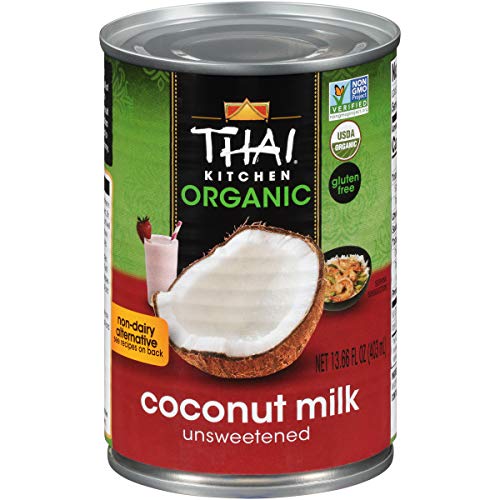 |  |  | |
| Product | Native Forest Simple | Native Forest Simple 12-Pack | Thai Kitchen Unsweetened | Native Forest Classic | Thai Kitchen Lite |
| Organic Integrity Score | 93/ 100 | 89/ 100 | 84/ 100 | 79/ 100 | 74/ 100 |
| Our rating | 4.7 | 4.5 | 4.2 | 4.0 | 3.7 |
| Additives | None | None | None added | Guar gum (under 1%) | Diluted, guar gum |
| Best for | Best overall | Pantry stock-up | Widely available | Consistent texture | Lower fat cooking |
| Certification | Non-GMO, Kosher, Gluten-free | Certified Organic, Non-GMO, Kosher | Non-GMO, Gluten-free, Vegan | Non-GMO, Kosher, Gluten-free | USDA Organic, Non-GMO, Gluten-free |
| Ingredients | Organic coconut, water | Organic coconut, water | Organic coconut milk, water | Organic coconut, water, less than 1% organic guar gum | Organic coconut milk, water, organic guar gum |
| Price | $8.78$0.65 / fluid ounce View on Amazon | $44.28 $47.99 −8%$0.27 / fluid ounce View on Amazon | Currently unavailable See buying options | $46.63$0.29 / fluid ounce View on Amazon | $19.76$0.24 / fluid ounce View on Amazon |
Price and availability as of October 11, 2026 7:10 pm EDT. Product prices and availability are accurate as of the date/time indicated and are subject to change. Any price and availability information displayed on Amazon.com at the time of purchase will apply to the purchase of this product.
Scores are ours, based on independent research of certification, ingredient purity, fat content, packaging, and value, using the same 10-criteria method we apply to every product. See how we research and rate.
What each certification on an organic coconut milk label actually covers
Most shoppers read a certification as a general signal of quality. Every one of them is narrower than that, and the gaps between them are where the marketing lives.
| Certification | Covers | Key exclusion |
| USDA Organic | Farming and handling: no synthetic pesticides or fertilizers, no GMOs, no sewage sludge or irradiation, audited yearly by an accredited certifier | Three different tiers share the one seal, and it makes no claim about worker pay, food miles, or nutrition |
| Non-GMO Project | Testing and supply-chain traceability showing the ingredients are not genetically engineered | Sets no limit on synthetic pesticides or fertilizers, so it is not an organic claim |
The mark most often mistaken for an organic claim is Non-GMO Project Verified. It is a real standard with real testing, and it verifies exactly one thing: that the ingredients are not genetically engineered. It sets no limit on synthetic pesticides, synthetic fertilizers, or anything else about how the crop was grown. USDA Organic already prohibits GMOs outright, so on a certified organic product the butterfly adds independent verification rather than a new promise. On a product carrying only the butterfly, the pesticide question has not been asked.
Key things to look for in organic coconut milk
Great canned coconut milk is about certification, ingredients, fat content, and packaging. Here is what matters.
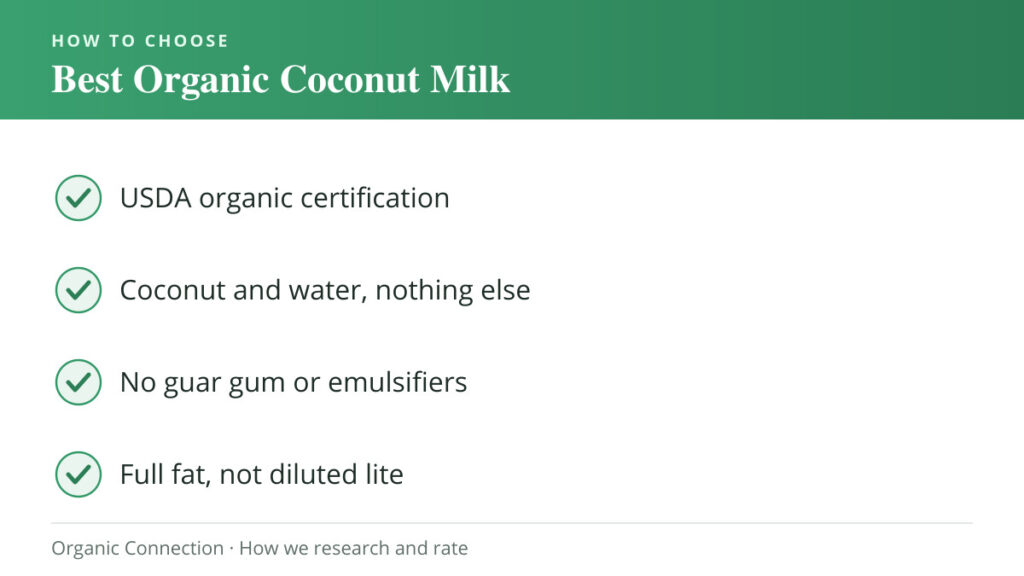
1. USDA organic certification
It verifies coconuts grown without synthetic pesticides and rules out non-organic additives and processing aids in the can.
2. No guar gum or emulsifiers
Coconut and water only. Gum-free milk separates in the can, which is normal and lets you skim the cream.
3. Full fat, not “light”
Light coconut milk is full fat diluted with water at a premium price. Buy full fat and dilute it yourself if you want.
4. A BPA-free can lining
Fatty contents draw more BPA out of epoxy linings than watery ones, so the lining matters more here than in most canned goods.
Canned versus carton, and why separation is good
Canned coconut milk and the coconut milk sold in refrigerated cartons are almost unrelated products despite sharing a name. Canned coconut milk is roughly 17 to 22 percent fat, thick enough to build a curry on, and it is a cooking ingredient. Carton coconut milk beverage is mostly water with a small percentage of coconut, plus stabilizers, gums, and usually added vitamins and sweetener, formulated to pour on cereal. Substituting one for the other in a recipe does not work: a curry made with carton coconut beverage will be thin and watery, and canned milk on cereal is unpleasantly rich. This guide covers the canned cooking product.
The separation question trips people up constantly. When you open a can of gum-free coconut milk, you will usually find a firm white layer of cream on top and thin coconut water underneath. That is not spoilage, it is what unemulsified coconut milk does, and it is genuinely useful: you can spoon the cream off for whipping, for the base of a Thai curry where you want to fry the paste in coconut fat first, or for adding richness to a sauce, and use the thin liquid separately. If you want it homogeneous, warm the can gently or shake and whisk it. Brands that add guar gum simply do this emulsifying for you at the factory, permanently, which removes the option.
How to choose organic coconut milk
- Confirm USDA organic. It covers the coconuts and rules out non-organic additives.
- Read the ingredient list. Organic coconut and water is the target; guar gum is the most common addition.
- Buy full fat. Light versions are diluted full fat sold at a similar price.
- Check for a BPA-free lining. It matters more with fatty contents than watery ones.
- Do not fear separation. A firm cream layer on top means no emulsifiers, which is what you want.
Who should buy organic coconut milk
The right can depends on what you cook. If you want the purest two-ingredient coconut milk, our top pick fits. If you want to stock the pantry, a widely stocked supermarket option, a classic gum-stabilized milk, or a lower-fat version for everyday cooking, we have a pick for each.
Best overall: Native Forest Organic Unsweetened Coconut Milk, Simple
| Organic Integrity Score | 93 / 100 |
| Ingredients | Organic coconut, water |
| Certification | Non-GMO, Kosher, Gluten-free |
| Best for | Curries, desserts, and anywhere you want to skim the cream |
Native Forest Simple is our top pick because it is the version of this product with nothing done to it. Two ingredients, organic coconut and water, no guar gum, no emulsifiers, no stabilizers, in a can Edward & Sons states is BPA-free. It is USDA certified organic and Non-GMO Project Verified, and it separates in the can exactly as unemulsified coconut milk should, which lets you spoon the firm cream off the top for a curry base or for whipping. The coconut flavor is clean and pronounced rather than muted.
The trade-off is that separation confuses first-time buyers, and if you want a uniform pourable milk you have to whisk or warm it yourself. It also costs more per can than the supermarket brands, and single cans are poor value compared with the multipack.
What we liked: Only organic coconut and water, no gums, USDA organic and Non-GMO verified, BPA-free lining, and a clean strong coconut flavor.
Keep in mind: Separates in the can, which is correct but surprises people, and single cans are expensive.
What the listing discloses: Native Forest states Non-GMO Project Verified and kosher certification, and does not say whether the USDA seal applies and where it was grown or made.
Best value: Native Forest Organic Coconut Milk Simple, 12-Pack
| Organic Integrity Score | 89 / 100 |
| Ingredients | Organic coconut, water |
| Certification | Certified Organic, Non-GMO, Kosher |
| Best for | Regular cooks who use coconut milk weekly |
Identical product, twelve cans, much better arithmetic. Coconut milk is one of the easiest things to buy in bulk: unopened cans keep for years at room temperature, they stack, and if you cook Thai, Indian, or Caribbean food with any regularity you will get through a case without effort. This is the format that makes gum-free organic coconut milk affordable as a default rather than a treat.
The trade-off is upfront cost and shelf space, plus the risk of dented cans in shipping, which is a recurring complaint with canned goods bought online. Check the case on arrival and reject anything with a dent on a seam.
What we liked: The best per-can price for gum-free organic coconut milk, with a multi-year shelf life that makes bulk sensible.
Keep in mind: Needs pantry space, and dented cans in transit are a known issue with case quantities.
What the listing discloses: Native Forest states Non-GMO Project Verified and kosher certification, and does not say whether the USDA seal applies and where it was grown or made.
Most widely available: Thai Kitchen Organic Unsweetened Coconut Milk, 6-Pack
| Organic Integrity Score | 84 / 100 |
| Ingredients | Organic coconut milk, water |
| Certification | Non-GMO, Gluten-free, Vegan |
| Best for | Everyday cooking with a brand you can also find locally |
Thai Kitchen is the organic coconut milk most people can actually buy without planning ahead, stocked in mainstream supermarkets as well as online, and made from pressed ripe coconut meat with no added sugar or preservatives. It performs reliably in curries, soups, and rice dishes, and the six-pack is a sensible quantity for a household that cooks with it monthly rather than weekly.
The trade-off is that it is a mass-market product from a large company (Thai Kitchen is a McCormick brand), and the formulation is built for consistency across huge production volumes rather than for the purist two-ingredient ideal. The coconut flavor is slightly milder than Native Forest.
What we liked: USDA organic, no added sugar or preservatives, reliable in cooking, and genuinely easy to find.
Keep in mind: Milder coconut flavor than the specialist brands, and it is a large-corporation label.
What the listing discloses: Little to verify on the Thai Kitchen listing: no word on whether the USDA seal applies and where it was grown or made.
Best consistent texture: Native Forest Organic Coconut Milk, Classic, 12-Pack
| Organic Integrity Score | 79 / 100 |
| Ingredients | Organic coconut, water, less than 1% organic guar gum |
| Certification | Non-GMO, Kosher, Gluten-free |
| Best for | Recipes where you want a uniform pour without whisking |
Classic is Native Forest’s original formula: the first pressing of fresh organic coconut meat, mixed with filtered water and under one percent organic guar gum. The gum keeps the can homogeneous, so you pour a smooth uniform milk with no separation and no whisking, which some cooks genuinely prefer for soups, smoothies, and baking where you want consistency rather than a skimmable cream layer.
It scores below the Simple version on our purity-weighted method purely because of that guar gum. The gum is organic, plant-derived, and used in a very small quantity, but it is an additive, and it removes the option of separating the cream. Choose Classic if you want convenience and Simple if you want control.
What we liked: First-pressing coconut, USDA organic, and a genuinely uniform texture straight from the can.
Keep in mind: Contains guar gum, so you cannot skim the cream, and some people find gums harder to digest.
What the listing discloses: On the Native Forest label: Non-GMO Project Verified and kosher certification. Not stated: whether the USDA seal applies and where it was grown or made.
Best light option: Thai Kitchen Organic Unsweetened Lite Coconut Milk
| Organic Integrity Score | 74 / 100 |
| Ingredients | Organic coconut milk, water, organic guar gum |
| Certification | USDA Organic, Non-GMO, Gluten-free |
| Best for | Lighter soups and everyday cooking with less fat |
Lite coconut milk has a legitimate use: soups, broths, and rice dishes where full-fat coconut milk would be too rich, and situations where you are watching calories. It is USDA certified organic with no added sugar, and it behaves predictably in the recipes it suits.
It scores lowest here for a reason worth stating plainly: light coconut milk is full-fat coconut milk with water added, and it is usually sold at a price close to the full-fat can. You can produce the same thing by diluting a can of full fat with water and get two cans’ worth for the price of one. It also cannot thicken a curry or whip, so it is a narrower product than the price suggests. Buy it for convenience, not because it is a better deal.
What we liked: USDA organic, no added sugar, and genuinely convenient for lighter soups and everyday cooking.
Keep in mind: It is diluted full-fat milk at close to full-fat prices, and it will not thicken a curry or whip.
What the listing discloses: Thai Kitchen states USDA organic certification, and does not say where it was grown or made.
Cooking with canned coconut milk
For a Thai-style curry, open a gum-free can without shaking it, spoon the thick cream off the top into a hot pan, and fry your curry paste in that fat until it splits and smells fragrant. That single step is the difference between a flat curry and a good one, and it is only possible with milk that has not been emulsified. Add the remaining thin liquid afterwards. Coconut milk curdles under a hard boil, so bring it to a bare simmer rather than a rolling one, and add acidic ingredients like lime or tamarind late. For whipped coconut cream, refrigerate a full-fat gum-free can overnight, scoop only the solid cream, and whip it cold with a little sweetener; light milk and gum-stabilized milk will not work. Leftovers do not keep in the opened can, so transfer to a glass container, refrigerate, and use within four to five days, or freeze in an ice cube tray for curries later. Unopened cans keep for two to three years in a cool pantry.
The additives, and which ones actually matter
Canned coconut milk is one of the shortest ingredient lists in the aisle when it is done well — coconut and water — and a surprisingly crowded one when it is not. Here is what each addition is doing.
| Ingredient | Purpose | Verdict |
| Guar gum | Stops separation, gives uniform texture | Harmless for most people. A minority report bloating. It also masks how much coconut is actually in the can. |
| Carrageenan | Thickener and stabilizer from red seaweed | Contested — see below |
| Sulfites | Preserve color, prevent browning | Worth avoiding if you are sulfite-sensitive; must be declared |
| Polysorbate 60 / emulsifiers | Uniform texture in some brands | Not permitted in certified organic products |
| Added water | Cheaper product | Check the coconut percentage — good cans state it, often 60–80% |
On carrageenan, honestly: the concern originates from studies on degraded carrageenan — also called poligeenan — which is a different, low-molecular-weight compound produced under harsh acid and heat conditions, and which is not the food additive. Food-grade carrageenan is approved by regulators including the FDA and EFSA, and it is permitted in certified organic food. The honest position is that evidence of harm from food-grade carrageenan at dietary levels is weak, that some people report digestive symptoms and find avoiding it helps, and that plenty of excellent coconut milk contains none of it — so avoiding it costs you nothing. Do not pay a large premium over it, but there is no reason to seek it out either.
The cleanest cans list organic coconut and water, full stop. They separate in the can, which is a feature rather than a fault.
Can linings: BPA-free is not the same as bisphenol-free
Keep in mind: coconut milk is fatty and acidic and sits in a can for months, which is close to a worst case for migration from can linings. Testing by Nordic consumer organizations found BPA and BADGE in the coating lacquer of coconut milk cans. The complication is what replaced it: “BPA-free” commonly means BPS or BPF instead, and research suggests these substitutes may be no safer, with some work indicating BPS may be more damaging than BPA. A BPA-free claim tells you which bisphenol is absent, not that none is present.
What actually reduces exposure:
- Cartons and Tetra Pak avoid the epoxy lining question altogether, though carton products are usually diluted beverage rather than cooking milk.
- Glass jars where available — a few brands offer them.
- Coconut milk powder or blocks of creamed coconut, reconstituted with hot water. Cheap, shelf-stable, no can, and genuinely good in curries.
- Make your own — blend desiccated coconut with hot water and strain. Takes five minutes and costs a fraction.
- Do not store leftovers in the opened can, regardless of lining. Once opened, the lining is exposed to air and the metal can affect flavor.
Milk, cream, lite and beverage are four different products
| Product | Typical fat | Use for |
| Coconut cream | ~20–25% | Whipping, rich curries, desserts |
| Full-fat canned coconut milk | ~17–22% | Curries, soups, braises. The default cooking product. |
| Lite coconut milk | ~5–7% | Diluted full-fat, sold at a premium. Water it down yourself instead. |
| Carton “coconut milk beverage” | ~1–2% | Drinking, cereal, coffee. Will split and taste thin in cooking. |
| Cream of coconut | High, heavily sweetened | Piña coladas and desserts only. Not a cooking substitute. |
The most common kitchen mistake is using carton coconut milk in a curry. It is largely water, contains stabilizers and often added sugar, and it will not build the emulsion a curry needs. Buying lite is the second: you are paying full price for a can that is mostly water, when diluting a full-fat can gives you the same thing plus control.
Cooking with it properly
- Do not boil hard. Coconut milk splits at a rolling boil — the fat separates and the texture goes grainy. Simmer gently.
- Add it late in most dishes, after the aromatics and any acidic ingredients have cooked.
- Acid splits it too. Lime, tamarind and tomato added directly to cold coconut milk can curdle it. Warm the milk first, or add acid at the end off the heat.
- “Cracking” the cream is deliberate in Thai cooking: fry the thick cream from the top of the can until the oil separates, then fry the curry paste in that oil. It builds far more flavor than adding everything at once, and it is the single biggest improvement most home curries can make.
- Do not shake the can if you want the cream separately. Refrigerate it overnight and the cream sets solid on top — that is what you scoop for whipping or cracking.
- Whipping: chill a can of full-fat coconut milk or cream overnight, scoop only the solid, leave the water behind, and whip cold. Guar gum actually helps here, which is one place the additive earns its keep.
Separation, storage and spoilage
- Separation in the can is normal and good. It means little or no emulsifier, so the product is closer to plain coconut and water. Warm it gently or blend to recombine.
- Unopened cans keep 2–5 years. Store upright, cool and dark.
- Once opened, transfer to glass and refrigerate. Use within 4–5 days.
- It freezes well in ice cube trays for cooking, though the texture becomes grainy on thawing — fine in curries and soups, not for whipping.
- Discard any can that is bulging, leaking or hisses when opened, and any milk that smells sour, fermented or fizzes. Coconut milk is low-acid and canned, so spoilage is not something to take chances with.
- Gray or pink discoloration can occur and usually reflects oxidation or minerals rather than spoilage, but combined with any off smell, discard.
How we researched this guide
We are a research-based review site. We compared each product against its certification (USDA organic, and where present Non-GMO Project Verified), ingredient purity and additives, fat content, can lining and packaging, and the weight of aggregated customer feedback on texture and cooking performance, then scored each with our 10-criteria Organic Integrity Score. No brand paid to be included or ranked. Read the full method on our How We Research and Rate page.
Coconut milk, saturated fat and the version you buy
Coconut milk is worth separating from coconut oil, because the two are often discussed together and behave quite differently in a diet.
Full-fat canned coconut milk is genuinely rich, running around 445 calories per cup with roughly 40 grams of fat, most of it saturated. That is closer to double cream than to dairy milk, and it is why a curry made with a whole can is a substantial meal regardless of what else is in it.
The MCT argument gets applied here as it does to coconut oil, and it fails for the same reason: about half of coconut fat is lauric acid, a twelve-carbon fat that behaves metabolically much more like a long-chain fat than like the shorter chain MCTs the thermogenesis research was done on. There is no demonstrated weight benefit, and controlled trials consistently show coconut fat raises LDL cholesterol relative to unsaturated oils.
The practical distinction is between the products, not within the food. Canned full-fat coconut milk, light canned coconut milk and carton coconut beverage are three quite different things sharing a name. The carton drink is mostly water and runs 40 to 80 calories a cup; the can is a cooking ingredient and runs six times that. Substituting one for the other in a recipe changes both the result and the arithmetic considerably.
Used as an ingredient in dishes built around vegetables and pulses, full-fat coconut milk earns its place through flavor and satiety. Used as a default liquid because it seems like a health food, it adds a great deal without anyone noticing.
Honest summary: a rich cooking ingredient with no metabolic advantage, where knowing which of the three products you have bought matters more than anything else.
Common questions about organic coconut milk
What is the best organic coconut milk?
Our overall pick is Native Forest Organic Unsweetened Coconut Milk Simple, because it is USDA certified organic, contains only organic coconut and water with no guar gum or emulsifiers, and comes in a BPA-free lined can. For a pantry stock-up, the 12-pack is our pick, and for the most widely available option, Thai Kitchen Organic Unsweetened.
Why does my coconut milk separate in the can?
Because it contains no emulsifiers. Coconut fat and water separate naturally, so a firm cream layer over thin liquid is exactly what unemulsified coconut milk should look like and is not a sign of spoilage. It is also useful, since you can skim the cream for curry bases or whipping. Brands that add guar gum prevent this at the factory.
Is guar gum in coconut milk bad?
No. Guar gum is a plant-derived thickener used in very small quantities, and organic versions are permitted under USDA organic rules. The reasons to avoid it are practical rather than safety-based: it locks the cream and water together so you cannot skim the cream, it changes the texture, and some people find gums harder to digest.
What is the difference between canned and carton coconut milk?
They are different products. Canned coconut milk is roughly 17 to 22 percent fat and is a cooking ingredient for curries and desserts. Carton coconut milk beverage is mostly water with a small percentage of coconut plus stabilizers and often added vitamins and sweetener, formulated to drink or pour on cereal. They do not substitute for each other.
Is light coconut milk worth buying?
Only for convenience. Light coconut milk is full-fat coconut milk diluted with water, usually sold at close to the full-fat price, so you can make it yourself from a full-fat can and get twice as much. It also will not thicken a curry or whip into cream.
Is carrageenan in coconut milk bad for you?
The evidence is weaker than the reputation. The concern originates from studies on degraded carrageenan, also called poligeenan, which is a different low-molecular-weight compound produced under harsh acid and heat and is not the food additive. Food-grade carrageenan is approved by the FDA and EFSA and permitted in certified organic food. Some people do report digestive symptoms and find avoiding it helps, and plenty of excellent coconut milk contains none — so avoiding it costs nothing, but it is not worth a large premium.
Does BPA-free coconut milk mean the can is safe?
Not necessarily. “BPA-free” tells you which bisphenol is absent, not that none is present — the common replacements are BPS and BPF, and research suggests these may be no safer, with some work indicating BPS may be more damaging. Coconut milk is fatty and acidic and sits in a can for months, which is close to a worst case for migration. Nordic consumer organizations found BPA and BADGE in coconut milk can linings.
How can you avoid canned coconut milk altogether?
Coconut milk powder or blocks of creamed coconut reconstituted with hot water are cheap, shelf-stable and genuinely good in curries. Glass jars are available from a few brands. Or blend desiccated coconut with hot water and strain — it takes five minutes. Whatever you buy, never store leftovers in the opened can, since the lining is then exposed to air and the metal affects flavor.
Can you use carton coconut milk in curry?
No — this is the most common kitchen mistake with it. Carton “coconut milk beverage” is roughly 1 to 2% fat against 17 to 22% for canned full-fat, plus stabilizers and often added sugar. It will not build the emulsion a curry needs and will taste thin and split. Cartons are for drinking, cereal and coffee.
Is lite coconut milk worth buying?
Rarely. It is full-fat coconut milk diluted with water and sold at a similar price. Buying full-fat and diluting it yourself gives the same result with control over how thin it is, and lets you use the undiluted cream when you want it.
Why did my coconut milk curdle?
Heat or acid, usually both. Coconut milk splits at a rolling boil, so simmer gently rather than boiling. Acid also splits it — lime, tamarind or tomato added to cold coconut milk can curdle it, so warm the milk first or add acid at the end off the heat.
What does “cracking” coconut cream mean?
Frying the thick cream from the top of the can until the oil visibly separates, then frying the curry paste in that oil. It is standard Thai technique and builds far more flavor than adding everything at once — probably the single biggest improvement most home curries can make. Do not shake the can if you want that cream; refrigerate it overnight and it sets solid on top.
How long does coconut milk last once opened?
4 to 5 days refrigerated, transferred to glass rather than left in the can. Unopened cans keep 2 to 5 years stored cool and dark. It freezes well in ice cube trays for cooking, though the texture goes grainy on thawing — fine in curries, not for whipping. Discard any can that bulges, leaks or hisses, and any milk that smells sour or fizzes.
- Organic Food & Pantry hub
- Best Organic Coconut Oil
- Best Organic Coconut Water
- How we research and rate products
- Organic Product Database — search every product we have reviewed, by certification
Price and availability as of October 11, 2026 7:10 pm EDT. Product prices and availability are accurate as of the date/time indicated and are subject to change. Any price and availability information displayed on Amazon.com at the time of purchase will apply to the purchase of this product.
Looking for other organic products?
We have checked more than 800 products across food, household goods, gardening, personal care and pet, every one against its stated certification. Browse all reviews.
Organic Connection is reader-supported. When you buy through links on this page we may earn a commission, at no extra cost to you. As an Amazon Associate we earn from qualifying purchases. We are not paid to feature or rank any product. How we research and rate.