
Last updated: September 30, 2026
We may earn a commission when you buy through links on this page, at no extra cost to you. How we research and rate.
The short version
After researching the certifications, cocoa content, and sourcing of the most popular organic dark chocolate bars, our top pick is Alter Eco Organic Dark Chocolate. It is USDA certified organic and Fair Trade certified, made with clean single-origin cacao and no soy lecithin, and the company is transparent about its supply chain, which is why it earned our highest Organic Integrity Score of 93 out of 100. For the best value in a multipack, Equal Exchange Organic Very Dark is our pick, and for the highest cocoa content, Equal Exchange Extreme Dark is the best choice.
With chocolate, certification does more work than in almost any other category, because cocoa has documented child labor and deforestation problems that an organic seal alone does not address. We flag each product’s certifications and cocoa percentage.
Best organic dark chocolate compared
| Best Choice | Best Value | ||||
 |  |  |  |  | |
| Product | Alter Eco Dark Sea Salt | Equal Exchange Very Dark | Equal Exchange Extreme Dark | Endangered Species Cacao Nibs | Endangered Species Forest Mint |
| Organic Integrity Score | 93/ 100 | 89/ 100 | 85/ 100 | 78/ 100 | 74/ 100 |
| Our rating | 4.7 | 4.5 | 4.3 | 3.9 | 3.7 |
| Cocoa | Dark, high cocoa | 71% | 88% | 72% | 72% |
| Best for | Best overall | Best value multipack | Highest cocoa | Texture and crunch | Mint lovers |
| Certification | USDA Organic, Fair Trade, Non-GMO | Fair Trade, Organic | Fair Trade, Organic | Fair Trade, Non-GMO | Fair Trade, Non-GMO |
| Price | $57.50$4.79 / count View on Amazon | $78.78$2.34 / ounce View on Amazon | $52.80 $69.99 −25%$4.40 / count View on Amazon | $63.99$5.33 / count View on Amazon | $62.99 $70.60 −11%$5.25 / count View on Amazon |
Price and availability as of October 12, 2026 1:10 am EDT. Product prices and availability are accurate as of the date/time indicated and are subject to change. Any price and availability information displayed on Amazon.com at the time of purchase will apply to the purchase of this product.
Scores are ours, based on independent research of certification, cocoa content, ingredient purity, sourcing transparency, and value, using the same 10-criteria method we apply to every product. See how we research and rate.
Reading the seals on organic dark chocolate: what each one does and does not cover
Certification names are easy to confuse and easy to trade on. Below is what each of these marks covers, and the part of the picture it says nothing about.
| Certification | Covers | Key exclusion |
| USDA Organic | Farming and handling: no synthetic pesticides or fertilizers, no GMOs, no sewage sludge or irradiation, audited yearly by an accredited certifier | Three different tiers share the one seal, and it makes no claim about worker pay, food miles, or nutrition |
| Fair Trade Certified | A price floor for producers, a community premium, and labor standards on the farms and in the facilities | An economic and labor standard; it is not an organic or pesticide claim |
| Regenerative Organic | Soil health, animal welfare and farmworker fairness, built on top of an existing organic certification | Requires organic certification as its baseline, so it is an addition to the USDA seal and never a replacement for it |
The USDA seal is a farming standard, and only a farming standard. It is enforced, it is audited annually, and it genuinely prohibits synthetic pesticides, synthetic fertilizers and GMOs. It says nothing about what the people who grew the crop were paid, how far the product traveled, or whether it is good for you. Organic sugar is organic. It is still sugar.
Key things to look for in organic dark chocolate
Great organic dark chocolate is about certification, cocoa content, emulsifiers, and sourcing transparency. Here is what matters.
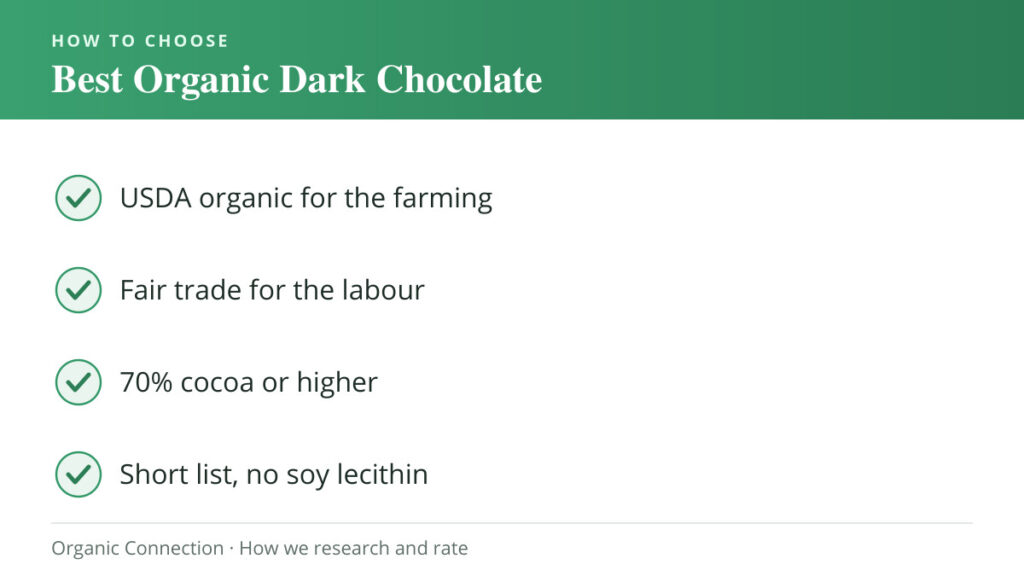
1. USDA organic plus a fair trade mark
Organic covers the farming; fair trade covers the labor. Cocoa’s history means you want both, not one.
2. Cocoa content of 70 percent or more
Higher cocoa means less sugar and more flavanols. Below about 65 percent, sugar is usually the first ingredient.
3. A short ingredient list
Cocoa mass, cocoa butter, sugar, and vanilla is a complete bar. Soy lecithin and “natural flavors” are shortcuts.
4. Named origin and real transparency
Single-origin sourcing and published supply chain information are the strongest signals a brand knows where its cocoa came from.
Cocoa percentage, and what “70%” actually tells you
The percentage on a dark chocolate bar is the proportion by weight of ingredients derived from the cacao bean: cocoa mass, cocoa butter, and sometimes added cocoa powder. Everything else is essentially sugar, plus a trace of vanilla and any emulsifier. So a 70 percent bar is roughly 30 percent sugar, an 85 percent bar is roughly 15 percent sugar, and a 55 percent “dark” bar is nearly half sugar and is closer to milk chocolate in composition than the label implies. If you are buying dark chocolate for the flavanols or to cut sugar, 70 percent is a sensible floor and 80 to 85 percent is where the difference becomes substantial.
What the percentage does not tell you is quality. A 90 percent bar made from poor beans, over-roasted and under-conched, will taste bitter, chalky, and flat, while a well-made 70 percent bar from good beans tastes of fruit, nuts, or earth depending on origin. Bean origin, fermentation, roast, and conching time matter enormously and none of them appear on the front of the pack. This is why single-origin sourcing and a transparent brand are worth more as quality signals than the number. Also worth knowing: soy lecithin, the most common emulsifier in chocolate, is used to reduce the amount of expensive cocoa butter needed and to make the chocolate flow in the molding machine. It is harmless, but its absence usually indicates a bar made with enough cocoa butter not to need it, which is a good sign.
How to choose organic dark chocolate
- Look for two seals. USDA organic for the farming, Fair Trade or equivalent for the labor.
- Aim for 70 percent or higher. The remainder of the bar is essentially sugar.
- Read the ingredient list. Four or five ingredients is a well-made bar; soy lecithin is a cost shortcut.
- Prefer named origins. Single-origin and published sourcing beat vague “sustainably sourced” language.
- Store it cool and dark. Chocolate absorbs odors and blooms in heat, and the fridge causes both.
Who should buy organic dark chocolate
The right bar depends on how dark you like it. If you want the cleanest, best-sourced organic bar, our top pick fits. If you want a multipack for everyday value, the highest cocoa content, a bar with texture from cacao nibs, or a widely stocked mint option, we have a pick for each.
Best overall: Alter Eco Organic Dark Chocolate, Dark Sea Salt
| Organic Integrity Score | 93 / 100 |
| Cocoa | Dark, high cocoa with sea salt |
| Certification | USDA Organic, Fair Trade, Non-GMO |
| Best for | The best-sourced everyday dark bar |
Alter Eco is our top pick because it stacks the certifications that matter in this specific category and backs them with genuine supply chain work. It is USDA certified organic and Fair Trade certified, so both the farming and the labor side are independently verified, and the company has been unusually transparent about where its cacao comes from and how growers are paid. The bar itself uses a short ingredient list with no soy lecithin, which means enough cocoa butter to carry the texture on its own, and the sea salt version balances the bitterness of a high-cocoa bar without adding much sugar.
The trade-off is price. Alter Eco sits at the premium end, and the bars are small at around 2.65 to 2.82 oz, so the cost per ounce is high. It also melts easily in transit during warm months; ordering chocolate in summer is a gamble regardless of brand.
What we liked: USDA organic and Fair Trade together, no soy lecithin, short clean ingredient list, genuine supply chain transparency, and excellent flavor.
Keep in mind: Premium pricing on a small bar, and it is prone to melting in warm-weather shipping.
What the listing discloses: Alter Eco lists a USDA organic claim and Fair Trade. The gap is where it was grown or made.
Best value: Equal Exchange Organic Very Dark Chocolate, 12-Pack
| Organic Integrity Score | 89 / 100 |
| Cocoa | 71% |
| Certification | Fair Trade, Organic |
| Best for | A household that eats dark chocolate regularly |
Equal Exchange is a worker-owned cooperative that buys from small farmer co-ops, which is a structurally different model from a brand simply purchasing certified beans, and their chocolate reflects it. Very Dark is a 71 percent bar, USDA certified organic and fairly traded, with a straightforward clean flavor and no gimmicks. Bought as a twelve-pack, the cost per bar drops well below what you pay for premium single bars, which makes daily dark chocolate affordable.
The trade-off is that twelve 2.8 oz bars is a lot of chocolate arriving at once, with the same summer melting risk, and the flavor is solid rather than exceptional; this is a good everyday bar rather than a tasting bar.
What we liked: USDA organic and fairly traded from a worker-owned co-op, 71% cocoa, and by far the best cost per bar here.
Keep in mind: Twelve bars is a commitment, and the flavor is dependable rather than remarkable.
What the listing discloses: Equal Exchange commits to Fair Trade but stops short of whether the USDA seal applies and where it was grown or made.
Highest cocoa: Equal Exchange Organic Extreme Dark, 88%
| Organic Integrity Score | 85 / 100 |
| Cocoa | 88% |
| Certification | Fair Trade, Organic |
| Best for | Minimum sugar and maximum cocoa flavor |
At 88 percent cocoa, this is the lowest-sugar bar in the guide by a wide margin, roughly 12 percent sugar against the 30 percent of a typical 70 percent bar. For anyone eating dark chocolate specifically to keep sugar down, or for the flavanols, this is the one that actually delivers on that goal, and it remains USDA organic and fairly traded from the same co-op supply chain as our value pick.
The trade-off is bluntly stated: 88 percent is genuinely intense and not everyone likes it. It is dry, bitter, and needs to be eaten slowly in small pieces rather than snapped through. If you are stepping up from a 70 percent bar, expect an adjustment. It also makes an excellent baking chocolate for anyone wanting to control sugar in a recipe.
What we liked: 88% cocoa with very low sugar, USDA organic and fairly traded, and genuinely useful for baking.
Keep in mind: Intensely bitter and dry; it is not a casual snacking bar.
What the listing discloses: Equal Exchange lists Fair Trade. The gap is whether the USDA seal applies and where it was grown or made.
Best texture: Endangered Species Dark Chocolate with Cacao Nibs, 72%
| Organic Integrity Score | 78 / 100 |
| Cocoa | 72% with cacao nibs |
| Certification | Fair Trade, Non-GMO |
| Best for | A crunchy, intensely cocoa-forward bar |
Cacao nibs are crushed roasted cacao beans, and folding them into a 72 percent bar gives you an appealing crunch plus a second, rawer hit of cocoa flavor. Endangered Species is Fair Trade Certified, donates a share of net profits to conservation, and is one of the easiest genuinely ethical chocolate brands to find in ordinary supermarkets, which counts for something.
We are being clear about why it scores below the picks above: Endangered Species bars are Fair Trade Certified but this bar is not USDA certified organic. That covers the labor half of what we look for in chocolate and leaves the farming half unverified. If organic certification is your priority, choose Alter Eco or Equal Exchange; if fair trade sourcing plus wide availability is what you need, this is a solid choice.
What we liked: Fair Trade Certified with genuine conservation giving, 72% cocoa, and a satisfying nib crunch.
Keep in mind: Not USDA certified organic, which is why it ranks below the certified bars here.
What the listing discloses: No organic certification appears anywhere on the Endangered Species Chocolate listing.
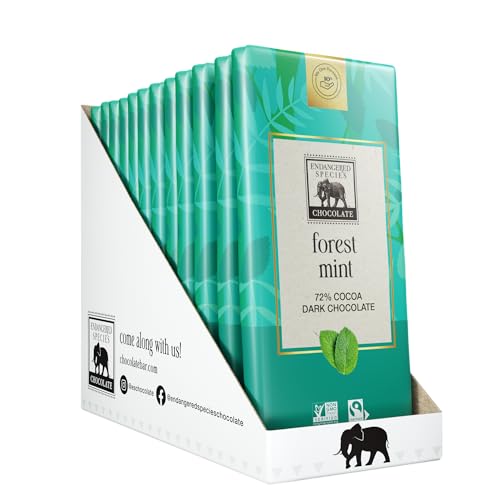
Best mint: Endangered Species Dark Chocolate with Forest Mint, 72%
| Organic Integrity Score | 74 / 100 |
| Cocoa | 72% with mint |
| Certification | Fair Trade, Non-GMO |
| Best for | Dark chocolate mint without artificial flavoring |
Mint and dark chocolate is a durable combination, and this bar does it at 72 percent cocoa with natural mint rather than the artificial peppermint flavoring common in supermarket mint chocolate. It is Fair Trade Certified, widely stocked, and the mint is present but not overwhelming, which is a harder balance to strike than it sounds.
It scores lowest here for the same reason as the nibs bar plus one more: it is Fair Trade Certified but not USDA certified organic, and flavored bars inherently carry a longer ingredient list than a plain one. It is a good bar for what it is; it simply meets fewer of the criteria this guide weights.
What we liked: Fair Trade Certified, 72% cocoa, real mint rather than artificial flavoring, and easy to find.
Keep in mind: Not USDA certified organic, and a longer ingredient list than a plain bar.
What the listing discloses: Endangered Species Chocolate makes no organic claim anywhere, so the case rests on the other claims it does make.
Storing and tasting chocolate properly
Keep chocolate between about 60 and 68 °F, sealed, away from light and strong smells. Do not refrigerate it: cold causes sugar bloom, the white film that appears when moisture condenses on the surface and dissolves sugar, and chocolate readily absorbs odors from a fridge. Bloom is harmless and the chocolate is still edible, but the texture goes chalky. If you must store it somewhere warm, wrap it airtight first and let it return to room temperature sealed before opening, which prevents condensation.
To actually taste a good bar, let a piece sit on your tongue and melt rather than chewing it. Cocoa’s aromatic compounds release as it reaches body temperature, and chewing skips most of them. Dark chocolate is calorie-dense at roughly 170 calories per ounce, so it works better as a small deliberate portion than as something to snack through, and one or two squares after a meal is the way most people who eat it daily do it. A high-cocoa bar also pairs well with coffee and with red fruit; it is worth trying a couple of origins side by side to see how differently two 70 percent bars can taste.
The heavy metals testing, and what it actually found
Keep in mind: Consumer Reports tested 28 dark chocolate bars and detected cadmium and lead in every one of them. 23 of the 28 exceeded California’s Maximum Allowable Dose Level for lead, cadmium or both, based on an adult eating one ounce per day. California’s MADLs are strict — 0.5 micrograms for lead and 4.1 micrograms for cadmium — and they are reproductive toxicity thresholds rather than acute-harm limits, so exceeding one is not the same as being unsafe. Five bars, from Mast, Taza, Valrhona and Ghirardelli, came in below both thresholds. Organic and premium brands appeared throughout the results, not clustered at the clean end.
Where the metals come from differs, and it matters:
- Cadmium is taken up from soil by the cacao tree itself, and is naturally elevated by geology in parts of Latin America where much fine-flavor and organic cacao grows. It ends up inside the bean. Nothing in processing removes it, and no farming method prevents it.
- Lead appears to arrive mostly after harvest, settling onto beans during outdoor drying and handling. That is a post-harvest hygiene problem, and it is one producers can actually fix.
Organic certification does not address either. Cadmium is a soil contaminant rather than a spray, and lead is a handling issue — so the seal tells you nothing here, which is worth being blunt about on a site that recommends organic products. What helps: keep daily intake moderate rather than heroic, prefer brands that publish batch-level heavy metal testing, be aware that West African cacao generally tests lower for cadmium than Peruvian, Ecuadorian or Dominican, and remember that children are more susceptible by body weight. A square or two of dark chocolate most days is a very different exposure from a bar a day.
What the cocoa percentage does and does not tell you
Our section above covers the basics. Three things the number specifically does not tell you:
- It is not a quality measure. The percentage is the total proportion of cocoa solids plus cocoa butter, so a manufacturer can raise it by adding cheap cocoa butter without improving the chocolate at all. An excellent 70% beats a mediocre 85% every time.
- Higher percentage generally means more cadmium, since cadmium sits in the cocoa solids. If you eat dark chocolate daily and heavy metals concern you, an 85% bar is the wrong direction.
- It says nothing about flavanols. Those depend on bean origin, fermentation and processing, and are destroyed by alkalization. A high-percentage bar made with heavily Dutched cocoa can carry fewer flavanols than a lower-percentage bar made with natural cocoa.
Reading the ingredient list
| What you see | What it means |
| Cocoa mass / cocoa liquor first | What you want — chocolate, not sweetened cocoa |
| Sugar first | Below about 55% cocoa this is normal; in a bar sold as dark it is a warning |
| Cocoa butter | Fine and traditional. Watch for it being used to inflate the percentage. |
| Soy or sunflower lecithin | An emulsifier at well under 1%. Harmless, and it improves flow during molding. Two-ingredient bars omit it. |
| PGPR | Polyglycerol polyricinoleate — a cheaper flow agent that lets manufacturers cut cocoa butter. Not permitted in certified organic chocolate. Its presence signals a cost-driven formulation. |
| Vanillin | Synthetic vanilla, often masking mediocre beans. Organic bars use real vanilla or none. |
| Milk fat / butterfat | In a “dark” bar, usually there to soften texture cheaply |
| Vegetable fats other than cocoa butter | Cocoa butter equivalents. Legal in some markets up to a limit; a genuine downgrade. |
On milk allergy: most dark chocolate is made on shared equipment with milk chocolate, and “may contain milk” is common even on bars with no dairy in the recipe. For a genuine milk allergy that warning matters — look for bars explicitly made in a dairy-free facility rather than relying on the ingredient list.
Bloom, tempering and what good chocolate should do
Chocolate quality has a physical tell, and it is easy to check.
- Snap. Properly tempered chocolate breaks with a clean, audible snap at room temperature. A bend or crumble means poor tempering or that it has been heat-damaged in transit.
- Gloss. A tempered bar has an even sheen. Dull or streaky suggests the cocoa butter crystals are not in the stable form.
- Melt. Good chocolate melts smoothly on the tongue at body temperature — cocoa butter’s melting point sits just below it, which is why chocolate does what it does. Waxy resistance suggests added vegetable fat.
- Fat bloom — a grayish-white film — happens when a bar warms and cocoa butter migrates to the surface. Harmless, and it means the bar got hot.
- Sugar bloom — a gritty, crystalline surface — happens when a bar meets moisture, typically from being refrigerated and then brought out into humid air. Also harmless, also a texture loss.
- Neither bloom is spoilage. Both are avoidable with correct storage, and both signal the bar has had a rough life.
Storing and tasting
- 15–18°C is the target, with humidity below about 50%. A cool cupboard, not the fridge.
- Do not refrigerate. This is the most common storage mistake — cold plus condensation on removal causes sugar bloom, and chocolate absorbs fridge odors aggressively.
- Wrap it well. Cocoa butter takes up neighboring smells faster than almost anything; never store it near coffee, spices or cheese.
- Dark chocolate keeps 1–2 years well stored, and improves slightly in the first months as flavors settle. Milk and white keep far less well.
- Taste at room temperature. Chocolate straight from a cold cupboard tastes muted; let it sit fifteen minutes.
- Let it melt rather than chewing. Most of the flavor is aromatic and reaches you retronasally as the cocoa butter melts — chewing a good bar wastes most of what you paid for.
How we researched this guide
We are a research-based review site. We compared each product against its certifications (USDA organic and Fair Trade or equivalent), cocoa content, ingredient purity and emulsifier use, sourcing transparency, and the weight of aggregated customer feedback on flavor and texture, then scored each with our 10-criteria Organic Integrity Score. No brand paid to be included or ranked. Read the full method on our How We Research and Rate page.
Flavanols, satiety, and the percentage that changes behavior
Dark chocolate has the strongest health reputation of any confectionery, and it is worth separating the part that holds from the part that has been stretched.
The flavanol research is real. Cocoa flavanols have been studied for effects on blood pressure and endothelial function, with meta-analyses finding small but measurable reductions in blood pressure. That is a legitimate body of work. It also mostly uses concentrated cocoa preparations at doses well above what a square of chocolate delivers, and alkalised cocoa loses a large share of its flavanols in processing.
On weight specifically, there is no direct benefit. Dark chocolate is around 500 to 600 calories per 100 grams regardless of percentage, because as sugar falls cocoa butter rises. A 90% bar is not a low-calorie food; it is a low-sugar one.
Where dark chocolate genuinely helps is behavioral. Higher percentages are more bitter and more intensely flavored, and people reliably eat less of them. Two squares of 85% satisfies a craving that would take half a bar of milk chocolate, and that difference is worth more in practice than any flavanol effect.
There is a modest satiety argument too. The fat and fiber content of high-cocoa chocolate slows eating and digestion compared with the sugar-dominant milk version.
One caution worth stating: high-percentage dark chocolate concentrates cadmium and lead, which occur naturally in cocoa. This is a genuine consideration at daily high intakes and is covered in more detail above.
Honest summary: real cardiovascular research at doses above what a bar provides, no calorie advantage, and a genuine behavioral benefit from bitterness that makes moderation easier.
Common questions about organic dark chocolate
What is the best organic dark chocolate?
Our overall pick is Alter Eco Organic Dark Chocolate, because it is both USDA certified organic and Fair Trade certified, uses a short ingredient list with no soy lecithin, and the company is genuinely transparent about its cacao sourcing. For the best value, Equal Exchange Organic Very Dark is our pick, and for the highest cocoa content, Equal Exchange Extreme Dark at 88%.
Why does fair trade matter more for chocolate?
Because cocoa’s supply chain has a long, well-documented record of child labor, forced labor, and deforestation, concentrated in West Africa. USDA organic certification only addresses farming practices, not labor conditions, so an organic bar can still come from a problematic chain. A fair trade mark alongside the organic seal covers both.
What does the percentage on dark chocolate mean?
It is the proportion by weight of ingredients from the cacao bean, mainly cocoa mass and cocoa butter. The remainder is essentially sugar. So a 70% bar is roughly 30% sugar and an 85% bar is roughly 15% sugar. It tells you about sugar content, not about quality, which depends on bean origin, fermentation, roast, and conching.
Is soy lecithin in chocolate a problem?
Not for safety. It is an emulsifier used to help chocolate flow during molding and to reduce the amount of expensive cocoa butter needed. Its absence is a positive signal because it usually means the bar contains enough cocoa butter to work without it, which tends to indicate a better-made product.
Should I keep chocolate in the fridge?
No. Refrigeration causes sugar bloom, the white film that forms when condensation dissolves surface sugar, and chocolate absorbs odors from a fridge easily. Store it sealed between about 60 and 68 °F, away from light and strong smells. Bloomed chocolate is safe to eat but the texture turns chalky.
Does dark chocolate contain lead and cadmium?
Yes — Consumer Reports tested 28 dark chocolate bars and detected both in every one. 23 of the 28 exceeded California’s Maximum Allowable Dose Level for lead, cadmium or both at one ounce per day. Those MADLs are strict reproductive toxicity thresholds — 0.5 micrograms for lead and 4.1 for cadmium — so exceeding one is not the same as being unsafe. Five bars came in below both. Organic and premium brands appeared throughout the results rather than clustered at the clean end.
Where do the heavy metals in chocolate come from?
Different places, which matters. Cadmium is taken up from soil by the cacao tree itself and ends up inside the bean — nothing in processing removes it and no farming method prevents it. Lead appears to arrive mostly after harvest, settling onto beans during outdoor drying and handling, which is a hygiene problem producers can actually fix. Organic certification addresses neither.
Is higher cocoa percentage better?
Not necessarily, and it works against you on two counts. The percentage is cocoa solids plus cocoa butter combined, so it can be raised with cheap cocoa butter without improving the chocolate — an excellent 70% beats a mediocre 85%. And since cadmium sits in the cocoa solids, higher percentage generally means more cadmium. It also says nothing about flavanols, which depend on origin, fermentation and whether the cocoa was alkalized.
What is PGPR in chocolate?
Polyglycerol polyricinoleate, a cheap flow agent that lets manufacturers reduce cocoa butter. It is not permitted in certified organic chocolate, so its presence signals a cost-driven formulation. Soy or sunflower lecithin is a different matter — an emulsifier at well under 1% that improves flow during molding and is entirely benign, though two-ingredient bars omit it.
Why has my chocolate turned white?
Bloom, and it is harmless. Fat bloom is a grayish-white film that appears when a bar warms and cocoa butter migrates to the surface. Sugar bloom is a gritty crystalline surface caused by moisture, typically from refrigerating a bar and bringing it into humid air. Neither is spoilage, both cost you texture, and both mean the bar has had a rough life.
Should you keep chocolate in the fridge?
No — it is the most common storage mistake. Cold plus condensation on removal causes sugar bloom, and chocolate absorbs fridge odors aggressively. Store it at 15 to 18°C in a cool cupboard, well wrapped and away from coffee, spices and cheese. Dark chocolate keeps 1 to 2 years stored properly and even improves slightly in the first months.
How do you tell if chocolate is well made?
Snap, gloss and melt. Properly tempered chocolate breaks with a clean audible snap at room temperature and has an even sheen — a bend or crumble means poor tempering or heat damage, and dull streaky surfaces mean the cocoa butter crystals are unstable. It should melt smoothly at body temperature; waxy resistance suggests added vegetable fat rather than cocoa butter.
Is dark chocolate safe for a milk allergy?
Check the allergen statement, not just the ingredients. Most dark chocolate is made on shared equipment with milk chocolate, so “may contain milk” is common even on bars with no dairy in the recipe. For a genuine milk allergy, look for bars explicitly made in a dairy-free facility.
- Organic Food & Pantry hub
- Best Organic Cocoa Powder
- Best Organic Candy
- How to Spot Greenwashing
- browse all our reviewed products — scores and certifications for 800+ products
- Heavy metals in organic food, explained
Price and availability as of October 12, 2026 1:10 am EDT. Product prices and availability are accurate as of the date/time indicated and are subject to change. Any price and availability information displayed on Amazon.com at the time of purchase will apply to the purchase of this product.
Looking for other organic products?
We have checked more than 800 products across food, household goods, gardening, personal care and pet, every one against its stated certification. Browse all reviews.
Organic Connection is reader-supported. When you buy through links on this page we may earn a commission, at no extra cost to you. As an Amazon Associate we earn from qualifying purchases. We are not paid to feature or rank any product. How we research and rate.