Last updated: September 30, 2026
We may earn a commission when you buy through links on this page, at no extra cost to you. How we research and rate.
The short version
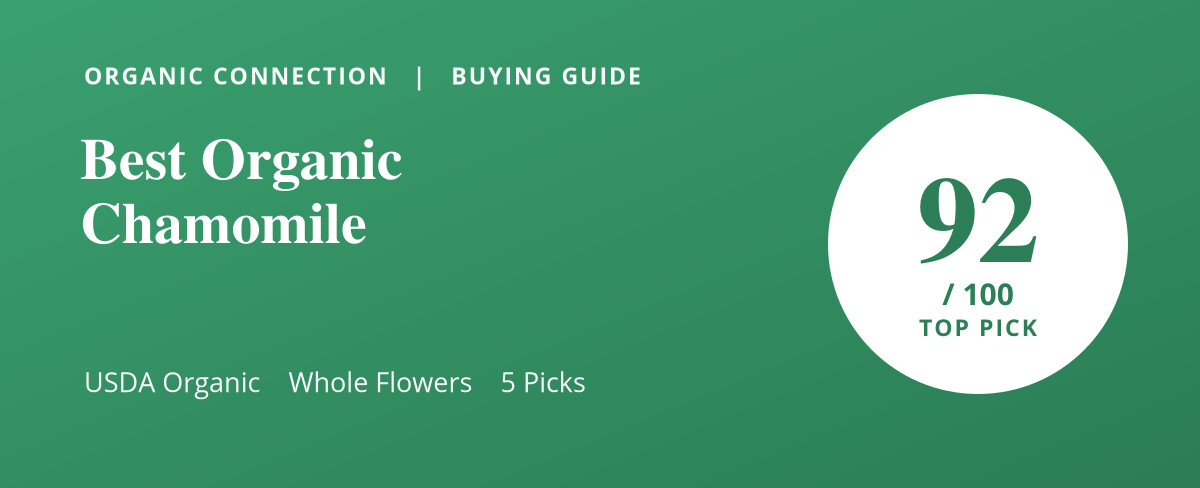
After researching the certifications, sourcing, and flower quality of the most popular organic chamomile teas, our top pick is Traditional Medicinals Organic Chamomile. It is USDA certified organic and Non-GMO Project Verified, made from a single ingredient with pharmacopoeial-grade herb sourcing, which is why it earned our highest Organic Integrity Score of 92 out of 100. For loose whole flowers, Frontier Co-op Organic German Chamomile is our pick, and for the best value, the Traditional Medicinals 96-bag pack is the best choice.
Chamomile is the most-bought herbal tea in the world and also one of the most variable, because the difference between whole flower heads and the dust left over from processing is enormous. We flag each product’s certification, format, and flower grade.
Best organic chamomile tea compared
| Best Choice | Best Value | ||||
 |  |  |  |  | |
| Product | Traditional Medicinals 16 ct | Frontier Co-op Whole 16 oz | Traditional Medicinals 96 ct | Davidson’s Loose Leaf 16 oz | TM Chamomile with Lavender |
| Organic Integrity Score | 92/ 100 | 90/ 100 | 87/ 100 | 84/ 100 | 81/ 100 |
| Our rating | 4.6 | 4.5 | 4.4 | 4.2 | 4.1 |
| Format | Tea bags | Whole loose flowers | Tea bags | Cut loose leaf | Tea bags |
| Best for | Best overall | Best loose flowers | Best value | Loose-leaf alternative | Best blend |
| Certification | Certified Organic, Non-GMO, Kosher | Certified Organic, Kosher | USDA Organic, Non-GMO, Kosher | USDA Organic, Non-GMO | Certified Organic, Non-GMO, Kosher |
| Ingredients | Organic chamomile flower | Organic German chamomile flowers, whole | Organic chamomile flower | Organic chamomile flowers | Organic chamomile, lavender, lemon balm |
| Price | Currently unavailable See buying options | $37.98$2.37 / ounce View on Amazon | $28.72 $31.72 −9%$0.30 / count View on Amazon | $21.76$1.36 / ounce View on Amazon | $5.88$0.37 / count View on Amazon |
Price and availability as of October 11, 2026 7:10 pm EDT. Product prices and availability are accurate as of the date/time indicated and are subject to change. Any price and availability information displayed on Amazon.com at the time of purchase will apply to the purchase of this product.
Scores are ours, based on independent research of certification, ingredient purity, flower grade and sourcing, packaging, and value, using the same 10-criteria method we apply to every product. See how we research and rate.
The certification map for organic chamomile tea, and what each one actually excludes
Most shoppers read a certification as a general signal of quality. Every one of them is narrower than that, and the gaps between them are where the marketing lives.
| Certification | Covers | Key exclusion |
| USDA Organic | Farming and handling: no synthetic pesticides or fertilizers, no GMOs, no sewage sludge or irradiation, audited yearly by an accredited certifier | Three different tiers share the one seal, and it makes no claim about worker pay, food miles, or nutrition |
| GOTS | Organic fiber from farm to finished textile, plus dyeing, finishing, wastewater and labor criteria | Has a weaker second tier, “made with organic”, that needs only 70% organic fiber and carries the same name |
| Non-GMO Project | Testing and supply-chain traceability showing the ingredients are not genetically engineered | Sets no limit on synthetic pesticides or fertilizers, so it is not an organic claim |
| Rainforest Alliance | Farm-level criteria for deforestation, biodiversity, water and working conditions | Permits a defined list of synthetic pesticides that organic certification prohibits outright |
| EU Organic | The European Union organic regulation, shown by the green leaf mark | A separate regime from USDA Organic, recognized through negotiated equivalence rather than identical rules |
| Kosher | Ingredients and production comply with Jewish dietary law, verified by a rabbinic agency that inspects the facility | A dietary-law standard: it makes no claim about pesticides, GMOs or farming practice |
| B Corp | The whole company: social and environmental performance, governance, and transparency | Certifies the company, not the product in your hand |
The mark most often mistaken for an organic claim is Non-GMO Project Verified. It is a real standard with real testing, and it verifies exactly one thing: that the ingredients are not genetically engineered. It sets no limit on synthetic pesticides, synthetic fertilizers, or anything else about how the crop was grown. USDA Organic already prohibits GMOs outright, so on a certified organic product the butterfly adds independent verification rather than a new promise. On a product carrying only the butterfly, the pesticide question has not been asked.
Key things to look for in organic chamomile tea
Great chamomile tea is about certification, flower grade, format, and packaging. Here is what matters.
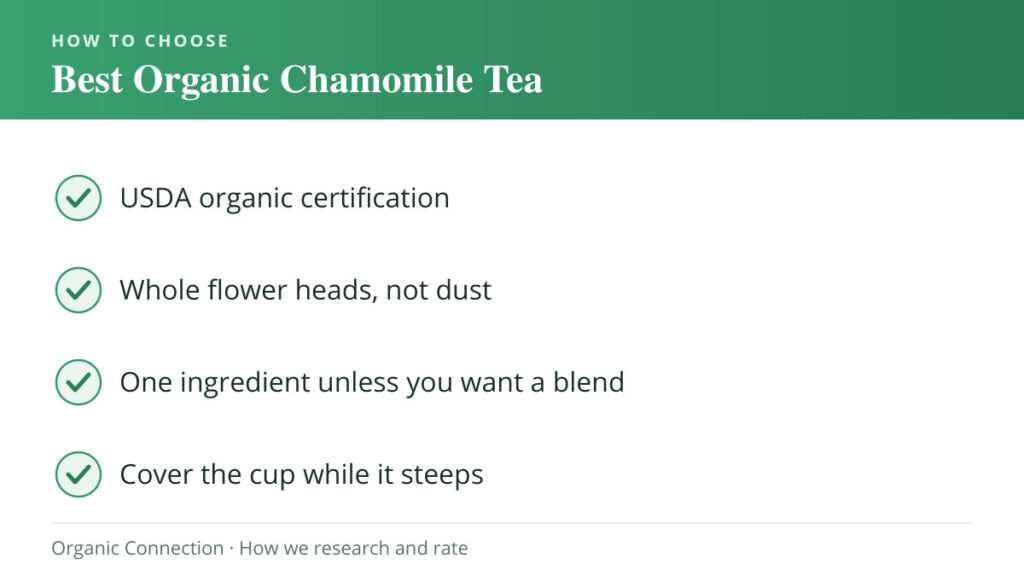
1. USDA organic certification
You steep the flower and drink the result without rinsing it, so pesticide certification matters more here than on a washed food crop.
2. Whole flower heads, not dust
Loose whole flowers are visibly better material than the powder in a cheap tea bag. If you buy bags, buy from a brand that grades its herb.
3. One ingredient
The list should read organic chamomile flower and nothing else, unless you have deliberately chosen a blend.
4. Unbleached, plastic-free bags
Many tea bags are heat-sealed with polypropylene. Unbleached paper or compostable bags avoid steeping plastic in near-boiling water.
What chamomile does, and what the evidence supports
Chamomile is bought overwhelmingly for sleep and for calming, so it is worth being straight about where the evidence sits rather than repeating packaging copy.
The mechanism, precisely. Chamomile’s headline compound is apigenin, a flavonoid that binds to GABA-A receptors in the brain, the same receptor family that benzodiazepines act on. That sounds dramatic until you see the scale: apigenin’s binding affinity is on the order of a thousand times weaker than a prescription benzodiazepine. That ratio explains chamomile precisely. It is genuinely acting on a sedative pathway, which is why the effect is real rather than imaginary, and it is acting on it very gently, which is why chamomile is non-addictive, safe at normal intakes, and modest in effect.
For sleep. A 2024 systematic review and meta-analysis pooled ten clinical trials covering 772 participants and found chamomile significantly improved overall sleep quality scores. The detail is more useful than the headline: the most consistent benefits were fewer night-time awakenings and faster sleep onset, while chamomile did not increase total sleep duration and did not improve how rested people felt the following day. A 2017 double-blind trial in older adults found chamomile extract improved subjective sleep quality over 28 days. So the honest summary is that chamomile appears to help you fall asleep and stay asleep somewhat, without making you sleep longer or wake up feeling better, and reviewers still describe the overall evidence base as inconclusive. Ritual and warmth contribute a good deal of the effect, and that is not a criticism, since a warm caffeine-free drink an hour before bed is a genuinely useful habit whatever the mechanism.
For anxiety. This is the use with arguably better support than sleep, and it gets far less attention. Systematic reviews of oral chamomile have found consistent anxiolytic signals across multiple trials, most clearly in mild to moderate generalized anxiety. Trials in this area have typically used standardized extract capsules at doses well above what a cup of tea delivers, so the caveat is the same as with peppermint oil capsules: the research is about a concentrated preparation, and tea is a gentler version of the same thing.
For digestion and cramping. Traditional use for indigestion and gut spasm is long-standing, and there is reasonable in vitro and animal evidence for an antispasmodic effect. Clinical evidence in humans is limited but broadly supportive at the level of mild everyday discomfort.
Cautions worth knowing. Chamomile is in the Asteraceae family alongside ragweed, daisies, and marigolds, so people with those allergies can react to it, occasionally seriously. It has mild anticoagulant activity, so anyone on warfarin or a similar blood thinner should mention it to their doctor. It is generally avoided in large quantities during pregnancy. Nothing on this page is medical advice.
How to choose organic chamomile tea
- Confirm USDA organic. You are drinking an unwashed steeped flower.
- Prefer whole flower heads if you are buying loose, and a herb-grading brand if you are buying bags.
- Check for a single ingredient, unless you want a blend on purpose.
- Look for plastic-free bags, or buy loose and use a stainless infuser.
- Buy a size you will finish in a year. Chamomile loses its aroma faster than black tea.
Who should buy organic chamomile tea
The right chamomile depends on how you drink it. If you want the best-sourced single-ingredient bagged tea, our top pick fits. If you want whole loose flowers, the best value in bulk, an alternative loose-leaf grower, or a calming blend, we have a pick for each.
Best overall: Traditional Medicinals Organic Chamomile, 16 Bags
| Organic Integrity Score | 92 / 100 |
| Ingredients | Organic chamomile flower |
| Certification | Certified Organic, Non-GMO, Kosher |
| Best for | An everyday evening cup with reliable herb quality |
Traditional Medicinals is our top pick because it treats tea as a herbal product rather than a beverage. The chamomile is USDA certified organic and Non-GMO Project Verified, it is a single ingredient, and the company tests its botanicals to pharmacopoeial-grade standards, which is a meaningfully higher bar than a private-label tea bought from an unnamed broker. The bags are compostable and the company is a certified B Corp. In the cup it is properly aromatic, sweet, and apple-like rather than the flat straw flavor of supermarket chamomile.
The trade-off is box size and price. Sixteen bags does not go far if you drink it nightly, and the per-bag cost sits above supermarket herbals. If you want the same herb quality at a better rate, the 96-bag pack below is the same tea in a sensible format.
What we liked: USDA organic and Non-GMO verified, single ingredient, pharmacopoeial-grade herb testing, compostable bags, and a genuinely aromatic cup.
Keep in mind: Only 16 bags per box and priced above supermarket chamomile.
What the listing discloses: Traditional Medicinals is explicit about kosher certification, and silent on whether the USDA seal applies and where it was grown or made.
Best loose flowers: Frontier Co-op Organic German Whole Chamomile Flowers, 16 oz
| Organic Integrity Score | 90 / 100 |
| Ingredients | Organic German chamomile flowers, whole |
| Certification | Certified Organic, Kosher |
| Best for | Loose-leaf drinkers and home blenders |
This is the format that shows you what you are actually buying. Frontier Co-op sells whole German chamomile flower heads by the pound, and the visual difference against a supermarket tea bag is stark: intact yellow-and-white heads rather than brown powder. Brewed properly, whole flowers give you the full apple-honey aroma, and a pound is an enormous quantity for the money, which makes chamomile a daily habit rather than an occasional treat. Frontier is a co-operative with strong sourcing transparency, and the material is non-irradiated and kosher certified.
The trade-off is that you need an infuser or a teapot with a strainer, and chamomile flowers float, which makes them slightly fiddly to handle. A pound is also a lot of tea to get through before the aroma starts to fade, so it suits households that drink it often, or people who blend their own teas.
What we liked: Whole flower heads rather than dust, USDA organic and non-irradiated, excellent value per cup, and strong co-operative sourcing.
Keep in mind: Requires an infuser, the flowers float, and a pound is a large commitment for occasional drinkers.
What the listing discloses: Frontier Co-op states kosher certification, and does not say whether the USDA seal applies and where it was grown or made.
Best value: Traditional Medicinals Organic Chamomile, 96 Tea Bags
| Organic Integrity Score | 87 / 100 |
| Ingredients | Organic chamomile flower |
| Certification | USDA Organic, Non-GMO, Kosher |
| Best for | Nightly drinkers and households |
Six boxes, ninety-six bags, identical herb quality to our top pick, and a substantially lower cost per cup. If chamomile is part of your evening routine rather than something you drink occasionally, this is simply the sensible way to buy it. Each box stays sealed until you open it, so the flowers keep their aroma rather than all fading at once in a single large tin.
The trade-off is shelf space and commitment. Ninety-six bags is several months of nightly drinking, and if you have not established that you like this particular chamomile, start with the 16-bag box. It is the same tea, so there is no quality reason to prefer the small box beyond trying it first.
What we liked: The best cost per cup for pharmacopoeial-grade organic chamomile, with individually sealed boxes preserving aroma.
Keep in mind: A multi-month commitment, and it takes up real cupboard space.
What the listing discloses: Traditional Medicinals documents USDA organic certification, kosher certification and a B Corp certification, and leaves where it was grown or made unsaid.
Loose-leaf alternative: Davidson’s Organics Chamomile Flowers, 16 oz
| Organic Integrity Score | 84 / 100 |
| Ingredients | Organic chamomile flowers |
| Certification | USDA Organic, Non-GMO |
| Best for | Buyers who want a vertically integrated grower |
Davidson’s is a third-generation organic tea company that grows, imports, blends, and packs its own tea, which is an unusual degree of vertical integration in a category dominated by brokers. The chamomile flowers are USDA organic, sold loose by the pound, and have the buttery, sweet character good chamomile should. If you like the loose format but want an alternative supplier to Frontier, this is the obvious one.
The trade-off is grade. This is a cut-and-sifted flower rather than the whole heads Frontier sells, so the pieces are smaller and a little more of the material is broken. That is not a defect, and it steeps faster, but if you specifically want to see intact flower heads then Frontier is the better buy at a similar price.
What we liked: USDA organic from a vertically integrated grower, good sweet flavor, and a large quantity for the price.
Keep in mind: Cut and sifted rather than whole flower heads, and a pound is a lot for occasional drinkers.
What the listing discloses: Davidson’s documents USDA organic certification, and leaves where it was grown or made unsaid.
Best blend: Traditional Medicinals Organic Chamomile with Lavender
| Organic Integrity Score | 81 / 100 |
| Ingredients | Organic chamomile, lavender, lemon balm |
| Certification | Certified Organic, Non-GMO, Kosher |
| Best for | People who find plain chamomile too mild |
Not everyone likes plain chamomile, and this is the blend to try if you find it too soft or too hay-like. Lavender adds a floral top note and lemon balm adds a light citrus edge, and both are traditional calming herbs in their own right. It is USDA organic, Non-GMO, caffeine-free, and uses the same herb-grading discipline as the single-ingredient tea. As an evening drink it is more interesting than plain chamomile without becoming a dessert tea.
It scores lowest here because it is a blend, and our scoring rewards single-ingredient purity. Lavender is also polarizing: a meaningful number of people find it soapy, and there is no way to know which camp you are in without trying it. Buy a 16-bag box first rather than a multipack.
What we liked: A genuinely well-balanced calming blend from a herb-grading brand, USDA organic and caffeine-free.
Keep in mind: It is a blend rather than pure chamomile, and lavender tastes soapy to a significant minority.
What the listing discloses: Traditional Medicinals is explicit about kosher certification, and silent on whether the USDA seal applies and where it was grown or made.
German versus Roman chamomile
Two different plants are sold as chamomile, and the label rarely explains which you are getting.
German chamomile (Matricaria chamomilla, sometimes Matricaria recutita) is what essentially all chamomile tea is made from. It is an annual, it is the higher-yielding plant, and it is what the sleep and anxiety research has studied. It brews sweet and apple-like, and it is what you want in a teabag.
Roman chamomile (Chamaemelum nobile) is a low-growing perennial used mainly in essential oils, aromatherapy, and skincare. As a tea it is noticeably more bitter, and it is uncommon as a drinking herb.
The practical implication is simple: if a tea just says “chamomile”, it is German chamomile, and that is what you want. If you are buying an essential oil for topical use, check which you are getting, because they differ in composition and price considerably. Both are in the Asteraceae family, so the ragweed allergy caution applies to both.
Other chamomile brands you will come across
A handful of brands dominate this category, and it is worth saying where they sit rather than pretending they do not exist.
Pukka Herbs is probably the strongest name we did not include. It is organic, the tea bags are plastic-free and compostable, and the chamomile is well graded with a genuinely sweet cup. It is a legitimate alternative to our top pick, and it sits just outside our five mainly because Pukka’s chamomile offerings are usually blends with other botanicals rather than single-herb, and our scoring rewards single-ingredient purity.
Yogi Tea is widely available, organic, and reliable, though its chamomile products are typically blends built around a flavor concept rather than pure chamomile.
Taylors of Harrogate carries USDA and EU organic certification plus Rainforest Alliance, and the company is carbon neutral certified. It is a good buy and the chamomile grade is a step below the herbalist brands.
FGO (For Goodness Grow) and Heath & Heather both offer organic chamomile at value pricing, generally milder in the cup than the picks above.
The pattern across the category: herbalist-founded brands such as Traditional Medicinals grade their botanicals to pharmacopoeial standards and cost more, mainstream organic brands are perfectly good and less rigorous about herb grade, and loose whole flowers from a co-operative give you the best quality per pound if you are willing to use an infuser.
How to brew chamomile properly
Most people brew chamomile too briefly and too coolly, which is why so many find it watery. It is a flower infusion, not a delicate green tea, so it wants water just off the boil and a long steep: pour, cover the cup, and leave it five to ten minutes. Covering matters more than people expect. The volatile oils that carry the apple-honey aroma escape in the steam, so an uncovered cup loses much of what you paid for. A saucer over the mug is enough.
If you are using loose flowers, a heaped teaspoon per cup is about right, in a large infuser or a teapot. Chamomile flowers expand and float, so give them room rather than cramming them into a small mesh ball. You can re-steep good whole flowers once, though the second cup is milder.
For an evening routine, drink it about an hour before bed rather than immediately before, which gives you time for a bathroom trip and lets the warmth do its work. A little honey suits it well. Chamomile is also very good iced: brew it double strength, cool it, and serve over ice with lemon. Store loose flowers and open boxes somewhere cool, dark, and airtight, and use within a year, since aroma is the first thing to fade.
How we researched this guide
We are a research-based review site. We compared each product against its certification (USDA organic, and where present Non-GMO Project Verified), ingredient purity, flower grade and sourcing transparency, packaging materials, format, and the weight of aggregated customer feedback on aroma and flavor, then scored each with our 10-criteria Organic Integrity Score. No brand paid to be included or ranked. Nothing here is medical advice, and people with ragweed allergies or on blood thinners should speak to a clinician before drinking chamomile regularly. Read the full method on our How We Research and Rate page.
Sleep, appetite regulation, and an indirect route
Chamomile has no direct connection to body weight, and the indirect one running through sleep is more interesting than most of the direct claims made for other products.
What chamomile has evidence for is mild sedation and sleep quality. Several small trials and a meta-analysis have found modest improvements in sleep quality scores, attributed to apigenin binding to benzodiazepine receptors. The effects are small and the trials are not large, but this is the best-supported thing the plant does.
The relevant chain is that sleep and appetite are genuinely linked, and the evidence there is considerably stronger than the chamomile evidence. Short sleep is associated with higher ghrelin and lower leptin, increased hunger, and a measurable shift toward higher-calorie food choices the following day. Controlled sleep-restriction studies show people eat several hundred more calories when short of sleep.
So the honest framing is a chain with a strong second link and a weak first one. If chamomile improves your sleep, better sleep plausibly helps appetite regulation. Whether chamomile improves your sleep is the uncertain part.
There is also a simpler behavioral benefit worth naming. A hot, caffeine-free drink in the evening occupies the hours when unplanned eating most commonly happens, and it does so for essentially zero calories. That is not a pharmacological effect and it is probably the most reliable thing on this page.
One caution: chamomile is in the daisy family, and people with ragweed or related allergies occasionally react to it. It may also interact with anticoagulants.
Honest summary: no metabolic effect, a plausible indirect route through sleep with modest evidence at the first step, and a genuinely useful evening habit for reasons that have nothing to do with the plant.
Common questions about organic chamomile tea
What is the best organic chamomile tea?
Our overall pick is Traditional Medicinals Organic Chamomile, because it is USDA certified organic and Non-GMO Project Verified, a single ingredient, and the company tests its botanicals to pharmacopoeial-grade standards. For whole loose flowers, Frontier Co-op Organic German Chamomile is our pick, and for the best value, the Traditional Medicinals 96-bag pack.
Does chamomile tea actually help you sleep?
Mildly, and the evidence is modest. Chamomile contains apigenin, which binds to benzodiazepine receptors, giving a plausible mechanism. Several small human trials have found improvements in sleep quality while others found no significant difference against placebo. It is a gentle effect, helped considerably by the ritual of a warm caffeine-free drink before bed, and it is not a sleep medication.
Why does my chamomile tea taste like hay?
Usually because of flower grade or brewing. Cheap tea bags are filled with the dust and broken stem left after whole flowers are sorted out, which brews flat and straw-like. Under-steeping and brewing uncovered also lose the aromatic oils. Use a graded or whole-flower tea, water just off the boil, and cover the cup for five to ten minutes.
Can you drink chamomile tea if you have hay fever?
Be cautious. Chamomile is in the Asteraceae family alongside ragweed, daisies, and marigolds, so people allergic to those plants can react to it, occasionally seriously. If you have a known ragweed allergy, speak to a clinician before drinking it, and stop immediately if you notice itching, swelling, or breathing difficulty.
Is chamomile tea safe in pregnancy?
Large quantities are generally avoided, because chamomile has traditional associations with uterine stimulation and mild anticoagulant activity, and the safety data in pregnancy is limited. An occasional cup is widely considered low-risk, but this is a question for your midwife or doctor rather than a buying guide.
How much chamomile tea should you drink for sleep?
One to three cups a day is the range generally considered safe and is what most trials approximate. For sleep specifically, drink a cup about 45 minutes to an hour before bed rather than immediately before, which gives the effect time to arrive and allows for a bathroom trip. Consistency matters more than quantity: the trials that found benefits ran for weeks, not nights.
Does chamomile tea help with anxiety?
The evidence here is arguably better than for sleep, though it gets less attention. Systematic reviews of oral chamomile have found consistent anxiolytic effects across trials, most clearly in mild to moderate generalized anxiety. Those trials generally used standardized extract capsules at doses well above a cup of tea, so tea is a gentler version of what was studied rather than the intervention itself.
What is the difference between German and Roman chamomile?
German chamomile (Matricaria chamomilla) is what virtually all chamomile tea is made from and what the research has studied. It brews sweet and apple-like. Roman chamomile (Chamaemelum nobile) is a different plant used mainly in essential oils and skincare, and it is noticeably more bitter as a tea. If a box just says chamomile, it is German.
Can chamomile interact with medication?
Yes, and it is worth mentioning to your doctor. Chamomile has mild anticoagulant activity and may add to the effect of warfarin and similar blood thinners, so it is usually recommended to stop it around two weeks before surgery. It may also interact with sedatives, since it acts on the same receptor family, and it can affect how some drugs are metabolized. Regular daily drinking is what matters here, not an occasional cup.
- Organic Food & Pantry hub
- Best Organic Loose Leaf Tea
- Best Organic Dandelion Root Tea
- Organic Coffee and Tea: A Cleaner Daily Cup
- every product we have reviewed — filter by USDA Organic, GOTS, Fair Trade and more
Price and availability as of October 11, 2026 7:10 pm EDT. Product prices and availability are accurate as of the date/time indicated and are subject to change. Any price and availability information displayed on Amazon.com at the time of purchase will apply to the purchase of this product.
Looking for other organic products?
We have checked more than 800 products across food, household goods, gardening, personal care and pet, every one against its stated certification. Browse all reviews.
Organic Connection is reader-supported. When you buy through links on this page we may earn a commission, at no extra cost to you. As an Amazon Associate we earn from qualifying purchases. We are not paid to feature or rank any product. This page is informational and is not medical advice. How we research and rate.