Last updated: September 30, 2026
We may earn a commission when you buy through links on this page, at no extra cost to you. How we research and rate.
The short version
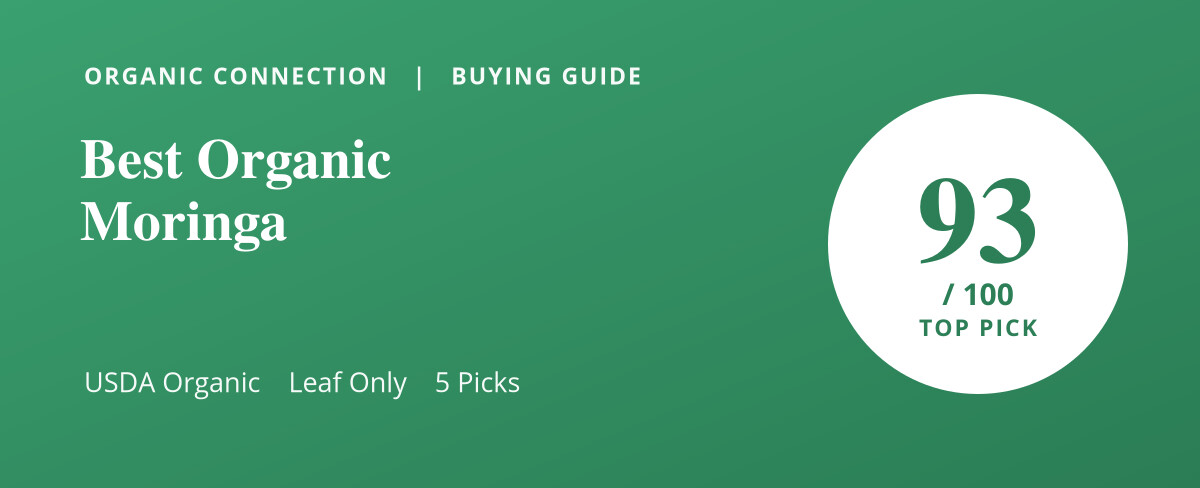
After researching the certifications, sourcing, and testing practices of the most popular organic moringa powders, our top pick is Kuli Kuli Organic Pure Moringa Powder. It is USDA certified organic, single-ingredient leaf powder with published third-party pesticide testing and a direct farmer-partnership supply chain, which is why it earned our highest Organic Integrity Score of 93 out of 100. For the best value, Terrasoul Superfoods Organic Moringa Leaf Powder is our pick, and for bulk buying, Micro Ingredients Organic Moringa is the best choice.
Moringa is a category where certification matters unusually much, because independent testing has repeatedly found pesticide residues and heavy metals in powders sold as organic. We flag each product’s certification, testing, and sourcing.
Best organic moringa powder compared
| Best Choice | Best Value | ||||
 |  |  |  |  | |
| Product | Kuli Kuli 10.6 oz | Terrasoul 11 oz | Micro Ingredients 2 lb | Kuli Kuli Capsules 60 ct | Kuli Kuli 7.4 oz |
| Organic Integrity Score | 93/ 100 | 89/ 100 | 85/ 100 | 83/ 100 | 80/ 100 |
| Our rating | 4.7 | 4.5 | 4.3 | 4.2 | 4.0 |
| Form | Leaf powder | Leaf powder | Leaf powder | Capsules | Leaf powder |
| Best for | Best overall | Best value | Bulk buying | No taste | Trying it first |
| Certification | USDA Organic, Non-GMO, Gluten-free | USDA Organic | USDA Organic, Vegan | Certified Organic | USDA Organic, Non-GMO, Gluten-free |
| Ingredients | Organic moringa oleifera leaf powder | Organic moringa leaf powder | Organic moringa oleifera leaf powder | Organic moringa oleifera leaf powder | Organic moringa oleifera leaf powder |
| Price | $21.18$2.00 / ounce View on Amazon | $14.99$1.36 / ounce View on Amazon | $29.95$0.94 / ounce View on Amazon | $17.89$0.30 / count View on Amazon | $15.37$2.08 / ounce View on Amazon |
Price and availability as of October 11, 2026 7:10 pm EDT. Product prices and availability are accurate as of the date/time indicated and are subject to change. Any price and availability information displayed on Amazon.com at the time of purchase will apply to the purchase of this product.
Scores are ours, based on independent research of certification, ingredient purity, sourcing transparency, published testing, drying method, packaging, and value, using the same 10-criteria method we apply to every product. See how we research and rate.
The certification map for organic moringa powder, and what each one actually excludes
Seals accumulate on a package faster than meaning does. This is what each of the marks you will see here certifies, and what it leaves out.
| Certification | Covers | Key exclusion |
| USDA Organic | Farming and handling: no synthetic pesticides or fertilizers, no GMOs, no sewage sludge or irradiation, audited yearly by an accredited certifier | Three different tiers share the one seal, and it makes no claim about worker pay, food miles, or nutrition |
| Non-GMO Project | Testing and supply-chain traceability showing the ingredients are not genetically engineered | Sets no limit on synthetic pesticides or fertilizers, so it is not an organic claim |
Non-GMO and organic are not two grades of the same thing. The butterfly certifies an absence of genetic engineering and stops there; the USDA seal prohibits genetic engineering as one clause among many, alongside synthetic pesticides, synthetic fertilizers, sewage sludge and irradiation. That makes organic the broader claim by some distance. Where both appear together, the butterfly is adding batch testing on top of a standard that had already banned GMOs.
Key things to look for in organic moringa powder
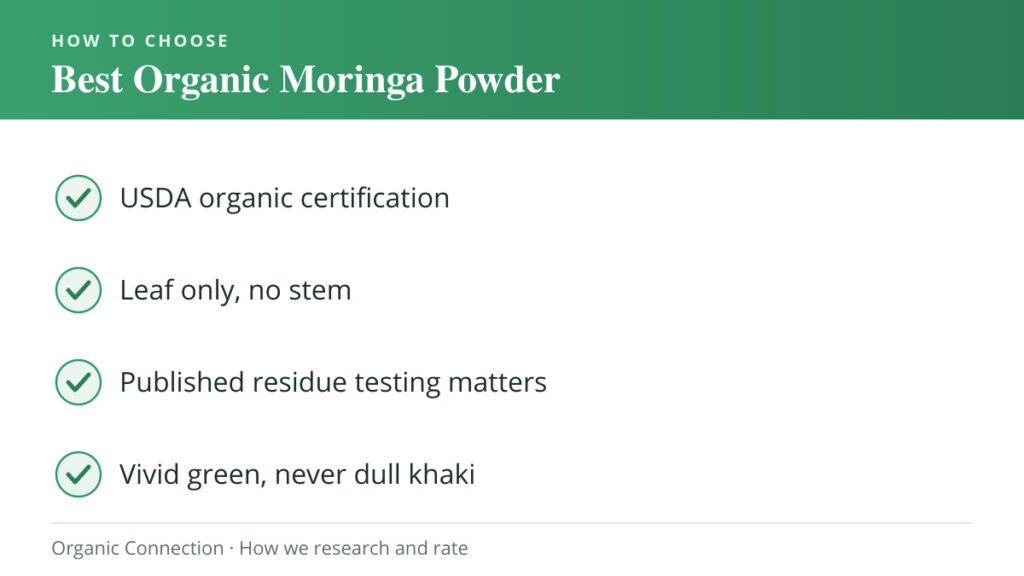
Great moringa comes down to certification, purity, color, and testing. Here is what matters.
1. USDA organic certification
You are eating a dried, unwashed leaf. Certification is the single most useful filter in this category.
2. Leaf only, no stem
The label should say leaf powder. Products that simply say moringa powder often include stem, which is cheaper and less nutritious.
3. Published third-party testing
Given the documented residue problems in this category, brands that publish results for pesticides and heavy metals deserve preference.
4. A vivid green color
Fresh, shade-dried leaf powder is bright green. Dull olive or brown indicates heat drying, age, or stem content.
What moringa does, and what it does not
Moringa is marketed harder than almost any other green powder, so it is worth separating the well-supported from the wishful.
Nutrient density is real. Moringa leaf is genuinely rich in vitamin A precursors, vitamin C, calcium, potassium, iron, and a complete amino acid profile, and it has a long track record in nutrition programs in regions where dietary diversity is limited. That is the strongest and least contested part of the case for it.
The dosage problem. Where marketing goes wrong is in comparing gram for gram against fresh foods. Claims like “seven times the vitamin C of oranges” compare dried leaf powder to a whole fresh fruit, which is not a like-for-like comparison at all. A realistic serving is one to two teaspoons, around 2 to 5 grams, which delivers a useful but modest nutrient contribution rather than a transformative one. Treat it as a good addition to a varied diet, not a replacement for vegetables.
Blood sugar: the most promising area. Several small human trials have found real effects. One reported that 1.5 g of moringa leaf powder daily for three months produced a statistically significant drop in fasting blood glucose against placebo. A 2016 trial found 4 g daily reduced fasting blood glucose by around 28% over 40 days in people with type 2 diabetes. The proposed mechanism is that compounds in the leaf slow carbohydrate breakdown and improve cellular glucose uptake. These are small, short trials rather than large replicated ones, and none of this replaces diabetes medication. If you take glucose-lowering drugs, moringa may compound the effect, which is a reason to tell your doctor rather than to experiment.
Cholesterol: better evidence than most superfoods can claim. A 2023 meta-analysis pooling nine randomized controlled trials across 423 participants found statistically significant reductions in LDL cholesterol, averaging about 14.2 mg/dL, and in triglycerides, averaging about 22.8 mg/dL. A separate twelve-week trial in overweight adults with raised cholesterol found that 1 g of moringa powder daily moved LDL from roughly 195 to 176 mg/dL while HDL rose from about 34 to 38 mg/dL. A meta-analysis of nine trials is a meaningfully stronger evidence base than the single-study claims most green powders rest on, and the effect sizes are still modest and the trials still small.
Cautions worth knowing. Moringa root and root bark contain spirochin and should be avoided entirely; stick to leaf. It is traditionally avoided in pregnancy, particularly the root and bark, because of uterine stimulant activity. If you take medication for blood pressure, blood sugar, or thyroid function, moringa may compound the effect, so speak to your doctor. Nothing here is medical advice.
How much moringa to take, and at what point it backfires
Dosage is where moringa guidance is vaguest, so here are the actual figures used in research and what tolerance data shows.
| Amount | Equivalent | What it is for |
| 1 g | Scant half teaspoon | Dose used in the 12-week cholesterol trial |
| 1.5 g | About half a teaspoon | Dose used in the 3-month blood glucose trial |
| 2.4 g | One level teaspoon | Typical everyday serving |
| 4 to 5 g | One to two teaspoons | Upper end of trials, still well tolerated |
| Above 7 g | Roughly a tablespoon | Bloating and loose stools become likely |
Two things are worth drawing out. First, the trials that found effects used surprisingly small amounts, often 1 to 4 grams, so you do not need to shovel it in. Second, a US acceptability study found doses up to about 5 grams daily were well tolerated while doses above roughly 7 grams were considerably more likely to cause mild, temporary digestive symptoms. Human studies have reported no adverse effects with whole leaf powder at up to a single 50 gram dose or at 8 grams daily for 40 days, so the safety margin is reasonable; the limiting factor in practice is your gut, not toxicity.
Start at half a teaspoon, take it with food, and build to a teaspoon over a couple of weeks. More is not better here, and the people who quit moringa usually did so because they started at a tablespoon.
Heavy metals: the risk organic certification does not cover
This is the most important thing to understand about buying moringa, and it is why our scoring weights published testing so heavily.
Moringa is a bioaccumulator: the tree is unusually efficient at drawing substances out of the soil and concentrating them in its leaves. That is useful agronomically and inconvenient nutritionally, because the substances it concentrates include lead, cadmium, arsenic, and mercury where those are present in the growing soil. Crucially, USDA organic certification does not test for heavy metals. Organic rules govern what is applied to a crop, and heavy metals come up from the ground rather than out of a sprayer, so a genuinely certified organic moringa can still carry them.
What actually protects you is batch-level third-party testing with published results. The brands worth preferring are the ones that test every lot against WHO and FDA thresholds and will show you the certificate of analysis. Kuli Kuli’s zero-residue result in the UC Davis analysis is the best-known example, and several smaller brands now publish heavy metal panels as a matter of course.
Practical rule: if a moringa brand cannot show you a batch-specific certificate of analysis covering lead, cadmium, arsenic, and mercury, treat the organic seal as necessary but not sufficient. This is one of the few supplement categories where that distinction genuinely matters.
How to choose organic moringa powder
- Confirm USDA organic, and treat uncertified moringa with real caution given the residue findings.
- Check it says leaf powder, not just moringa powder.
- Prefer brands that publish testing for pesticides and heavy metals.
- Look for shade-dried or low-temperature dried, which preserves color and nutrients.
- Buy a size you will finish in six months, in an opaque resealable pouch rather than a clear jar.
Who should buy organic moringa powder
The right moringa depends on how you use it. If you want the best-tested, best-sourced leaf powder, our top pick fits. If you want the best price per ounce, a bulk supply, capsules instead of powder, or a smaller pouch to try first, we have a pick for each.
Best overall: Kuli Kuli Organic Pure Moringa Powder, 10.6 oz
| Organic Integrity Score | 93 / 100 |
| Ingredients | Organic moringa oleifera leaf powder |
| Certification | USDA Organic, Non-GMO, Gluten-free |
| Best for | Anyone who wants tested, traceable moringa |
Kuli Kuli is our top pick because it is the brand that took the category’s biggest problem seriously. In an independent UC Davis analysis of leading moringa brands, Kuli Kuli showed zero detectable pesticide residues while several competitors failed to meet USDA organic standards. That is exactly the kind of external verification this category needs. The company sources through direct partnerships with smallholder farmers in West Africa and Haiti rather than through anonymous brokers, the powder is single-ingredient leaf only, and the color is a genuinely vivid green.
The trade-off is price. Kuli Kuli is one of the more expensive moringa powders per ounce, and the pouch is mid-sized rather than bulk. The flavor is also assertively green and peppery, closer to horseradish leaf than to a mild green powder, which some people take a while to get used to in a smoothie.
What we liked: Independently verified as residue-free, USDA organic single-ingredient leaf, direct farmer sourcing, and excellent color and freshness.
Keep in mind: Among the priciest per ounce, and the flavor is strongly peppery.
What the listing discloses: Kuli Kuli documents USDA organic certification and a single-ingredient formula, and leaves where it was grown or made unsaid.
Best value: Terrasoul Superfoods Organic Moringa Leaf Powder, 11 oz
| Organic Integrity Score | 89 / 100 |
| Ingredients | Organic moringa leaf powder |
| Certification | USDA Organic |
| Best for | Daily smoothie use at a sensible price |
Terrasoul hits the balance most people actually want: USDA organic, 100% pure leaf powder, finely milled so it disperses well rather than clumping, and priced well below the premium brands. Terrasoul has a solid reputation across its superfood range for consistency, and the powder has the bright green color and clean grassy smell that indicate properly dried leaf. At 11 oz it is enough for months of daily use without being a bulk commitment.
The trade-off is transparency rather than quality. Terrasoul does not publish the same level of farm-level sourcing detail or independent residue testing that Kuli Kuli does, so you are relying on the USDA certification alone. For most buyers that is sufficient; for anyone specifically concerned about the residue findings in this category, the top pick offers more assurance.
What we liked: USDA organic pure leaf powder, very finely milled, reliable brand, and clearly the best price-to-quality ratio here.
Keep in mind: Less published sourcing detail and no independent residue testing to point to.
What the listing discloses: On the Terrasoul Superfoods label: a USDA organic claim and a single-ingredient formula. Not stated: where it was grown or made.
Best for bulk: Micro Ingredients Organic Moringa Leaf Powder, 2 lb
| Organic Integrity Score | 85 / 100 |
| Ingredients | Organic moringa oleifera leaf powder |
| Certification | USDA Organic, Vegan |
| Best for | Households using moringa daily, or multiple people |
Two pounds is by far the most moringa per dollar in this guide. Micro Ingredients states explicitly that the powder is pure leaves without stems, which is the specific dilution problem to watch for in cheap bulk moringa, and it is USDA organic and India-grown. If you are adding moringa to smoothies every day, or several people in the household use it, this is the format that makes the habit affordable.
The trade-off is freshness over time. Moringa’s color, aroma, and nutrient content all degrade with exposure to air, light, and heat, and two pounds is roughly a year of daily use for one person. Realistically the last third of the bag will not be as good as the first. If you buy this size, decant a few weeks at a time into a small airtight jar and keep the main bag sealed, cool, and dark.
What we liked: Outstanding cost per ounce, USDA organic, and explicitly stem-free leaf powder.
Keep in mind: Two pounds is more than most people can use before quality declines.
What the listing discloses: Micro Ingredients documents a USDA organic claim and a single-ingredient formula, and leaves where it was grown or made unsaid.
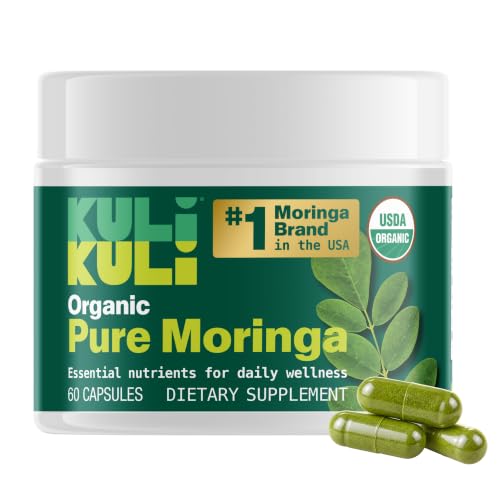
Best capsules: Kuli Kuli Organic Pure Moringa Capsules, 60 ct
| Organic Integrity Score | 83 / 100 |
| Ingredients | Organic moringa oleifera leaf powder |
| Certification | Certified Organic |
| Best for | People who cannot get past the taste |
Moringa’s peppery, horseradish-adjacent flavor is the single biggest reason people stop taking it. Capsules solve that completely. This is the same USDA organic Kuli Kuli leaf powder as our top pick, encapsulated and pre-dosed, which also removes the daily measuring and makes it easy to travel with. For anyone who has bought a bag of moringa, used it twice, and left it in the cupboard for a year, this is the format that gets used.
The trade-off is cost per gram and flexibility. Capsules are a substantially more expensive way to buy the same leaf, and a typical two-capsule serving delivers less powder than a heaped teaspoon, so the effective dose is smaller than most people assume. You also cannot cook with them or add them to anything.
What we liked: Our top-pick powder with the taste problem removed, pre-dosed, USDA organic, and genuinely travel-friendly.
Keep in mind: Much more expensive per gram, and a smaller effective dose than a spoonful of powder.
What the listing discloses: Sparse documentation from Kuli Kuli — nothing on whether the USDA seal applies and where it was grown or made.
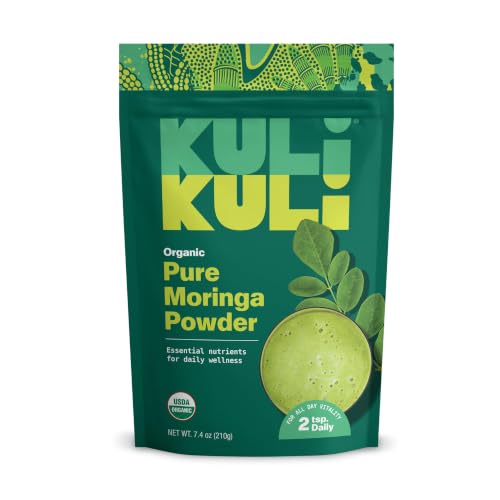
Best small pouch: Kuli Kuli Organic Moringa Powder, 7.4 oz
| Organic Integrity Score | 80 / 100 |
| Ingredients | Organic moringa oleifera leaf powder |
| Certification | USDA Organic, Non-GMO, Gluten-free |
| Best for | First-time buyers |
The same certified organic, farmer-direct Kuli Kuli leaf powder in a smaller pouch. Moringa has a strong and genuinely divisive flavor, and buying a large bag before you know whether you can drink it every day is how most moringa ends up unused at the back of a cupboard. This size is enough for six to eight weeks of daily use, which is long enough to know whether it is going to stick.
It scores lowest here on economics alone. The cost per ounce is the highest of the powders in this guide, and if you already know you like moringa there is no reason to buy this over the larger pouch of the same product. It is a trial size, priced like one.
What we liked: Top-pick quality and certification in a size that makes trying moringa a low-risk decision.
Keep in mind: The highest cost per ounce of any powder here; buy the larger pouch once you know you like it.
What the listing discloses: Kuli Kuli commits to USDA organic certification and a single-ingredient formula but stops short of where it was grown or made.
How to use moringa without hating the taste
Moringa tastes green and peppery, somewhere between matcha, spinach, and rocket, with a faint horseradish edge. Fighting that flavor is a losing game; the trick is to pair it with things that complement it. Start with half a teaspoon rather than the full teaspoon on the label, and build up. Strong fruit works best: mango, pineapple, and banana all cover it well, and a squeeze of lime lifts the whole thing. Cocoa and peanut butter also mask it effectively in a smoothie.
Do not put moringa in boiling water or cook it hard. Heat degrades the vitamin C and much of the color, which is why moringa tea made with boiling water tastes flat and looks brown. If you want it as a drink, use warm rather than boiling water, or stir it into a smoothie or juice cold. It is also genuinely good stirred into soups, dals, and stews at the very end of cooking, off the heat, which is closer to how it is traditionally eaten.
Store it like a spice, not a staple: airtight, cool, dark, and away from the stove. An opaque resealable pouch or a jar in a cupboard is right; a clear jar on a sunny counter is not. Use it within about six months of opening. The signals of decline are visual and olfactory, so if your bright green powder has gone dull khaki and smells of hay rather than fresh grass, it has lost most of what you bought it for.
How we researched this guide
We are a research-based review site. We compared each product against its certification (USDA organic and, where present, Non-GMO Project Verified), ingredient purity and leaf-only status, published third-party testing for pesticides and heavy metals, sourcing transparency, drying method, packaging and light protection, and the weight of aggregated customer feedback on color, aroma, and texture, then scored each with our 10-criteria Organic Integrity Score. No brand paid to be included or ranked. Nothing here is medical advice; moringa can interact with blood pressure, blood sugar, and thyroid medication, and is traditionally avoided in pregnancy. Read the full method on our How We Research and Rate page.
What the moringa research actually covers
Moringa is marketed with a long list of benefits, weight among them, and separating the studied from the asserted is unusually worthwhile here.
Most of the research on moringa and metabolism is preclinical: cell cultures and rodent studies, where extracts have shown effects on fat accumulation, insulin sensitivity and inflammatory markers. Those findings are real and they are the basis of the marketing. They are also, at this stage, exactly what they appear to be — early work in animals at doses that do not translate directly to a spoonful of leaf powder.
Human trials are few, small and mostly focused on blood glucose or lipids rather than body weight. Some report modest improvements in glycaemic markers. None constitutes evidence that moringa causes weight loss in people.
The gap between rodent dose and human serving is the recurring problem across this category. Extracts used in animal work are frequently concentrated and administered at body-weight-scaled doses that would correspond to eating a great deal of powder. A teaspoon in a smoothie is not the same intervention.
What moringa genuinely offers is nutrient density in a small volume: vitamin A precursors, vitamin C, calcium, iron and a reasonable protein content per gram, with the same caveat about serving size that applies to every green powder.
Honest summary: promising preclinical work, almost no human weight data, and a serving size far below the doses studied. It is a nutritious addition to food and not a weight intervention, and any listing presenting it as the latter is running ahead of the evidence.
Common questions about organic moringa powder
What is the best organic moringa powder?
Our overall pick is Kuli Kuli Organic Pure Moringa Powder, because it is USDA certified organic single-ingredient leaf powder, sourced through direct farmer partnerships, and showed zero detectable pesticide residues in an independent UC Davis analysis where several competitors failed. For the best value, Terrasoul Superfoods is our pick, and for bulk, Micro Ingredients.
Is organic certification important for moringa?
More than for most products. You are eating a dried, unwashed leaf, and independent testing has found pesticide residues and heavy metals in moringa powders, including some sold as organic. USDA certification is the most useful baseline filter, and brands that also publish third-party residue testing are worth preferring.
How much moringa powder should you take a day?
One to two teaspoons, roughly 2 to 5 grams, is the usual serving. Start at half a teaspoon and build up, both because the flavor is strong and because larger amounts can be laxative. Marketing comparisons like “seven times the vitamin C of oranges” compare dried powder with whole fresh fruit and are not a like-for-like measure.
Why does my moringa powder taste bitter?
Usually stem content, heat damage, or age. Pure shade-dried leaf is grassy and peppery rather than harshly bitter. Powder that is dull khaki rather than vivid green has usually been heat-dried or has sat too long, and cheaper powders often include stem, which is more bitter and less nutritious than leaf.
Can you drink moringa as a tea?
Yes, but use warm rather than boiling water. Heat degrades the vitamin C and the color, which is why moringa steeped in boiling water tastes flat and turns brownish. It is better stirred cold into smoothies or juice, or added to soups and stews off the heat at the end of cooking.
Does moringa actually lower blood sugar?
Small trials suggest yes, modestly. One found 1.5 g daily for three months significantly reduced fasting blood glucose against placebo, and a 2016 trial reported roughly a 28% reduction over 40 days at 4 g daily in people with type 2 diabetes. These are small, short studies. Moringa does not replace diabetes medication, and because it may compound glucose-lowering drugs, tell your doctor before starting.
Does moringa lower cholesterol?
The evidence here is unusually good for a green powder. A 2023 meta-analysis of nine randomized trials across 423 participants found significant reductions in LDL cholesterol, averaging around 14.2 mg/dL, and in triglycerides, averaging around 22.8 mg/dL. Effect sizes are modest and the trials are small, but a pooled analysis of nine trials is a stronger footing than most superfood claims have.
Does organic moringa get tested for heavy metals?
Not as part of organic certification, which is the key thing to understand. Organic rules cover what is applied to a crop, while heavy metals such as lead, cadmium, and arsenic come up out of the soil. Since moringa is a bioaccumulator, look for brands that publish batch-level third-party certificates of analysis covering heavy metals, and treat the organic seal as necessary but not sufficient.
When should you take moringa, and does it keep you awake?
Morning suits most people. Moringa is caffeine-free so it will not keep you awake in the way coffee does, but many people report a mild energizing effect, so it is more naturally a breakfast addition than an evening one. Take it with food to reduce the chance of digestive upset, and avoid taking it on an empty stomach when you first start.
- Organic Supplements & Wellness hub
- Best Organic Super Greens Powder
- Best Organic Spirulina
- A Beginner’s Guide to Organic Supplements
- every organic supplement we have reviewed — searchable by certification and testing
- Third-party testing for supplements, explained
Price and availability as of October 11, 2026 7:10 pm EDT. Product prices and availability are accurate as of the date/time indicated and are subject to change. Any price and availability information displayed on Amazon.com at the time of purchase will apply to the purchase of this product.
Looking for other organic products?
We have checked more than 800 products across food, household goods, gardening, personal care and pet, every one against its stated certification. Browse all reviews.
Organic Connection is reader-supported. When you buy through links on this page we may earn a commission, at no extra cost to you. As an Amazon Associate we earn from qualifying purchases. We are not paid to feature or rank any product. This page is informational and is not medical advice. How we research and rate.