Last updated: September 30, 2026
We may earn a commission when you buy through links on this page, at no extra cost to you. How we research and rate.
The short version
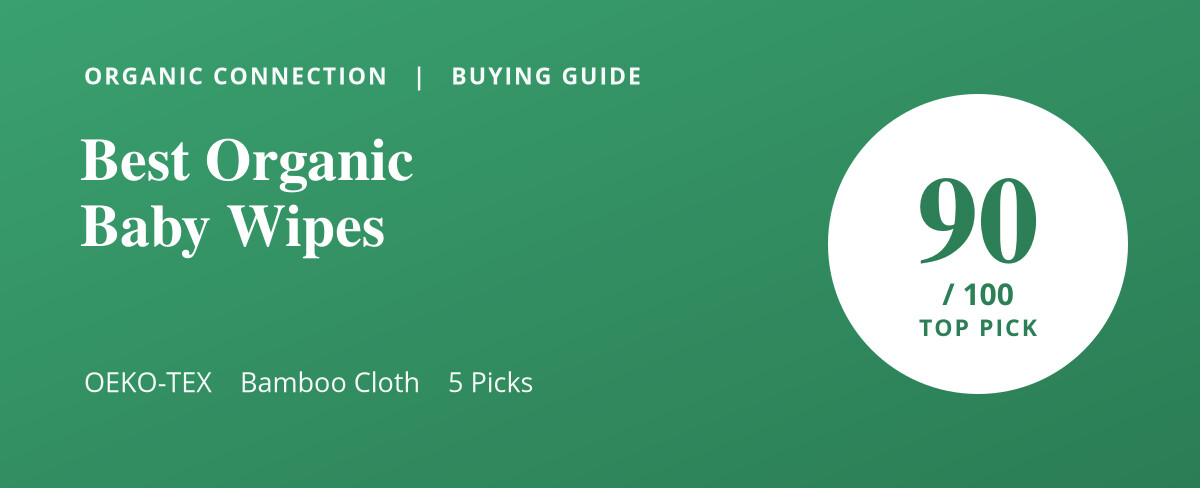
After researching the certifications, materials, and ingredient lists of the most popular organic and natural baby wipes, our top pick is JOONYA Unscented Baby Wipes, Plant-Based and Fragrance-Free. They use a bamboo viscose cloth with organic aloe and botanical extracts, and the ingredient list is free of alcohol, chlorine, phthalates, formaldehyde donors, parabens, and SLS, which is why they earned our highest Organic Integrity Score of 90 out of 100. For the best value, Caboo Bamboo Baby Wipes are our pick, and for a genuinely certified organic cotton option, The Honest Company Organic Cotton Dry Wipes are the best choice.
This is a category where the word organic is doing less work than parents assume, and being straight about that is more useful than pretending otherwise. We flag each product’s cloth material, certifications, and ingredient list.
Best organic baby wipes compared
| Best Choice | Best Value | ||||
 |  |  |  |  | |
| Product | JOONYA Unscented | Caboo 432 Count | Bambo Nature 768 ct | Honest Cotton Dry 192 ct | Caboo Travel 72 ct |
| Organic Integrity Score | 90/ 100 | 88/ 100 | 86/ 100 | 84/ 100 | 80/ 100 |
| Our rating | 4.5 | 4.4 | 4.3 | 4.2 | 4.0 |
| Material | Bamboo viscose | Bamboo viscose | Biobased fiber | Organic cotton | Bamboo viscose |
| Best for | Best overall | Best value | Highest water content | Certified organic cotton | Travel |
| Type | Wet | Wet | Wet | Dry | Wet |
| Certification | — | OEKO-TEX, MADE SAFE | Not stated on the listing | — | MADE SAFE, Organic |
| Price | $25.99$0.11 / count View on Amazon | $34.99$0.08 / count View on Amazon | $42.50$5.53 / count View on Amazon | Currently unavailable See buying options | $13.11$0.18 / count View on Amazon |
Price and availability as of October 11, 2026 7:10 pm EDT. Product prices and availability are accurate as of the date/time indicated and are subject to change. Any price and availability information displayed on Amazon.com at the time of purchase will apply to the purchase of this product.
Scores are ours, based on independent research of cloth material, third-party certifications, ingredient list, water content, packaging, and value, using the same 10-criteria method we apply to every product. See how we research and rate.
What each certification on an organic baby wipes label actually covers
Most shoppers read a certification as a general signal of quality. Every one of them is narrower than that, and the gaps between them are where the marketing lives.
| Certification | Covers | Key exclusion |
| USDA Organic | Farming and handling: no synthetic pesticides or fertilizers, no GMOs, no sewage sludge or irradiation, audited yearly by an accredited certifier | Three different tiers share the one seal, and it makes no claim about worker pay, food miles, or nutrition |
| OEKO-TEX Standard 100 | Laboratory testing of the finished textile against limits for more than 1,000 harmful substances | Says nothing at all about whether the fiber was organically grown |
| MADE SAFE | Screens every ingredient against a banned list covering human health and ecosystem harm | An ingredient-hazard screen; it does not verify organic farming or that the product works |
| EWG Verified | Full ingredient disclosure and avoidance of the chemicals on the EWG list of concern | Run by an advocacy group rather than a standards body, and not an organic claim |
Standard 100 answers “what is in this fabric”, not “how was it grown”. That is a useful question and the testing behind it is rigorous, covering formaldehyde, heavy metals, azo dyes and a long list besides. But a product can pass it while having been grown with every pesticide the organic standards prohibit, because those residues do not survive to the finished textile. Treat it as a floor for chemical safety and look elsewhere for the farming claim.
Key things to look for in organic baby wipes
Good wipes come down to cloth, water content, preservatives, and what is deliberately absent. Here is what matters.
1. The cloth material
Bamboo viscose and cotton are plant-based and biodegrade far better than the polyester and polypropylene in most conventional wipes.
2. A high water percentage
The best wet wipes are 98 to 99% water with a short list of everything else. That figure is usually printed and easy to compare.
3. No fragrance, no alcohol, no harsh preservatives
Fragrance is the most common cause of reaction. Avoid alcohol, parabens, phenoxyethanol if you prefer, and formaldehyde-releasing preservatives.
4. A meaningful third-party certification
OEKO-TEX Standard 100, Made Safe, EWG Verified, or FSC on the cloth are checkable. The word natural on the front is not.
Wet wipes versus dry wipes, and the flushability problem
Two practical decisions matter more than brand choice, and neither gets much attention.
Dry wipes are the genuinely organic option. A dry cotton wipe made from certified organic cotton, which you wet with warm water at the changing table, sidesteps the entire preservative question. There is no solution, so there is nothing to preserve. This is what most midwives suggest for newborns and for babies with reactive skin, and it is the cheapest option per wipe by a distance. The cost is convenience: it needs water to hand, which is fine at home and impractical in a car park.
Nothing here is flushable. No baby wipe should go down a toilet, including ones labeled flushable and including bamboo ones. Wipes do not disperse the way toilet paper does, and they are the primary cause of the fatbergs that block sewers. Bamboo viscose biodegrades far better than polyester in a landfill or compost setting, but it still does not break up fast enough in a sewer pipe. Bin them.
On bamboo. Bamboo viscose is a genuinely better material than plastic for this use, because it is plant-derived, soft, strong when wet, and biodegradable. It is worth knowing that viscose production is a chemical process, so “bamboo” is not the same as unprocessed plant fiber, and it is not the same as organic. OEKO-TEX certification of the finished cloth is the useful assurance that no harmful residues remain.
The ingredients worth avoiding, and why
Since the cloth is only half the product, here is what to look for in the solution. A good wipe has a short list, ideally five to seven ingredients, and is mostly water.
| Ingredient | Why it is there | The concern |
| Fragrance or parfum | Scent | Can legally hide hundreds of undisclosed compounds; the most common irritant |
| Phenoxyethanol | Preservative, replaced parabens | Can irritate, and may worsen existing nappy rash |
| Parabens | Preservative | Suspected endocrine disruption |
| PEG compounds | Penetration enhancers, emulsifiers | Help other ingredients absorb deeper; poor choice on broken skin |
| Formaldehyde donors | Preservative | Release formaldehyde slowly; known sensitizer |
| Alcohol | Cleansing, preservation | Drying and stinging on broken skin |
A quick label rule. Scan for the strings “paraben”, “phenoxy”, “PEG”, “formal”, “fragrance”, and “parfum”. If none appear and water is listed first at a high percentage, the wipe is likely fine. Certifications worth trusting are OEKO-TEX Standard 100 on the cloth, USDA Organic where it genuinely applies, EWG Verified, and Made Safe.
The nuance on preservatives. A wet wipe genuinely needs a preservative system, because a warm damp cloth is otherwise an excellent place to grow bacteria and mold. So the goal is not zero preservatives but gentler ones, typically sodium benzoate and potassium sorbate at low levels. This is also why very low-preservative natural wipes have shorter shelf lives, and why an old pack found at the back of a cupboard is more likely to have gone off than a conventional one.
If your baby has nappy rash right now, the safest approach is to stop using wet wipes entirely for a few days. Use cotton wool or a dry organic cotton wipe with warm water, pat rather than rub, and let the skin air-dry fully before a fresh nappy. Persistent rash, or rash with blisters, weeping, or spots spreading beyond the nappy area, should be seen by a health visitor or GP rather than treated with a different wipe.
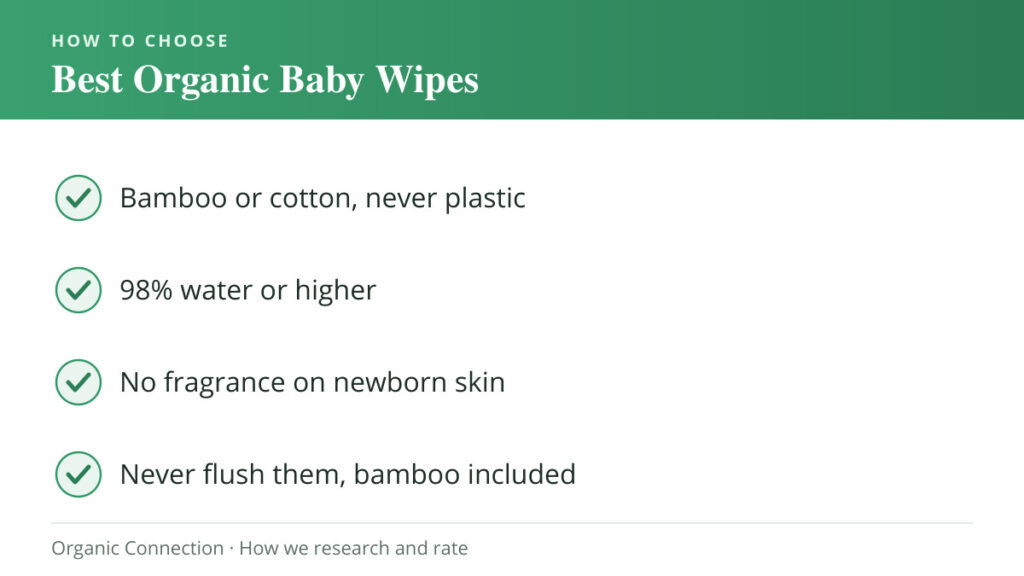
How to choose organic baby wipes
- Check the cloth first: bamboo viscose or cotton, not polyester or polypropylene.
- Look for the water percentage, and prefer 98% or higher.
- Read the full ingredient list, not the claims on the front of the pack.
- Avoid fragrance entirely, especially on newborn and reactive skin.
- Consider dry wipes for home and keep wet ones for the changing bag.
Who should buy organic baby wipes
The right wipe depends on where you are using it. If you want the best all-round wet wipe on ingredients, our top pick fits. If you want the best price per wipe, a genuinely certified organic cotton dry wipe, a high-water biobased option, or a travel pack, we have a pick for each.
Best overall: JOONYA Unscented Baby Wipes, Plant-Based and Fragrance-Free
| Organic Integrity Score | 90 / 100 |
| Material | Bamboo viscose cloth |
| Key ingredients | Organic aloe vera, calendula, chamomile, lavender and sweet orange oils |
| Best for | Everyday changes and general cleanup |
Bum Boosa is our top pick because the ingredient list is the shortest and most defensible in the category, and the cloth is genuinely good. The wipes are bamboo viscose, noticeably thicker and stronger when wet than most competitors, which in practice means one wipe does a job that takes two or three of a thinner brand. The solution uses organic aloe vera with calendula and chamomile, and the company is explicit that there is no alcohol, chlorine, phthalates, formaldehyde, parabens, phenols, SLS, SLES, or lanolin.
The trade-off is the essential oils. Lavender and sweet orange give these a light natural scent, and while both are gentle, any fragrance component is a possible irritant on very reactive newborn skin. If your baby has eczema or has reacted to scented products, choose an unscented option instead. They are also priced above supermarket wipes.
What we liked: Thick strong bamboo cloth, organic aloe and botanicals, and an unusually clear list of what is deliberately excluded.
Keep in mind: Lightly scented with essential oils, which does not suit the most reactive skin, and priced above mainstream brands.
What the listing discloses: You are told EWG Verified for JOONYA; you are not told whether the USDA seal applies and where it was grown or made.
Best value: Caboo Bamboo Baby Wipes, 432 Count
| Organic Integrity Score | 88 / 100 |
| Material | Bamboo viscose cloth |
| Certification | OEKO-TEX, MADE SAFE |
| Best for | Everyday use on sensitive skin |
Caboo is the best-value pick and arguably the safest choice for reactive skin. The wipes are tree-free bamboo viscose, unscented, and 99.7% naturally derived, and crucially the company holds genuine third-party certifications rather than self-declared claims: OEKO-TEX Standard 100 on the cloth, Made Safe on the ingredients, and FSC and BRC accreditation on the manufacturing. Six travel packs of 72 gives you 432 wipes at a competitive price per wipe.
The trade-off is thickness. Caboo wipes are thinner than Bum Boosa’s, so for a heavy nappy change you will reach for a second one, which eats into the price advantage. The travel-pack format also means more individual packaging than one large tub, and the peel tabs lose their stick after a few openings, which dries out the last wipes in a pack.
What we liked: Genuine third-party certifications, unscented and Made Safe, tree-free bamboo, and the best price per wipe here.
Keep in mind: Thinner than the top pick, and the resealable tabs weaken with repeated opening.
What the listing discloses: No organic certification appears anywhere on the Caboo listing.
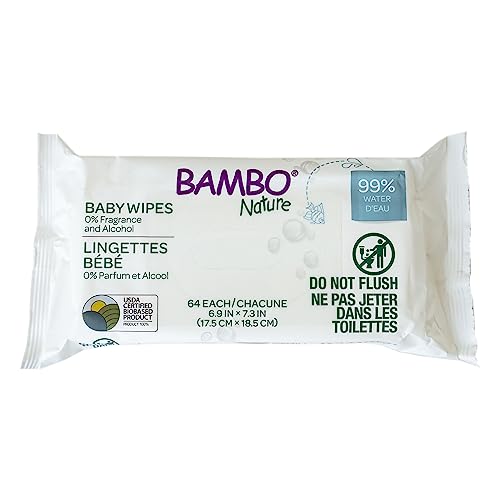
Highest water content: Bambo Nature Baby Wipes, 768 Count
| Organic Integrity Score | 86 / 100 |
| Material | USDA Certified Biobased fiber |
| Certification | Not stated on the listing |
| Best for | Eczema-prone and highly sensitive skin |
Bambo Nature is a Danish brand with a strong reputation in sensitive-skin baby care, and these wipes are built around a 99% water formulation with aloe. Fragrance-free, dye-free, paraben-free, dermatologist approved, and marketed as free of all known allergens, they are the pick if your baby has eczema or has reacted to other wipes. The USDA Certified Biobased label is a real, verifiable certification, and worth understanding precisely: it certifies the proportion of the product derived from renewable biological material, not that it is organic.
The trade-off is that “biobased” is easily misread as organic, and it is a different and lower bar. The 768-count case is also a serious commitment if your baby turns out not to get on with them, and the wipes are on the thinner side, which is a common consequence of a very high water content.
What we liked: 99% water with aloe, fragrance and dye free, USDA Certified Biobased, and a strong record on sensitive skin.
Keep in mind: Biobased certification is not organic certification, and 768 wipes is a large commitment.
What the listing discloses: No organic certification appears anywhere on the Bambo Nature listing.
Best certified organic cotton: The Honest Company Organic Cotton Dry Wipes, 192 ct
| Organic Integrity Score | 84 / 100 |
| Material | 100% organic cotton, dry |
| Certification | — |
| Best for | Newborns, reactive skin, and home changing |
This is the only product here where the word organic applies to the thing you are actually holding. They are 100% organic cotton cloths, sold dry, which you wet with warm water at the changing table. Because there is no solution, there is no preservative, no fragrance, and no surfactant, which makes them the gentlest option in this guide by a wide margin and the standard recommendation for newborn skin and for babies with genuine reactivity. They also double as face cloths, burp cloths, and general-purpose wipes.
The trade-off is convenience, and it is a real one. You need warm water within reach, which rules them out for changes in a car, a park, or a restaurant. They are also less effective on a heavily soiled nappy than a wipe carrying a mild cleanser. Most parents who use these keep a pack of wet wipes in the changing bag as well, which is a perfectly sensible arrangement.
What we liked: Genuinely organic cotton, no preservatives or fragrance at all, exceptionally gentle, and useful for far more than nappy changes.
Keep in mind: Needs water on hand, so impractical away from home, and less effective on heavy messes.
What the listing discloses: The Honest Company commits to a single-ingredient formula but stops short of whether the USDA seal applies and where it was grown or made.
Best for travel: Caboo Bamboo Baby Wipes Travel Pack, 72 Count
| Organic Integrity Score | 80 / 100 |
| Material | Bamboo viscose cloth |
| Certification | MADE SAFE, Organic |
| Best for | Changing bags, cars, and days out |
A single 72-count pack of the same OEKO-TEX certified, unscented bamboo wipes as our value pick, sized for a changing bag. It is slim enough to fit in a coat pocket, and the peel tab reseals well enough for the life of one pack. If you keep a stash in the car, the pram, and the nappy bag, buying these individually rather than in a six-pack means you can top up without opening a large case.
It scores lowest here on economics rather than quality. Buying single travel packs is meaningfully more expensive per wipe than the 432-count multipack of the identical product, and it generates more packaging per wipe. Buy the multipack for the house and keep one of these in the bag, rather than making single packs your default purchase.
What we liked: Same certified bamboo wipes in a genuinely pocketable pack, unscented, with a reseal that lasts a pack.
Keep in mind: The most expensive per wipe here, and more packaging per wipe than a multipack.
What the listing discloses: Caboo leaves the basics open, including whether the USDA seal applies and where it was grown or made.
How to use and store baby wipes well
Wipes dry out from the top down, so store packs flat rather than upright and always press the reseal closed properly. If a pack has dried out, a tablespoon of boiled and cooled water poured in and left for an hour will usually revive it. Keep them out of direct sun and away from radiators, which is where most packs die.
For newborns in the first few weeks, plain warm water and cotton wipes are what most health visitors and midwives recommend, because newborn skin has a barrier that is still developing and is more permeable than adult skin. Wet wipes are fine after that for most babies, and the practical rule is simple: fewer ingredients is better, and fragrance is the first thing to cut. If your baby develops redness that follows the pattern of where you wipe rather than where the nappy sits, suspect the wipe before you suspect the nappy.
Never flush wipes, including ones marketed as flushable and including bamboo. They do not break up like toilet paper and are the main cause of sewer blockages. Bamboo viscose and cotton wipes will biodegrade in landfill or industrial composting far better than polyester ones, but only if they get there. Finally, do not use baby wipes as a substitute for handwashing before feeds, and check dates: the preservative systems in low-preservative natural wipes are less robust, so an old pack at the back of a cupboard is more likely to grow mold than a conventional one.
How we researched this guide
We are a research-based review site. We compared each product against its cloth material, verifiable third-party certifications (OEKO-TEX, Made Safe, FSC, USDA Certified Biobased), full ingredient list, water percentage, presence of fragrance, alcohol, parabens and formaldehyde donors, packaging and reseal quality, and price per wipe, then scored each with our 10-criteria Organic Integrity Score. No brand paid to be included or ranked. This page is informational and is not medical advice; persistent nappy rash or skin reactions should be discussed with your health visitor, midwife, or doctor. Read the full method on our How We Research and Rate page.
Common questions about organic baby wipes
What are the best organic baby wipes?
Our overall pick is Bum Boosa Bamboo Baby Wipes, because they use a thick bamboo viscose cloth with organic aloe and botanicals and exclude alcohol, chlorine, phthalates, formaldehyde, parabens, and SLS. For the best value, Caboo Bamboo Baby Wipes, and for a genuinely certified organic material, The Honest Company Organic Cotton Dry Wipes.
Are any baby wipes actually certified organic?
Wet wipes essentially never are, because a shelf-stable wet wipe needs a preservative system that organic certification does not permit. When a pack says organic it usually means one or two botanical ingredients in the solution are organic. A dry organic cotton wipe that you wet yourself is the only genuinely certified organic option.
Are bamboo baby wipes better than regular ones?
Materially, yes. Most conventional wipes are made from polyester or polypropylene, which is plastic, while bamboo viscose is plant-derived, soft, strong when wet, and biodegradable. Bamboo viscose is still a chemically processed fiber rather than raw plant matter, so look for OEKO-TEX certification on the finished cloth as assurance no harmful residues remain.
Can you flush biodegradable baby wipes?
No. No baby wipe should be flushed, including ones labeled flushable and including bamboo. Wipes do not disperse in water the way toilet paper does and are the main cause of sewer blockages. Biodegradable refers to how they break down in landfill or composting, not in a sewer pipe.
What should you use on a newborn?
Most midwives and health visitors recommend cotton wool or cotton wipes with plain warm water for the first few weeks, because newborn skin is more permeable and its barrier is still developing. After that, a fragrance-free wipe with a very high water content is fine for most babies. If redness follows where you wipe rather than where the nappy sits, suspect the wipe.
- Organic Household & Cleaning hub
- Best Natural Diapers
- Best Organic Baby Food Pouches
- Switching to Organic for Babies and Families
- our searchable product database — compare all 800+ picks side by side
Price and availability as of October 11, 2026 7:10 pm EDT. Product prices and availability are accurate as of the date/time indicated and are subject to change. Any price and availability information displayed on Amazon.com at the time of purchase will apply to the purchase of this product.
Looking for other organic products?
We have checked more than 800 products across food, household goods, gardening, personal care and pet, every one against its stated certification. Browse all reviews.
Organic Connection is reader-supported. When you buy through links on this page we may earn a commission, at no extra cost to you. As an Amazon Associate we earn from qualifying purchases. We are not paid to feature or rank any product. This page is informational and is not medical advice. How we research and rate.