Last updated: September 11, 2026
Some links in this guide point to our product reviews, which may earn us a commission at no extra cost to you. How we research and rate.
“Herbal tea” is one of the loosest terms on a supermarket shelf, and the confusion has a practical consequence: people avoiding caffeine regularly drink something that contains it, and people avoiding it entirely buy decaf assuming it has none. The rule is simpler than the packaging suggests, and once you know it you can work out the answer for any box in the aisle. This guide sets out which infusions genuinely contain no caffeine, which ones catch people out, and why “decaffeinated” and “caffeine-free” are not the same claim.
Genuinely caffeine-free infusions
These contain no caffeine whatsoever, at any stage, because the plants simply do not produce it. There is no processing involved and no residual amount.
- Rooibos. The South African red bush. Naturally caffeine-free, very low in tannins, and one of the few tisanes that takes milk well.
- Chamomile. The classic evening infusion, made from the flower head.
- Peppermint and spearmint. Leaf infusions, and among the most reliably caffeine-free things you can drink.
- Hibiscus. The tart ruby-red calyx infusion, also known as karkade or agua de jamaica.
- Dandelion root. Roasted root, and the closest thing to a coffee substitute that contains nothing stimulating.
- Ginger, turmeric, cinnamon, liquorice, fennel, lemon balm, lemongrass, nettle, raspberry leaf, rosehip, lavender, honeybush. All caffeine-free.
- Fruit infusions. Berry, apple, and citrus blends, provided they contain no added tea leaf, which some do.
The three that catch people out
These are sold alongside herbal teas, are botanically unrelated to Camellia sinensis, and contain caffeine anyway. This is where most of the confusion in the category sits.
Yerba mate. A South American holly, and a genuinely caffeinated drink at roughly 30 to 85 mg per cup, comparable to a cup of tea or a weak coffee. It is frequently shelved with herbal teas and described as a herbal infusion, which is technically accurate and thoroughly misleading if you are avoiding caffeine. Anyone drinking mate in the evening because it is “herbal” is making a mistake.
Guayusa. A close relative of yerba mate from the Amazon, similarly caffeinated, increasingly common in energy drinks and wellness blends.
Guarana. A seed with a caffeine content higher than coffee beans by weight, which turns up in blends and supplements far more often than as a standalone tea.
One more worth flagging: chocolate and cacao husk teas contain theobromine, a stimulant closely related to caffeine, and small amounts of caffeine itself. They are mild, and they are not nothing.
Decaffeinated is not caffeine-free
This is the distinction that matters most for anyone genuinely avoiding caffeine, and the labeling does not make it obvious.
Caffeine-free means the plant never contained caffeine. Chamomile is caffeine-free. There is nothing to remove.
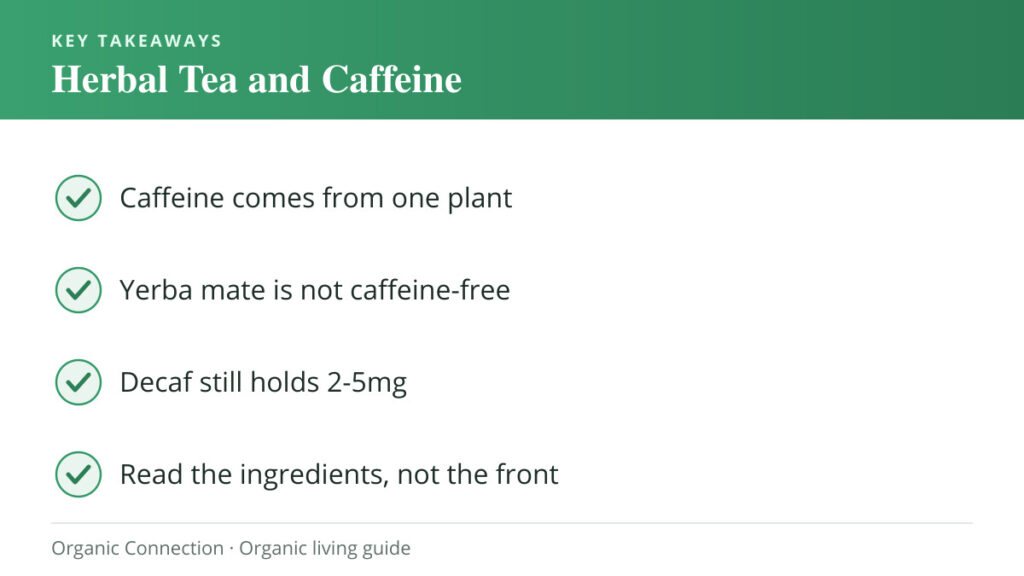
Decaffeinated means caffeine was removed from a plant that had it, and removal is never complete. A decaf black tea typically retains somewhere around 2 to 5 mg of caffeine per cup, versus roughly 40 to 70 mg for regular black tea. That is a large reduction and it is not zero. If you are extremely caffeine-sensitive, or drinking several cups in an evening, that residue adds up.
How it was removed matters too. Commercial decaffeination uses several methods. Ethyl acetate, often labeled “naturally decaffeinated” because the compound occurs naturally in fruit, is a solvent process. Methylene chloride is another solvent method, permitted with residue limits. CO2 decaffeination and the Swiss Water process use no chemical solvent and are generally regarded as the better options, and they are what you will usually find on certified organic decaf tea, since USDA organic rules prohibit the synthetic solvent methods. If you want decaf and care about processing, look for organic certification or an explicit mention of CO2 or Swiss Water.
How much caffeine is actually in tea?
Useful rough figures per 8 oz cup, though the variation within each category is genuinely large:
- Matcha: 60 to 80 mg, because you consume the whole leaf rather than an infusion.
- Black tea: 40 to 70 mg.
- Oolong: 30 to 50 mg.
- Green tea: 25 to 45 mg.
- White tea: 15 to 30 mg.
- Yerba mate: 30 to 85 mg.
- Decaf tea: 2 to 5 mg.
- True herbal infusions: 0 mg.
- Filter coffee, for comparison: 95 to 165 mg.
Two persistent myths worth correcting. First, green tea is not inherently lower in caffeine than black tea because of the plant; the difference comes from leaf grade, growing conditions, and how you brew it, and a strong green tea can easily exceed a weak black tea. Second, the widely repeated advice that steeping for 30 seconds and discarding the first infusion removes most of the caffeine does not work. Caffeine is highly water-soluble but not that fast, and studies have found only a modest proportion is removed by a short rinse. You lose a good deal of flavor and most of the caffeine stays.
What actually changes the caffeine in your cup: steeping time and water temperature, both of which increase extraction; leaf grade, since broken leaf and dust in cheap tea bags extract faster than whole leaf; and how much leaf you use. If you want less caffeine from real tea, use less leaf and steep it more briefly at a lower temperature.
Practical guidance for the evening
If you are cutting caffeine after a certain hour, the useful thing to know is that caffeine has a half-life of roughly five to six hours in most adults, meaning half of a 3pm cup is still circulating at 9pm. Sensitivity varies enormously and is partly genetic, so some people genuinely can drink espresso after dinner and sleep, while others are affected by a cup of green tea at lunchtime.
For an evening drink with nothing stimulating in it at all, rooibos, chamomile, peppermint, and dandelion root are the safest choices, and all four are pleasant enough to build a habit around. Rooibos is the best option if you want something that behaves like tea, since it takes milk and does not turn bitter. Dandelion root is the best coffee substitute. Chamomile has the most tradition behind it as a sleep drink, though the evidence for that effect is modest. If you want the ritual of a strong dark cup, roasted dandelion or a chicory blend gets closest.
One caution that applies specifically to herbal teas. Caffeine-free does not mean pharmacologically inert. Hibiscus genuinely lowers blood pressure and can interact with antihypertensive medication. Liquorice root raises blood pressure and can deplete potassium with regular use. Peppermint relaxes the esophageal sphincter and commonly worsens reflux. Raspberry leaf is not recommended in early pregnancy. These are real effects, and the absence of caffeine says nothing about them. Read what is actually in the blend, and if you take regular medication, mention a daily herbal tea habit to your doctor.
How to check any box in thirty seconds
- Read the ingredient list, not the front of the packet.
- Look for tea, green tea, black tea, or Camellia sinensis. If it is there, the product contains caffeine.
- Check for yerba mate, guayusa, or guarana, the three caffeinated non-tea plants.
- Distinguish “caffeine-free” from “decaffeinated”. The first means none; the second means a small residual amount.
- For decaf, look for organic certification or CO2 or Swiss Water processing if you would rather avoid solvent decaffeination.
- Ignore “herbal” as a caffeine claim. It describes botany, not stimulant content.
Common questions about caffeine in herbal tea
Are herbal teas caffeine free?
Almost all are, because caffeine in tea comes from one plant, Camellia sinensis, and true herbal infusions are made from other plants. Chamomile, rooibos, peppermint, hibiscus, ginger, and dandelion root all contain zero caffeine. The exceptions are yerba mate, guayusa, and guarana, which are sold as herbal but do contain caffeine naturally.
Does decaf tea have caffeine in it?
Yes, a small amount. Decaffeination removes most but never all of it, so a decaf black tea typically retains around 2 to 5 mg per cup against 40 to 70 mg for regular black tea. That is a big reduction rather than zero, which matters if you are very caffeine-sensitive or drinking several cups in an evening.
Does yerba mate have caffeine?
Yes, roughly 30 to 85 mg per cup, comparable to tea or a weak coffee. Yerba mate is a South American holly rather than a true tea, so it is often shelved and described as a herbal infusion, which misleads people avoiding caffeine. It is not an evening drink.
Does rinsing tea leaves remove the caffeine?
Not meaningfully. The common advice to steep for 30 seconds and discard the first infusion removes only a modest proportion of the caffeine, because caffeine is not extracted as quickly as the claim assumes. You lose a lot of flavor and keep most of the caffeine. To reduce caffeine from real tea, use less leaf, cooler water, and a shorter steep.
Is green tea lower in caffeine than black tea?
Usually, but not because of the plant, since both are Camellia sinensis. The difference comes from leaf grade, growing conditions, and how each is typically brewed, with green tea usually made at lower temperatures for less time. A strong green tea can easily contain more caffeine than a weak black tea, and matcha contains more than either because you consume the whole leaf.
Keep reading
- Best Organic Rooibos Tea
- Best Organic Chamomile Tea
- Organic Coffee and Tea: A Cleaner Daily Cup
- How to Read an Ingredient List
- every organic food product we have reviewed — searchable by brand and certification
- Organic Food and Pantry hub
- our organic product database — compare brands across every guide
Organic Connection is reader-supported. When you buy through links in our reviews we may earn a commission, at no extra cost to you. As an Amazon Associate we earn from qualifying purchases. We are not paid to feature or rank any product. This page is informational and is not medical advice. How we research and rate.