Last updated: September 12, 2026
Some links in this guide point to our product reviews, which may earn us a commission at no extra cost to you. How we research and rate.
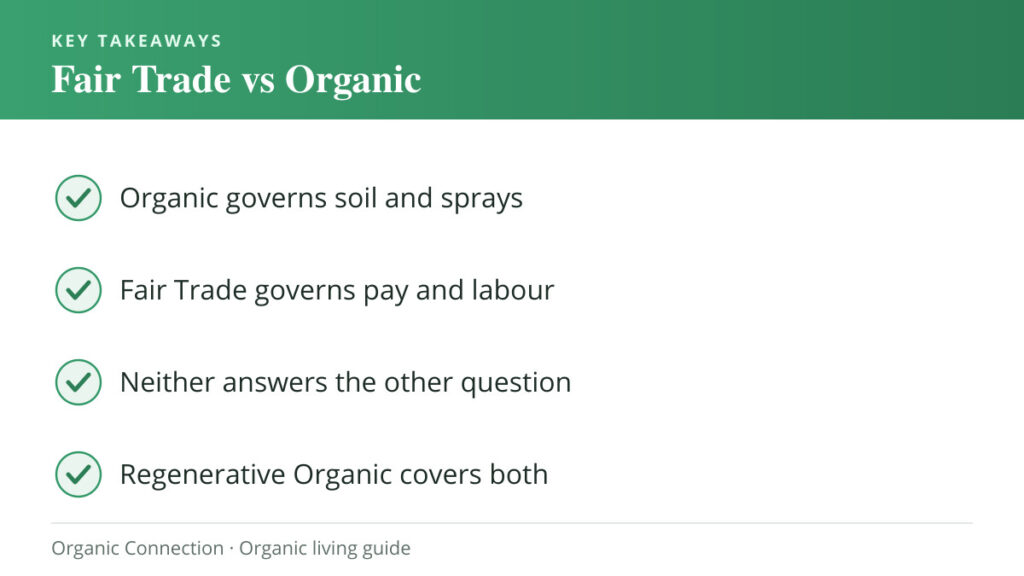
Fair Trade and organic seals sit side by side on a huge number of products, and they are routinely treated as two flavors of the same idea. They are not. One is fundamentally about the environment and what may be applied to a crop; the other is fundamentally about people and what they are paid. A product can carry either, both, or neither, and knowing which question each seal answers tells you what you are actually buying, and where each certification has genuine limits.
What USDA organic actually guarantees
USDA organic certification is a legally enforceable standard with accredited certifiers and annual on-site inspections. Products carrying the seal must meet defined requirements.
What it covers. No synthetic pesticides or fertilizers beyond a specific approved list. No genetically modified organisms. No sewage sludge or irradiation. Land must have been free of prohibited substances for at least three years before certification. Livestock must have outdoor access, organic feed, and no routine antibiotics or growth hormones. In processed foods, a product labeled “organic” must be at least 95% organic ingredients, and “made with organic ingredients” at least 70%. In extraction, solvents such as hexane are prohibited, which is a genuinely useful and under-appreciated part of the standard for oils.
What it does not cover. Wages, working hours, or labor conditions, beyond the general legal requirements any US employer faces. Carbon footprint or food miles. Animal welfare beyond the specific outdoor access and feed rules, which are considerably weaker than dedicated welfare certifications. Heavy metals, which come from soil rather than spraying and are not tested for under organic rules, a point that matters for supplements and greens powders. And nutritional quality, which organic certification makes no claim about at all.
What Fair Trade actually guarantees
Fair Trade is not a single scheme, which is the first thing to understand. Several organizations certify to different standards under similar-sounding names.
Fairtrade International, whose mark is the familiar blue and green circle, is the most established. It guarantees a Fairtrade Minimum Price that acts as a floor when world prices crash, plus a Fairtrade Premium paid on top that the producer organization democratically decides how to spend, typically on schools, clinics, or processing equipment. It prohibits forced and child labor, requires freedom of association, and sets health and safety standards. It also has environmental criteria, including restrictions on the most hazardous pesticides, though these are weaker than organic requirements.
Fair Trade USA split from Fairtrade International in 2011, largely over its decision to certify large plantations and independent smallholders rather than only democratically organized co-operatives. That is a genuine philosophical difference: supporters argue it extends benefits to more workers, critics argue it dilutes the co-operative model the movement was built on.
Fair for Life and Small Producers’ Symbol are further schemes with different emphases, the latter run by producer organizations themselves.
What Fair Trade does not guarantee. That farmers escape poverty, which the premium alone does not achieve. That the product is organic, though many Fairtrade products also are, partly because Fairtrade pays a differential for organic certification. And that every worker on a certified plantation is well paid, since the standards set floors rather than good wages.
Where each one genuinely matters most
The useful question is not which seal is better but which matters more for the specific thing you are buying.
Where organic matters most. Foods you eat whole and unwashed, particularly dried leaves and powders you steep or swallow directly: herbal teas, green powders, and spices. Thin-skinned produce. Crops that are heavily sprayed conventionally, such as almonds, apples, and strawberries. Anything you put on your skin and leave there. And crops that are overwhelmingly GM in conventional form, notably soy, corn, and canola.
Where Fair Trade matters most. Crops grown almost entirely in low-income countries with documented labor problems and long, opaque supply chains. Cocoa is the clearest case, with well-documented child labor issues in West African production. Coffee, tea, bananas, sugar, and cotton follow. If you buy one category on Fair Trade credentials alone, chocolate is the one where it makes the biggest difference.
Where both matter. Coffee, cocoa, tea, bananas, and rooibos are the classic dual-certified categories, and for good reason: they are grown in regions where both pesticide exposure for workers and wage exploitation are real. Note the overlap here, since agricultural workers are the people most exposed to pesticides, organic certification has a labor benefit that is rarely framed that way.
The honest criticisms of both
Neither system is above scrutiny, and pretending otherwise does readers no favors.
Criticisms of organic. Certification is expensive and paperwork-heavy, which excludes many small farmers who already farm without synthetic inputs but cannot afford the audit. Organic yields are generally lower, which means more land per unit of food, a genuine environmental trade-off. “Organic” says nothing about food miles, packaging, or water use, so an organic product airfreighted across the world may have a worse footprint than a conventional local one. And some approved organic pesticides, copper sulfate being the standard example, are not benign.
Criticisms of Fair Trade. The share of the retail price reaching farmers is often small, and several academic studies have questioned how much of the premium translates into higher household income. Certification costs fall on producer organizations, which can disadvantage the poorest. There have been documented cases of standards being breached on certified farms. And because supply of Fairtrade-certified crop frequently exceeds demand, farmers often sell only part of their harvest at Fairtrade terms and the rest at market rates, which dilutes the benefit considerably.
What follows from this. Both seals are meaningfully better than nothing and neither is a guarantee of a good outcome. They are audited floors, not proof of virtue. The most useful way to treat them is as filters that remove the worst options rather than as certificates that the product is beyond criticism.
The other seals you will see next to them
Regenerative Organic Certified is the highest bar currently available and the most relevant development here, because it explicitly combines the two: it requires organic certification as a baseline, then adds audited soil health, animal welfare, and farmworker fairness. It is the answer to the criticism that organic ignores labor. It is still uncommon and expensive, and you will find it on things like Dr. Bronner’s soaps and Manitoba Harvest hemp hearts.
Rainforest Alliance focuses on environmental and social sustainability with an emphasis on biodiversity and deforestation. It is generally considered a lower bar than Fairtrade on price guarantees, since it has no minimum price, and it covers more ground on land use.
Non-GMO Project Verified tests for genetically modified material only, and nothing else. Organic certification already prohibits GMOs, so the two together are somewhat redundant, though the Non-GMO Project does involve direct testing.
Direct trade is not a certification at all. It is a claim, usually by coffee roasters, that they buy straight from producers at above-market prices. From a serious roaster who publishes prices paid it can mean more than Fairtrade; from anyone else it is an unverifiable marketing term.
A practical way to spend your money
You cannot buy everything with every seal, and the honest advice is to prioritize rather than agonize.
- Buy Fair Trade first on cocoa and chocolate. This is the category where the labor problem is most severe and the certification most consequential.
- Buy organic first on things you eat unwashed or apply to skin, particularly dried herbs, teas, powders, and facial oils.
- Buy both on coffee, tea, bananas, and sugar, where they are widely available together and both issues are real.
- Prefer Regenerative Organic Certified where it exists, since it answers both questions at once.
- Do not pay a premium for seals on things that do not need them. Fair Trade on a domestically grown crop, or organic on a thick-skinned vegetable you peel, buys you less.
- Treat unverified words as decoration. “Ethically sourced”, “sustainably grown”, and “responsibly farmed” have no legal definition or audit behind them.
The consistent theme across every label question is the same: a seal from a named certifier with an audit behind it means something specific and limited, and an adjective on the front of a packet means nothing at all. Knowing which question each seal answers is what turns a wall of logos into useful information.
Common questions about Fair Trade and organic
What is the difference between fair trade and organic?
Organic certification is about the environment and what may be applied to a crop: it governs synthetic pesticides, fertilizers, GMOs, and processing solvents. Fair Trade certification is about people: it governs minimum prices, a community premium, and prohibitions on forced and child labor. Neither answers the other’s question, which is why many products carry both.
Does organic certification cover workers’ rights?
Barely. USDA organic standards cover farming inputs and practices, not wages, hours, or working conditions beyond general employment law. There is an indirect benefit, since agricultural workers are the people most exposed to pesticides, but if labor conditions are your concern, Fair Trade or Regenerative Organic Certification addresses that directly and organic certification does not.
Is Fair Trade chocolate worth paying more for?
Of all the categories, this is where the case is strongest. Cocoa production has well-documented child labor and forced labor problems, particularly in West Africa, and supply chains are long and opaque. Fair Trade certification is an audited floor rather than a guarantee of a good outcome, and it is meaningfully better than nothing in a category where the alternative is genuinely bad.
What is Regenerative Organic Certified?
The highest current bar, and the one that combines both concerns. It requires organic certification as a baseline, then adds audited requirements for soil health, animal welfare, and farmworker fairness. It directly answers the criticism that organic certification ignores labor. It is still uncommon and costs more, and it is worth preferring where it exists.
Are “ethically sourced” and “sustainably grown” regulated terms?
No. Those phrases have no legal definition, no standard, and no audit behind them, and any company may print them. They are marketing language rather than certification. If a claim about environment or labor matters to you, look for a named certifier with an audit process, not an adjective on the front of the packet.
Keep reading
- What “Organic” Really Means: A Complete Guide to Certifications
- What Does Regenerative Organic Mean?
- Greenwashing: 12 Label Tricks
- Organic vs Natural vs Non-GMO
- every product we have reviewed — filter by USDA Organic, GOTS, Fair Trade and more
- Organic Food and Pantry hub
- our organic product database — compare brands across every guide
Organic Connection is reader-supported. When you buy through links in our reviews we may earn a commission, at no extra cost to you. As an Amazon Associate we earn from qualifying purchases. We are not paid to feature or rank any product. How we research and rate.