Last updated: September 12, 2026
Some links in this guide point to our product reviews, which may earn us a commission at no extra cost to you. How we research and rate.
Greenwashing is what happens when a product is marketed as environmentally or ethically better than it actually is. It is not usually outright lying, which is why it works: the claims are technically defensible, legally survivable, and designed to be read faster than they are examined. Once you know the specific techniques, they become almost comically obvious. This guide walks through the twelve tactics you will meet most often on organic and natural product packaging, the seals that are genuinely verified versus the ones a brand invented last quarter, and a thirty-second routine for checking any product in the aisle.
Twelve greenwashing tactics, and how to see through them
1. The meaningless word
“Natural” is the flagship offender. On food, the FDA has no formal definition for it and has historically only taken the position that it means nothing artificial or synthetic was added, which permits a great deal. On cosmetics and household products, it means nothing at all. The same applies to “pure,” “wholesome,” “clean,” “eco-friendly,” “earth-conscious,” and “green.” None of these are regulated, none are audited, and any product on the shelf may use them.
How to see through it: Treat these words as decoration and go directly to the certification seals and the ingredient list. If a product’s environmental case rests entirely on adjectives, there is no case. Our full breakdown of the regulated versus unregulated terms is in Organic vs Natural vs Non-GMO.
2. The fake seal
This one is deliberate. Brands create logos that mimic the visual language of real certification: a circular badge, a green border, a leaf, and text like “Certified Natural,” “Eco Verified,” or “Purity Approved.” They look like the USDA organic seal at a glance and are frequently placed beside genuine seals to borrow credibility. Some are self-certification schemes the brand created; a few belong to industry associations whose standard is membership plus a fee.
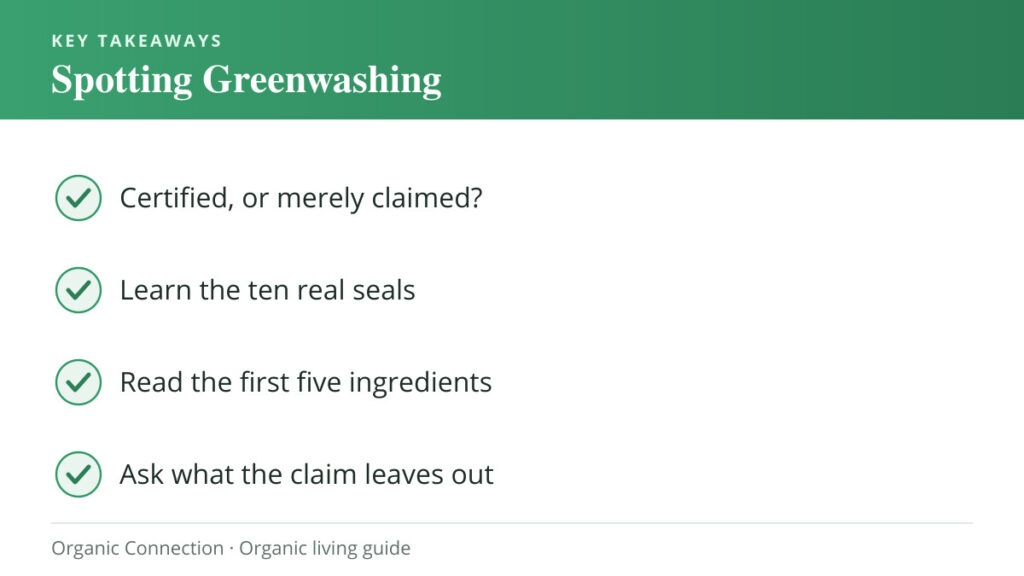
How to see through it: Learn the handful of real seals by sight. USDA Organic (green and white circle), GOTS for textiles, GOLS for organic latex, OMRI Listed for garden inputs, Fair Trade Certified, EPA Safer Choice, Non-GMO Project Verified, Leaping Bunny, and OEKO-TEX Standard 100. If a badge is not one of these, search the certifying body’s name. Real certifiers publish a searchable database of certified operations; invented ones have a marketing page or nothing at all.
3. Hiding behind one ingredient
A shampoo built on conventional detergents adds a small amount of organic aloe and puts “with organic aloe vera” across the front. The claim is true. It is also irrelevant to the other 98 percent of the bottle. This is the most common technique in personal care, and it is effective because the claim is specific enough to sound substantive.
How to see through it: Read where the highlighted ingredient sits in the list. Ingredients are listed in descending order of quantity, so anything appearing after the fragrance or preservative is present in a trace amount. A product genuinely built on organic ingredients names them in the first three or four positions.
4. “Made with organic ingredients” versus certified organic
The USDA organic system has tiers, and brands exploit the gap between them. “100% Organic” means every ingredient is certified organic. “Organic” means at least 95 percent, and these two tiers may display the USDA seal. “Made with organic ingredients” means at least 70 percent, and this tier may not use the seal, though it can list up to three organic ingredients on the front. Below 70 percent, a product may only identify organic ingredients in the ingredient list itself.
How to see through it: Look for the actual USDA seal, not the word “organic” in the product name. “Made with organic oats” on the front with no seal tells you the product is somewhere between 70 and 94 percent organic, which may be fine, but it is not the same thing. Full detail is in our guide to organic certifications.
5. The irrelevant claim
“CFC-free” on an aerosol, when CFCs have been banned for decades. “Gluten-free” on a bottle of water. “No cholesterol” on a plant oil, which never contained any. “BPA-free” on a product that was never made with BPA. Each statement is true, and each is engineered to imply that competing products lack the same property.
How to see through it: Ask whether the absent thing was ever plausibly present, or whether it is simply illegal now. If either is the case, the claim is filler, and filler on the front of a box usually indicates there was nothing stronger to put there.
6. The hidden trade-off
A product is promoted on one genuine environmental attribute while a larger impact goes unmentioned. Bamboo viscose fabric marketed as sustainable because bamboo grows quickly, without mentioning that converting bamboo to viscose is a chemical-intensive process. A “recyclable” package that is technically recyclable but not accepted by most municipal programs. Single-use items sold as compostable when they only break down in industrial facilities most people cannot access.
How to see through it: Ask what the claim omits. If a product’s environmental story covers only one stage of its life, raw material but not processing, or disposal but not production, the missing stages are usually missing for a reason.
7. Nature imagery as argument
Kraft paper packaging, muted greens and browns, leaf motifs, a serif typeface, a photograph of a field. None of this is a claim, which is precisely the point: visual identity is not regulated because it does not technically assert anything. A conventional product in earth-toned packaging is consistently perceived as healthier and more natural than the identical product in bright packaging.
How to see through it: Deliberately separate what the package looks like from what it says. If you covered the design and read only the ingredient list and the certification marks, would you still reach the same conclusion? Kraft paper is a design choice, not a certification.
8. The vague number
“Up to 70 percent less plastic.” “Carbon neutral by 2050.” “Made with 30 percent recycled content.” Numbers feel rigorous, but “up to” makes any figure a ceiling rather than a typical value, a distant pledge commits nobody currently employed, and “recycled content” without specifying post-consumer versus post-industrial can mean factory offcuts that were never waste.
How to see through it: Look for the baseline and the verification. Less plastic than what, measured how, and audited by whom? Reputable claims cite a comparison and a verifying body. Vague ones cite neither.
9. The organic sub-brand
A large conventional manufacturer launches an “organic” or “simply” line with different packaging and a warmer name. This is not automatically greenwashing, since many such lines are genuinely certified and represent real supply chain investment. It becomes greenwashing when the sub-brand’s aesthetic implies a different kind of company, or when only some products in the line are certified and shoppers assume the whole range is.
How to see through it: Check each product individually rather than trusting the line. Within a single “organic” range it is common to find some items carrying the USDA seal and others carrying only “made with organic” or nothing at all.
10. Certifying the trivial part
A mattress advertised as having a certified organic cotton cover, where the cover is a small fraction of the product and the foam core is conventional polyurethane. A “GOTS certified” garment where only the fabric is certified and the finishing is not. A skincare line where the carrier oil is certified organic and everything doing the actual work is not.
How to see through it: Ask what proportion of the product the certification actually covers. Real textile certification like GOTS covers fiber, processing, dyeing, and finishing; a mattress certification like GOLS covers the latex itself. If a brand is specific about which component is certified, read that specificity as a limit, not a detail.
11. Borrowed credibility
“Dermatologist recommended,” “as seen in,” “award-winning,” “clinically proven,” and a logo from a magazine that ran a sponsored feature. None of these are certifications. “Clinically proven” without a citation is a phrase, not a study, and a single small company-funded trial is a very different thing from independent evidence.
How to see through it: Look for the source. A real study has authors, a journal, and a date. An award has an awarding body you can look up. If none of that is available on the packaging or the brand’s website, it is atmosphere.
12. Organic junk
The subtlest one, because nothing is false. A product genuinely carries USDA organic certification, and the certification is being used to imply health benefits the product does not have. Organic cane sugar is sugar. Organic candy is candy. An organic snack bar with organic syrup as its second ingredient is a confection. The seal describes how ingredients were farmed, not what they do to you.
How to see through it: Separate the two questions entirely. “Was this grown without synthetic pesticides and GMOs?” is answered by the seal. “Is this good for me?” is answered by the nutrition panel and the ingredient list. A product can genuinely pass the first and clearly fail the second.
The seals that are actually verified
A short reference, because recognizing these by sight neutralizes most of the tactics above.
- USDA Organic: food, supplements, and some personal care. Legally defined, accredited certifiers, annual inspection. Tiered at 100%, 95%, and 70%.
- GOTS (Global Organic Textile Standard): textiles. Covers organic fiber content plus every processing stage, restricted chemicals, wastewater treatment, and social criteria.
- GOLS (Global Organic Latex Standard): organic latex in mattresses and toppers.
- OEKO-TEX Standard 100: tests finished fabric for harmful substances. Note it is a safety test, not an organic certification.
- OMRI Listed: garden and farm inputs reviewed against the USDA organic standard. The mark to look for on mulch, fertilizer, and compost.
- Non-GMO Project Verified: genuine third-party verification, but narrow. It addresses genetic modification only and says nothing about pesticides.
- Fair Trade Certified / Fair for Life: labor standards, wages, and community investment.
- EPA Safer Choice: household and cleaning products, every ingredient reviewed for human and environmental safety.
- Regenerative Organic Certified: builds on USDA organic with soil health, animal welfare, and farmworker fairness requirements.
- Leaping Bunny: animal testing only. A real certification, but not a health or environmental claim.
A thirty-second aisle check
You do not need to research every purchase. This sequence catches nearly everything.
- Ignore the front of the package entirely. That surface is advertising. Turn it over.
- Find a real seal. Is there a certification you recognize from the list above? If not, every environmental claim on the product is self-asserted.
- Read the first five ingredients. They make up the bulk of the product. Whatever the front promotes should appear here, not in the last three positions.
- Check what the certification covers. Whole product, one component, or one stage of processing?
- Ask what is missing. If the claim covers only material, or only disposal, the unmentioned stages are the interesting ones.
If a product survives all five, it is very likely what it says it is. If it fails at step two, everything else on the label is the company’s own opinion of itself.
Why this keeps happening
It is worth understanding the incentive, because it explains why greenwashing is persistent rather than occasional. Demand for organic and sustainable products has grown far faster than the supply of genuinely certified goods, and certification is expensive, slow, and in the case of organic requires a three-year land transition. Marketing language, by contrast, is free and immediate. A brand can adopt the visual and verbal vocabulary of sustainability in a packaging redesign, capture much of the price premium, and take on none of the compliance cost.
Regulators are catching up unevenly. The FTC’s Green Guides set out what environmental marketing claims should mean in the US, and enforcement actions do happen, but the guides are advisory and the pace is slow relative to how quickly packaging changes. In practice, the check on greenwashing is informed shoppers and the certifying bodies themselves, which is why knowing which seals are real does more work than any regulation currently in force.
None of this means organic certification is a scam or that every brand is cynical. The opposite: certification is valuable precisely because it is difficult and audited, which is exactly why so much marketing tries to approximate its appearance without meeting its requirements. The seal is worth trusting. The adjectives around it are not.
How to judge a green label quickly
Greenwashing works by looking like verification without being verification. Every technique in this guide, the invented seal, the trace ingredient, the irrelevant claim, the earth-toned packaging, the vague percentage, ultimately relies on you not asking whether an independent body checked. Ask that one question, learn the ten or so seals that answer it, read the first five ingredients, and the aisle becomes dramatically easier to navigate. You will also find that the products that survive scrutiny tend to be quieter about it, because a certification mark does not need adjectives to back it up.
Common questions about greenwashing
What is greenwashing?
Greenwashing is marketing a product as more environmentally friendly, natural, or ethical than it actually is. It usually works through technically true but misleading claims, unregulated words like “natural” and “eco-friendly,” invented certification-style logos, and packaging design that implies environmental credentials without asserting them.
How can I tell if an organic claim is real?
Look for an independent certification seal rather than the word alone. USDA Organic, GOTS, GOLS, OMRI Listed, Fair Trade Certified, and EPA Safer Choice are verified by third parties with audits and consequences. If a product’s only support is words like natural, clean, green, or eco-friendly, the claim is self-asserted and unverified.
Does “natural” mean anything on a label?
Very little. On food, the FDA has no formal definition and has generally treated it as meaning nothing artificial or synthetic was added, which permits a great deal. On cosmetics and household products it has no regulatory meaning at all. Unlike “organic,” no one audits a natural claim.
What is the difference between “organic” and “made with organic ingredients”?
They are different USDA tiers. “Organic” means at least 95 percent certified organic ingredients and may carry the USDA seal. “Made with organic ingredients” means at least 70 percent and may not display the seal, though it can name up to three organic ingredients on the front. The presence or absence of the seal is the fastest way to tell them apart.
Are fake certification logos legal?
Brands can create their own logos and self-certification programs, and doing so is not automatically illegal, though the FTC’s Green Guides address deceptive environmental marketing and enforcement does occur. The practical defense is recognizing the genuine seals by sight and searching any unfamiliar certifier, since real ones publish searchable databases of certified operations.
Keep reading
- What “Organic” Really Means: A Complete Guide to Certifications
- Organic vs Natural vs Non-GMO: What Labels Actually Mean
- Is Organic Worth It? An Honest Cost Breakdown
- How we research and rate products
- all our reviewed products in one place — sortable by Organic Integrity Score
Organic Connection is reader-supported. When you buy through links in our reviews we may earn a commission, at no extra cost to you. As an Amazon Associate we earn from qualifying purchases. We are not paid to feature or rank any product. How we research and rate.