
Last updated: September 11, 2026
Some links in this guide point to our product reviews, which may earn us a commission at no extra cost to you. How we research and rate.
The single most effective way to make organic produce affordable is not a coupon or a bulk buy. It is buying what is actually in season. Organic strawberries in June and organic strawberries in January are the same fruit at wildly different prices, and the January version is usually worse. This guide walks the year month by month, explains why seasonal organic produce costs so much less and often tastes better, and covers the practical mechanics of preserving a glut so a summer surplus feeds you through the winter.
Why seasonal organic produce costs less
Three things drive the price difference, and they compound.
Supply and scarcity
When a crop is at peak harvest in your region, supply is abundant and prices fall. Out of season, that same crop must come from a different hemisphere or a heated greenhouse, and the supply is limited and expensive to produce. Organic amplifies this, because the organic share of any crop is smaller to begin with, so out-of-season organic supply is scarcer still.
Transport and storage
Out-of-season produce travels, often by air for delicate items like berries and asparagus, and refrigerated air freight is one of the most expensive ways to move food. In-season local produce travels a short distance by road. That cost lands directly in the shelf price.
Growing conditions
Producing a summer crop in winter requires heated, lit greenhouses, which is energy-intensive and expensive. Growing the same crop in its natural season needs sunlight, which is free. It is also easier to farm organically in season, because a crop grown in the conditions it evolved for is less stressed and less prone to the pest and disease pressure that makes organic production difficult.
There is a quality argument on top of the price one. Produce destined to travel is bred and picked for durability rather than flavor, harvested underripe so it survives the journey, and ripened in transit or with ethylene. Produce picked ripe and sold locally has none of those compromises. This is why a seasonal organic tomato tastes like something and a January one tastes like water.
A month-by-month guide
Seasons vary by region and climate zone, so treat this as a template for the temperate US rather than a fixed calendar. If you are in the deep south or the Pacific Northwest, shift it by a few weeks and check a local growing calendar.
January and February
At their best: citrus of all kinds, oranges, grapefruit, mandarins, lemons; hardy brassicas including kale, cabbage, Brussels sprouts, and cauliflower; storage roots such as carrots, beets, parsnips, turnips, and potatoes; onions, leeks, and winter squash.
This is the season where the pantry does most of the work, and where a well-stocked one earns its keep. Citrus is the star and organic citrus is genuinely affordable in these months. Lean on grains, legumes, and shelf-stable staples: this is soup and stew territory, built on organic rice, dried beans, and pasta, with frozen organic vegetables filling the gaps. Buying frozen organic berries and spinach now costs a fraction of fresh and loses nothing nutritionally.
March and April
At their best: asparagus, spring greens, spinach, radishes, spring onions, artichokes, peas, rhubarb, and the first strawberries in warmer regions.
The hungry gap, when winter storage crops are tired and summer has not arrived. Asparagus is the first genuinely exciting thing and its organic season is short, so buy it while it lasts. Spring greens are cheap and abundant. This is a good moment to plant, too: if you have any outdoor space, organic seeds sown now in decent potting soil deliver the most expensive organic items, salad leaves and herbs, at nearly no cost by June. Our gardening guide covers the basics.
May and June
At their best: strawberries, cherries, apricots, peas, lettuce and salad leaves, cucumbers, early zucchini, new potatoes, and herbs.
Strawberry season is the clearest illustration of everything in this guide. Strawberries sit consistently at the top of the Dirty Dozen for pesticide residue, so this is a fruit where organic genuinely matters, and in peak season organic strawberries are affordable in a way they never are in January. Buy them in quantity, eat what you can, and freeze the rest on a tray before bagging. The same applies to cherries and apricots.
July and August
At their best: tomatoes, corn, peppers, zucchini and summer squash, green beans, eggplant, peaches, nectarines, plums, melons, blueberries, raspberries, and basil.
Peak abundance, and the months when organic produce is at its cheapest and best all year. Tomatoes are the thing to prioritize: a seasonal organic tomato and a supermarket winter tomato are barely the same food. This is the time to buy in bulk and preserve, because everything you put away now is something you do not pay a premium for in February. Stone fruit and berries freeze well; tomatoes, peppers, and beans are all worth putting up.
September and October
At their best: apples, pears, grapes, figs, winter squash and pumpkins, sweet potatoes, broccoli, cauliflower, Brussels sprouts, late tomatoes, and the first of the storage roots.
The overlap season, and arguably the best of the year: summer crops are still coming while autumn ones arrive. Apples and pears are at their cheapest and most varied, and both sit on the Dirty Dozen, so organic is worth it here. Winter squash is a bargain and stores for months in a cool room without any processing at all, making it one of the easiest ways to carry autumn abundance into winter.
November and December
At their best: winter squash, root vegetables, cabbage, kale, Brussels sprouts, leeks, cranberries, pomegranates, and late apples and pears.
Back into storage and brassica territory. Cranberries appear briefly and freeze perfectly, so buy extra bags and put them in the freezer. Root vegetables and squash are cheap, and organic versions of both are among the smallest premiums in the produce aisle. This is also when coffee, tea, and warming spices like cinnamon and ginger do the heavy lifting on flavor, and none of those are seasonal.
Preserving a glut, practically
Buying seasonally only halves the problem; the other half is making a July surplus last until March. You do not need canning equipment for most of it.
Freezing
The easiest and most forgiving method, and it preserves nutrients well. Berries, cherries, and stone fruit: spread on a tray, freeze solid, then bag, which stops them clumping. Green beans, peas, broccoli, and corn need blanching first, two to three minutes in boiling water then straight into ice water, which deactivates the enzymes that would otherwise degrade color and texture. Herbs freeze well chopped into ice cube trays with a little olive oil. Tomatoes can go into the freezer whole and unblanched; the skins slip off under warm water later, and they are perfect for sauces.
Drying
Apples, pears, stone fruit, tomatoes, and herbs all dry well in a low oven or a dehydrator, and dried produce takes almost no storage space. Dried tomatoes and apple rings are genuinely worth the effort; dried herbs from your own garden are far better than most of what you can buy.
Fermenting
The cheapest preservation method there is, requiring only salt and a jar. Cabbage into sauerkraut, cucumbers into pickles, mixed vegetables into a brine. Fermented vegetables keep for months refrigerated and add probiotic value rather than just preserving what was there.
Cold storage
The method people forget. Winter squash, onions, garlic, and potatoes keep for months in a cool, dark, dry place with no processing whatsoever. Apples keep for weeks to months in a cold garage. This is free preservation and it handles a large share of autumn abundance.
Where seasonality does not apply
A useful counterweight: most of a well-run organic kitchen is not seasonal at all. Grains, flour, legumes, oils, nut butters, coffee, tea, spices, canned tomatoes, and vinegars are shelf-stable commodities available at stable prices year round, and they are also the categories where the organic premium is smallest. Building a solid organic pantry, which we cover in detail in our pantry guide, means seasonal produce is the variable layer on top of a stable base rather than the whole strategy.
Frozen organic produce also deserves defending. It is picked and frozen at peak ripeness, retains nutrients well, costs substantially less than out-of-season fresh, and eliminates spoilage waste. Buying frozen organic berries in February is not a compromise; it is usually the better choice on price, quality, and waste simultaneously. The same goes for canned and jarred organic tomatoes, which are processed in season and are generally better than fresh out-of-season tomatoes for cooking.
And a note on air miles: transport is a smaller share of most foods’ environmental footprint than production method, so a locally grown but heavily heated greenhouse tomato can carry a larger footprint than one shipped by sea from a warmer climate. Seasonality is a strong heuristic for price and flavor and a decent one for footprint, but it is not an absolute rule.
Making it work in practice
A few habits turn this from a nice idea into actual savings. Shop the produce section by price rather than by list: whatever is cheapest and looks best that week is almost certainly in season, and that is a more reliable signal than any calendar. Plan meals around what you bought rather than buying to a predetermined plan, which is also the single biggest lever on food waste. Visit a farmers market late in the day, when prices soften and growers would rather sell than pack up, and ask small growers about their practices, since many farm organically without paying for certification.
Buy in quantity when something hits its seasonal low, and preserve the same day rather than intending to and forgetting. Keep a running freezer inventory so summer berries actually get eaten rather than becoming an archaeological layer. And accept that eating seasonally means eating repetitively for stretches, a lot of squash in November, a lot of greens in April. That is the trade, and it is the same trade that makes the food cheaper and better.
What seasonal eating is really worth
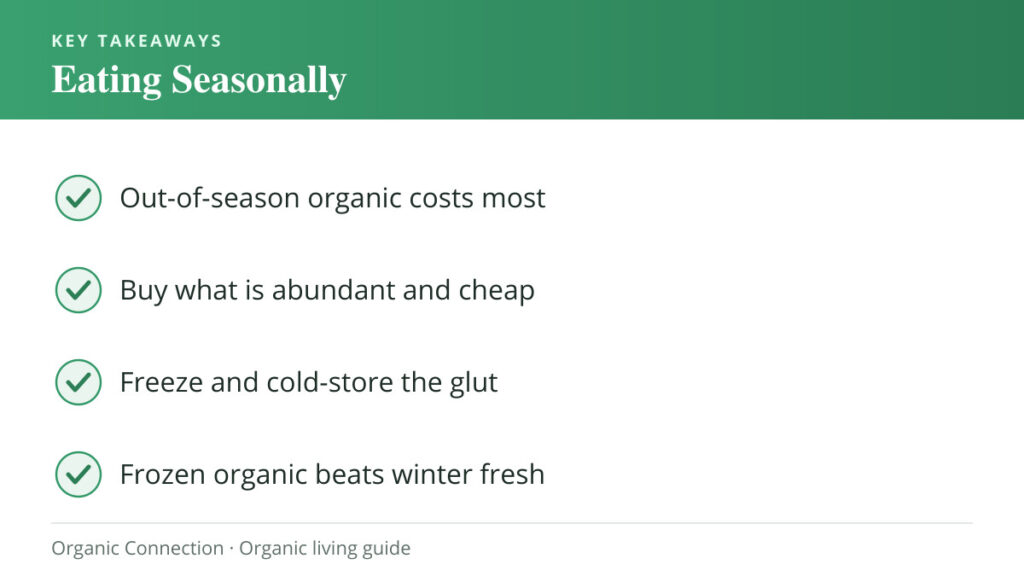
Seasonality is the rare strategy that improves quality and cuts cost at the same time, and on organic produce the effect is amplified because out-of-season organic carries the steepest premium in the store. Buy what is abundant, prioritize organic on the Dirty Dozen items when they are in season and cheap, preserve the gluts by freezing and cold storage, lean on frozen organic and a stable pantry through the lean months, and stop paying four times the price for a January strawberry that does not taste of anything. Done consistently, this alone brings an organic produce budget within range of a conventional one.
Common questions about seasonal eating
Why is organic produce cheaper in season?
Because supply is abundant and local. Out of season, the same crop must come from another hemisphere or a heated greenhouse, adding refrigerated or air freight, energy costs, and scarcity pricing. Organic amplifies this because the organic share of any crop is smaller, so out-of-season organic supply is scarcer and more expensive still.
Is frozen organic produce as good as fresh?
For most purposes, yes, and out of season it is usually better. Frozen produce is picked and frozen at peak ripeness, retains nutrients well, costs substantially less than out-of-season fresh, and eliminates spoilage waste. Out-of-season fresh produce is picked underripe to survive transit and often tastes noticeably worse.
Which organic produce is worth prioritizing?
Thin-skinned items you eat whole, which sit at the top of the Dirty Dozen: berries, leafy greens, grapes, apples, peaches, peppers, and celery. These are also the items where seasonal timing makes the biggest difference to price, so buying them organic at peak season is the best combination of value and residue reduction.
Do I need canning equipment to preserve produce?
No. Freezing handles most of it and needs nothing but bags and a tray. Blanch green vegetables briefly before freezing; berries and stone fruit freeze on a tray first to stop clumping. Fermenting needs only salt and a jar, and winter squash, onions, garlic, and potatoes keep for months in a cool dark place with no processing at all.
Is local always better than imported?
Not always. Transport is generally a smaller share of a food’s environmental footprint than how it was produced, so a local tomato grown in a heated greenhouse in winter can carry a larger footprint than one shipped by sea from a warmer climate. Seasonality is an excellent guide to price and flavor and a reasonable one for footprint, but not an absolute rule.
Keep reading
- Is Organic Worth It? An Honest Cost Breakdown
- The Dirty Dozen and Clean Fifteen
- How to Build an Organic Pantry Without Overspending
- Organic Gardening for Beginners
- Organic Product Database — search every product we have reviewed, by certification
- Organic Food and Pantry hub
- our organic product database — compare brands across every guide
Organic Connection is reader-supported. When you buy through links in our reviews we may earn a commission, at no extra cost to you. As an Amazon Associate we earn from qualifying purchases. We are not paid to feature or rank any product. How we research and rate.