Last updated: September 11, 2026
Some links in this guide point to our product reviews, which may earn us a commission at no extra cost to you. How we research and rate.
If you have ever stood in a store holding two similar products, one that says “organic” and one that says “all natural,” and wondered whether the difference is real or just marketing, you are asking the right question. The short answer: “organic” is a legally regulated claim backed by certification and inspection, while “natural” usually is not. This guide explains what the major organic and clean-product certifications actually mean, what each one verifies, and how to use them to shop with confidence across food, skincare, supplements, textiles, and your garden.
Why “organic” is a regulated word (and “natural” is not)
In the United States, the word “organic” on food is regulated by the US Department of Agriculture under the National Organic Program. A product cannot legally call itself organic, or display the USDA Organic seal, unless it and the farm or facility that made it have been certified by a USDA-accredited agent. That means real paperwork, annual inspections, and rules about what can and cannot be used in growing and processing. Break the rules and a producer can lose certification and face penalties.
“Natural,” by contrast, is a marketing term with no consistent legal standard on most products. A cereal, a lotion, or a cleaning spray can say “natural” while still containing synthetic ingredients, because no agency verifies the claim across the board. This is the single most important thing to understand as an organic shopper: a certification seal is a promise someone checked, while an unregulated adjective is a promise the brand is making about itself. Both can appear on the same shelf, and they are not equal.
That does not mean every uncertified product is bad, small producers sometimes follow organic practices without paying for certification, but it does mean the burden of proof shifts to you. With a certified product, an independent body has already done the checking. This is the logic behind our own research and rating method: we weight genuine certification heavily because it is verifiable, and we are skeptical of unregulated buzzwords.
USDA Organic: the food and supplement standard
The USDA Organic seal is the one most Americans recognize, and it applies to food, beverages, and many supplements. To carry it, crops must be grown without most synthetic pesticides and fertilizers, without genetically modified seed, and without sewage sludge or irradiation. Animals must be raised on organic feed, given access to the outdoors, and raised without routine antibiotics or added growth hormones. Processing must avoid a long list of synthetic additives.
There are actually tiers worth knowing. “100% Organic” means every ingredient is certified organic. “Organic” means at least 95% of ingredients (by weight, excluding water and salt) are organic. “Made with organic ingredients” means at least 70%, and these products cannot display the USDA seal on the main label. Below 70%, a product can only list specific organic ingredients in the ingredient panel. So the seal itself is a shortcut: if you see the round green-and-white USDA Organic seal, you know it is at least 95% organic and was inspected.
This standard is why we insist on the USDA seal in categories where it genuinely applies, from the best organic coffee and olive oil to ghee, pasta, and supplements like turmeric and beet root. When you shop our food and supplement reviews, the USDA seal is the first thing we verify.
CCOF and Oregon Tilth: certifiers, not separate standards
You will sometimes see “CCOF” (California Certified Organic Farmers) or “Oregon Tilth Certified Organic” alongside or instead of the USDA seal. These are not competing standards, they are USDA-accredited certifying agents that inspect to the same national organic rules. Seeing them is a good sign: it tells you which independent body did the inspection. A product certified by CCOF is USDA organic; the extra name just adds traceability.
GOTS: the gold standard for organic textiles
Food is not the only thing that can be organic. The fibers in your sheets, clothing, and towels are grown crops too, and the equivalent of USDA Organic for textiles is GOTS, the Global Organic Textile Standard. GOTS is stricter than a simple “organic cotton” claim because it certifies the entire supply chain, not just the field. To be GOTS certified, a textile must contain at least 95% certified organic fibers, and every processing step, spinning, weaving, knitting, dyeing, and finishing, must meet strict environmental and toxicological criteria. That rules out the harsh chemical dyes, formaldehyde finishes, and heavy metals used in conventional textile manufacturing.
GOTS also includes social criteria covering fair labor conditions in the factories. So a GOTS label is doing double duty: it verifies the cotton was organically grown and that turning it into fabric did not poison workers, waterways, or, ultimately, your skin. This is why GOTS is the certification we look for first in bedding and apparel, from the best organic cotton sheets and duvet covers to pajamas and underwear. If a product says “made with organic cotton” but carries no GOTS seal, only the fiber might be organic while the dyeing and finishing were conventional.
GOLS: organic latex
A close cousin of GOTS is GOLS, the Global Organic Latex Standard, which certifies natural latex made from organically grown rubber-tree sap. You will encounter it on mattresses and mattress toppers. Just as GOTS is the mark of genuinely organic cotton, GOLS is the mark of genuinely organic latex, as opposed to synthetic or blended foam sold under a vague “natural” banner. We lean on it heavily in our guide to the best organic mattress topper.
OEKO-TEX: safe, but not the same as organic
OEKO-TEX Standard 100 is a certification you will see often on bedding and clothing, and it is important to understand exactly what it does and does not promise. OEKO-TEX tests the finished fabric for harmful substances and certifies that it is free of regulated levels of hundreds of chemicals. That makes it a genuine safety assurance: an OEKO-TEX certified sheet has been tested for the nasties.
But OEKO-TEX is not an organic certification. It says nothing about how the fiber was grown; a conventionally farmed cotton, treated to remove residues, can be OEKO-TEX certified. So the honest way to read it is: OEKO-TEX means “tested safe to touch your skin,” while GOTS means “organically grown and cleanly processed.” The two often appear together, and both are valuable. This distinction matters most in categories where true organic fiber is rare. In our guide to the best organic linen sheets, for example, we explain that genuinely GOTS-organic linen barely exists, so the practical standard for clean linen becomes 100% European flax with OEKO-TEX certification, and we are transparent about that trade-off rather than pretending a linen is organic when it is not.
Non-GMO Project Verified: overlap, but not organic
The orange-and-blue Non-GMO Project butterfly is one of the most common seals in natural-food aisles, and it causes a lot of confusion. It verifies that a product was made without genetically modified organisms, following the Non-GMO Project’s testing and traceability standard. That is worthwhile, but it is a narrower claim than organic. Non-GMO says nothing about pesticides, synthetic fertilizers, or organic processing.
Here is the key relationship: all certified USDA organic products are already non-GMO by definition, because organic rules prohibit GMOs. So if something is USDA Organic, the separate Non-GMO seal is a nice confirmation but not additional protection. Where the Non-GMO butterfly earns its keep is on products that are not organic: it lets you avoid GMOs even when you are buying conventional. Think of organic as the bigger circle that already contains non-GMO inside it.
Fair Trade: people and planet, alongside organic
Fair Trade certification (from bodies like Fair Trade USA or Fairtrade International) is not about how clean the product is, it is about how fairly the people who grew it were treated. It sets standards for fair prices, safe working conditions, community investment, and environmental practices, and is especially common on coffee, tea, chocolate, sugar, and bananas. Many of the best organic products are also Fair Trade, because the same conscientious brands care about both. When you see Fair Trade next to USDA Organic on a bag of coffee or a box of black tea, you are getting a product that is both cleanly grown and ethically sourced. It is a bonus signal of quality, not a substitute for the organic seal.
Specialty seals worth knowing
A few more certifications show up in specific categories and are worth recognizing:
- GREENGUARD Gold: certifies that a product, often a mattress, furniture piece, or building material, meets strict limits for chemical emissions and off-gassing. It is about the air quality around the product, not organic content. It is a key mark in our guide to the best organic crib mattress, where low emissions matter enormously for infant sleep.
- MADE SAFE: screens a product against a large list of known harmful chemicals across ingredients. You will see it on some baby products, personal care, and mattresses.
- OMRI Listed: the Organic Materials Review Institute reviews inputs, fertilizers, pest controls, potting soils, for use in certified organic growing. If you garden organically, OMRI Listed is the seal that tells you a product is allowed under organic rules. It anchors our guide to the best organic fertilizer and related gardening reviews.
- USDA Biobased: indicates the percentage of a product made from renewable biological materials, common on cleaning products. Useful, but again not the same as organic.
How to actually use certifications when you shop
You do not need to memorize every logo. A simple mental checklist covers most situations:
- For food, drinks, and supplements: look for the USDA Organic seal first. It is the strongest, most regulated claim. Fair Trade and Non-GMO are welcome extras.
- For cotton and textiles: look for GOTS. If you only see “made with organic cotton” and no GOTS, only the fiber may be organic. OEKO-TEX is a good safety backup but is not organic on its own.
- For latex bedding: look for GOLS.
- For mattresses and anything you breathe around: GREENGUARD Gold and MADE SAFE add emissions and chemical-safety assurance on top of organic content.
- For gardening inputs: look for OMRI Listed.
- Everywhere: treat unregulated words, natural, clean, eco, green, non-toxic, botanical, as marketing until proven otherwise. They are not lies by default, but they are not verified either.
One more habit worth building: read the ingredient or fiber list, not just the front of the package. A short list of recognizable, certified ingredients is almost always a better sign than a long list padded with things you cannot pronounce, no matter how “natural” the front label looks. This is exactly the lens we bring to every product we review.
Which certification to trust
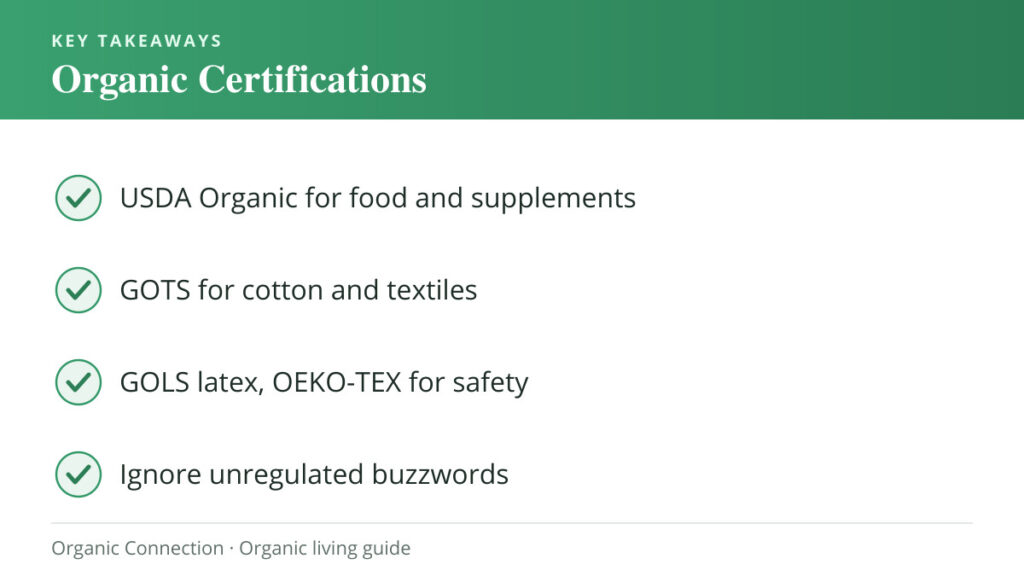
Certifications exist because you cannot personally inspect a farm in another state or a factory on another continent, so an independent body does it for you and stamps the result on the package. USDA Organic is the benchmark for food and supplements; GOTS and GOLS for textiles and latex; OEKO-TEX for fabric safety; Non-GMO, Fair Trade, GREENGUARD Gold, MADE SAFE, and OMRI for specific added assurances. Learn to spot these six or seven seals and you will shop faster, spend smarter, and stop paying premium prices for unregulated adjectives. To see how we apply all of this to real products, browse our rating method and any of our category reviews.
Common questions about organic certification
Is “natural” the same as “organic”?
No. “Organic” on food is legally regulated by the USDA and requires certification and inspection, while “natural” has no consistent legal definition on most products and is not independently verified. A product can say “natural” and still contain synthetic ingredients, so treat “natural” as marketing unless it is backed by a real certification.
What is the difference between USDA Organic and Non-GMO?
USDA Organic is a comprehensive standard covering pesticides, fertilizers, GMOs, and processing, verified by inspection. Non-GMO Project Verified only confirms the absence of genetically modified organisms. All USDA Organic products are already non-GMO, but a non-GMO product is not necessarily organic, since it can still use synthetic pesticides.
Does “made with organic cotton” mean the product is organic?
Not fully. It usually means the fiber is organically grown, but without a GOTS certification, the dyeing and finishing may have used conventional chemicals. For genuinely organic textiles, look for the GOTS seal, which certifies both the organic fiber and clean, low-toxicity processing across the whole supply chain.
Is OEKO-TEX an organic certification?
No. OEKO-TEX Standard 100 tests finished fabric for harmful substances and certifies it is safe to touch your skin, but it says nothing about whether the fiber was organically grown. A conventionally farmed cotton can be OEKO-TEX certified. It is a safety assurance that complements, but does not replace, an organic certification like GOTS.
Which certification should I trust most?
It depends on the product. For food and supplements, USDA Organic is the strongest. For textiles, GOTS. For latex, GOLS. For gardening inputs, OMRI Listed. The common thread is that all of these are awarded by independent bodies that inspect against a published standard, which is what makes them trustworthy compared with unregulated marketing words.
Keep reading
- Organic vs Natural vs Non-GMO: What Labels Actually Mean
- The Dirty Dozen and Clean Fifteen: Where Buying Organic Matters Most
- The Complete Guide to Organic Cotton and Natural Textiles
- How we research and rate products
- Organic Product Database — search every product we have reviewed, by certification
- Organic Baby Essentials hub
- our organic product database — compare brands across every guide
Organic Connection is reader-supported. When you buy through links in our reviews we may earn a commission, at no extra cost to you. As an Amazon Associate we earn from qualifying purchases. We are not paid to feature or rank any product. How we research and rate.