Last updated: September 19, 2026
Some links in this guide point to our product reviews, which may earn us a commission at no extra cost to you. How we research and rate.
A “non-toxic home” sounds like a project that requires gutting your cupboards and spending a fortune. It does not. Most of the meaningful improvement comes from a handful of changes in the rooms where you spend the most time and use the most product, and the rest can wait until things run out. This guide walks the house room by room, explains what is actually in conventional cleaning and laundry products, which certifications mean something and which are decoration, and gives you a replacement order that starts with the items that matter most.
What is actually in conventional cleaning products
It helps to know what you are replacing and why, because not everything in a conventional bottle deserves the alarm it gets.
Undisclosed fragrance
Because fragrance formulas are treated as trade secrets, a single “fragrance” listing can stand for a long list of undisclosed ingredients, including phthalates used to make scent linger. This is the largest genuine gap in household product transparency, and it is why fragrance-free is such a reliable shortcut: it removes the one component you cannot inspect.
Quaternary ammonium compounds (“quats”)
These are the disinfecting agents in most antibacterial sprays and wipes, identifiable on labels as benzalkonium chloride and similar names ending in “-onium chloride.” They are effective disinfectants but are also respiratory irritants, and there is a reasonable case that routine daily use on every surface is overkill. Reserve disinfectants for genuine contamination, raw meat prep, illness in the house, and use plain soap and water for everything else.
Volatile organic compounds
Solvents in glass cleaners, degreasers, and air fresheners evaporate into indoor air. Indoor air is commonly more polluted than outdoor air in developed countries, and cleaning products are a meaningful contributor. This is why ventilation matters as much as product choice, and why “air freshener” is a category worth abandoning entirely rather than replacing.
Optical brighteners and dyes
Optical brighteners in laundry detergent do not clean anything; they are fluorescent compounds that stay on fabric and shift its color to look whiter under light. They remain on clothing against your skin, they persist in wastewater, and they are pure cosmetics. Dyes are the same story in a different color.
What deserves less alarm
In fairness: plain soap, washing soda, citric acid, and hydrogen peroxide are all perfectly ordinary chemicals doing useful work, and “chemical-free” is a marketing phrase rather than a real property. The goal is not to avoid chemistry, it is to avoid ingredients that are undisclosed, unnecessary, or irritating.
Certifications that actually mean something
Household products are a certification minefield, with a lot of green-looking logos that are self-awarded. Here is which is which.
USDA Organic
Rare on cleaning products because most contain non-agricultural minerals, but where it appears on a soap or plant-based cleaner it carries the same legal weight as on food. A genuine seal, verified by an accredited certifier.
EPA Safer Choice
The most useful mark in this category. It means the EPA has reviewed every ingredient in the formula against safety criteria for human health and the environment, and the product still has to work. It is a functional standard, not just a hazard screen.
EWG Verified
A stricter ingredient-transparency standard from the Environmental Working Group, requiring full disclosure including fragrance components. Useful precisely because it closes the fragrance loophole.
Leaping Bunny and Certified Cruelty Free
These address animal testing specifically and say nothing about ingredient safety. Both are real certifications; just do not read them as a health claim.
Marks that mean little
“Natural,” “eco-friendly,” “green,” “non-toxic,” “plant-derived,” and “chemical-free” have no regulatory definition on household products. A leaf on a bottle is graphic design. Treat these as prompts to read the ingredient list rather than as conclusions. We go deeper on this in Organic vs Natural vs Non-GMO.
The laundry room
Laundry deserves first place because it produces the largest ongoing skin contact of anything in the house. You wear the residue of your detergent against your skin for roughly two-thirds of every day, and you sleep in it for the other third.
Detergent
Look for fragrance-free, dye-free, and free of optical brighteners. Plant-based surfactants and enzyme blends clean modern loads perfectly well at lower temperatures. Concentrated formats and sheets cut both packaging and shipping weight substantially. Our picks are in Best Natural Laundry Detergent. If anyone in the house has eczema or sensitive skin, this single swap often does more than any skincare change.
Fabric softener and dryer sheets
These are the products to eliminate rather than replace. Fabric softener works by depositing a waxy cationic coating on fibers, which reduces towel absorbency, degrades the wicking in athletic fabrics, and is a heavy fragrance carrier. Wool dryer balls do the mechanical part, softening and reducing static and drying time, with no chemistry at all. For stubborn static, a half cup of white vinegar in the rinse works and rinses out completely without leaving any smell.
Stain treatment and whitening
Oxygen bleach (sodium percarbonate) handles most of what chlorine bleach is used for, without the fumes or the fabric damage, and it breaks down into washing soda, water, and oxygen. Sunlight is a genuinely effective free whitener on cotton. Save chlorine bleach for actual disinfection needs, and never mix it with anything, particularly ammonia or vinegar.
Wash habits that matter
Use less detergent than the cap suggests, since the cap is a marketing device and excess detergent leaves residue on fabric. Wash at lower temperatures with an enzyme detergent. Run an occasional empty hot cycle with vinegar or washing soda to clear the machine of buildup, which is what causes that musty smell in front-loaders.
The kitchen
The kitchen is where the disinfectant reflex is strongest and where it most often exceeds what is needed.
Everyday surfaces
For daily counter and table cleaning, a simple castile soap solution or a plant-based all-purpose cleaner is sufficient. Soap and water physically remove soil and the great majority of microbes; you do not need to kill everything on a table you just ate at. A castile bar or liquid castile diluted in water covers a surprising amount of household cleaning at very low cost.
When disinfection is genuinely warranted
After raw meat, poultry, or eggs, and during illness in the household. In those cases a disinfectant is the right tool, and it needs contact time to work: most require the surface to stay visibly wet for several minutes, which almost nobody does. Wiping a disinfectant off immediately mostly just spreads it around. Ventilate while using them.
Dish soap and dishwasher detergent
Fragrance-free plant-based dish soap performs comparably to conventional on everyday loads. For dishwashers, look for phosphate-free formulas and skip the rinse aid fragrance. Powder and tablet formats generally use less packaging than gels.
Food contact and storage
Reducing plastic contact with hot and fatty foods is one of the more evidence-supported kitchen changes. Glass or stainless containers for leftovers, never microwaving in plastic, and replacing scratched non-stick pans are all straightforward. Beeswax wraps and silicone lids replace cling film for most jobs.
The bathroom
The bathroom concentrates two things: humidity, which drives mold and drain problems, and personal care products, which are the highest-frequency skin contact in the house.
Cleaning
Most bathroom cleaning is limescale and soap scum, both of which yield to acid. Citric acid solution or plain white vinegar handles taps, glass, and tiles; a paste of baking soda does the abrasive work on tubs. For toilets, citric acid or an oxygen-based cleaner works well. Never mix bleach with acid or ammonia; the resulting gases are genuinely dangerous, and this is the single most common serious cleaning accident in homes.
Mold and humidity
The real fix for bathroom mold is not a stronger cleaner, it is ventilation. Run the extractor fan during and for twenty minutes after showers, squeegee glass and tiles, and keep the door open afterwards. Persistent mold that returns quickly usually indicates a moisture problem rather than a cleaning problem.
Personal care
These are worth prioritizing because they go directly on skin daily. In rough order of impact: deodorant and body lotion, which stay on the skin all day; then body wash or bar soap and shampoo, which rinse off; then sunscreen, where a mineral filter is the cleaner choice. Replace as bottles empty rather than all at once. Our full walkthrough is in Organic Skincare 101.
The bedroom
You spend roughly a third of your life in this room, in prolonged skin contact with fabric, which makes it a higher priority than most people assume.
Bedding
Conventional cotton is one of the most pesticide-intensive crops grown, and finished fabrics may carry formaldehyde-based wrinkle-resistant treatments and azo dyes. GOTS certification covers both the fiber and every processing stage, including restricted chemicals and wastewater treatment, which is why it is the mark worth paying for on textiles. Start with sheets and pillowcases, since your face is against them for eight hours, then a duvet cover. Full detail is in our guide to organic cotton and textiles.
Mattresses
Mattresses are the big-ticket item and the one people replace least often, so it is worth getting right when the time comes. Look for GOLS-certified organic latex, GOTS-certified cotton and wool, and GREENGUARD Gold certification for low chemical emissions. Wool is a natural flame barrier, which lets manufacturers meet flammability standards without chemical retardants. A certified topper is a legitimate interim step on an existing mattress.
Air and dust
Household dust is a genuine reservoir for flame retardants and other semi-volatile compounds shed by furniture and electronics. Damp dusting rather than dry, vacuuming with a HEPA filter, and opening windows daily do more for bedroom air than any product you can buy. Skip plug-in air fresheners entirely; they add VOCs to solve a problem ventilation solves better.
Living areas, floors, and everywhere else
Hard floors need remarkably little: a plant-based floor cleaner or diluted castile soap, and for sealed hardwood, barely damp mopping. Carpets benefit more from frequent vacuuming than from shampooing, and a doormat plus a shoes-off habit cuts the amount of outdoor pesticide, road grime, and dust tracked in by a large margin, which is one of the cheapest interventions available.
Furniture and electronics off-gas most in their first months, so ventilating a room with new items matters. Houseplants are pleasant but their air-cleaning capacity is routinely overstated; you would need an implausible number to match cracking a window. If you use candles, unscented beeswax or soy with a cotton wick beats heavily fragranced paraffin, and any open flame needs ventilation regardless.
A realistic replacement order
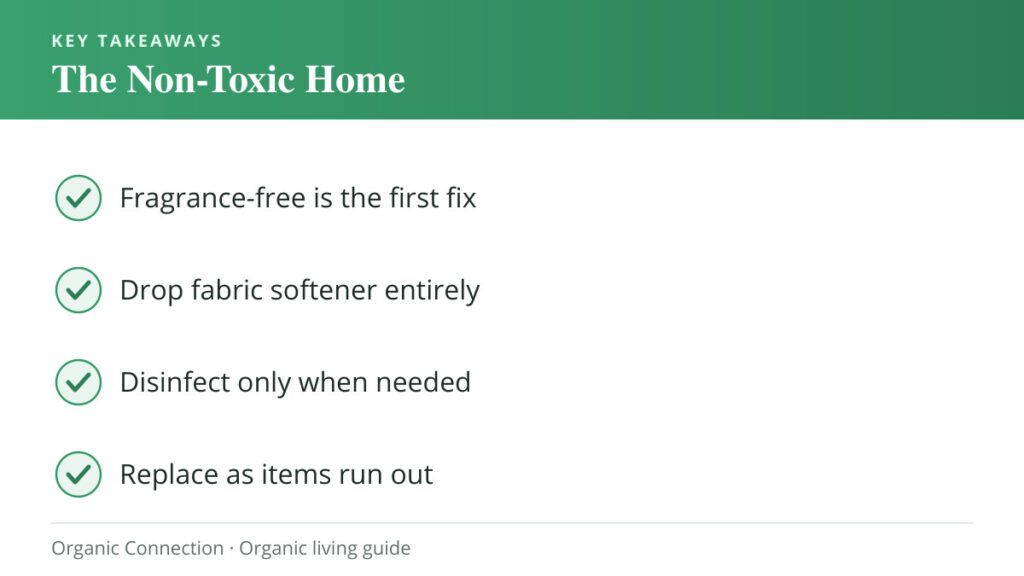
Do not throw everything out at once. That is expensive, wasteful, and the most common reason people abandon the project. Replace as items run out, in this priority order:
- Laundry detergent, to fragrance-free and brightener-free. Highest skin contact, lowest effort.
- Fabric softener and dryer sheets, eliminated and replaced with wool dryer balls.
- All-purpose cleaner, to a fragrance-free plant-based or castile-based option.
- Air fresheners and plug-ins, removed entirely in favor of ventilation.
- Daily leave-on personal care: deodorant, body lotion, hand cream.
- Dish soap and dishwasher detergent.
- Bathroom and glass cleaners, to citric acid or vinegar-based.
- Rinse-off personal care: body wash, shampoo, conditioner.
- Bedding, to GOTS-certified, starting with pillowcases and sheets.
- Mattress and larger furniture, when they are due for replacement anyway.
Working down this list over a year, buying each item only when the old one is finished, costs very little more than you were spending anyway and gets you most of the way there.
Where to start in a non-toxic home
A non-toxic home is not a purity project and it does not require a purge. It is a sequence of ordinary replacement decisions made in a sensible order, weighted toward the products with the most skin contact and the most daily use. Fragrance-free laundry detergent, no fabric softener, no air fresheners, a simple all-purpose cleaner, disinfectant reserved for when it is actually needed, and good ventilation will get you the overwhelming majority of the benefit. Certified bedding and personal care follow as things wear out. Everything after that is refinement, and refinement is optional.
Common questions about a non-toxic home
What is the most important product to switch first?
Laundry detergent, to a fragrance-free, dye-free, brightener-free formula. Detergent residue stays on the fabric you wear all day and sleep in all night, so it produces more skin contact than any other household product, and “fragrance” is the one ingredient category you cannot inspect on a label.
Are natural cleaning products as effective as conventional ones?
For everyday cleaning, yes. Soap and water physically remove soil and most microbes, and plant-based surfactants clean comparably to conventional ones. Where conventional products have a genuine edge is disinfection, so keep a disinfectant for raw meat prep and illness, use it with the contact time on the label, and use soap for everything else.
Which household certifications actually mean something?
EPA Safer Choice, which reviews every ingredient for safety and still requires the product to work; EWG Verified, which requires full disclosure including fragrance components; USDA Organic where it appears; and GOTS for textiles. Words like “natural,” “green,” “eco-friendly,” and “non-toxic” have no regulatory definition on household products.
Do I need to replace everything at once?
No, and you should not. Replacing items as they run out costs very little more than you already spend, avoids waste, and is far more likely to stick. Work down a priority list starting with laundry detergent and daily leave-on personal care, and let durable goods like bedding change on their natural replacement cycle.
Is fabric softener bad?
It is the household product easiest to justify dropping. It works by leaving a waxy coating on fibers, which reduces towel absorbency and ruins the wicking in athletic fabrics, and it is one of the heaviest fragrance carriers in the house. Wool dryer balls provide the softening and static reduction mechanically, and white vinegar in the rinse handles stubborn static.
Keep reading
- The Complete Guide to Organic Cotton and Natural Textiles
- Organic Skincare 101: How to Read Labels and Build a Clean Routine
- Switching to Organic for Babies and Families
- How we research and rate products
- our searchable product database — compare all 800+ picks side by side
- Organic Household hub
- our organic product database — compare brands across every guide
- Best Glass Pantry Jars
- Best Dinnerware Sets
- Lead and cadmium in dishes, explained
- Best Reusable Produce Bags
Organic Connection is reader-supported. When you buy through links in our reviews we may earn a commission, at no extra cost to you. As an Amazon Associate we earn from qualifying purchases. We are not paid to feature or rank any product. How we research and rate.