
Last updated: September 12, 2026
Some links in this guide point to our product reviews, which may earn us a commission at no extra cost to you. How we research and rate.
“Is organic worth it?” is really three questions wearing one coat: does organic cost more, is the difference in what you get real, and where does that difference actually justify the money? The honest answers are yes, sometimes, and it depends enormously on the category. This guide breaks down what the organic premium really looks like in a shopping basket, what the evidence supports and what it does not, and how to build a strategy that gets you most of the benefit for a fraction of the cost. No absolutism in either direction, just the arithmetic.
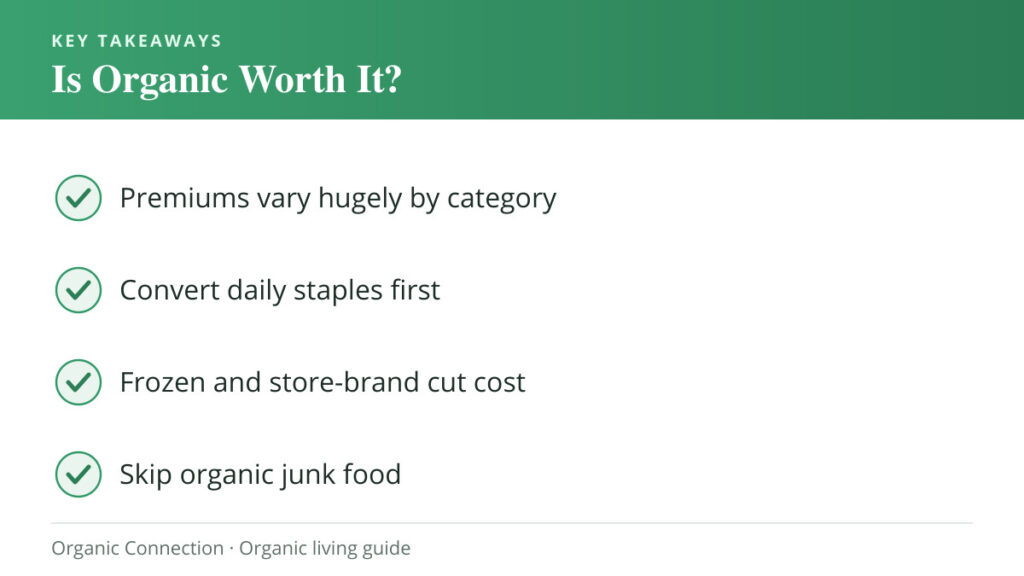
What the organic premium actually costs
The often-quoted figure is that organic food costs 20 to 50 percent more than conventional. That average is nearly useless in practice, because the spread underneath it is enormous and it is the spread that determines your grocery bill.
At the low end sit dry, shelf-stable staples. Organic oats, rice, dried beans, lentils, flour, and popcorn frequently cost only 10 to 25 percent more than their conventional equivalents, and when a store brand runs a promotion the organic version is sometimes cheaper than a conventional name brand. These are commodity crops with mature organic supply chains, low spoilage, and no cold chain, so the cost of certification is spread thin. Buying organic oatmeal, rice, bread flour, or popcorn is close to a free upgrade.
In the middle sit pantry goods with more processing: oils, nut butters, coffee, tea, spices, and canned goods. Here the premium is typically 25 to 60 percent. It is a real cost but a manageable one, and these are also often the categories where the organic difference is most meaningful, because you consume them daily and the crops themselves are frequently sprayed.
At the high end sit fresh produce, dairy, eggs, and meat. Organic milk routinely costs 60 to 100 percent more than conventional. Organic berries in winter can be double. Organic chicken and beef can be 50 to 150 percent more. These are the purchases that make people conclude organic is unaffordable, and they are the categories where the strategy in the rest of this guide earns its keep.
Non-food categories follow their own logic. GOTS-certified organic cotton sheets or underwear carry a substantial premium over conventional cotton, but they are durable goods you buy every several years rather than every week, so the annualized cost is small. Organic laundry detergent and cleaning products sit at a modest premium and last months. And organic garden inputs like compost and potting soil are usually within 20 to 30 percent of conventional, which is why organic gardening is one of the least expensive places to start.
What you are actually paying for
It helps to know what the premium buys, because it is not a single thing.
Lower yields and more labor
Organic farming forgoes synthetic nitrogen fertilizer and most synthetic pesticides, which typically means lower yields per acre and more hand labor for weeding and pest management. On many crops, organic yields run meaningfully below conventional. That gap is the largest single component of the price difference, and it is a real production cost rather than a marketing markup.
Certification and paperwork
USDA organic certification requires a three-year transition period during which land is farmed organically but the crop cannot be sold as organic, annual inspections, detailed record keeping, and certifier fees. Every handler and processor in the chain must be certified too. That compliance cost is baked into the final price, and it is also what makes the seal mean something.
Scale and supply chain
Organic is still a minority of production in most categories, so producers lack the scale economies of conventional agriculture in everything from seed purchasing to distribution. This is the component that shrinks over time; the fall in organic milk and organic baby food prices over the past two decades tracks growing scale.
Sometimes, simply because people will pay
It is worth being honest that some organic pricing is positioning rather than cost. A premium organic brand in attractive packaging in a specialty store carries a margin that the identical certified product under a supermarket’s own organic label does not. Store-brand organic lines are, in our experience, the single most underused money-saver in the category.
Where the evidence is strong, and where it is not
An honest cost analysis needs an honest benefit analysis. Here is our read of where the case for organic is solid and where it is weaker than the marketing suggests.
Strong: reduced pesticide residue
This is the best-supported benefit and it is not really disputed. Organic produce consistently shows dramatically lower synthetic pesticide residues than conventional, and studies of people switching to an organic diet show measurable drops in pesticide metabolites in urine within days. Whether the residue levels on conventional produce pose a health risk is a separate and more contested question, since regulators consider them within legal safety limits. But the exposure reduction itself is real and measurable.
Strong: no GMOs, no synthetic growth hormones, restricted antibiotics
These are definitional rather than probabilistic. USDA organic prohibits genetically modified seed, prohibits added growth hormones in dairy and beef, and sharply restricts routine antibiotic use in livestock. If any of those matter to you, certification delivers them reliably.
Moderate: environmental impact
Organic farming generally supports higher soil organic matter, greater on-farm biodiversity, and eliminates synthetic pesticide runoff. The complication is yield: because organic produces less per acre, comparisons made per unit of food rather than per acre are much less clear-cut, and land use is a genuine environmental cost. Both things are true at once, which is why regenerative certifications that address soil carbon directly are gaining ground.
Weak: dramatic nutritional superiority
This is where marketing outruns evidence. Reviews of the research find some differences, generally higher levels of certain antioxidants and, in organic dairy, a somewhat better omega-3 profile, but the differences are modest and inconsistent across studies. An organic apple is not a nutritionally transformed apple. If someone tells you organic food will change your health through nutrient density alone, treat that claim with skepticism. The stronger case is about what is absent, not what is added.
The strategy: spend where it matters
Once you accept that both the premium and the benefit vary by category, an obvious approach falls out: rank your purchases by benefit-per-dollar and spend from the top down.
Tier one: high frequency, high residue, low premium
Convert these first. They are the daily staples where the organic price gap is smallest and the cumulative exposure difference largest. Grains and grain products, since conventional wheat and oats are often treated with glyphosate as a pre-harvest desiccant. Cooking oils. Coffee and tea, which are unwashed crops you steep directly and drink. Spices, many of which are irradiated or fumigated with ethylene oxide in conventional production, something USDA organic prohibits. This tier costs relatively little to convert and delivers a large share of the total benefit.
Tier two: the Dirty Dozen produce you eat whole
Thin-skinned produce you cannot peel, berries, leafy greens, grapes, peppers, celery, apples, holds the most residue. This is where the premium is high but the residue reduction per dollar is also highest. Buy frozen organic where you can: frozen organic berries and greens are typically far cheaper than fresh, nutritionally equivalent, and available year round. Our full breakdown is in The Dirty Dozen and Clean Fifteen.
Tier three: high-contact non-food items
Things touching your skin for hours a day are the next reasonable priority: bedding, underwear, and daily-use skincare like body lotion and deodorant. These are mostly durable or slow-consumption goods, so the annualized cost is far lower than the sticker price suggests.
Tier four: everything else, when it is on sale
Thick-skinned and peeled produce, the Clean Fifteen, and categories where the premium is steep and the benefit marginal. Buy organic here when the price is close or you have a specific reason, and do not feel you have failed when you do not.
Eleven ways to cut the organic premium
The premium is not fixed. These tactics routinely take 30 to 50 percent off an organic grocery bill without dropping a single item from the list.
- Buy store-brand organic. Supermarket own-label organic lines carry the identical USDA certification as premium brands at substantially lower prices. This is the single biggest lever most shoppers are not pulling.
- Buy frozen. Frozen organic fruit and vegetables are picked at ripeness, nutritionally comparable to fresh, available year round, and often half the price. They also eliminate spoilage waste.
- Buy dry staples in bulk. Organic oats, rice, beans, lentils, flour, and popcorn have long shelf lives and the lowest premiums. Bulk bins and large bags cut the unit cost sharply.
- Shop seasonally. Organic produce in season and grown regionally can approach conventional pricing. Out-of-season organic berries are where budgets go to die.
- Cook more from scratch. Organic ingredients are far cheaper than organic prepared foods. A bag of organic pasta and a jar of organic tomatoes beat organic ready meals by a wide margin.
- Waste less. Households throw away a large share of the food they buy. Cutting waste is mathematically identical to a discount, and it applies to the expensive organic items first.
- Buy concentrated. Concentrated laundry detergent and cleaning products cost less per wash and ship lighter, which lowers price and footprint together.
- Grow the expensive stuff. Herbs, salad greens, tomatoes, and berries are the priciest things to buy organic and among the easiest to grow. A packet of organic seeds and a bag of potting soil pay back quickly.
- Use subscriptions and case discounts. On staples you buy anyway, subscribe-and-save style discounts typically knock 5 to 15 percent off.
- Try farmers markets late. Prices soften near closing, and small local growers are often uncertified but farming organically, which is worth asking about directly.
- Prioritize rather than convert everything at once. The all-or-nothing switch is what makes people quit. Work down the tiers over months.
Two realistic budgets
To make this concrete, here is roughly how a household might allocate an organic budget at two different levels.
The modest budget
Convert tier one only: grains, flour, oats, rice, pasta, cooking oil, coffee or tea, spices, and peanut butter. Buy frozen organic berries and spinach. Everything else conventional, washed well. This typically raises a grocery bill by a modest single-digit percentage while covering the daily-consumption items where cumulative exposure is highest. It is the highest return on investment available in this category, and for many households it is where the analysis should stop.
The committed budget
Add tier two and three: Dirty Dozen produce fresh or frozen, organic dairy and eggs, organic honey and olive oil, plus GOTS-certified bedding and underwear replaced as items wear out, and organic personal care as bottles run empty. The food portion of this raises a bill more noticeably, but replacing durable goods on their natural cycle rather than all at once spreads the non-food cost almost invisibly. This is where most people who describe themselves as “mostly organic” actually land.
When organic is not the right answer
A few honest caveats, because a guide that says yes to everything is not useful.
Organic junk food is still junk food. Organic cane sugar is sugar, organic candy is candy, and an organic cookie is not a health food. The seal describes how ingredients were grown, not whether the product is good for you.
Organic certification is not the only meaningful standard. Many small local farms follow organic practices without paying for certification because the cost is prohibitive at their scale. Buying from a grower you can talk to is often a better outcome than buying certified produce shipped across a continent.
Some claims sold alongside organic are simply marketing. “Natural” is essentially unregulated, and a great deal of packaging leans on organic’s reputation without carrying its certification. That is a whole topic on its own, covered in Organic vs Natural vs Non-GMO.
And if the choice is between conventional vegetables and no vegetables because the organic ones are unaffordable, buy the conventional vegetables. Every serious dietary body agrees the benefit of eating produce far outweighs the residue concern. Perfect is genuinely the enemy of good here.
When organic is worth paying for
Is organic worth it? For daily staples where the premium is small and the exposure difference is real, unambiguously yes. For thin-skinned produce you eat whole, yes if the budget allows, and frozen makes it allowable more often than people think. For things that touch your skin all day, yes on the replacement cycle rather than all at once. For thick-skinned produce, out-of-season imports, and organic versions of foods that were never healthy, the case is much weaker and there is no reason to feel guilty about skipping it.
The mistake is treating this as a yes-or-no identity question. It is a spending allocation problem with a clear structure: spend where a small premium meets a large benefit, save where a large premium meets a small one, and let the savings from the second fund the first. Done that way, an organic kitchen is achievable on an ordinary budget, which is exactly what most people are actually asking about.
Common questions about whether organic is worth it
How much more does organic food actually cost?
It depends heavily on the category. Dry staples like oats, rice, beans, and flour are often only 10 to 25 percent more, while fresh produce, dairy, and meat can be 60 to 150 percent more. The commonly quoted 20 to 50 percent average hides that spread, and the spread is exactly what makes a targeted strategy work.
Is organic food actually healthier?
The strongest evidence is about what organic food lacks rather than what it contains: dramatically lower synthetic pesticide residues, no GMOs, no added growth hormones, and restricted antibiotic use. Nutritional differences exist but are modest and inconsistent across studies. Claims of dramatic nutrient superiority run ahead of the evidence.
What should I buy organic first on a tight budget?
Start with daily staples where the premium is small: oats, rice, flour, pasta, cooking oil, coffee or tea, and spices. These are consumed frequently, the crops are commonly treated with pesticides including pre-harvest glyphosate on grains, and the price gap is the narrowest in the store.
Is organic worth it for produce you peel?
Usually not, from a residue standpoint. Thick-skinned and peeled produce like avocados, bananas, onions, and melons consistently test low for residue because you discard the part that holds it. Save your organic budget for thin-skinned produce you eat whole, and buy these conventional unless prices are close.
How can I make organic food more affordable?
Buy store-brand organic rather than premium brands, choose frozen over fresh for berries and greens, buy dry staples in bulk, shop seasonally, cook from ingredients rather than buying organic prepared foods, and cut food waste. Together these routinely take 30 to 50 percent off an organic grocery bill.
Keep reading
- The Dirty Dozen and Clean Fifteen: Where Buying Organic Matters Most
- How to Build an Organic Pantry Without Overspending
- Organic vs Natural vs Non-GMO: What Labels Actually Mean
- How we research and rate products
- our searchable product database — compare all 800+ picks side by side
Organic Connection is reader-supported. When you buy through links in our reviews we may earn a commission, at no extra cost to you. As an Amazon Associate we earn from qualifying purchases. We are not paid to feature or rank any product. How we research and rate.