
Last updated: September 21, 2026
Some links in this guide point to our product reviews, which may earn us a commission at no extra cost to you. How we research and rate.
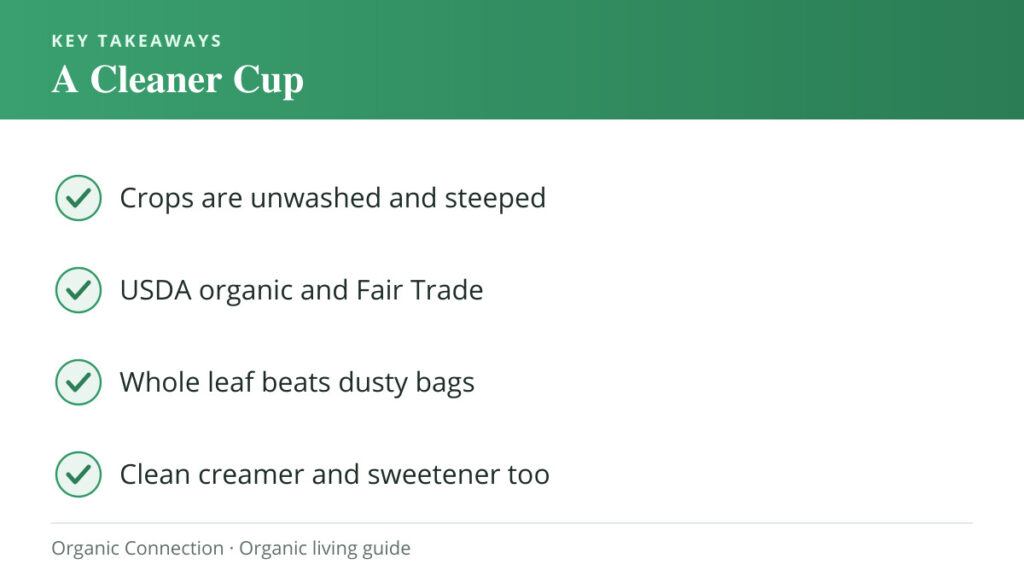
If there is one daily ritual where switching to organic pays off more than almost anywhere else, it is your morning cup. Coffee and tea are among the most chemically treated crops in the world, they are not washed before processing, and you steep or brew them directly, so residues can pass straight into your cup. Because you drink them every single day, the cumulative difference is real. This guide explains why organic matters so much for coffee and tea, what to look for, and how to build a genuinely clean cup from bean to mug.
Why organic matters more for coffee and tea
Most crops are washed before they reach you, and many you peel or cook. Coffee and tea are different. Tea leaves are picked, withered, and dried, then steeped whole in hot water, and you drink the infusion. Coffee cherries are processed and roasted, then ground and brewed, and again you drink the extract directly. There is no step that rinses residues off the part you consume, and hot water is an efficient extractor. On top of that, both crops are frequently grown in tropical regions with heavy pest pressure and, in conventional farming, significant pesticide and fungicide use.
USDA organic certification prohibits synthetic pesticides and fertilizers, so organic coffee and tea are grown without them. Combine that with the sheer frequency of consumption, a daily habit for most people, and the case becomes compelling: this is a crop where the organic choice removes residues from something you ingest every day, for a modest price difference. It is the same logic we apply across our food reviews and detail in the Dirty Dozen guide: prioritize organic where residue and frequency are both high.
Building a cleaner cup of coffee
Coffee offers several routes to a clean cup depending on how you brew. For the best flavor and freshness, whole-bean or ground organic coffee is the core choice, look for USDA Organic, and ideally Fair Trade too, since coffee is a crop where fair labor matters enormously and often signals a quality-focused producer. Freshly ground beans, brewed with clean water, give you the fullest flavor and control.
For busy mornings, organic instant coffee has come a long way and delivers a genuinely clean, convenient cup without equipment, ideal for travel or the office. And what you add matters as much as the coffee itself: a conventional creamer can undo the point of a clean cup with artificial flavors, hydrogenated oils, and additives. An organic coffee creamer or a splash of organic oat milk keeps the whole cup clean. Sweeten, if you like, with organic honey or maple syrup rather than refined sugar. Assembled this way, every component of your coffee is clean, not just the beans.
Building a cleaner cup of tea
Tea is arguably an even stronger case for organic, because you steep the whole leaf directly and often drink several cups a day. The good news is that excellent organic tea is easy to find across every style.
For a bold morning cup, organic black tea, whether an English Breakfast blend, a single-origin Assam or Chinese black, or Earl Grey, gives you caffeine and depth, and the best are whole-leaf rather than the broken “dust” in many cheap bags. For something lighter and antioxidant-rich, organic green tea is a daily staple, and organic matcha takes it further: because matcha is powdered whole leaf that you whisk and drink entirely (not steep and discard), the organic choice matters even more, since you consume the entire leaf. For loose-leaf enthusiasts who want the freshest, fullest flavor, organic loose leaf tea across many varieties rewards a little extra effort with an infuser. And for a caffeine-free, soothing option, an organic herbal tea like ginger supports digestion after meals.
Whole leaf vs tea bags: a quick note
Loose leaf and quality tea bags follow the same organic standard; the difference is leaf quality and convenience. Loose leaf is usually whole or large-piece leaf that unfurls fully for more flavor and better value per cup, but needs an infuser. Many mass-market tea bags contain broken “fannings” that brew fast but flat, and some use plastic in the bag itself. The best organic tea-bag brands use whole-leaf or full-leaf sachets and plastic-free, biodegradable bags, giving you convenience without sacrificing quality or adding microplastics to your cup. Choose loose leaf for the best flavor and value, and a quality organic tea-bag brand when you want convenience.
Brewing tips for the best clean cup
Once you have clean ingredients, a few habits maximize flavor:
- Use good water. Coffee and tea are mostly water, so filtered water noticeably improves both flavor and the “clean” character of your cup.
- Mind the temperature. Black tea and coffee want near-boiling water (about 200 to 212 F); green tea and matcha prefer cooler water (around 160 to 180 F) to avoid bitterness.
- Watch the steep time. Over-steeping tea turns it astringent; 3 to 5 minutes suits most black teas, less for green. Loose leaf can often be resteeped.
- Grind fresh for coffee. If you use whole beans, grinding just before brewing preserves aroma and flavor.
- Store airtight. Keep coffee and tea in airtight containers away from light, heat, moisture, and strong odors, both readily absorb smells and lose aroma over time.
These small adjustments turn clean ingredients into a genuinely great cup, so your organic coffee or tea is not just cleaner but tastes better than the conventional habit it replaced.
What organic certification actually changes in a cup
Coffee and tea are worth treating together here, because they share an awkward property: you consume an infusion of a plant that was dried rather than washed, and in tea’s case you often consume the leaf material itself in a bag.
Organic certification governs the inputs used to grow that plant. Under the National Organic Program rule at 7 CFR 205.105, organic production may not use synthetic substances unless the specific substance appears on the National List, may not use prohibited nonsynthetics, and may not use excluded methods, ionizing radiation or sewage sludge.
Read carefully, that is a statement about a farm, not about a cup. It means fewer synthetic pesticide applications on the crop. It does not mean the finished tea was tested, and it says nothing at all about what happens between the field and the box: processing, blending, flavoring, or the bag the leaves sit in.
The honest summary is that organic certification is a good proxy for one thing — pesticide use on the farm — and no proxy at all for the questions people often hope it answers, which are about contaminants and processing. Those need separate evidence, and our explainer on heavy metals in organic food covers the ones that come from soil rather than spraying.
Decaffeinated coffee: the one processing detail with a number attached
Here is a specific, checkable fact that almost no coffee listing mentions and most shoppers have never been told.
Caffeine has to be removed from green beans somehow, and there are several methods. One of them uses methylene chloride as a solvent, and it is explicitly permitted in the United States. Under 21 CFR 173.255, methylene chloride may be present as a residue from caffeine extraction “at a level not to exceed 10 parts per million (0.001 percent) in decaffeinated roasted coffee and in decaffeinated soluble coffee extract.”
The alternatives are worth knowing by name, because a brand that has chosen one usually says so:
| Method | How it works | What the label tends to say |
| Swiss Water | Water and activated carbon filtration, no added solvent | Named explicitly, because it is a selling point |
| CO₂ process | Pressurized carbon dioxide extracts caffeine selectively | “CO₂ decaffeinated”, also usually named |
| Ethyl acetate | A solvent that occurs naturally in fruit; often marketed as “natural” or “sugarcane” decaf | Sometimes named, sometimes implied |
| Methylene chloride | Solvent extraction, residue capped at 10 ppm by the FDA regulation above | Usually not named at all |
The pattern is the tell. When a producer uses a method people like, the method appears on the bag. Silence about the method is not proof of anything, but it is the one place in coffee labeling where absence of information is itself informative. Certified organic decaf is a partial answer here, since the National List governs what may be used in organic processing — but the direct answer is a brand naming its process, which is what our organic decaf coffee guide looks for.
What the tea bag is made of
The leaf is only part of what goes into the pot. Bags are made from filter paper, from plant-based mesh such as PLA, or from nylon, and the pyramid-shaped “silken” bags that signal premium quality are often plastic.
Loose leaf sidesteps the question entirely, which is one reason our organic loose leaf tea guide exists. Where bags are wanted, the listing detail worth hunting for is what the bag is made from and whether it is heat-sealed with adhesive or folded and stapled. Very few listings say. Our guides to green tea, black tea, chamomile, peppermint, rooibos and hibiscus record which ones do.
Where the money actually goes
A practical note on price, since “organic” and “premium” get conflated constantly in this category.
In coffee, the biggest determinants of what is in your cup are freshness and grind, not certification. A certified organic bag roasted four months ago will disappoint next to a conventional bag roasted last week. Roast date beats every other signal on the bag, and our organic coffee, instant coffee and mushroom coffee guides check whether the listing gives one.
In tea, the biggest determinant is leaf grade and freshness. Dust and fannings — the fragments that fill most commodity bags — brew fast and harshly. Whole leaf costs more per gram and yields more per gram, because it can be steeped more than once.
Certification sits on top of both of those, and it is worth paying for when the basics are already right. It is not a substitute for them.
Is organic coffee and tea worth the extra cost?
For a daily drinker, the value is strong. The price premium on organic coffee and tea is usually modest per cup, often just a few cents, while the benefit accrues every single day: no synthetic pesticide residue in a beverage you steep directly and drink 365 times a year, plus, with Fair Trade options, support for the farmers who grow it. Compared with occasional purchases, a daily ritual is exactly where a small per-unit premium adds up to a meaningful cumulative difference. If you are prioritizing where to spend an organic budget, your everyday coffee and tea belong near the top of the list, right alongside the grains and cooking oils covered in our organic pantry guide.
What matters most in organic coffee and tea
Coffee and tea are near the top of the list for where organic genuinely matters, because the crops are heavily treated, unwashed, steeped directly into your cup, and consumed daily. Build a clean cup end to end: organic beans or leaves, a clean creamer or oat milk, and a natural sweetener if you use one, and pay attention to whole-leaf quality and plastic-free bags for tea. Brew with good water at the right temperature, and your organic cup will taste as good as it is clean. For our specific picks across coffee, tea, and add-ins, follow the links above, and see our full rating method.
Leaf grade, roast date, and the two words that predict quality
If you strip away every certification and claim, two pieces of information predict what a cup will taste like better than anything else on the package. Neither is required to appear, and both are printed by producers who are proud of the answer.
For coffee, it is the roast date. Not a best-before date twelve months out, which every bag carries and which tells you nothing, but the day the beans were roasted. Coffee is at its best within weeks of roasting and degrades steadily afterwards as the volatile aromatics escape and the oils oxidize. A bag with a roast date is a bag from a roaster who expects you to notice; a bag with only a best-before date is asking you not to.
For tea, it is the leaf grade. Commodity teabags are usually filled with dust and fannings, the small fragments left after whole-leaf processing. They brew fast and hard, which suits a strong builder’s tea with milk and suits nothing else. Whole-leaf tea costs more per gram, steeps more gently, and can usually be steeped more than once, which changes the real cost per cup considerably.
Neither fact has anything to do with organic certification, which is exactly why they are worth stating on a page about it. A certified organic tea made from dust is still dust.
Storage: the part that undoes everything else
Both products are dried plant material, and both are ruined by the same four things: air, light, heat and moisture. The care instructions follow directly.
- Buy smaller amounts more often. This is the single most effective change for coffee especially, where the difference between week two and week ten is obvious to anyone.
- Keep coffee whole and grind it as you use it. Ground coffee has vastly more surface area exposed to air, and stales in days rather than weeks. Our burr grinder guide covers why grind consistency matters as much as freshness.
- Store in an opaque, airtight container at room temperature, away from the stove and out of the sun. Not the fridge: temperature cycling draws moisture into the beans every time the door opens.
- Keep tea away from strong smells. Dried leaf is porous and will take on the character of a spice cupboard or a bag of coffee stored beside it. Rooibos and green tea are particularly quick to pick up outside aromas.
- Leave the original packaging alone if it is good. A resealable foil bag with a one-way valve is better than most decorative canisters, whatever the canister cost.
Water and temperature do more than the price tag
A short digression that repays itself immediately, because most disappointing cups of good tea and coffee are the drinker’s doing rather than the producer’s.
Water is the majority of the cup, and heavily chlorinated or very hard water will flatten a delicate tea and make coffee taste dull. A simple filter jug changes the result more than moving up a price tier. Our countertop water filter and refrigerator filter guides cover what different filters actually remove.
Temperature matters most for green and white tea. Water straight off a rolling boil scalds delicate leaves and pulls out bitterness; letting the kettle stand for a few minutes, or using a kettle with a temperature setting, makes a striking difference. Black tea, rooibos and most herbal infusions are happy with boiling water. Our gooseneck kettle and glass teapot guides look at which listings state a temperature range at all.
Steeping time is a dial, not a rule. The instruction on the box is a starting point calibrated for the manufacturer’s expected cup size. If your tea is bitter, steep less; if it is thin, use more leaf rather than longer time, since extended steeping pulls tannins before it pulls flavor.
Certification stacking: organic, Fair Trade, Rainforest Alliance
Coffee and tea carry more overlapping seals than almost any other category, and they answer genuinely different questions. The mistake is reading any of them as a general quality mark.
| Mark | The question it answers | What it does not address |
| USDA Organic | Which inputs were permitted on the farm, audited annually | Price paid to growers, labor conditions, contaminant testing, cup quality |
| Fair Trade | Trading terms, a minimum price and a community premium | Pesticide use unless combined with organic certification, and quality |
| Rainforest Alliance | Farm management criteria covering ecosystems and worker welfare | Organic status; it permits some inputs organic prohibits |
| Direct trade | Nothing verifiable on its own — it is a description of a buying relationship, not a certification | Everything, unless the roaster publishes the detail |
Our explainer on fair trade versus organic takes that comparison apart properly. The short version: they stack rather than substitute, and a bag carrying three seals is answering three narrow questions rather than one broad one.
A buying checklist that works in a shop
- Coffee: find the roast date. If there is only a best-before, consider it a commodity product and price it accordingly.
- Tea: find the leaf grade or the words “whole leaf”. If a bagged tea says nothing about grade, assume fannings.
- Decaf: find the method. Swiss Water and CO₂ get named. Silence usually means solvent extraction, which is legal and capped, but which you are entitled to know about.
- Check what the bag is made of if you buy bagged tea, and prefer loose leaf where you can be bothered.
- Read the seals as a set of narrow answers, not as a quality score, and check that the organic claim names a certifier.
- Then buy the smallest quantity that makes sense, because freshness beats almost everything else on this list.
Common questions about organic coffee and tea
Why is organic more important for coffee and tea?
Because coffee and tea are not washed before processing, you steep or brew them directly into hot water that you drink, and you consume them daily. There is no step that rinses residues off the part you consume, so organic certification, which prohibits synthetic pesticides, removes residues from a beverage you ingest every day.
Is organic matcha worth it?
Especially so. Matcha is powdered whole tea leaf that you whisk into water and drink entirely, rather than steeping and discarding the leaf. Because you consume the whole leaf, any residue is consumed too, which makes the organic choice more meaningful for matcha than for teas where you discard the leaves.
Is loose leaf tea better than tea bags?
Loose leaf is usually whole or large-piece leaf that unfurls fully for more flavor and better value per cup, while tea bags are more convenient. Many cheap bags contain broken “dust” and some use plastic. The best organic tea-bag brands use whole-leaf, plastic-free bags, so choose based on flavor versus convenience.
Does organic coffee taste different?
Organic certification is about how the coffee is grown, not its flavor, so taste depends mainly on the bean, roast, and freshness. Many people find high-quality organic and Fair Trade coffees excellent because the producers focused on quality. Grinding fresh and using filtered water improves any coffee’s flavor.
Is the extra cost of organic coffee and tea worth it?
For daily drinkers, generally yes. The premium is usually just a few cents per cup, but the benefit, no synthetic pesticide residue in a beverage you brew directly and drink every day, accrues 365 times a year. Everyday rituals are exactly where a small per-cup premium adds up to a meaningful difference.
Keep reading
- How to Build an Organic Pantry Without Overspending
- The Dirty Dozen and Clean Fifteen: Where Buying Organic Matters Most
- What “Organic” Really Means: A Guide to Certifications
- How we research and rate products
- all our reviewed products in one place — sortable by Organic Integrity Score
- Organic Food and Pantry hub
- our organic product database — compare brands across every guide
Organic Connection is reader-supported. When you buy through links in our reviews we may earn a commission, at no extra cost to you. As an Amazon Associate we earn from qualifying purchases. We are not paid to feature or rank any product. How we research and rate.