
Last updated: September 21, 2026
Some links in this guide point to our product reviews, which may earn us a commission at no extra cost to you. How we research and rate.
Your skin is your largest organ, and it absorbs some of what you put on it, which is why more people are looking closely at the products they use every single day. But skincare is also the category where marketing runs wildest, “natural,” “clean,” and “botanical” splashed across bottles that may still be mostly synthetic. This guide cuts through the noise: what “organic” really means in personal care, how to read an ingredient list, which ingredients to seek out and which to question, and how to build a simple, genuinely clean routine without falling for greenwashing.
What “organic” means in skincare (and why it is murkier than food)
Unlike food, personal care products in the US are not covered by a single mandatory organic standard, so the word “organic” is used more loosely on cosmetics. A product can say “organic” while containing only one organic ingredient among many synthetics. That does not make organic claims meaningless, but it does mean you have to look closer. The most reliable signal is a genuine certification: some skincare carries the USDA Organic seal (when it qualifies as an agricultural product), and others carry independent certifications like COSMOS Organic, Ecocert, or NSF/ANSI 305 for personal care, each with defined thresholds for organic content.
Because the labeling is looser, the ingredient list matters even more here than in the pantry. This is why our skincare reviews weight the actual formulation heavily and are transparent about the difference between a fully certified organic product and one that is simply clean and well-formulated. Our guide to natural deodorant, for example, explains where a genuine organic certification exists and where the realistic standard is a clean, aluminum-free formula, rather than pretending every product clears the highest bar. Honesty about that distinction is more useful than marketing gloss.
How to read a skincare ingredient list
Ingredient lists look intimidating because of the Latin and chemical names, but a few rules make them readable:
- Order equals quantity. Ingredients are listed from most to least, so whatever appears in the first five is most of the product. If water and a couple of plant oils lead the list, that tells you a lot.
- Latin names are often plants. INCI uses botanical Latin, so “Simmondsia Chinensis” is jojoba, “Cocos Nucifera” is coconut, “Butyrospermum Parkii” is shea butter. A long Latin name is not automatically a red flag; many are just plants.
- Learn a few genuine cautions. Ingredients some people prefer to avoid include added synthetic “fragrance”/”parfum” (which can hide dozens of undisclosed compounds), certain parabens, phthalates, formaldehyde-releasing preservatives, and, in some products, drying sulfates. Their presence is not a scandal, but for a clean routine they are worth noting.
- Short is usually better. A concise list of recognizable ingredients tends to signal a more thoughtful formulation than a long one padded with synthetics and fillers.
You do not need to become a cosmetic chemist. Just flipping the bottle over and scanning the first several ingredients will tell you more than the entire front label. If a product is truly clean, its ingredient list will show it; if it is greenwashed, the list will give it away.
The clean-skincare heroes: simple, single-ingredient plant oils
Some of the best clean skincare is not a fancy formula at all, but a single, pure plant oil. These are inexpensive, versatile, and about as transparent as an ingredient list gets, one thing.
Organic jojoba oil is a standout because its structure closely mimics the skin’s own sebum, so it absorbs well and suits most skin types as a moisturizer, makeup remover, or carrier oil. Organic castor oil is a thick, traditional oil prized for lashes, brows, hair, and as a rich occlusive. For deeper moisture and body care, a quality organic coconut oil doubles as a skin and hair treatment. Building part of your routine around one or two pure organic oils is a foolproof way to know exactly what you are putting on your skin, and it is easy on the budget.
Building a simple clean routine, step by step
A clean routine does not need ten products. A well-chosen handful covers the essentials for most people:
Cleanse
Start with a gentle, non-stripping cleanser. For body, an organic body wash free of harsh sulfates and synthetic fragrance keeps skin from feeling tight and dry. For hair, an organic shampoo with clean surfactants cleans without stripping. The goal at this step is to remove dirt and oil without damaging the skin’s protective barrier.
Moisturize
Follow cleansing with moisture while skin is still slightly damp. An organic body lotion works for most people, while those who prefer minimalism can use a pure plant oil like jojoba. Moisturizing is where a clean formula pays off daily, since you apply it over large areas of skin, so it is one of the highest-value places to choose an organic or genuinely clean product.
Protect
Daily sun protection is the single most effective anti-aging and skin-health step there is. A clean, mineral-based organic sunscreen using zinc oxide or titanium dioxide protects without some of the controversial chemical UV filters, and mineral formulas are often gentler on sensitive skin. Do not skip this step in the name of minimalism; sun protection matters more than almost anything else in your routine.
Targeted extras
Beyond the basics, add only what you need. An organic lip balm keeps lips protected, organic essential oils can be used (properly diluted) for aromatherapy and DIY blends, and if you color your hair, an organic and cleaner hair color reduces exposure to some of the harshest conventional dye chemicals. The principle throughout is the same: fewer, better, cleaner products beat a crowded shelf of half-understood ones.
Patch test and introduce slowly
“Natural” and “organic” do not mean allergen-free, plants can irritate skin too, and essential oils in particular are potent and must be diluted. Whenever you try a new product, especially an active oil or a fragranced one, patch test it: apply a small amount to your inner forearm and wait 24 hours to check for irritation before using it on your face or widely. Introduce one new product at a time so that if a reaction occurs, you know the cause. This simple discipline prevents most bad experiences and is doubly important for sensitive or reactive skin.
Avoiding greenwashing in the beauty aisle
Skincare is ground zero for greenwashing, so bring extra skepticism. A leaf logo, an earthy color, and the words “natural botanicals” tell you nothing verifiable. Instead, apply the same discipline we describe in our guide to decoding labels: look for a real certification, read the ingredient list, and discount the soft marketing words. Be especially wary of “fragrance-free” versus “unscented” (the latter can still contain masking fragrance), and of “dermatologist-tested,” which does not indicate any particular result. When a brand is genuinely clean, it tends to be specific and transparent about its ingredients and sourcing rather than leaning on vague virtue.
What organic really means in skincare
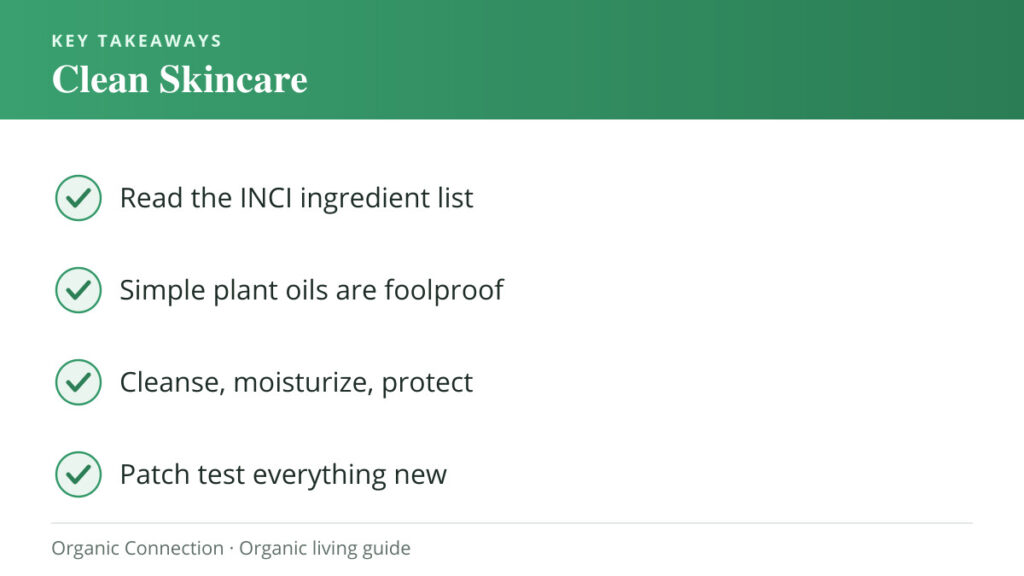
Clean skincare comes down to a few durable habits: understand that “organic” is loosely regulated in personal care so the ingredient list is your real guide, learn to scan that list for recognizable plant-derived ingredients and a short list of cautions, build a simple routine around a gentle cleanser, a clean moisturizer, and daily mineral sun protection, and patch test everything new. Single-ingredient organic oils like jojoba and castor are foolproof, transparent starting points. For our specific product picks in each step, follow the links above, and see how we evaluate every formulation in our rating method.
What the FDA does and does not control in your bathroom
The single most useful fact about skincare regulation in the United States is how little pre-market control exists, and the FDA states it plainly: “cosmetic products and ingredients do not need FDA premarket approval, with the exception of color additives.”
What exists instead is responsibility placed on the seller: “companies and individuals who manufacture or market cosmetics have a legal responsibility to ensure the safety of their products,” and regulations “prohibit or restrict the use of several ingredients” and require warnings on certain products.
So a new serum can reach a shop without any agency reviewing it. The maker is legally accountable for its safety, and the FDA acts afterwards against products that turn out to be adulterated or misbranded. That is the gap every certification in this category exists to fill, and it is why we read listings the way we do.
MoCRA: the rules changed, and most listings have not caught up
The Modernization of Cosmetics Regulation Act of 2022 is the largest change to US cosmetics law in decades, and it is worth knowing what it did and did not do.
| Requirement | What it obliges a company to do |
| Facility registration | Manufacturers and processors must register facilities with the FDA and renew every two years |
| Product listing | List each marketed product with the FDA, including its ingredients, with annual updates |
| Safety substantiation | A responsible person must ensure and keep records supporting adequate safety substantiation |
| Adverse event reporting | Report serious adverse events to the FDA within 15 business days |
Notice what is still absent: pre-market approval. MoCRA added registration, listing, record-keeping and reporting. It did not create a system where a regulator checks a product before you can buy it. Safety substantiation is a record the company holds, not a certificate you can look up.
This matters for reading marketing. A brand saying it is “MoCRA compliant” is describing paperwork it is legally required to complete, not an endorsement. It is the cosmetics equivalent of a restaurant mentioning that it has a kitchen.
Where “organic” fits in a category with no definition of “natural”
Cosmetics have no federal definition of natural, and organic in skincare works differently from organic in food, so the hierarchy is worth setting out.
- USDA organic certification can apply to a personal care product made from agricultural ingredients, under the same National Organic Program standard used for food. A certified product may carry the USDA seal, and the tiers work the same way: 95% or more for “organic”, 70% or more for “made with organic ingredients”.
- “Made with organic ingredients” on a cosmetic means what it means on a jar of jam: a stated proportion of the agricultural content is certified, and the finished product is not.
- Organic in the brand name means nothing at all. There is no requirement to be certified to use the word in a company name or a product title, which is why reading the listing rather than the brand name is the whole method here: we have repeatedly found well-known “Organic” brands whose listings make no organic claim anywhere in them.
The practical test is the one we apply throughout: does the listing name a standard and a certifier, or does it use the word as an adjective? Our guides to organic face moisturizer, shampoo, body lotion, lip balm and sunscreen record the answer product by product.
The claims that are regulated, and the ones that are decoration
Because the category has so little pre-market control, the words on a skincare package do wildly different amounts of work. Sorting them once makes every future purchase faster.
| Claim | Status | What it actually tells you |
| USDA Organic seal | Certified, auditable | 95%+ certified organic agricultural content, with a certifier behind it |
| Made with organic ingredients | Certified, lower tier | 70%+ organic content; the product itself is not certified organic |
| Natural | Undefined for cosmetics | Nothing verifiable |
| Clean | Undefined, retailer-specific | Whatever that shop’s own list excludes — the lists differ |
| Hypoallergenic | No federal standard | The maker’s own judgment; no test is required |
| Dermatologist tested | Undefined | That some testing involved a dermatologist. Not the result |
| Fragrance-free | Meaningful in practice | No added fragrance. Worth more than “unscented”, which can mean masking fragrance was added |
| Non-comedogenic | No standard | An intention, not a measurement |
The two rows worth memorizing are fragrance-free versus unscented — the first means nothing was added, the second can mean something was added to cover a smell — and clean, which is defined by whichever retailer is using it and changes from shop to shop.
Reading a cosmetic ingredient list
Cosmetic ingredient lists follow their own conventions, and three of them explain most of the confusion.
- Descending order applies, but only down to 1%. Below that threshold, ingredients may be listed in any order. So the position of anything in the last third of a long list tells you very little.
- INCI names are not marketing names. The list uses international nomenclature, so aloe appears as Aloe barbadensis leaf juice and vitamin E as tocopherol. A brand selling itself on aloe will name it in the marketing and the INCI list will confirm where it really sits.
- “Fragrance” or “parfum” is a permitted collective term. Like “natural flavor” in food, it can stand for a complex mixture that is not individually disclosed. If you react to fragrances, this single word is the one to avoid rather than to research.
Put those together and the practical routine is quick: read the first five ingredients, check whether the hero ingredient appears before or after the preservatives, and treat everything after the 1% line as present rather than prominent. Our explainer on ingredients worth avoiding covers the specific ones people most often ask about, and how to read an ingredient list covers the food version of the same skill.
Where certification is worth paying for on skin
Rinse-off versus leave-on is the division that should drive spending, and it rarely does.
Leave-on products stay on your skin for hours: moisturizers, serums, face oils, body lotions, lip balms. Contact time is long, the quantity absorbed is greater, and for lip products some of it is eaten. This is where certified organic content and a short ingredient list are worth paying for.
Rinse-off products are on the skin for under a minute: cleansers, shampoos, body washes. They still matter for irritation and for what they strip, but the case for paying a premium for certified organic botanical content is weaker, because most of it goes down the drain.
The ranking that follows: prioritize face moisturizer, lip balm, body lotion and facial oils such as jojoba, rosehip and argan. Spend less thought on body wash and shampoo, where fragrance-free and a gentle surfactant matter more than the certification.
And for everything: patch test on a small area for a few days before committing, particularly with botanical-heavy formulas. Natural materials are among the most common sensitizers, which is the opposite of what the marketing in this category implies.
Sunscreen is the exception, and the exception is instructive
One category in your bathroom is regulated far more tightly than the rest, and understanding why explains the whole system.
Sunscreen is a drug in the United States, not a cosmetic. It makes a therapeutic claim — preventing sunburn, reducing skin cancer risk — so it is regulated as an over-the-counter drug, with an approved list of active ingredients, standardized testing for SPF and broad spectrum, and a Drug Facts panel rather than a cosmetic ingredient list.
That is why sunscreen labels look different from every other product on the shelf, and why “organic sunscreen” is a more complicated claim than “organic moisturizer”: the active ingredients are drug actives from an approved list, and zinc oxide and titanium dioxide are minerals rather than agricultural products. A sunscreen can carry organic certification for its other ingredients while its actives sit outside the organic question entirely. Our organic sunscreen guide works through that distinction.
The lesson generalizes: the more a product claims to do, the more tightly it is regulated. A moisturizer that says it hydrates is a cosmetic. The same product claiming to treat eczema has made a drug claim, and the rules change entirely.
Common questions about organic skincare
Is organic skincare regulated like organic food?
No. Personal care products in the US are not covered by a single mandatory organic standard, so “organic” is used more loosely on cosmetics than on food. The most reliable signals are genuine certifications like USDA Organic (when it applies), COSMOS Organic, or Ecocert, and, above all, the actual ingredient list.
How do I read a skincare ingredient list?
Ingredients are listed from most to least, so the first several make up the bulk of the product. Botanical Latin names are usually just plants (jojoba, coconut, shea). Scan for recognizable plant-derived ingredients near the top and note a few cautions like synthetic fragrance, certain parabens, and phthalates. A short, readable list is usually a good sign.
Are single plant oils good for skin?
For many people, yes. Pure organic oils like jojoba (which mimics skin’s natural sebum) and castor oil are inexpensive, versatile, and completely transparent, since the ingredient list is one item. They work as moisturizers, makeup removers, and carrier oils, though you should patch test any new oil first.
Do natural and organic products cause fewer reactions?
Not necessarily. Natural and organic do not mean allergen-free; plant extracts and essential oils can irritate skin, and essential oils must be diluted. Always patch test a new product on your inner forearm and wait 24 hours before wider use, and introduce one new product at a time.
What is the most important step in a clean routine?
Daily sun protection. A clean, mineral-based sunscreen using zinc oxide or titanium dioxide is the single most effective step for long-term skin health and appearance. No amount of natural moisturizer replaces sunscreen, so it is the one product you should not skip in the name of minimalism.
Keep reading
- A Beginner’s Guide to Organic Supplements
- Organic vs Natural vs Non-GMO: What Labels Actually Mean
- Switching to Organic for Babies and Families
- How we research and rate products
- every organic skincare product we have reviewed — filter by NATRUE, COSMOS and USDA
- Organic Skincare and Beauty hub
- our organic product database — compare brands across every guide
Organic Connection is reader-supported. When you buy through links in our reviews we may earn a commission, at no extra cost to you. As an Amazon Associate we earn from qualifying purchases. We are not paid to feature or rank any product. This article is general information, not medical or dermatological advice. How we research and rate.